
Review · ROME
Pantheon Audio Guided Tour: Endless Imperial Rome Experience
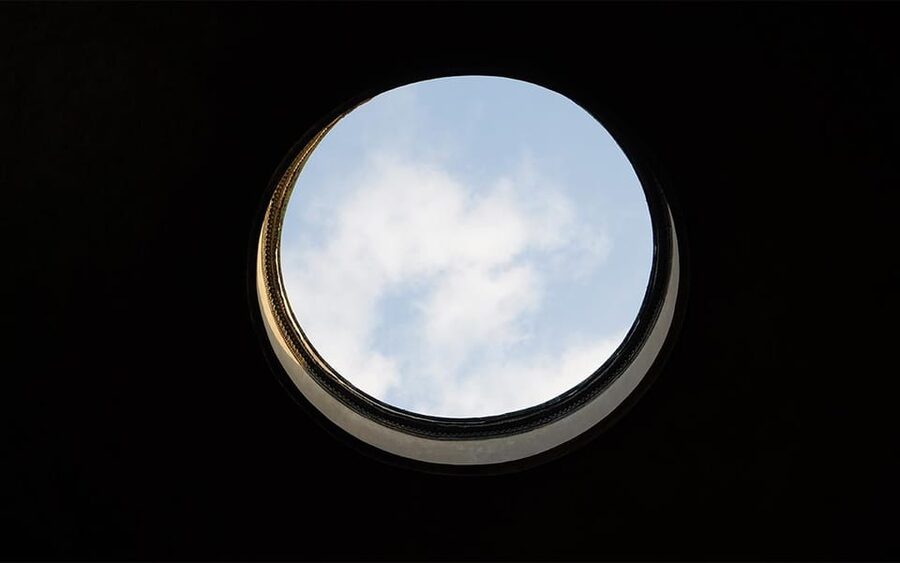
The Pantheon’s open roof is the star of this one-hour visit. Sunlight, rain, and shifting clouds enter through the oculus, or eye, while the audio guide explains why Emperor Hadrian rebuilt the building and how its vast interior was designed. I like the archaeologist-written narration and the chance to examine the dome at your own pace. I also like the priority entry, especially when your Rome schedule is tight.
This is a self-guided visit, not a live tour with a named guide, so you need to bring headphones and pay attention to your entry time. One important caution: a booking was reported as invalid, forcing the ticket holder to pay again. Confirm your ticket details before you arrive, and keep proof of purchase handy.
Key points to know before you book
- The oculus is the main event: Look straight up through the open center of the dome and watch how natural light shifts across the interior.
- Hadrian’s Pantheon is the focus: The present building dates from the early second century AD, after the emperor rebuilt an earlier structure linked to Augustus.
- The audio guide is self-paced: You receive professional commentary in English or Italian, but headphones are not supplied.
- Priority access saves time: You have express security access, but you must enter at your selected starting time.
- The architecture rewards patience: The dome, seven large niches, and 12-meter granite columns make more sense when you know what to look for.
- The price is moderate for a short visit: At $17 per person, the value depends on how much you want historical explanation with your entry.
Why the Pantheon still feels startling today
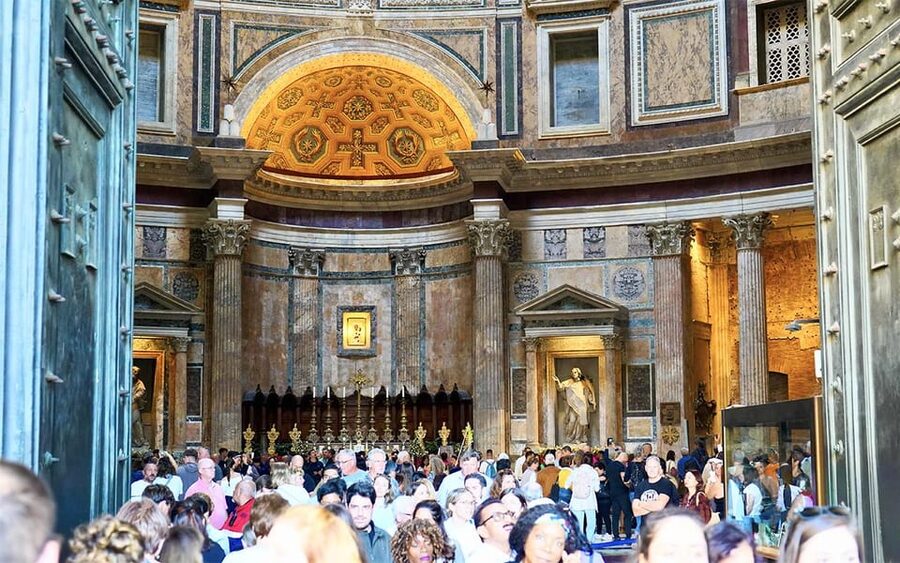
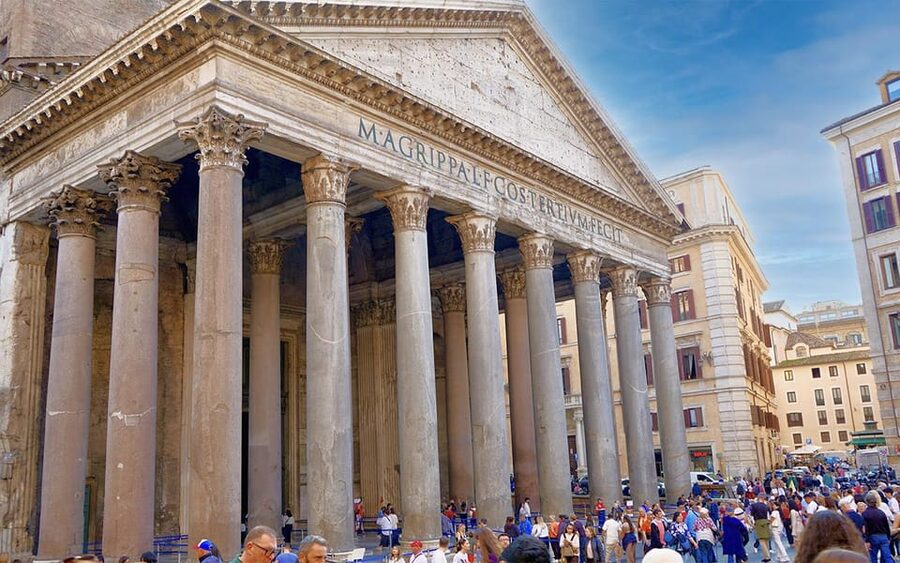
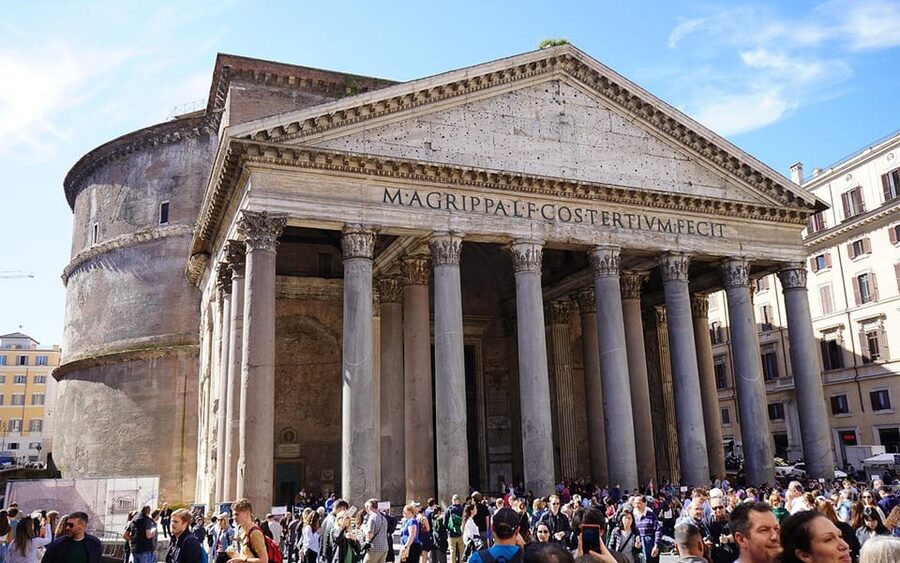
Rome has no shortage of ancient monuments, but the Pantheon delivers its surprise indoors. From the outside, the portico and massive columns suggest a traditional temple. Once you pass into the rotunda, the building changes character. Your eye is pulled upward into a great curved ceiling that appears to continue beyond the walls.
The open oculus gives the room its drama. It is not a small skylight tucked into the roof. It is a clear opening at the dome’s center, an eye aimed at the sky. The audio guide uses that feature to explain both the practical and symbolic side of the building.
You can expect the visit to last about an hour. That is enough time to enter, follow the main audio material, study the dome and columns, and pause at the significant details. It is not a full archaeological tour of Rome, and it does not try to be one. The strength here is focus.
The experience works best if you resist the urge to rush through after one glance upward. Give yourself time to notice the relationship between the circular floor, the curved walls, the niches, and the dome. The building’s harmony is easier to grasp from inside than from photographs.
More audio tours around Rome:
- Rome: Colosseum & Forum with Audio Guide App -Optional Arena
★ 4.2 · 24,770 reviews - Rome: City Sightseeing Hop-on Hop-off Bus with Audioguide
★ 4.0 · 16,045 reviews - Rome: St. Peter’s Basilica & Dome Entry Ticket & Audio Tour
★ 4.2 · 7,537 reviews
Entering at your chosen time
You already have your ticket, so you enter independently rather than meeting a live guide at a street corner. The activity includes priority access and an express security check, which can make the arrival simpler than joining a general admission line.
There is an important condition: you must arrive at the selected starting time. If you are late, entry may not be allowed. Build in extra time for reaching the Pantheon and finding the entrance. The booking information does not promise a flexible arrival window.
Priority access does not mean you can ignore security. Weapons, sharp objects, alcohol, and drugs are not allowed. Wear comfortable shoes, since you will spend your visit on foot while looking around and listening.
The Pantheon is listed as wheelchair accessible. If accessibility is important for your plans, the listed feature is reassuring, though the activity information does not provide further details about routes, seating, or restroom facilities.
What the one-hour audio tour covers
Your audio guide begins with the Pantheon’s identity and purpose. The name comes from the Greek word meaning all gods, suggesting a temple for the full Roman divine world. The guide also examines the political message behind that name rather than treating it as a simple label.
That distinction matters. The Pantheon is often pictured as a straightforward shrine to twelve major gods, but the building’s interior does not contain twelve large statue spaces. It has seven imposing niches. The audio commentary points out the gap between the grand name and the evidence inside.
Only three deities are certainly recorded as being worshiped beneath the great dome: Mars, Venus, and Julius Caesar, who was deified after his death. This gives the building a political edge. The Pantheon was not only about religion. It also expressed Roman power, imperial order, and the memory of a ruler transformed into a god.
The guide then takes you back before the building you see today. The first Pantheon was erected under the direction of Marcus Agrippa during the age of Augustus. After a devastating fire, the structure was rebuilt by Emperor Hadrian in the early second century AD.
The present Pantheon is therefore not simply an untouched survival from Augustus’s time. It is Hadrian’s reconstruction, created more than a century after the original building. That distinction helps you read the monument as a product of several periods rather than a single moment.
Reading the dome through the oculus
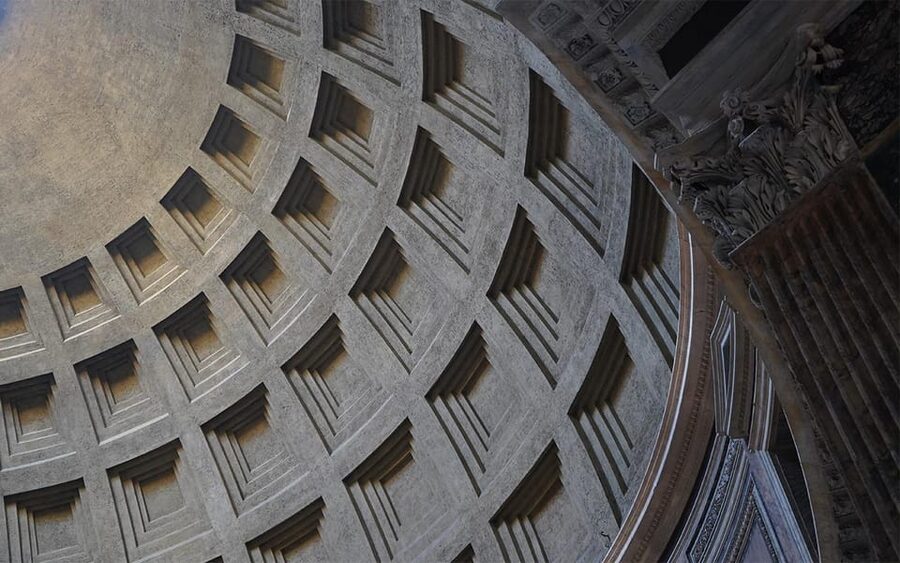
The dome is the part of the visit that benefits most from audio commentary. Its interior is a carefully ordered spherical space, and the oculus gives the upper section a sense of endless height. You may feel that the volume continues upward instead of closing neatly overhead.
The open eye has an obvious visual effect, but it also changes your sense of scale. A sealed ceiling would make the room feel contained. The oculus connects the interior with the sky and brings time, weather, and moving light into the architecture.
The guide asks you to consider how and why the dome was made with an opening at its top. You will not merely hear a date and move on. The commentary links the feature to the building’s design and the ideal experience Hadrian wanted to convey to Romans.
Rain can enter through the oculus, though the floor is designed with drainage openings. The provided tour details do not promise a weather-based event or a special effect, so do not book expecting a dramatic storm inside. The point is the permanent connection between the building and the sky.
Look for the changing light rather than one fixed view. The oculus does not illuminate every part of the rotunda equally. It creates a moving focus, and that is one reason the interior can feel different from one visit to the next.
Same sights, a different narrator:
- Colosseum, Roman Forum & Palatine Hill with Audioguide App
★ 4.4 · 6,291 reviews - Vatican & Sistine Chapel Ticket with Optional Audio Guide
★ 4.1 · 5,405 reviews - Rome: Castel Sant’Angelo Entry Ticket & Digital Audioguide
★ 4.7 · 5,347 reviews - Rome: Castel Sant’Angelo Entry Ticket & Audio App
★ 4.3 · 4,952 reviews
The seven niches and the politics of all gods
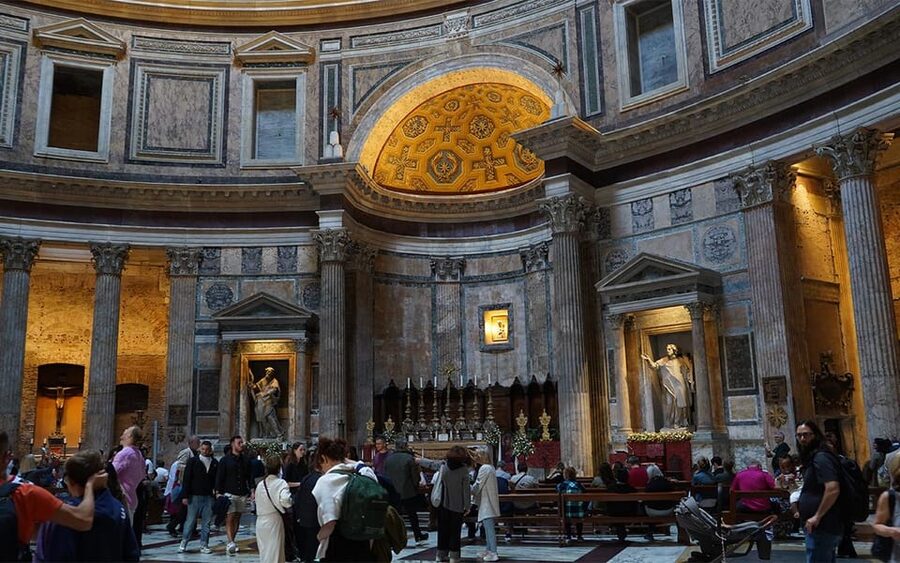
The seven large niches are easy to miss if you are concentrating only on the dome. They break up the circular walls and give the interior a rhythm. The audio guide places them within the question of what the Pantheon was meant to contain.
The title all gods sounds inclusive, but the surviving arrangement does not match a simple lineup of twelve major deities. The seven niches could hold imposing statues, yet historical records name only Mars, Venus, and Julius Caesar with certainty.
I find this one of the most useful parts of the tour because it turns a familiar fact into a question. Ancient monuments often present power through names, scale, and carefully controlled symbolism. Here, the building’s title may suggest universal authority, while the actual evidence is more limited and more political.
You can use the audio guide as a prompt to inspect the walls yourself. Notice how the niches organize the room and how the dome unifies everything above them. The Pantheon’s effect comes from this combination of specific architectural parts and a much larger imperial message.
The 12-meter granite columns at the entrance
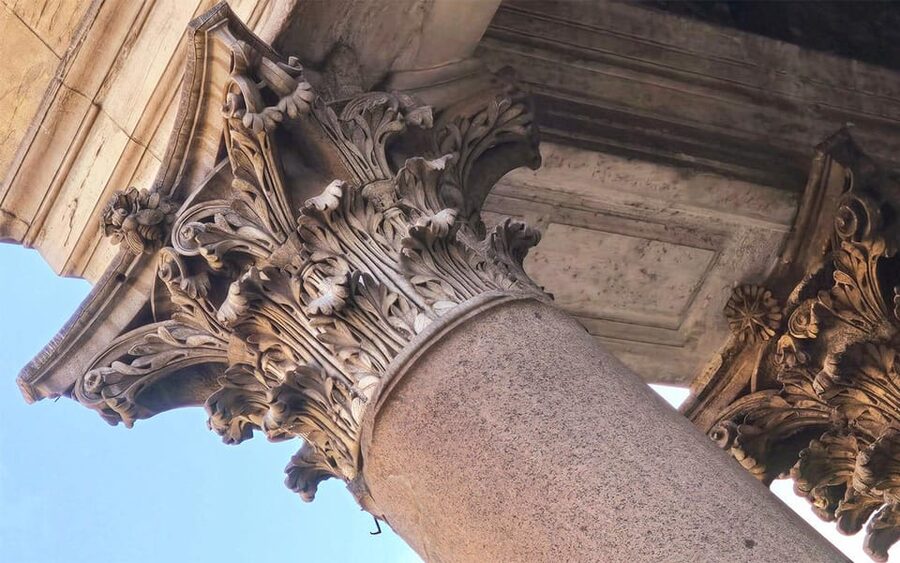
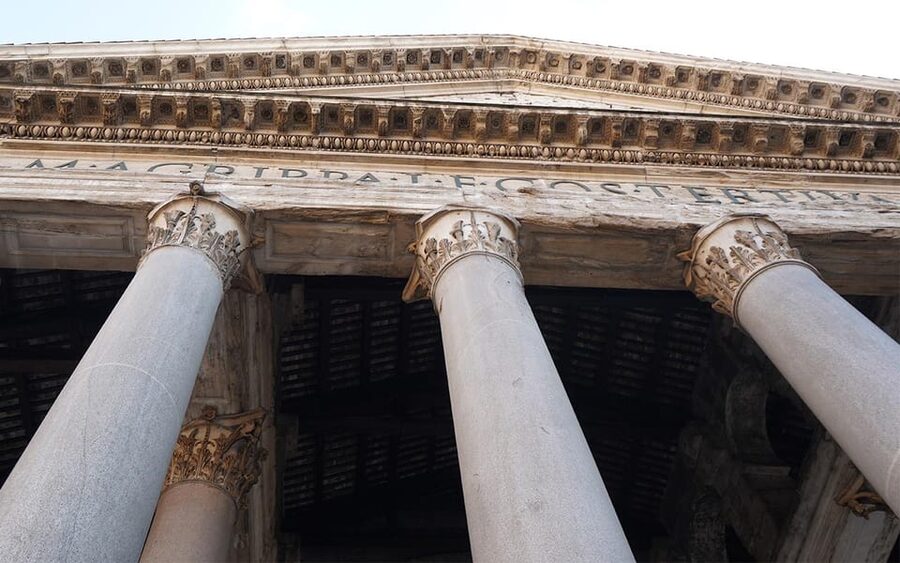
Before or after you focus on the rotunda, spend time with the columns beneath the portico. They rise 12 meters and have a circumference of more than 4.5 meters. Their size prepares you for the scale inside, but they also deserve attention in their own right.
The columns are made of granite, described in the tour material as rare, indestructible, and marked by a fine grain of colored crystals. Those crystals create particular lighting effects. In Rome, it is easy to treat columns as background scenery. Here, the guide gives you a reason to look at the stone rather than simply walk past it.
The portico creates a strong contrast with the rotunda. Outside, the architecture reads as a formal temple front. Inside, the circular room and upward sweep of the dome take over. The audio explanation helps connect these two experiences.
The information provided does not identify the exact quarry or explain how each column reached Rome, so you should not expect a detailed transportation story. What you do get is a useful introduction to their scale, material, and visual effect.
From imperial Rome to Renaissance artists
The Pantheon did not stop mattering when ancient Roman religious practice changed. The audio guide follows the building’s later influence, including its effect on Renaissance artists.
That later life is important because the Pantheon survived not only as an old structure but as a source of ideas. Its dome, proportions, and controlled geometry offered a model for artists and architects who were studying the ancient world.
The tour does not list individual Renaissance artists in the supplied information, so you should not expect a biographical lecture about a particular painter or architect. Instead, the emphasis is on the building’s influence across time.
This section gives the visit a wider frame. You begin with Hadrian’s imperial project, study the practical details of the room, and then see how the building continued to shape European art and architecture. The Pantheon becomes more than a single ancient stop on a sightseeing route.
Is $17 a fair price?
At $17 per person, this is a fairly focused purchase. You are paying for priority access and an audio guide in English or Italian, not for a live historian, a long walking route, or a wider Rome itinerary.
I think the price makes sense if you want context but prefer to explore independently. A bare entry can leave you wondering what the niches, dome, and columns mean. The audio guide gives those features a clear sequence and adds the political story behind the building’s name.
The value is weaker if you already know the Pantheon well or prefer to read a guidebook in advance. You may find the one-hour format short if you want a detailed study of Roman construction, later Christian use, or the surrounding square.
The priority entry adds practical value when your day is tightly planned. Still, the chosen time is strict, and the ticket problem reported by one purchaser makes accuracy important. Check that your confirmation clearly shows the date and time, and keep it available when you arrive.
Who will get the most from this visit?
This activity suits first-time visitors who want more than a quick photograph of the oculus. It is also useful for anyone who likes to pause, replay information, and move through a monument without keeping pace with a group.
Families may appreciate the short duration, though the audio format works best when everyone can listen through headphones. Visitors interested in architecture will find the explanation of the spherical interior, dome, niches, and granite columns especially useful.
It is less suited to you if you want a personal exchange with a guide. No live guide is named, and the experience is built around a professional audio guide written by archaeologists. You receive interpretation, but not questions answered on the spot.
Bring your own headphones. This is easy to overlook because the audio guide is included, while headphones are not. The available languages are English and Italian.
Practical advice for making the hour count
Arrive early enough to find the entrance and settle your ticket before the scheduled time. The entry rule is firm, and late arrival can mean missing access.
Once inside, do not spend the whole hour with your eyes on the floor while listening. Alternate between the commentary and the building. Look up during the sections on the oculus and dome, then return your attention to the niches and columns when those features are discussed.
If you are visiting with someone who does not want the audio guide, agree on a meeting point inside or near the end of the visit. The information provided says the activity ends back at the meeting point, but it does not describe a guided group route or a separate final gathering.
Take the claims about priority access in practical terms. You should have express security access, but you still need to arrive at the right time and follow the site’s entry rules. Priority helps most when used with careful planning.
Should you book the Pantheon audio guide?
Book it if you want a short, structured explanation of one of Rome’s most remarkable interiors, especially if the oculus, Hadrian’s rebuilding, and the building’s political symbolism interest you. The archaeologist-written audio guide gives you more to notice than a silent walk-through, and the $17 price is reasonable for priority access plus commentary.
Skip it if you want a live guide, a longer architectural lecture, or a flexible arrival time. Before paying, verify the ticket details carefully because an invalid-ticket problem has been reported. With that precaution, this is a practical way to turn a one-hour Pantheon visit into a focused lesson in Roman design and imperial messaging.
FAQ
How long does the Pantheon audio guided tour last?
The activity lasts one hour. Starting times vary, so you need to check availability when booking.
What languages are available for the audio guide?
The audio guide is available in English and Italian.
Are headphones included?
No. You need to bring your own headphones.
Do I need to meet a guide before entering?
No. You already have your ticket and can enter independently at your chosen time. This is an audio-guided visit rather than a live guided tour.
Does the activity include priority access?
Yes. The activity includes priority access to the Pantheon and an express security check.
What happens if I arrive late?
You must enter at your selected starting time. If you are late, you may not be allowed to enter.
Is the Pantheon accessible by wheelchair?
Yes. The activity is listed as wheelchair accessible.
Can I cancel the booking for a refund?
You can cancel up to 24 hours in advance for a full refund. A reserve-now-and-pay-later option is also available.
New audio tours around Rome
- Rome: St. Peter’s Basilica and Dome Entry + Audio Guide★ 4.5 · 13 reviews
- St. Peter’s Basilica: Hosted Entrance & Digital Audioguide★ 4.1 · 35 reviews
- Sorrento & Pompeii Day Trip from Rome Audio Guide Tour★ 4.2 · 50 reviews
- Rome:St. Peter’s Basilica Hosted Entry + Official Audioguide★ 3.4 · 10 reviews
- Colosseum, Roman Forum, Palatine Hill access and AudioGuide★ 4.7 · 12 reviews
- Rome+Jubilee Audioguide – TravelMate app for your smartphone★ 4.2 · 38 reviews
- Rome:Ostia Antica Skip-the-line Ticket & Audioguide★ 4.3 · 11 reviews
- Rome: St. Peters Basilica Reserved Entrance + Audio Guide★ 3.6 · 206 reviews
Rome Audio Tours, compared.
Rome: Colosseum & Forum with Audio Guide App -Optional Arena
Read our review →
Rome: City Sightseeing Hop-on Hop-off Bus with Audioguide
Read our review →
Rome: St. Peter’s Basilica & Dome Entry Ticket & Audio Tour
Read our review →
Colosseum, Roman Forum & Palatine Hill with Audioguide App
Read our review →
Vatican & Sistine Chapel Ticket with Optional Audio Guide
Read our review →
Rome: Castel Sant’Angelo Entry Ticket & Digital Audioguide
Read our review →
Rome: Castel Sant’Angelo Entry Ticket & Audio App
Read our review →
Rome: Hop-on Hop-off Sightseeing Bus Tour with Audioguide
Read our review →Browse the lists this tour appears in