
Review · GREECE
Ancient Corinth: Self-Guided Audiovisual Tour with 3D Models
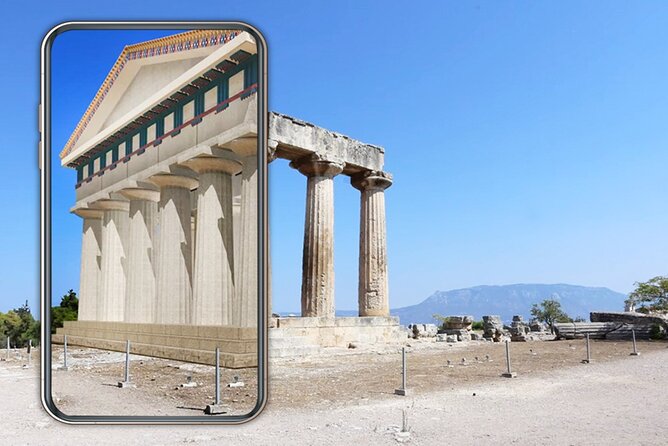
Ancient Corinth comes alive when you can compare the broken stones in front of you with 3D reconstructions of the city as it once looked. This self-guided app leads you through Greek, Roman, Byzantine, and early Christian remains, with the Bema and Peirene Fountain providing two especially memorable stops.
I like the freedom to pause, replay, and move at your own speed. I also like the low price, especially for an app offering audio, text, videos, 360-degree views, and 3D models in eight languages. The main concern is navigation: GPS did not work for at least one user, so you should be ready to use the map and site signs without relying on your phone to guide every step.
Key points
- Ancient Corinth in about one hour: Follow the main routes from the archaeological museum entrance through the site.
- The Bema and Peirene Fountain: Hear about the platform linked to Saint Paul and the fountain whose water still runs.
- Thirteen 3D and video presentations: Reconstructed views help you picture missing buildings and monuments.
- Eight language choices: Use the app in English, Greek, Spanish, German, French, Italian, Dutch, or Chinese.
- Bring your own setup: You need a smartphone, headphones, and internet access, plus the separate €8 entrance ticket.
- Acrocorinth views: The experience points your attention toward the rocky fortress above the ancient city.
Ancient Corinth through a phone screen
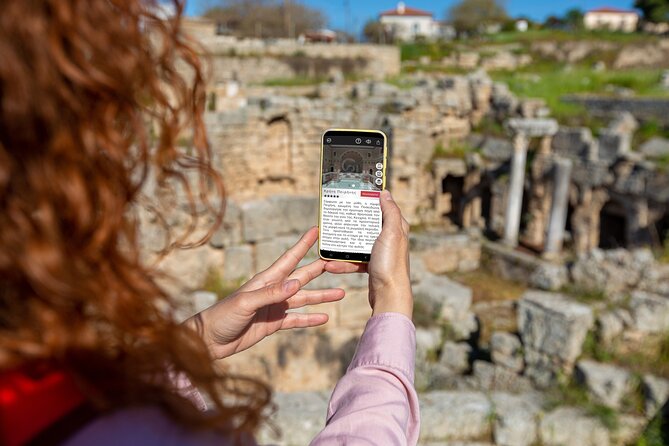
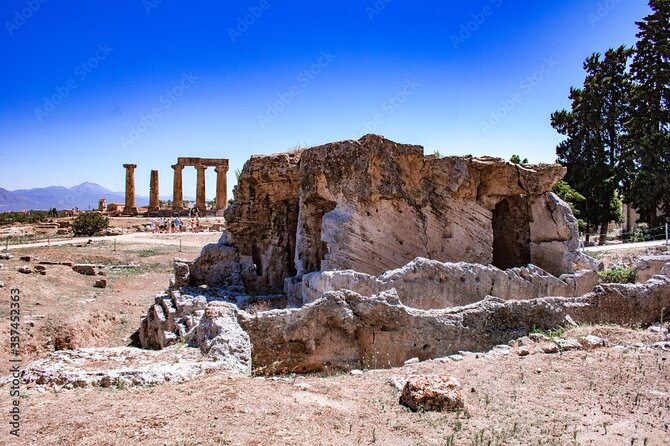
Ancient Corinth is an easy place to visit but not always an easy place to read. You see columns, foundations, paving, fountains, and scattered blocks, yet the original city can be hard to picture from ruins alone. This is where the audiovisual format earns its modest price.
The app combines spoken narration with written information, photographs, 3D models, 360-degree panoramas, and short videos. The models are not decoration. They give you a way to see how important buildings may have appeared before earthquakes, rebuilding, weather, and time reduced them to fragments.
You are not joining a scheduled group, and no guide meets you at the gate. Instead, you download the app after booking, select your language, and let the content load onto your phone. The format suits you if you prefer quiet exploration and want to stop for photographs or linger at a monument without holding up a group.
The tour takes about one hour, though the stated duration allows up to an hour and a half. That extra time is useful if you read all the text, replay sections, watch the videos, or pause to look closely at the remains.
More History Audio Tours in Greece
- Athens: National Archaeological Museum Ticket & Audio Guide
★ 4.3 · 1,330 reviews - Delphi: Archaeological Site & Museum Ticket with Audio Tours
★ 4.3 · 721 reviews - Athens: National Archaeological Museum Ticket w/ Opt. Audio
★ 4.4 · 713 reviews
Starting beside the archaeological museum
The route begins at the entrance to the archaeological site near the Archaeological Museum of Ancient Corinth on Argous Street. This is a practical starting point because the museum and ruins sit together, though the separate admission charge covers the archaeological site rather than this digital tour.
The app uses an interactive map with GPS tracking to help you move between stops. In the best case, your position on the map lets you see where you are and what comes next. Still, you should not treat the GPS as essential equipment. One user found the location feature unreliable and had trouble finding the way through the site.
There is a useful fix. The app requires permission to use your phone’s location during setup. If you refuse that permission, the GPS feature will not work. The location function can also be activated manually inside the app, so check those settings before you begin.
I recommend downloading the content before you start walking and confirming that the tour opens in your chosen language. The experience requires internet access to function properly, and your phone battery will matter during audio playback, video viewing, and map use.
Greek, Roman, and Byzantine remains along the main route
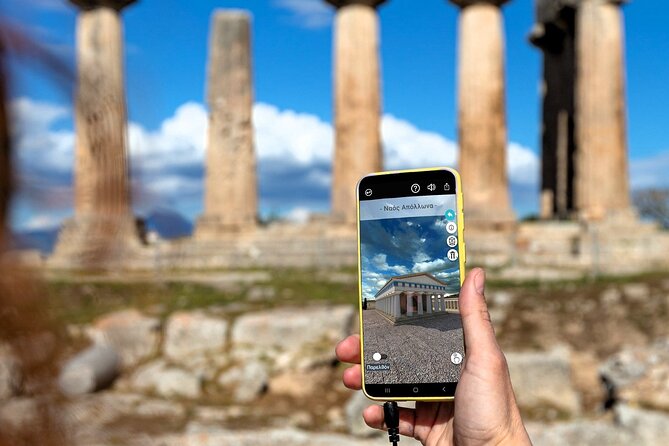
The route follows the principal paths through Ancient Corinth and presents 15 monuments with audio narration and written information. Thirteen of those monuments also include 3D models and 360-degree panoramas, with immersive videos for the same number.
That mix matters because no single format works equally well for every ruin. Audio lets you keep your eyes on the stones. Text helps you check a name or date. A 3D reconstruction gives shape to a building that may now survive only as a few foundations. A panorama helps you understand how the site connects from one point to the next.
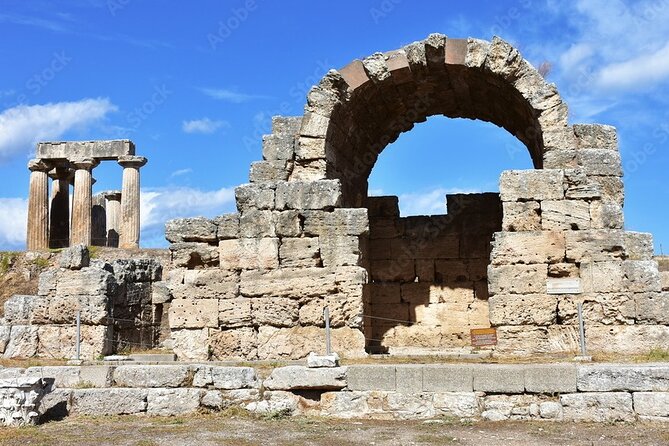
Ancient Corinth’s appeal comes from its different layers. You are not looking at a single, neatly preserved Greek settlement. The site reflects ancient Greek life, Roman rebuilding, Byzantine use, and Christian connections. The app’s historical range helps you read those changes instead of treating every stone as part of one period.
You should also expect a self-guided experience rather than a personal conversation. There is no guide to answer a question on the spot or adapt the pace to your interests. In exchange, you can pause the narration, replay a section, or skip ahead whenever you wish.
The Bema and the story of Saint Paul
The Bema is one of the tour’s most meaningful stops. This raised stone platform is connected with the Apostle Paul, who defended himself there about 2,000 years ago. Standing beside it gives the site a human scale. You are no longer simply looking at an ancient civic structure. You are considering a public setting tied to a major episode in early Christian history.
The app’s audio and visual material can help you picture the Bema within the Roman city. The 3D presentation is particularly useful here because the surviving platform does not immediately explain how it functioned or how people would have encountered it.
Take a moment before moving on. This is the kind of stop that rewards attention more than speed. Listen to the narration, inspect the stonework, and use the reconstruction to connect the remains with the larger city around you.
The Christian connection also adds variety to the visit. Ancient Corinth was not only a Greek and Roman center. Its later religious importance forms another layer of the story, and the tour makes that part of the site easier to notice.
More Self-Guided Audio Tours in Greece
- Athens: Acropolis Ticket & Optional Self-Guided Audio Tours
★ 4.1 · 2,542 reviews - Santorini: Akrotiri Ticket with Optional Self-Guided Audios
★ 4.1 · 298 reviews - Acropolis & Parthenon Admission Ticket w/ self guided audio tours
★ 3.5 · 172 reviews - Delphi Self-Guided Tour with 3D Models & Audio (No Ticket)
★ 4.1 · 69 reviews
Listening for water at Peirene Fountain
Peirene Fountain offers a different kind of experience. The water still runs, giving you an actual sound from the site rather than another silent ruin. The tour connects the fountain with the myth of a nymph’s lament, adding a touch of ancient storytelling to the physical sound of water.
I like this stop because it asks you to slow down. Many archaeological visits become a march from one foundation to the next. A working fountain breaks that pattern. You can listen, look at the surviving structure, and imagine why a dependable water source mattered to daily life in Corinth.
The 3D material helps with the parts you cannot see. Ancient fountains were functional public spaces, but their original appearance and setting are not always clear from the remains. The digital reconstruction provides a visual comparison between the fountain today and the monument in its earlier form.
If you are visiting in the middle of a warm day, this may also feel like a welcome pause. The tour does not promise a guided rest break, so use the fountain and nearby shaded opportunities when available rather than trying to rush through the audio.
Looking toward Acrocorinth

The experience also directs you toward Acrocorinth, the rocky height above Ancient Corinth. From there, your gaze opens across a broad view of the surrounding area. The contrast is striking: below you are the ordered remains of a planned ancient city, while above you is the defensive rock that shaped the region’s identity.
The information provided does not describe a separate transport service or a full Acrocorinth excursion. Treat this part as a visual conclusion to the Ancient Corinth visit unless your own plans include reaching the rock itself. The archaeological site tour begins and ends at Ancient Corinth, not with hotel pickup or a guided drive.
Even so, the view gives useful context. Corinth was not an isolated collection of temples and public buildings. Its position, roads, water, and high ground all affected how people lived and moved through the area.
The combination of ruins below and Acrocorinth above makes this more than a museum-style audio guide. It encourages you to connect individual monuments with the setting around them.
How the 3D models help, and where they do not
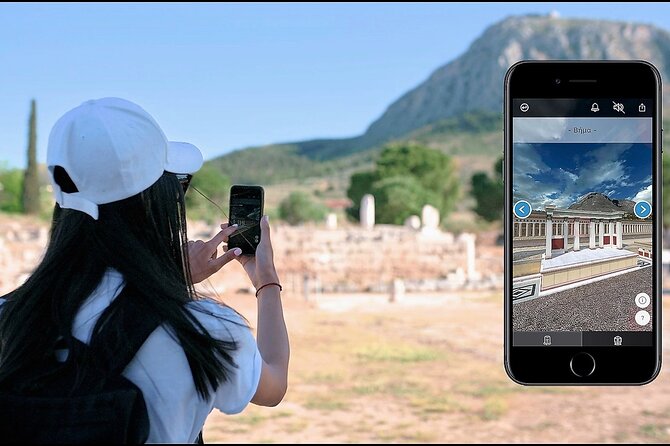
The strongest part of the app is its attempt to bridge the gap between remains and reconstruction. You can look at a damaged monument, then use the model to picture roofs, walls, columns, and a fuller urban setting.
That visual help is valuable for first-time visitors, families, and anyone who finds archaeological plans hard to read. The models also give you something to compare with the actual stones, rather than asking you to accept a long spoken explanation without visual support.
Do not expect the 3D images to replace the real site. They are interpretive tools, not a physical reconstruction. Their value depends on your willingness to look from the phone to the ruins and back again.
Navigation is the weak point. The app includes GPS and an interactive map, but location accuracy can vary. If you focus too heavily on the moving dot, you may spend more time checking the screen than looking at Corinth. Download the map, note the general route, and use the monument names and site paths as backup.
The content covers 15 monuments, but only 13 include the full combination of 3D models, 360-degree panoramas, and videos. That is still a generous amount for a tour lasting about an hour, but not every stop will have identical presentation.
Price, entry fee, and what you receive
The app costs $8.13 per person. You must also pay the archaeological site entrance fee, listed as €8 at full price or €4 at the reduced rate. The entrance ticket is not included in the app purchase.
At that combined cost, the experience offers good value if you want more than a basic walk through the ruins. You receive audio narration, written information, GPS mapping, 3D models, panoramas, and videos without paying for a private guide. The eight language options also make the price practical for couples or families with different language needs.
The value is lower if you only want a quick look at the site or already know Corinth well. You may not use every video or written explanation during a short visit. A traditional guide would provide conversation and live answers, while this app gives you control and a lower cost.
The tour is offered for individual use, but the booking system allows up to 999 participants. That figure does not mean you will be placed in a group. It reflects the digital nature of the activity, where each person uses the app independently.
Timing, access, and practical preparation

The site hours are listed as 8:00 a.m. to 8:00 p.m., Monday through Sunday, for the stated operating period ending June 17, 2026. Check the current opening information before setting out, especially if your visit falls near a seasonal change.
Plan on one hour at minimum and up to 90 minutes if you want to use the full digital content. You need your own smartphone and headphones. Headphones are important if you want to hear the narration clearly without disturbing people around you.
The tour does not include pickup or drop-off. You make your own way to the archaeological site entrance. It is near public transportation, and the ending point is on Odos Apollonos near the central square of Ancient Corinth.
The site’s only exit is near that picturesque square. From there, it is about a two-minute walk back to the starting area, which makes the end point easy to manage if you are continuing with lunch, transport, or another stop in town.
Most people can take part, but the experience requires you to walk through an archaeological site while handling a phone. Wear practical shoes and keep your attention on the ground as well as the screen. That advice is general site sense, not a claim about specific surfaces or facilities.
You can cancel for a full refund up to 24 hours before the scheduled start time. Changes or cancellations made inside that period are not accepted for a refund.
Who will enjoy this Ancient Corinth tour?
I would choose this for an independent visitor who wants structure without a fixed guide. It suits you if you like to pause at an interesting monument, take photographs, or move quickly past a section that does not hold your attention.
It is also a good match for families and mixed-language groups because the app offers English, Greek, Spanish, German, French, Italian, Dutch, and Chinese. The visual reconstructions can make the ruins easier for younger visitors to understand, though you still need to manage the phone and headphones.
History fans will appreciate the range from Greek and Roman remains to Byzantine and Christian connections. Saint Paul’s link to the Bema gives the visit special importance for people interested in early Christianity.
I would be more cautious if reliable GPS navigation is your top priority. The app includes location tracking, but one user had difficulty with it, and permission settings can prevent it from working. Download the content, allow location access, and keep a simple backup plan using the physical route and monument names.
Should you book it?
Book this tour if you want an inexpensive way to add shape and context to Ancient Corinth without joining a group. The Bema, Peirene Fountain, and 3D reconstructions give you specific moments to look forward to, while the eight language choices make the app broadly useful.
Skip it if you prefer a live guide, need guaranteed turn-by-turn navigation, or plan to spend only a few minutes at the site. For most independent visitors with a charged smartphone, headphones, and the separate entrance fee, it is a sensible tool that makes the ruins easier to picture and the visit easier to pace.
FAQ
How long does the Ancient Corinth audiovisual tour take?
The tour lasts approximately one hour to one hour and 30 minutes. The shorter time works for a focused visit, while the longer estimate allows time for audio, text, videos, and pauses.
Is the archaeological entrance ticket included?
No. The site entrance costs €8 at full price or €4 at the reduced rate. You pay this separately from the app tour.
What does the app include?
It includes an interactive GPS map, audio narration, written information about 15 monuments, 3D models and 360-degree panoramas for 13 monuments, and immersive videos for 13 monuments.
Which languages are available?
You can use the tour in English, Greek, Spanish, German, French, Italian, Dutch, or Chinese.
Do I need internet access?
Yes. The tour requires internet access to function properly. After booking, you receive instructions to download the app and its content.
Do I need to bring headphones?
Yes. A smartphone and headphones are not included, so you need to bring your own equipment.
Where does the tour start and finish?
It starts at the entrance to the Archaeological Museum of Ancient Corinth, at Argous 105 in Archaia Korinthos. It ends near the only exit of the archaeological site on Odos Apollonos, close to the central square.
Can I cancel for a refund?
Yes. You can cancel up to 24 hours before the scheduled start time for a full refund. Cancellations or changes made less than 24 hours before the start are not refunded.
New audio tours around Greece
- Kos Scavenger Hunt and Highlights Self Guided Audio Tour★ 4.5 · 17 reviews
- Half-Day Ancient Olympia VR Audio Tour from Katakolo Cruise Port★ 3.5 · 57 reviews
- E-Ticket to Heraklion Archaeological Museum with Audio Guide★ 4.5 · 26 reviews
- Knossos Palace & Archeological Museum: E-Tickets with Audio Tours★ 4.0 · 18 reviews
- Kasos Audio-Tour from Karpathos by Art and Walk★ 4.5 · 4 reviews
- Delphi: Self-guided Audiovisual Tour with 3D Representations★ 5.0 · 5 reviews
- Delphi Self-guided Audio Tour on Your Phone (no ticket)★ 3.5 · 10 reviews
- Delphi: Archaeological Site & Museum Ticket with Audio★ 3.5 · 24 reviews
Greece Audio Tours, compared.

Athens: Acropolis Ticket with Optional Audio or Live Guide
Read our review →
Athens: Cape Sounio & Poseidon Temple Trip with Audio Guide
Read our review →
From Athens: Delphi Full Day V.R. Audio Guided Tour
Read our review →
Athens: Acropolis Museum Ticket with optional Audio Guide
Read our review →
Athens: Acropolis Ticket & Optional Self-Guided Audio Tours
Read our review →
From Athens: Small-Group Delphi, Museum & Arachova Day Trip
Read our review →
Parthenon & Acropolis Museum with Audio or Live Tour Option
Read our review →Browse the lists this tour appears in