
Review · GREECE
Athens: Temple of Olympian Zeus Ticket and Audio Tour
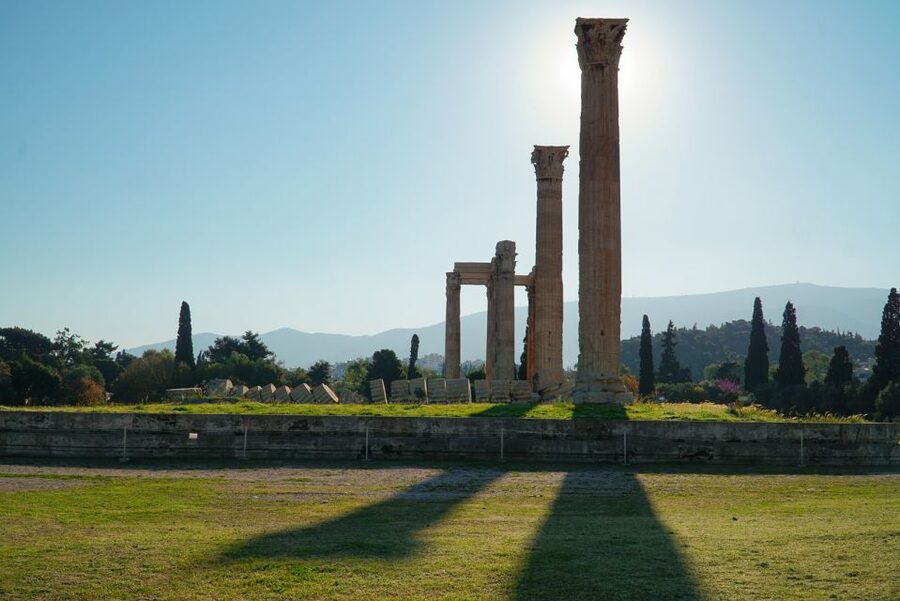
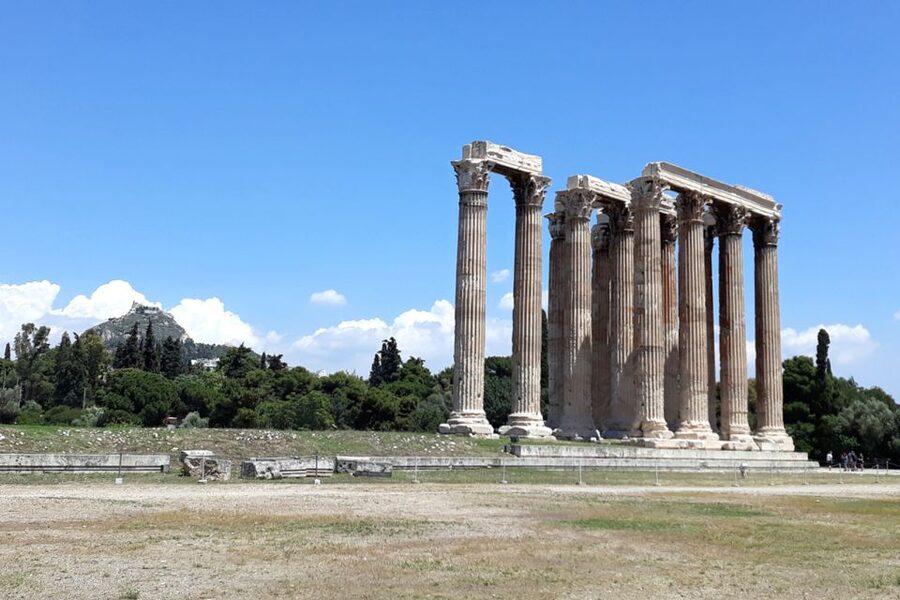
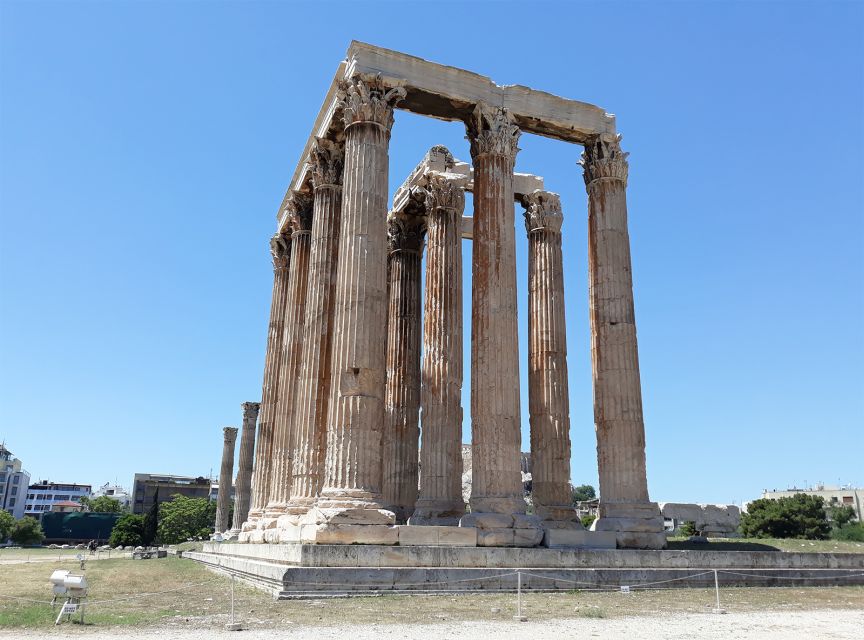
The surviving columns of the Temple of Olympian Zeus give you a sharp sense of ancient Athens’ ambition. At 17 meters high, they are huge even in their ruined state, and the audio tour adds the missing story: a temple that took about 700 years to build, suffered damage from storms, and watched Athens change around it. I especially like the pre-booked e-ticket and the offline audio, which let you explore at your own pace without joining a guide.
You also get a quieter final stop at the Balaneion, an ancient public bathhouse where the tour shifts from grand rulers and gods to ordinary routines. The main drawback is simple: much of the temple is gone, and some of it can be viewed from outside. At $30 per person, the ticket makes the most sense if you want context and a flexible audio walk, not just a quick look at the ruins.
Key points to know before you go

- The 17-meter columns are the main event: The remaining Corinthian columns make the temple’s scale easy to picture, even with so little of the building left.
- The story covers 700 years: You’ll hear about the temple’s long construction, political ambition, damage, and eventual decline.
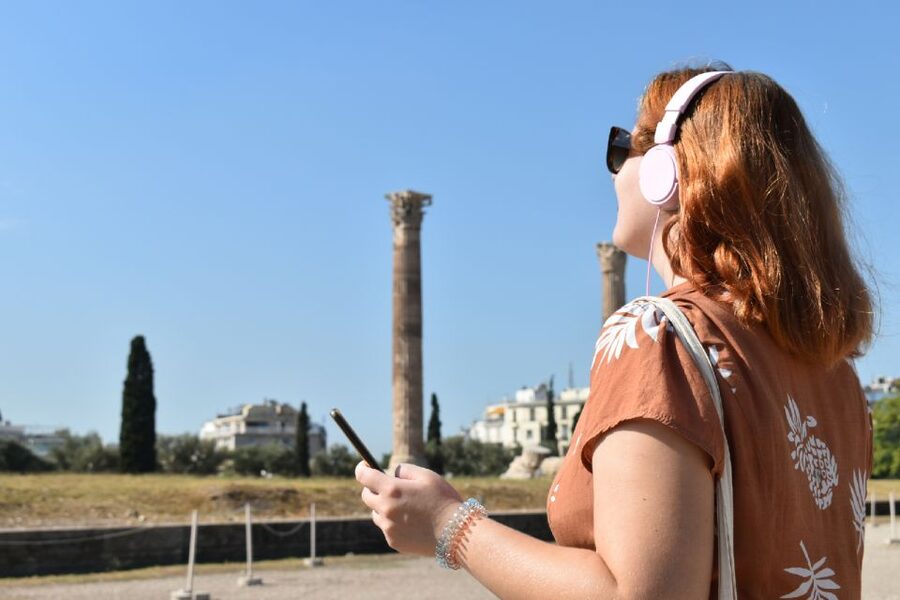
- The audio tour is self-guided: Use your own Android or iOS phone, headphones, and the supplied access code. There is no live guide.
- The route ends at an ancient bathhouse: The Balaneion offers a more personal look at everyday Greek life.
- The app works offline: Download the content and map before entering to avoid roaming charges.
- Admission may be free for some children and young EU citizens: EU citizens aged 0 to 25 can enter free with identification, while children up to age five from non-EU countries can receive free admission with a passport.
What the Olympieion gives you in one to two hours
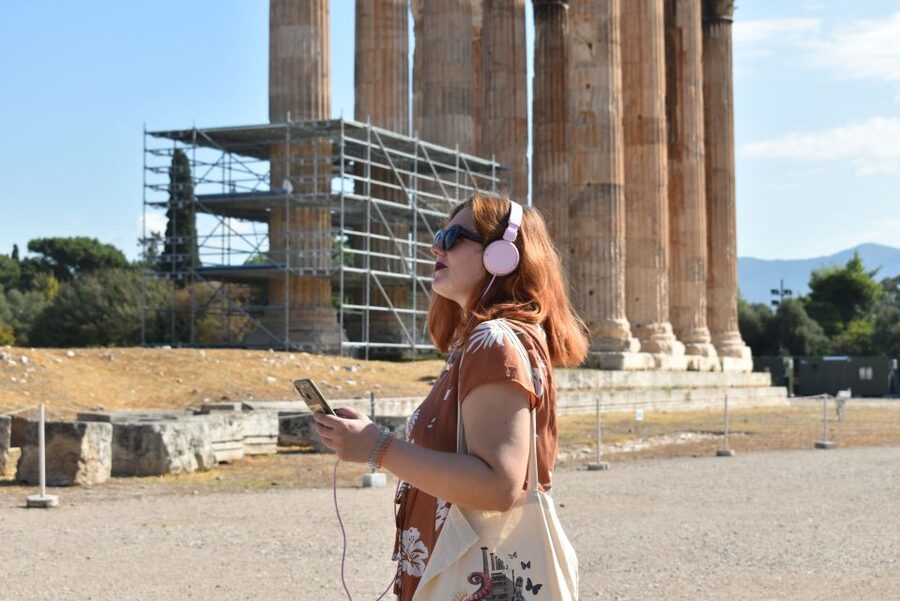
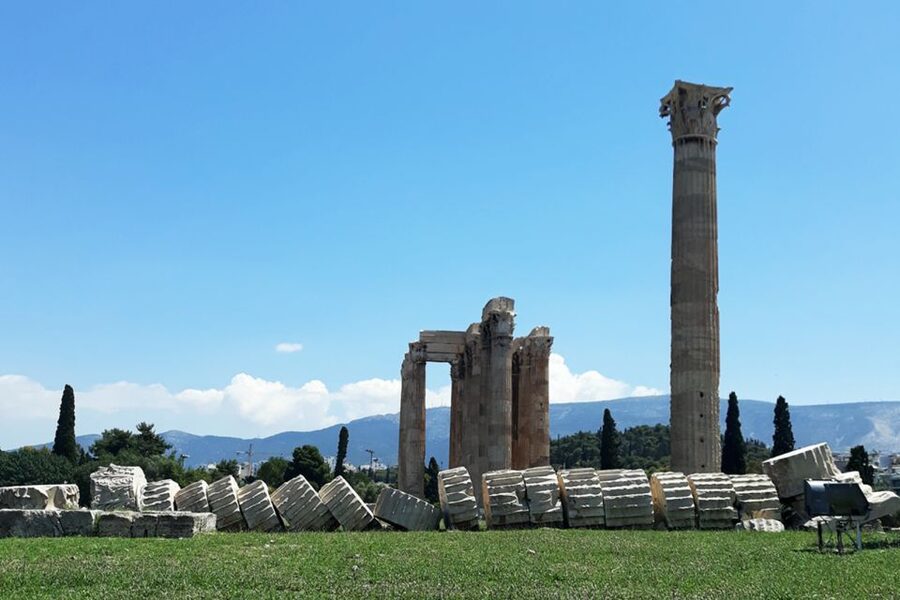
The Temple of Olympian Zeus, also called the Olympieion, is one of those Athens sights that can look deceptively simple from the street. You see a handful of tall columns against the sky. Then you step closer and notice their size, the broad archaeological site around them, and the gap between what survives and what once filled the area.
This experience is built for that gap. The entrance ticket gets you inside, while the audio tour supplies the sequence of events and legends that the stones cannot explain on their own. You move through the site independently, stopping when you want and replaying sections if a story catches your attention.
Allow between one and two hours. You can finish faster if you mainly want photographs and a look at the ruins. I would allow closer to two hours if you plan to listen carefully, pause in the shade, and spend time imagining the temple as a complete structure.
The experience has a published rating of 3.4 from 188 bookings, which is a useful reminder to keep expectations in check. The site itself is impressive, but it is not a fully preserved temple. The quality of your visit depends in part on how much you value interpretation.
More audio tours around Greece:
- Athens: Acropolis Ticket with Optional Audio or Live Guide
★ 4.2 · 11,055 reviews - Athens: Cape Sounio & Poseidon Temple Trip with Audio Guide
★ 4.4 · 4,521 reviews - Athens: Acropolis Ticket with Audio Guide
★ 4.0 · 3,575 reviews
Entering through the Great Propylon
The story begins as you approach the Great Propylon, the monumental entrance connected with the sanctuary. The audio starts with the Great Deluge, a myth about divine anger and Zeus’ power over humankind.
That opening gives the visit a mythological frame rather than launching straight into dates. You hear about Zeus as a god of thunder, storms, and authority before turning to the human rulers who wanted to connect themselves with that power.
The Great Propylon is also a useful place to get your bearings. Since there is no guide walking beside you, listen to the opening material before moving too far into the site. Download the tour in advance, check that the access code works, and bring headphones so you can hear the narration clearly in the open air.
The app includes an interactive offline map. That matters here because a self-guided site visit is more enjoyable when you are not constantly checking your phone for directions or using mobile data.
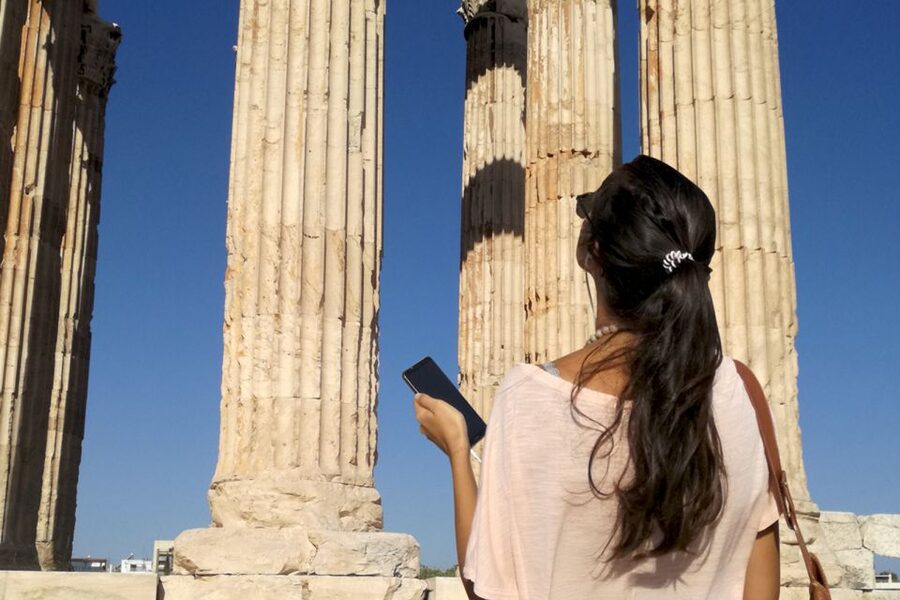
Looking up at the 17-meter columns

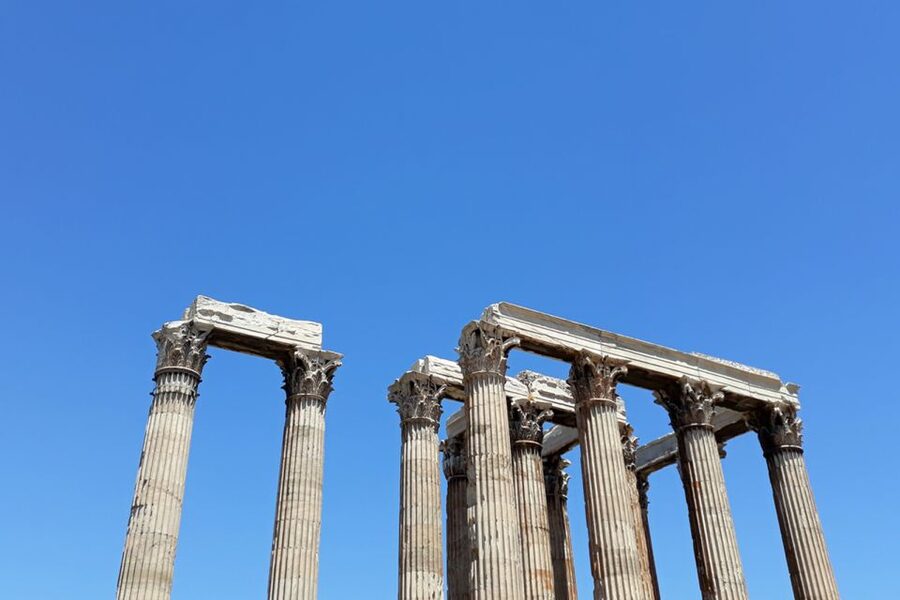
The surviving columns are the clearest reason to enter the archaeological site rather than simply view it from the surrounding streets. Their height and spacing give you a physical sense of the project, even though the roof, walls, and much of the colonnade have vanished.
The audio tour explains how long the temple took to complete. Its construction stretched across roughly 700 years, which turns the building into more than a single ruler’s project. Different political periods shaped its progress, and the temple’s unfinished or changing state reflects the unstable fortunes of Athens.
You hear about an Athenian tyrant and a Roman emperor who each tried to link their rule with the celestial authority of Zeus. That political angle is one of the stronger parts of the tour. It explains why a building dedicated to the king of the gods could also serve as a statement about the power of men.
I like this sort of interpretation because it helps you read the columns as political signs, not just architectural fragments. The temple was meant to communicate scale, wealth, and control. Even in ruins, it still does that job rather well.
The site also gives you room to pause. One useful detail is the presence of benches in shaded areas. In Athens’ strong sun, that is more than a comfort. It lets you sit with the view, replay a section of the audio, and picture the structure as a whole instead of rushing from one marker to the next.
Myths of Theseus and the birth of Athens
The audio narrative also moves from Zeus to Theseus and the violent founding stories attached to Athens. You hear about the bloodshed connected with the city’s legendary beginnings.
This is not a dry architectural commentary. The tour ties the temple to the city’s coming-of-age story, using myths and political episodes to show how Athens built an identity around power, gods, rulers, and civic pride.
The Theseus material will appeal to you if you enjoy Greek mythology. It also helps explain why ancient sites often mix legend with physical remains. The stones tell you where the monument was. The myths tell you what people wanted the monument to mean.
Do not expect a dramatic theatrical production. One person specifically wished for more sound effects and a more dramatic presentation. The narration is designed to inform, not recreate a storm or stage a battle. That is a drawback if you prefer a performance. It is an advantage if you want to stop, think, and continue without a guide controlling the pace.
Same sights, a different narrator:
- From Athens: Delphi Full Day V.R. Audio Guided Tour
★ 4.6 · 3,028 reviews - Athens: Acropolis Museum Ticket with optional Audio Guide
★ 4.4 · 2,652 reviews - Athens: Acropolis Ticket & Optional Self-Guided Audio Tours
★ 4.1 · 2,542 reviews - From Athens: Small-Group Delphi, Museum & Arachova Day Trip
★ 4.8 · 2,476 reviews
Storm damage and warnings in nineteenth-century Athens
One of the later parts of the story concerns a ferocious thunderstorm that caused serious damage to the temple. Since the monument is dedicated to Zeus, the weather episode has an almost fitting quality, but the point is practical: ancient ruins continued to change long after their original builders were gone.
The audio also reaches nineteenth-century Athens, when local people had premonitions of further disaster. This brings the site closer to modern memory. The Olympieion was not frozen at the moment of antiquity. Residents continued to live with the ruins, interpret them, and worry about what might happen to them.
That wider timeline is valuable because a short stop at the columns can otherwise feel disconnected. You are not only seeing an ancient temple. You are seeing what remains after construction, political change, weather, neglect, and modern development have all left their mark.
The Balaneion and the everyday side of antiquity
The tour ends near the remains of the Balaneion, an ancient Greek public bathhouse. This is a welcome change of scale.
The temple represents gods and rulers. The bathhouse points toward ordinary life: washing, socializing, and the rejuvenating role of public bathing. You will not get the same towering visual impact as the main columns, but the site helps you picture how people spent time in ancient Athens.
I consider the bathhouse a strong ending because it prevents the visit from becoming only a story about powerful men. The route moves from Zeus and political ambition to a basic human routine. Ancient Athens becomes easier to imagine when you think not only about temples, but also about places used by people in their daily lives.
The bathhouse is also a reminder that the experience is not simply a photo stop. If you only want the largest monument, you may find the final section less memorable. If you enjoy small clues about daily life, it adds useful balance.
Is $30 a fair price?
The cost is $30 per person. That is not a bargain admission price for a site you can partly see from outside, so the value depends on your priorities.
You are paying for two things: entry and interpretation. The ticket removes the need to arrange admission at the site, while the audio tour turns scattered remains into a connected story. For a first visit to Athens, that added explanation can make the difference between seeing a few columns and understanding why they matter.
The price is harder to justify if you already know the Olympieion well, plan to spend only 15 or 20 minutes there, or prefer to read a short guide on your own. One assessment of the experience found the audio tour boring and felt the site was not worth entering because so much could be seen from outside. That is a fair concern.
The value is better for you if you want to listen at your own speed. You can repeat sections, pause in the shade, and continue without waiting for a group. The app is also available in English, French, German, Italian, Spanish, and Greek.
There is no live guide included. The small-group option listed for the activity does not change the basic character of this product: it is an e-ticket and a self-guided audio tour. If you want questions answered on the spot or a person pointing out details, choose a guided visit instead.
Practical details that affect your visit
Wear comfortable shoes. The site involves walking and standing, and the experience works best when you are free to look around rather than thinking about sore feet.
Bring sunglasses, a sun hat, headphones, and a fully charged smartphone. The audio is central to the experience, so a dead battery or forgotten headphones can reduce the visit to a look at the ruins.
You need an Android or iOS phone. The tour does not support Windows phones, iPhone 5, iPhone 5C, older iPhones, older iPod Touch models, iPad fourth generation or older, or the first iPad Mini. Download the content before you arrive, then use the offline map to avoid roaming charges.
Pets and baby strollers are not allowed. The experience is not suitable for wheelchair users, so check your needs carefully before booking. The meeting point can vary by the option selected, so read the confirmation rather than assuming one fixed meeting place.
From October 7, 2025, construction work is scheduled in front of the archaeological site exit. The exit will be closed, and the accessible entrance will temporarily serve as both entrance and exit. This may affect how you finish the visit, so pay attention to current instructions when you arrive.
Admission rules can also change the value for families. EU citizens aged 0 to 25 are entitled to free admission, but they must wait in line and show an identity card or passport. Children up to age five from non-EU countries can receive free admission when a passport confirms their age and country of origin. At $30, check these rules before buying a paid ticket for someone who may qualify for free entry.
Who will enjoy this audio tour most?
I would recommend it to first-time visitors who want a clear introduction to the Olympieion but do not need a live guide. It suits independent sightseers who like to control the pace and listen again when a story gets interesting.
It is also a good match for people who enjoy mythology. The Great Deluge, Zeus, Theseus, the temple’s political role, and the storm damage give the walk a narrative shape.
You may be less satisfied if your main goal is a large, intact monument. The Acropolis has a stronger visual payoff for many people, and seeing it does not automatically make the Olympieion essential. One assessment even felt that a visit to the Acropolis made this stop less important.
Still, the Olympieion offers a different experience. It is more open, less focused on one preserved building, and useful for understanding how ancient Athens expressed power through scale. The shaded benches and flexible audio also make it an easy stop between other central Athens sights, as long as you are comfortable with a site where absence is part of what you see.
Should you book the Temple of Olympian Zeus audio tour?
Book it if you want more than a quick view of the columns. The audio gives you myths, politics, weather, construction, and everyday bathing, while the offline map and self-guided format keep the visit simple.
Skip it if you only want a fast photograph, need wheelchair access, dislike listening on your phone, or already have strong background knowledge about the Olympieion. At $30, this is not the cheapest way to see a partly ruined temple.
For the right visitor, the product works because it gives the remains a human story. You see the ambition of Zeus’ temple, then finish with the modest bathhouse that brings ancient Athens back to daily life. That contrast is the real reason to enter.
FAQ
How long does the Temple of Olympian Zeus experience take?
The activity lasts about one to two hours, depending on how carefully you listen and how long you spend at the site.
Is a live guide included?
No. This is a self-guided audio tour, and no live guide accompanies you.
What languages are available for the audio tour?
The audio guide is available in English, French, German, Italian, Spanish, and Greek.
Do I need a smartphone?
Yes. You need a charged Android or iOS smartphone to use the digital audio tour.
Does the audio tour work with a Windows phone?
No. Windows phones are not compatible with the audio tour.
Do I need headphones?
Headphones are listed among the recommended items to bring. They will make it easier to hear the audio clearly while walking around the site.
Can I use the tour without mobile data?
Yes. The tour includes offline content and an offline interactive map, so you can avoid roaming charges after downloading it.
Are children admitted free?
EU citizens aged 0 to 25 are entitled to free admission, but they must show an identity card or passport. Children up to age five from non-EU countries can receive free admission with a passport confirming their age and country of origin.
Is the site suitable for wheelchair users?
No. The activity is listed as unsuitable for wheelchair users.
Can I bring a pet or baby stroller?
No. Pets and baby strollers are not allowed.
New audio tours around Greece
- Kos Scavenger Hunt and Highlights Self Guided Audio Tour★ 4.5 · 17 reviews
- Half-Day Ancient Olympia VR Audio Tour from Katakolo Cruise Port★ 3.5 · 57 reviews
- E-Ticket to Heraklion Archaeological Museum with Audio Guide★ 4.5 · 26 reviews
- Knossos Palace & Archeological Museum: E-Tickets with Audio Tours★ 4.0 · 18 reviews
- Kasos Audio-Tour from Karpathos by Art and Walk★ 4.5 · 4 reviews
- Delphi: Self-guided Audiovisual Tour with 3D Representations★ 5.0 · 5 reviews
- Delphi Self-guided Audio Tour on Your Phone (no ticket)★ 3.5 · 10 reviews
- Delphi: Archaeological Site & Museum Ticket with Audio★ 3.5 · 24 reviews
Greece Audio Tours, compared.

Athens: Acropolis Ticket with Optional Audio or Live Guide
Read our review →
Athens: Cape Sounio & Poseidon Temple Trip with Audio Guide
Read our review →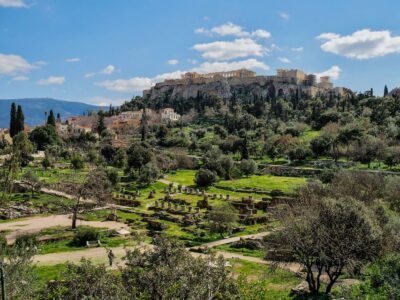
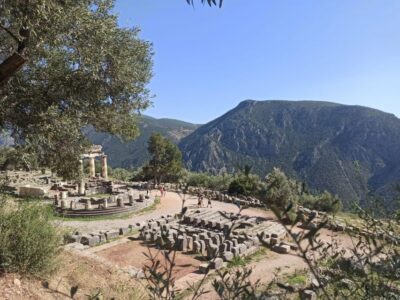
From Athens: Delphi Full Day V.R. Audio Guided Tour
Read our review →
Athens: Acropolis Museum Ticket with optional Audio Guide
Read our review →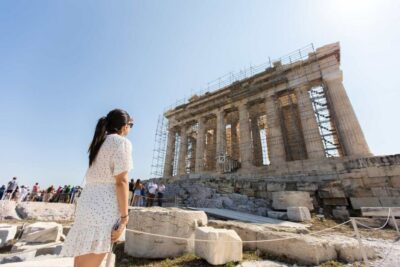
Athens: Acropolis Ticket & Optional Self-Guided Audio Tours
Read our review →
From Athens: Small-Group Delphi, Museum & Arachova Day Trip
Read our review →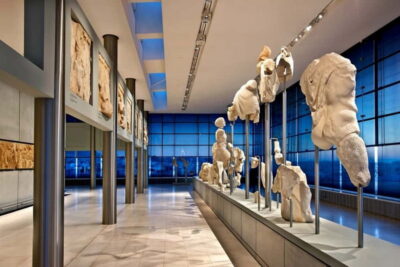
Parthenon & Acropolis Museum with Audio or Live Tour Option
Read our review →Browse the lists this tour appears in