
Review · BELGIUM
Brussels Audioguided walking tour 2h40 and 25 reviews
Brussels packs a surprising amount into a compact walk. This self-guided route takes you from Grand Place to the cathedral, Royal Palace, Art Nouveau façades, Manneken-Pis, Saint-Catherine, the Saint-Hubert Galleries, and the famous Delirium bar. The audio adds context without tying you to a guide’s timetable.
I like the freedom to pause and wander, especially around Grand Place and the small streets near Manneken-Pis. I also like the price: $7.13 covers a private group of up to 15, which makes this one of the cheapest ways to get an organized introduction to central Brussels. The drawback is simple: you guide yourself, so you will need a charged phone, your own headphones if you want them, and enough attention to follow the map.
Key points at a glance
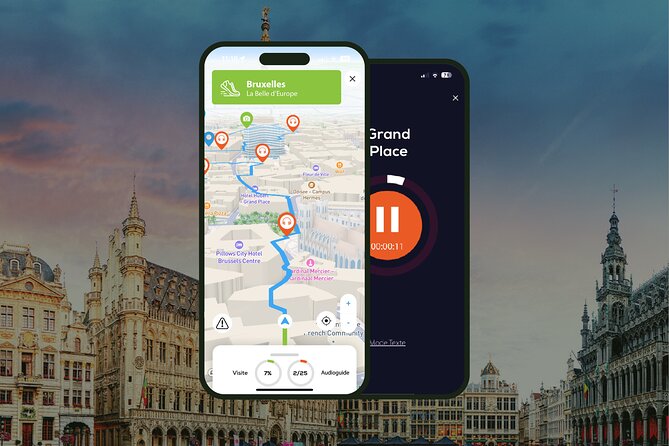
- Twenty-five audio stops cover major sights, local characters, architecture, and Belgian culture.
- The route links upper and lower Brussels, from the cathedral and Royal Palace down toward Grand Place, Saint-Catherine, and Place de la Monnaie.
- Offline access matters, since the map and audio can be used without consuming mobile data.
- One booking covers up to 15 people, making the $7.13 group price unusually good value.
- You can walk at your own pace, with transcripts available when listening is inconvenient.
- Optional paid entrances are not included, so budget separately if you decide to enter any attraction.
A smart first walk through central Brussels
This is not a museum tour or a formal guided walk. It is an app-based route that gives you 25 audio comments as you move through the city. You receive immediate access, with no tickets or printed materials to collect, and the experience is available in English, French, and Spanish.
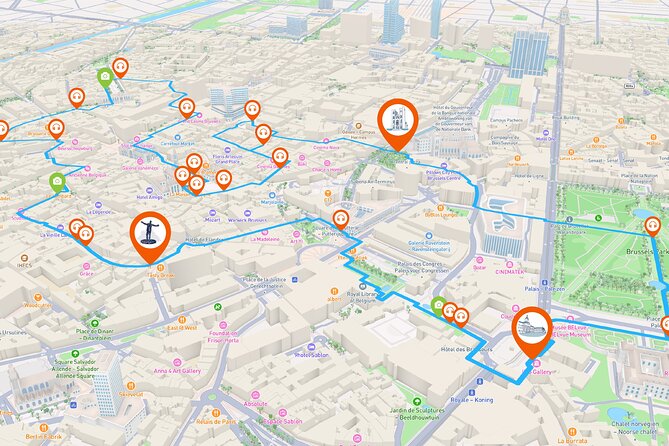
The route begins at Grand Place, but it does not simply circle the square and stop. It first takes you through a broad slice of Brussels, including the cathedral, Brussels Park, the Royal Palace, the Royal Square, Art Nouveau buildings, Manneken-Pis, Saint-Catherine, Grand Place, the Saint-Hubert Galleries, Delirium, and Place de la Monnaie.
That order gives you a useful sense of Brussels geography. You move from the upper part of the city, where the palace and museums are located, toward the historic center and its busy public squares. The walk ends back at the meeting point, according to the supplied details, so you are not left at an unfamiliar edge of town.
The advertised duration is approximately 2 hours 30 minutes, though the tour title refers to 2 hours 40 minutes. Treat it as a roughly two-and-a-half-hour walk, not a timed race. You will need more time if you stop for photos, browse shops, or enter a paying attraction.
More Audio Walking Tours in Belgium:
- Antwerp: City Walk with Audio Guide in 7 Languages on your Phone
★ 3.0 · 15 reviews - Bruges Walking Tour with Audioguide on Your Smartphone
★ 4.5 · 14 reviews - Ghent Walking Tour with Audioguide on Your Smartphone
★ 4.5 · 13 reviews
Starting at the Cathedral of St. Michael and St. Gudula
The first stop is the Cathedral of St. Michael and St. Gudula, one of Brussels’ most important Gothic landmarks. The building dates from the 13th century and was built on the remains of an older Romanesque cathedral.
That detail gives the opening stop some weight. You are not simply looking at a striking church façade. You are seeing one layer of Brussels built over another, a pattern that repeats throughout the city.
The audio format works well here because you can listen while examining the exterior at your own pace. If you want to enter the cathedral, remember that admission to paid establishments along the route is not included. The walk itself provides the commentary, but any optional entrance costs extra.
Brussels Park and the Belgian monarchy
From the cathedral, the route leads through Brussels Park toward the Royal Palace. The park was formerly called the Royal Park, and the path gives you a change of pace after the cathedral’s stonework.
The route then brings you down a palace alley toward the Royal Palace itself. This is a useful point for first-time visitors, since Belgium’s monarchy can be easy to overlook amid the city’s grand squares, beer bars, and comic-style murals.
The palace is not presented as an isolated sight. It is part of a larger urban setting, with the park, ceremonial avenues, and nearby royal buildings explaining how the upper part of Brussels was planned. You get a clearer sense of the city’s official face before moving into its more playful and commercial streets.
Royal Square and the city’s grand rebuild
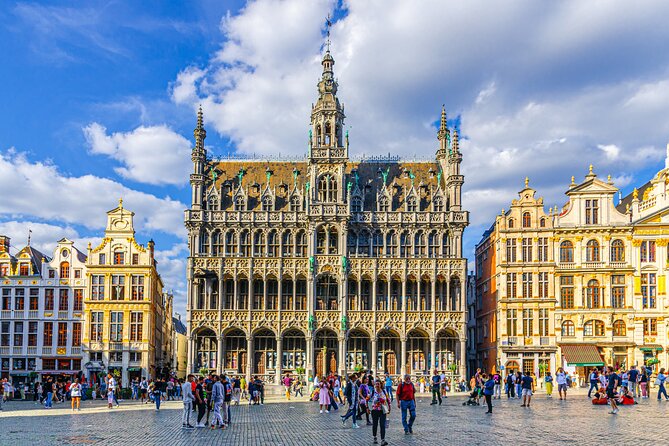
Royal Square, or Place Royale, is surrounded by elegant mansions and the Church of St. James on Coudenberg. The square was created during major urban redevelopment in the 1770s.
That date helps you read the architecture. Instead of viewing the square as a collection of handsome buildings, you can see it as a planned statement of power and order. The route uses the square to connect the monarchy, the old Coudenberg area, and Brussels’ later architectural ambitions.
This part of the walk may appeal most to you if you like urban design. The audio does not only point out isolated monuments. It explains how streets and squares fit together, which is more useful than a list of names.
More audio tours around Belgium:
- Bruges: Choco-Story Museum with Audio Guide and Tastings
★ 4.2 · 1,825 reviews - Bruges: The Beer Experience Museum Entry with Audio Guide
★ 4.4 · 201 reviews - Bruges Scavenger Hunt and Highlights Self Guided Audio Tour
★ 4.0 · 54 reviews - AudioGuide Ghent
★ 4.5 · 23 reviews
Art Nouveau around Old England and the English Pharmacy
Brussels is closely linked with Art Nouveau, and this route gives the style more than a passing mention. One featured building is Old England, a former department store designed by architect Paul Saintenoy.
The building is also associated with the Musical Instrument Museum, often called the MIM. Its metalwork and decorative details reward a slower look, so this is a good place to pause the audio and study the façade rather than keep walking automatically.
A short distance away, you find another Saintenoy work, the English Pharmacy. The building has been converted into a cocktail bar, but its earlier identity remains part of the story. This is one of the route’s more appealing details because it connects architecture with everyday city life. Brussels does not preserve every historic building as a silent monument. Some continue with a new use.
The main limitation is that an audio stop cannot replace a dedicated Art Nouveau tour. If this architectural style is your main reason for coming to Brussels, you will probably want extra time beyond this route. Still, the walk gives you a useful introduction and points out buildings you might otherwise pass without noticing.
A playful turn toward Manneken-Pis
The route shifts tone after the royal and architectural stops. You pass a reference to The Envol, a work connected with Grand Jacques, the affectionate nickname for Belgian singer Jacques Brel. It is a reminder that Brussels’ identity is not only palaces and churches. Music, sculpture, humor, and popular culture also shape the city.
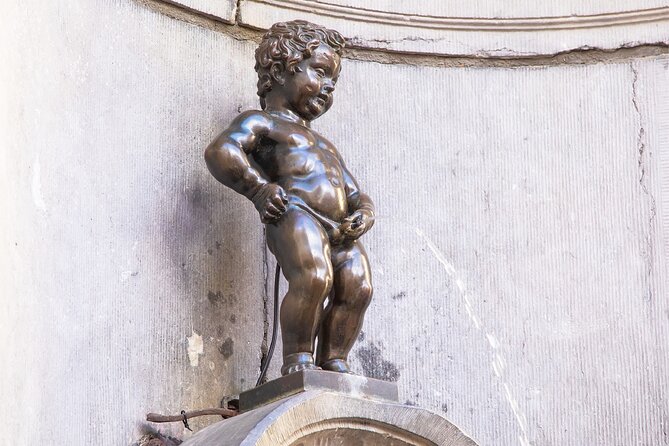
Then comes Manneken-Pis, the small bronze figure that has become one of Belgium’s best-known symbols. The stop warns you to expect a crowd around the corner, which is practical advice. The statue is small, and the surrounding attention can seem out of proportion to its size.
You should keep your expectations realistic. Manneken-Pis is not a grand monument. Its appeal comes from the joke, the local affection, and the way this tiny figure has become part of Brussels’ public personality. The audio helps explain why the sight matters, while the route gives you time to take in the nearby streets.
The same area also features Jeanneke-Pis, the female counterpart, followed by Zinneke Pis, the bronze dog. Together, the three figures form a comic family of public sculptures. Zinneke Pis is particularly useful as a reminder of Belgian humor: the joke continues, even after the famous little boy has had his turn.
The crossroads near Manneken-Pis
The walk encourages you to linger at the busy crossroads near Manneken-Pis. This is good advice. The point is not only the statue. You also get colorful façades, bars, shops, and the movement of people through one of central Brussels’ most visited areas.
I would use the app’s pause function here. The audio may take only a few minutes, but the area deserves a look without one ear occupied by narration. The transcript is useful if you prefer reading, need to lower the volume, or want to revisit a detail later.
This is also where the route’s self-guided nature becomes a benefit. A live group usually keeps moving. Here, you can stop for a photo, look into a shop, or wait for a less crowded view without holding anyone up.
Saint-Catherine and a different side of the center
Place Sainte-Catherine sits in the lively district of the same name. The route presents it as a center for creators and culture, giving you a break from the formal royal spaces and postcard monuments.
The square is a useful stop because it broadens your view of central Brussels. You are not only being taken from one famous façade to another. You are also shown a neighborhood with its own character and contemporary energy.
The supplied route information does not promise restaurant recommendations, museum admissions, or a long stop here, so you should treat Saint-Catherine as a place to observe and perhaps return to later. The walk gives you orientation, not a full neighborhood guide.
Grand Place, the powerful centerpiece
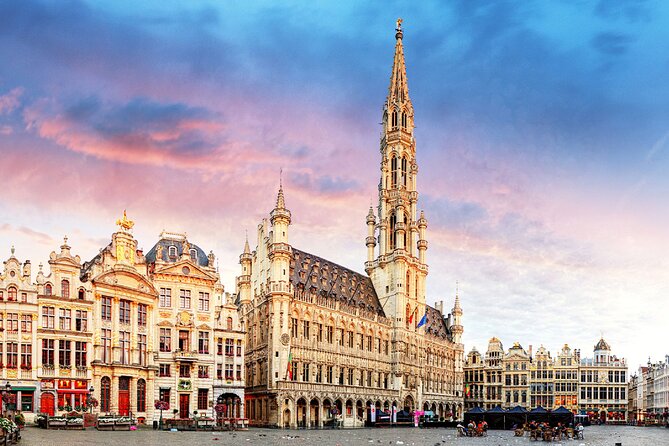
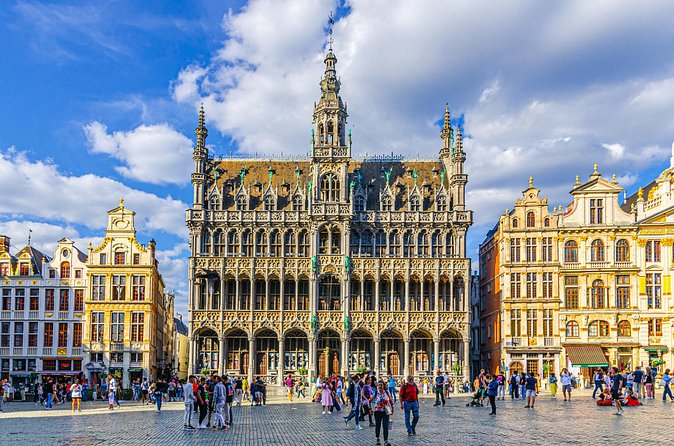
Grand Place is the emotional high point of the route. The square surrounds you with ornate façades and a sense of scale that is hard to grasp from photographs. The commentary presents it as one of the world’s most beautiful squares, and the setting makes clear why it has such a strong reputation.
This is the starting point, too, so you may see it twice if you follow the route as intended. That is an advantage. On your first visit, you can get your bearings. At the later stop, you can listen with more context and notice the details in the surrounding buildings.
The audio points out the former home of the Dukes of Brabant, an enormous architectural block occupying the east side of Grand Place. Its scale helps explain the square’s power. Grand Place is not just a pretty plaza with cafés. Its buildings were designed to communicate wealth, status, and civic importance.
Give yourself extra time here. The listed duration is approximate, and Grand Place is exactly the sort of stop that can stretch your walk. The audio is included, but your time for photographs, people-watching, and looking up at the façades is yours to control.
Saint-Hubert Galleries and Belgian beer culture
The route next enters the Galeries Saint Hubert, built in 1847 and among Europe’s oldest shopping galleries. The covered passages offer a polished change from open squares and narrow streets.
This is a good place to pay attention to the route’s balance. You move from medieval and royal subjects to 19th-century commercial architecture, then into modern Belgian leisure culture. The galleries remain useful as a shopping passage, but the building itself is the main attraction.
The walk also passes Delirium, a famous Belgian beer institution. Belgium’s beer culture has UNESCO Intangible Cultural Heritage status, so this stop gives a cultural frame to what might otherwise look like a popular bar with a memorable name.
No drink is included, and the tour does not promise a tasting. That is worth noting if you expect a food or beer experience. This is a sightseeing route with cultural commentary, not a pub crawl. You can decide for yourself if you want to return to Delirium after the walk.
Place de la Monnaie and the route back
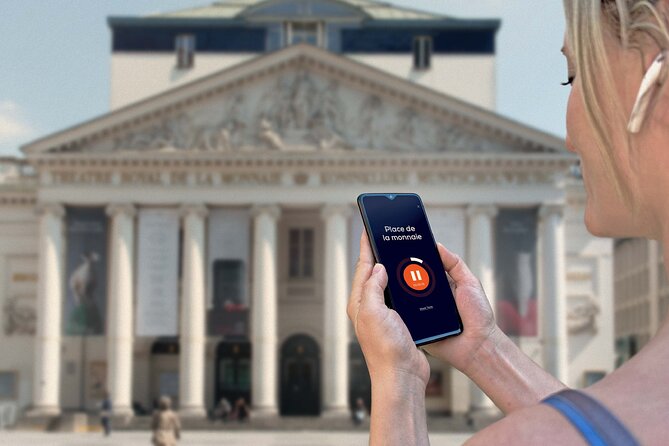
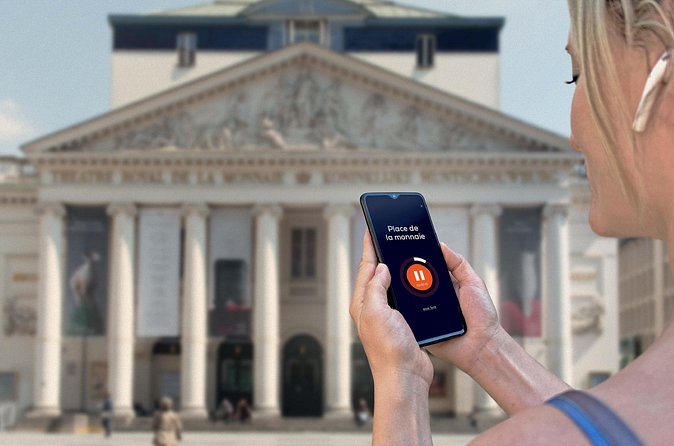
The final stop is Place de la Monnaie, opposite the imposing opera house of the same name. Both names refer to the square’s earlier function as a place where coins for the Duchy of Brabant were minted from 1420.
It is a fitting ending because the square links public culture, architecture, and commerce. The opera house gives the area a grand civic presence, while the older name points back to Brussels’ economic past.
The route ends back at the meeting point, making Grand Place a practical base for the rest of your day. You can continue exploring on foot, return to a hotel nearby, or use public transportation, which is close to the activity according to the supplied details.
What $7.13 really gets you
The price is $7.13 per group, not per person, for up to 15 people. That changes the value calculation completely. A couple pays very little for a structured orientation, while a larger family or friend group gets an especially strong deal.
You are paying for the route, audio content, transcripts, navigation, and photo recommendations. You are not paying for a human guide, attraction tickets, food, drinks, or headphones. If you already plan to walk central Brussels, the added cost is modest.
The private format is another advantage. Only your group participates, but the experience remains self-guided. You do not have to match another group’s speed or listen to questions that do not interest you.
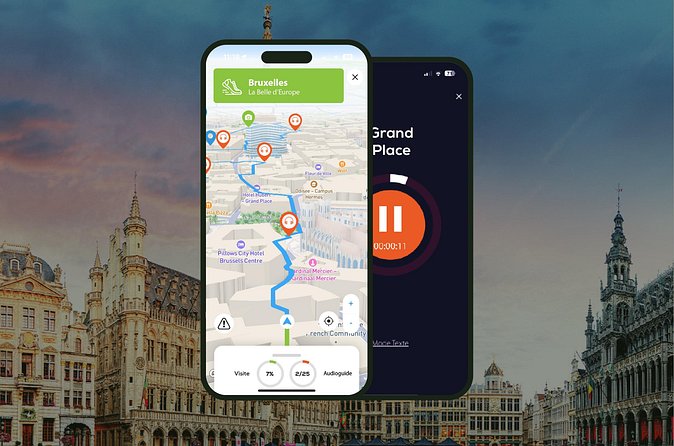
The tradeoff is that the value depends on your phone use. You need to follow the interactive 3D map and start each audio comment at the right place. The offline mode helps by avoiding mobile data charges, but it does not remove the need to manage your device.
Who should choose this Brussels walk?
I would recommend it most to first-time visitors who want a broad introduction without committing to a costly private guide. It also suits couples, families, and groups of friends, especially when the group price is shared.
It is a good fit if you enjoy deciding when to stop. The transcripts help if you do not always want to listen, and the three-language choice makes the tour practical for English, French, and Spanish speakers.
You may want something else if you prefer a live guide, detailed questions and answers, or a tour focused entirely on Art Nouveau, beer, food, or museums. Paid entries are not included, and the route does not replace a full visit inside the cathedral, palace, or any other attraction.
You can book any day during the stated operating period, from June 5, 2025, through February 16, 2027. The activity is listed as available around the clock, from midnight to 11:59 p.m., so you have broad flexibility. Free cancellation is available if you cancel at least 24 hours before the start time. Changes or cancellations inside that window are not refundable.
Should you book it?
Book this walk if you want low-cost orientation with room to roam. The route covers a generous stretch of central Brussels, and its best feature is the mix: Gothic cathedral, monarchy, 18th-century planning, Art Nouveau, comic sculpture, Grand Place, shopping galleries, beer culture, and opera.
Skip it if you want a personal guide or a specialized tour. For everyone else, the $7.13 group price makes this an easy add-on, especially on your first day. Bring a charged phone, use the offline mode, and plan to pause often at Grand Place, the Art Nouveau buildings, and the Manneken-Pis area.
FAQ
How long does the Brussels audio walk take?
The stated duration is approximately 2 hours 30 minutes. The tour title refers to 2 hours 40 minutes, so allow roughly two and a half hours, with extra time if you stop for photos or optional visits.
Where does the tour begin?
The walk begins at Grand Place, also called Grand-Place de Bruxelles, in Brussels 1000, Belgium.
Where does the tour end?
The activity ends back at the meeting point.
How many people can join one booking?
One booking covers a private group of up to 15 people.
Which languages are available?
The audio tour is available in English, French, and Spanish. The supplied booking information lists English as the offered language.
Are attraction entrance fees included?
No. Entrance fees for paid establishments along the route are optional and not included.
Do I need headphones?
Headphones are optional and are not included. You can bring your own if you prefer to listen privately.
Can I use the tour without mobile data?
Yes. The experience includes an offline mode, so you can use the route without consuming mobile data during the visit.
Is cancellation free?
Yes, provided you cancel at least 24 hours before the experience start time. Cancellations made less than 24 hours before the start time are not refunded.
New audio tours around Belgium
- Liege Scavenger Hunt and Highlights Self Guided Audio Tour★ 4.0 · 9 reviews
- Ghent Walking Tour with Audioguide on Your Smartphone★ 4.5 · 13 reviews
- Ghent Scavenger Hunt and Highlights Self Guided Audio Tour★ 3.5 · 3 reviews
- Ghent: City Walk with Audio Guide in 7 Languages on your Phone★ 4.5 · 3 reviews
- Hidden Ghent: A Self-Guided Audio Tour Of The Flemish City★ 5.0 · 2 reviews
- Brussels: City Walk with Audioguide in 7 Languages on your Phone★ 3.5 · 4 reviews
- Leuven: City Walk with Audio Guide in 7 Languages on your Phone★ 3.0 · 3 reviews
- Brussels Scavenger Hunt and Highlights Self Guided Audio Tour★ 5.0 · 4 reviews
Belgium Audio Tours, compared.

Bruges: Choco-Story Museum with Audio Guide and Tastings
Read our review →
Bruges: The Beer Experience Museum Entry with Audio Guide
Read our review →
Bruges Scavenger Hunt and Highlights Self Guided Audio Tour
Read our review →

Antwerp: City Walk with Audio Guide in 7 Languages on your Phone
Read our review →
Antwerp Scavenger Hunt and Highlights Self Guided Audio Tour
Read our review →
Antwerp Scavenger Hunt and Best Landmarks Self Guided Audio Tour
Read our review →
Bruges Walking Tour with Audioguide on Your Smartphone
Read our review →Browse the lists this tour appears in