
Review · NETHERLANDS
Explore Groningen City with Self-Guided GPS and Audio Tour
Groningen’s story is packed into a walk of about two hours, from the old fish market to medieval churches, a striking synagogue, and the modern Forum building. The GPS and audio format lets you move at your own pace, with no group to catch and no guide setting the rhythm.
I like the route’s mix of old and new Groningen, especially the free chance to visit the Forum roof for city views. I also like the relaxed feel praised in the available feedback, where the Niki app was appreciated for guiding the walk without fuss. The main drawback is that the experience depends on your phone and the audio content, so anyone seeking lively conversation or in-depth questions from a local guide may want a traditional tour instead.
Key points
- Two hours through central Groningen: The walk links the Vismarkt, Grote Markt, churches, guesthouse, synagogue, and Akerk.
- English audio guidance: The Niki app provides the route and commentary, with no live guide listed.
- Free stops with strong variety: You can enter the Forum, and the route encourages a look inside the Pelstergasthuis.
- A useful city-center introduction: The route explains how trade, religion, local government, and student life shaped Groningen.
- Flexible private format: Only your group takes part, and you can pause for photos or short visits.
- Good value at $8.41: The low price works best if you want orientation and context rather than a long guided lecture.
Starting at Vismarkt, where Groningen traded fish
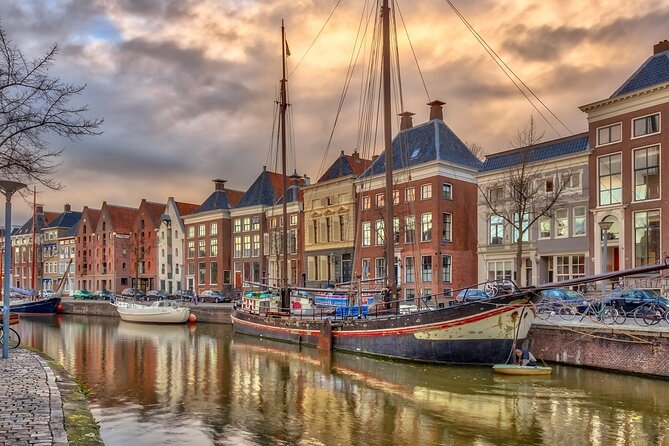
The walk begins at PronkVismarkt 56, at the edge of the Vismarkt. The name is plain and useful: fish was once sold here, and the square remains one of the clearest places to begin understanding Groningen as a trading city.
The commentary also raises an interesting theory about the city center. Its street pattern may have been influenced by Roman-era city plans, with Vismarkt intended as a central square. That is the kind of detail that gives you something to look for as you walk, rather than simply handing you a list of dates.
Take a moment to look at the buildings around the square, including Vismarkt 56. The stop is only about five minutes in the planned timing, so you will not receive a long architectural lecture here. That is useful if you want to get moving, but you should pause longer if façades and city layouts interest you.
The starting point is practical. It is near public transportation, and the activity operates daily from 7:00 in the morning until 7:00 in the evening during the stated operating period. You can begin when it suits your day, though the experience is best treated as a daytime walk since several stops are exterior viewing points.
More Self-Guided Audio Tours in the Netherlands
- Lisse: Self-Guided Tulip Fields GPS Audio Tour
★ 4.6 · 83 reviews - Utrecht Scavenger Hunt and Highlights Self Guided Audio Tour
★ 4.0 · 10 reviews - Amsterdam’s Red Light District: A Self-Guided Audio Tour
★ 4.5 · 9 reviews
A science museum and a turn into Groningen’s smaller streets
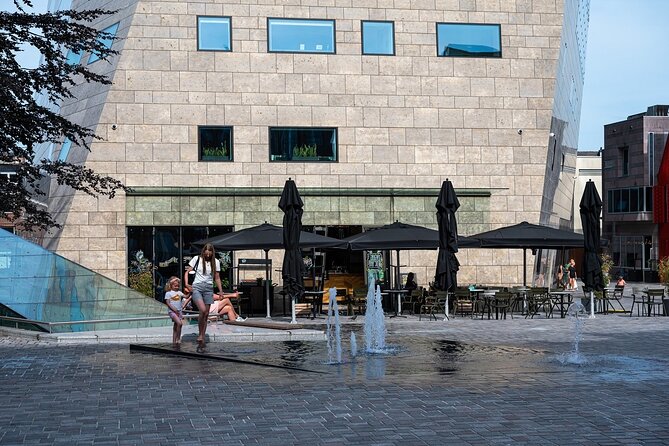
After Vismarkt, the route passes a science museum located in Groningen’s academic center. The museum has been at this site since 1934 and holds collections connected with science, nature, and culture.
The route does not require you to enter. If you want a museum visit, you can look through the collection, but the audio walk continues calmly toward Muurstraat. This makes the stop easy to adapt. You can add an indoor visit if you have time, or simply use the museum as a bridge between the market and the next major sight.
Muurstraat gives the route a change of scale. After the open market, you turn into one of the smaller streets in the center. I like this kind of transition because it helps you notice how Groningen shifts between broad public squares and compact lanes within a short distance.
The science museum is not given a separate admission price in the tour information, so do not assume entry is included beyond the route itself. The practical choice is to check the museum separately if you want to go in.
Forum Groningen, a modern stop with a free roof view
Forum Groningen is the route’s clearest piece of modern city life. Inside, you will find films, exhibitions, events, festivals, games, Storyworld, books, and talks. The building is aimed at current culture and future ideas, which makes it a sharp contrast to the old churches and civic buildings that follow.
You can enter the Forum for free and visit the roof for a view over Groningen. This is one of the strongest parts of the walk because it gives you a chance to see the city from above without adding a ticket cost. The planned stop lasts about 15 minutes, though you may want longer if the view is important to you.
The Forum is also a useful rest point. An audio walk can feel repetitive if every stop means standing outdoors and listening to another block of narration. Here, you can step inside, look around, and reset before continuing.
The route description lists films, exhibitions, games, and talks as part of the Forum program, but it does not promise that a particular event will be running when you visit. Treat those as available types of programming, not fixed inclusions.
Martinikerk and the long growth of Groningen
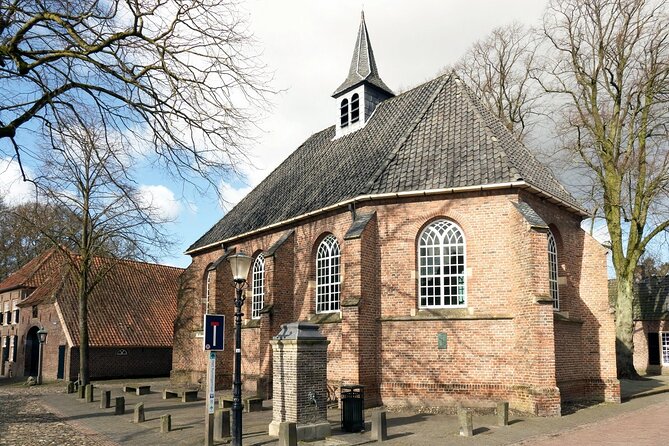
The next major section takes you to the Martinikerk, Groningen’s oldest church. The first stone church on this site dates to around the year 1000. A larger Romanesque church followed around 1220, built with tuff stone and later expanded as the city population grew.
The church’s shape changed over many centuries. The earlier building had three aisles, a high central nave, lower side aisles, and rounded apses. Some traces of that phase remain in the round windows and recessed brickwork on the north and south façades.
In the 15th century, during a strong economic period for Groningen, the church gradually became the building you see today. This is a good example of how the route handles history. You are not only told that a church is old. You are shown how it changed as the city became larger and wealthier.
The planned route does not give a separate admission price or fixed interior visit for Martinikerk. Depending on opening arrangements, you may mainly view it from outside. The exterior still carries much of the story, especially if you pay attention to the different masonry details.
Same sights, a different narrator:
- Amsterdam: 75 Minute City Canal Cruise with Audio Guide
★ 4.4 · 19,938 reviews - Amsterdam: City Centre Canal Cruise including Audioguide
★ 4.3 · 16,901 reviews - Amsterdam: Royal Palace Entry Ticket + Audio guide
★ 4.6 · 7,889 reviews - Amsterdam: Heated Canal Cruise Including Audioguide
★ 4.2 · 2,773 reviews
Martinitoren, or D’Olle Grieze
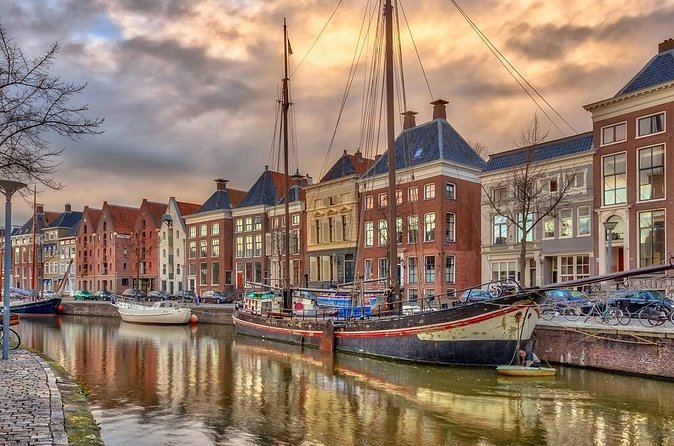
Beside the church rises the Martinitoren, Groningen’s best-known tower and the highest tower in the city. Local people affectionately call it D’Olle Grieze, meaning the old grey one.
The tower you see was not the first one on this site. An earlier tower, built in the 13th century, reached about 30 meters and appears on the city seal. Lightning destroyed it in 1408. A second tower, built after the Martinikerk was expanded in Gothic style, reached about 45 meters but collapsed in 1468. Fire and lightning had already caused trouble there.
Those failures make the present tower more interesting. It is not simply an old landmark that survived untouched. It is part of a long series of rebuilding efforts tied to the church and the city’s changing fortunes.
The audio commentary works well here because the tower is easy to recognize, but its history is less obvious from the street. You can stop, look up, and understand why this single structure became such a strong symbol of Groningen. The tour information does not state that tower admission is included, so do not plan on an included climb.
Grote Markt and Groningen’s city hall
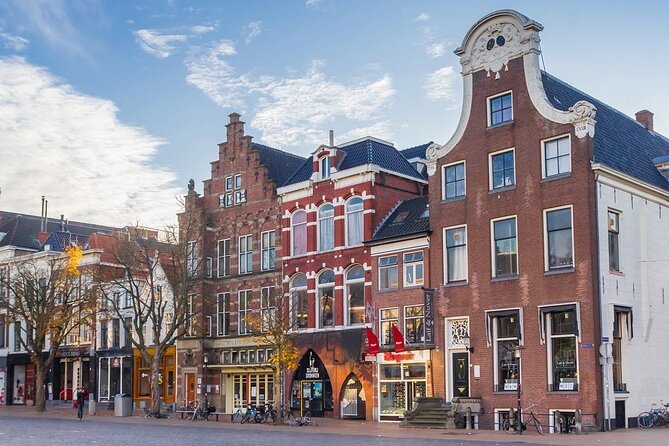
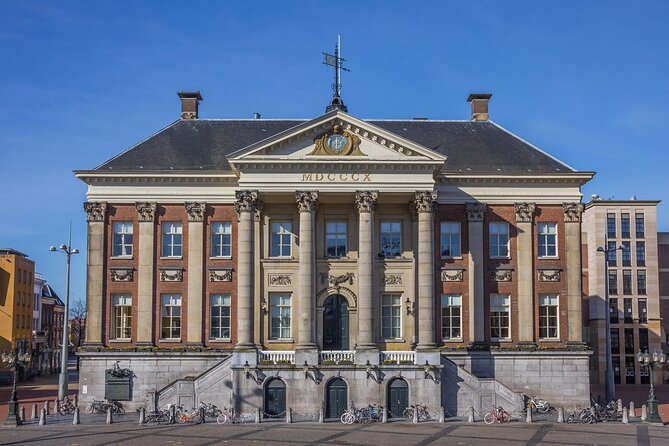
The route continues to Groningen’s city hall in the Grote Markt. For more than two centuries, the building has occupied the middle of the square, though the city hall once consisted of several buildings, some medieval.
The current structure came from the first architectural competition held in the Netherlands, in 1774. Jacob Otten Husly won the design competition. Money shortages and the French invasion around 1800 delayed the work, and the building finally opened in 1810.
Its Dutch classicist and neoclassical design gives the square a formal center. The building was fully renovated between 2020 and 2022, so the stop also offers a reminder that old civic buildings need regular care if they are to keep serving the city.
I appreciate this stop because it moves the story beyond churches and merchants. City hall explains local government and public power. You are looking at the place where Groningen’s civic decisions have been organized for more than two centuries.
The Goudkantoor and the business of collecting taxes
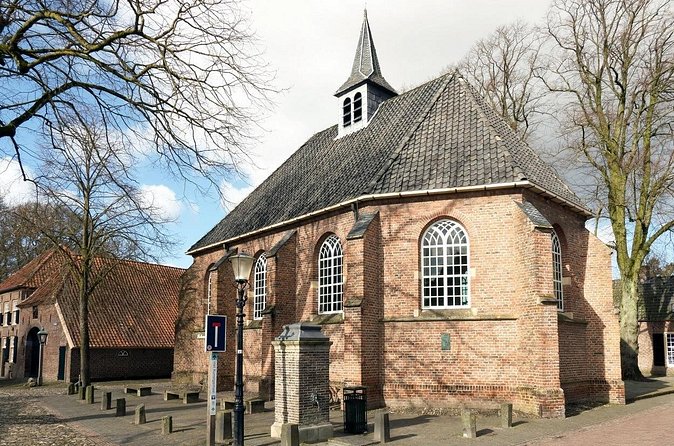
The Renaissance-style Goudkantoor was built in 1635 for the province as a tax office. Its original purpose is still spelled out on the façade with a Latin message about giving the emperor what belongs to the emperor.
The building later became known as Goudkantoor because one of its users was an office responsible for guaranteeing gold and silver work. That office occupied the upper floor from 1814 to 1887.
The building also reflects a period of uncertainty over ownership. After French rule ended in 1814, the city and province disputed who had the right to the property. The matter was not settled until 1843, when the building was renovated and the provincial coats of arms on the façades were replaced with city arms.
This is a short exterior stop, but it rewards close looking. The building is not just pretty Renaissance decoration. Its façade records taxation, government, ownership, and the value once placed on precious metals.
Pelstergasthuis, Groningen’s oldest guesthouse
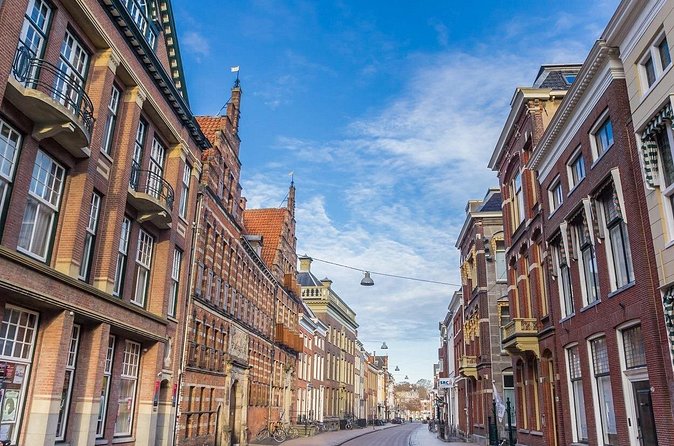
Pelstergasthuis is one of the route’s most human stops. It is considered the oldest guesthouse in Groningen and is thought to date from the 13th century. Until 1342, it was the city’s only guesthouse.
The site was first mentioned in 1267, when Pope Clement IV granted permission for a chapel and cemetery. The buildings now present come from several periods between the 14th and 19th centuries. The church is the oldest surviving part.
You are encouraged to look inside, and this is worth attempting if the building is open. Inside hangs Groningen’s oldest bell, dated 1459. That small detail gives the site a direct connection to the people who used it, rather than leaving you with only an exterior façade.
The stop is planned for about five minutes. I would allow a little extra time if you are able to enter, since the guesthouse offers a quieter change from the main squares and major landmarks.
Groningen Synagogue and the story behind its design
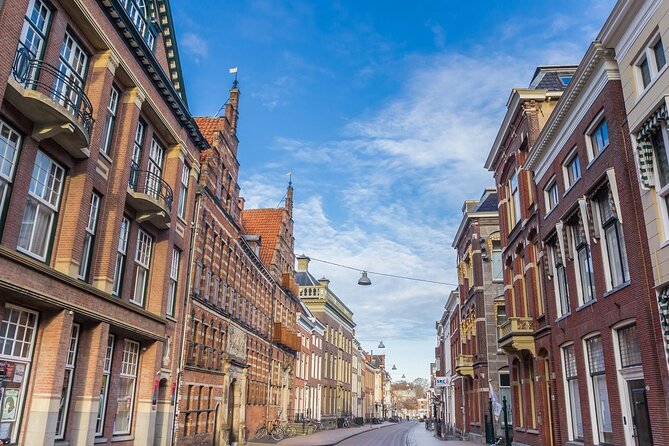
The Groningen Synagogue is a compact but distinctive stop. The earlier synagogue had served the Jewish community from 1756 in Kleine Folkingestraat, also known as Jodenstraatje. In 1903, the municipality approached architect Kuipers about a new building.
Kuipers had designed many churches but knew little about synagogue design, so he traveled through Germany for ideas. In Berlin, he was influenced by the Moorish or oriental style of the synagogue on Oranienburgerstrasse.
The result includes an oriental dome and horseshoe arches inside and out. These features reflected the period’s idea that Jewish buildings should express oriental roots. The commentary gives you useful context for the style, helping you see the design as part of a particular time rather than treating it as decoration without meaning.
The stop is planned for about five minutes. The route does not state that entry is guaranteed, so you should be prepared to view the building from outside. Even so, its dome and arches make it easy to identify and worth a pause.
Akerk, an old church at the heart of city life
The walk ends at the Akerk, an approximately 800-year-old church near the former river A. A chapel was built here around 1200, then expanded into a basilica dedicated to Saint Nicholas, the patron saint of sailors.
The river was an important trade route, so the church’s location was closely tied to commerce. In the 15th century, major building work gave the Akerk much of the shape it has today, completed around 1495.
The church was built for Catholic worship but passed to Protestant use during the Reformation in 1594. Catholic furnishings and reminders were removed, and Protestant services continued until 1970.
The Akerk is a fitting final stop because it connects religion, trade, architecture, and city life. The route notes that the church remains at the center of Groningen life, even though its religious use has changed. The planned stop lasts about five minutes, but the building deserves a slower look if it is open.
What $8.41 buys you
At $8.41 per person, this is inexpensive for a two-hour city orientation, particularly because it is private and only your group takes part. You are paying for an English GPS and audio route, not a live guide who can adjust the talk to your interests.
The value comes from the route design. In a short distance, you get a market, science museum, modern cultural center, medieval churches, a famous tower, city hall, a Renaissance tax office, an old guesthouse, and a synagogue. That range would be difficult to organize without some advance planning.
I would not book it if you want entry tickets, a personal guide, or detailed answers about every building. Those are not part of the stated offer. I would book it if you want a low-cost way to get your bearings, hear clear background information, and decide which places deserve a second visit.
The walk is offered in English only. Travel time is included in the approximate two-hour duration, and you return to the starting point at Vismarkt 56. Because you control the pace, the actual experience can be shorter or longer depending on how long you pause.
Who will get the most from this walk
This route suits independent visitors who like to stop for photographs, enter a free building when possible, and continue when ready. It is also a good first look at Groningen for anyone staying near the center or arriving by public transportation.
Families and mixed-age groups may appreciate the flexible format. You can pause the audio rather than hold up a group, and the Forum offers a change of pace from architecture and church history.
I would also recommend it to budget-conscious visitors. The price is modest, the Forum roof is free, and several important sights can be appreciated without paying an admission fee.
The weaker match is someone who wants a strong personal connection with a local guide. No guide name is provided, and the experience is built around the Niki app. You should also be comfortable following GPS directions and listening through your phone.
Booking includes confirmation at the time of purchase. Service animals are allowed, most people can participate, and the activity is near public transportation. Free cancellation is available up to 24 hours before the start time. Inside 24 hours, the payment is not refunded, and changes are not accepted.
Should you book the Groningen audio walk?
Book it if you want a relaxed, low-cost introduction to central Groningen with a smart mix of old buildings and modern culture. The best parts are the easy self-guided pace, the Forum roof view, and the way the route explains why the market, churches, civic buildings, and river trade belong in the same story.
Skip it if your priority is a live guide, guaranteed interior access, or a highly personal tour. For $8.41, though, the route gives you a practical framework for exploring Groningen on your own. Start with time to spare, pause at the Forum and Pelstergasthuis, and treat the two-hour estimate as a guide rather than a deadline.
FAQ
How long does the Groningen self-guided tour take?
The tour lasts approximately two hours, with travel time already included in the total duration.
Where does the tour start?
It starts at PronkVismarkt 56, 9711 KV Groningen, Netherlands.
Where does the tour end?
The activity ends back at the starting point.
What language is the audio tour offered in?
The tour is offered in English.
Is this a private tour?
Yes. Only your group participates in the activity.
Can I cancel for a full refund?
Yes. You can cancel at least 24 hours before the experience start time for a full refund. Cancellations or changes made less than 24 hours before the start time are not refunded or accepted.
New audio tours around the Netherlands
- Explore Highlights of Haarlem: Self-Guided GPS and Audio Tour★ 4.0 · 2 reviews
- Explore Gouda with Self-Guided GPS and Audio Tour★ 4.0 · 2 reviews
- Den Bosch: City Walk Audio Guide in 7 Languages on your Phone★ 5.0 · 2 reviews
- Van Gogh Museum Ticket with Audio Guide and Unlimited Access Time★ 5.0 · 25 reviews
- Van Gogh Museum Amsterdam Entry with Optional Audio Guide★ 4.0 · 111 reviews
- Van Gogh Museum with Audio Guide★ 3.5 · 80 reviews
- Self-Guided Audio Tour of The Red Light District★ 5.0 · 5 reviews
- Combo Ticket: Rijksmuseum Amsterdam & 1h Cruise with Audio Guide★ 3.0 · 83 reviews
Netherlands Audio Tours, compared.
Amsterdam: 75 Minute City Canal Cruise with Audio Guide
Read our review →
Amsterdam: City Centre Canal Cruise including Audioguide
Read our review →
Amsterdam: Royal Palace Entry Ticket + Audio guide
Read our review →
Amsterdam: Heated Canal Cruise Including Audioguide
Read our review →
Amsterdam: Canal Cruise with Live Commentary & Audio Guide
Read our review →
Amsterdam Sightseeing Canal Cruise with Audio Guide
Read our review →
Amsterdam City Centre Cruise on heated boat with Audioguide
Read our review →
Rotterdam: Steamship Rotterdam Audio Tour Entry Ticket
Read our review →Browse the lists this tour appears in