
Review · LISBON
Lisbon: National Tile Museum E-Ticket & Audio Guide
Lisbon’s National Tile Museum tells Portugal’s story through painted ceramic, from Mudéjar patterns and a 16th-century tile to the wonderfully odd Mickey Mouse panel. The building itself adds to the visit, with the Dona Leonor Chapel and a pleasant courtyard area near the cafeteria.
I like the freedom to pause, replay, or skip the English audio stories, and I like that the $16 ticket handles admission before you arrive. The main drawback is the app: its route can feel out of order, so you may need to select the room or image that matches your location instead of simply pressing play and following along.
Key points to know
- See Lisbon’s tile story in one focused museum: Exhibits cover Portugal’s tile industry from medieval work to modern examples.
- Look for the Mickey Mouse panel: This unusual display is one of the museum’s memorable talking points.
- Use the audio guide selectively: It includes short stories and historical context, but you may need to advance manually.
- Allow at least 1 to 2 hours: A quick visit is possible, but the material rewards a slower pace.
- Bring a charged smartphone and headphones: The ticket includes the digital guide, not the equipment needed to play it.
Why the National Tile Museum deserves your time

Lisbon is full of patterned facades, tiled churches, and blue-and-white panels. The National Tile Museum gives you the background needed to understand what you are seeing around the city.
The museum presents tiles as more than decoration. They reflect changing tastes, outside influences, religious devotion, industry, and daily life in Portugal. You can move from medieval designs to later Portuguese work, then connect those displays with the tiled buildings you pass on Lisbon streets.
This is not a huge museum visit in the style of a major national art collection. The suggested visit lasts 1 to 2 hours, which makes it a useful stop between other plans. If you read every label and listen to the full audio program, you may want closer to three hours. If you are short on time, you can choose only the sections that interest you.
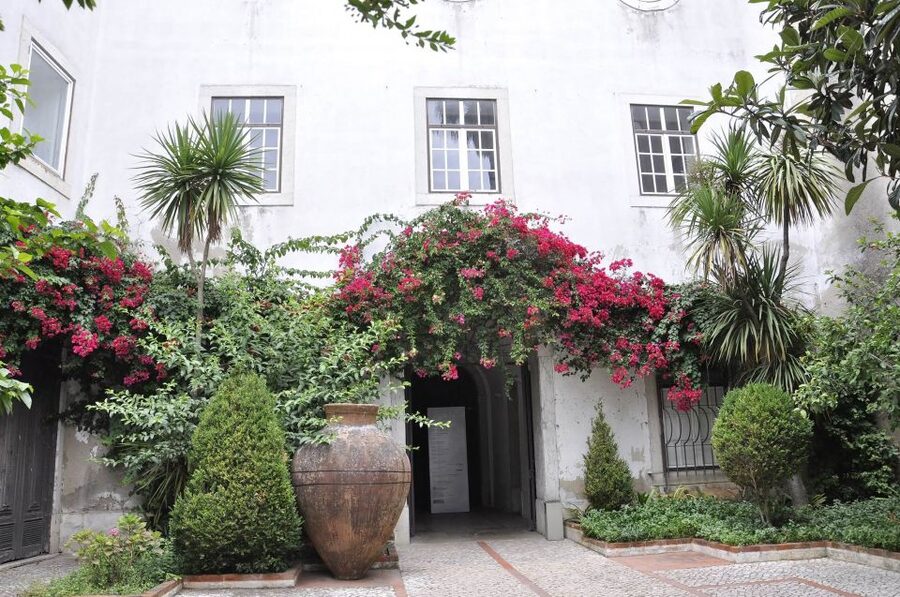
The museum also gives you a break from Lisbon’s steep streets and busy central sights. The visit is indoors, self-paced, and easy to divide into small sections. Near the cafeteria, a pretty garden area with tables and chairs gives you a place to sit with food or a drink.
More Smartphone Audio Tours in Portugal
- Lisbon: São Jorge Castle E-Ticket and Audio Guide
★ 4.3 · 2,182 reviews - Lisbon: Jerónimos Monastery E-Ticket and Audio Guide
★ 3.7 · 660 reviews - Lisbon: National Palace of Ajuda E-Ticket & City Audio Guide
★ 4.1 · 87 reviews
What you will see inside the museum
The experience does not provide a live guide. Instead, you receive an entry ticket and access to an English audio guide that runs through an app on your smartphone.
After entering, put on your headphones and use the museum displays as your guide. The audio content uses short stories, facts, and less familiar details to explain what you are looking at. It reaches back to Portugal’s medieval past and continues into the modern period, with the country’s tile industry as the main thread.
The exact route may not feel perfectly linear. The audio program can leave you listening to information about an earlier or later section if you simply follow the opening sequence. A better method is to check the images or room selections in the app and move to the item that matches your position.
That small adjustment matters. If you are listening to the wrong section, the museum can feel harder to follow than it should. Once you learn to advance manually, the guide becomes more useful. You can also replay a passage or skip material without waiting for a group.
The 16th-century tile and Mudéjar designs
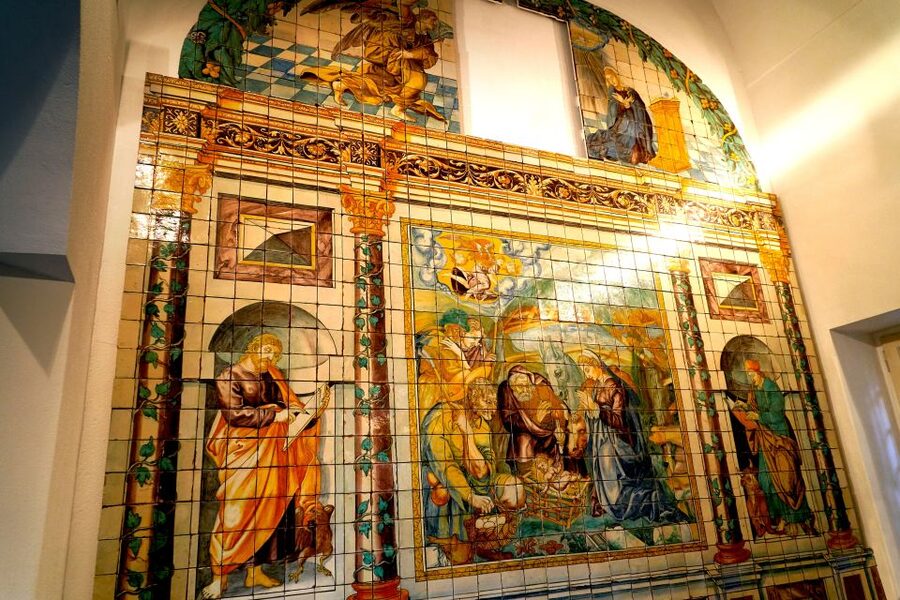
One focus is a 16th-century tile, which helps show the age and changing character of Portuguese ceramic work. The museum also displays Mudéjar-patterned tiles, an important reminder that Portuguese design developed through contact with different artistic traditions.
Look closely at the geometry. Repeated shapes, borders, and patterns can seem simple from a distance, but the effect depends on careful placement. These designs also help explain why tiles became so useful in Portugal: a wall could be practical, patterned, and visually striking at the same time.
The audio guide gives you the historical setting behind these objects. You do not have to memorize every date or technical term. The best approach is to listen for the broader story of how tile making developed and how styles changed.
The Mickey Mouse panel
The Mickey Mouse panel is one of the museum’s most unexpected displays. It gives the visit a lighter moment among the older religious and decorative pieces.
This panel is also a reminder that tile art did not stop with medieval or early modern examples. The museum connects older traditions with later work, so you can see the medium as part of Portugal’s continuing visual culture rather than a closed chapter.
If you are visiting with children, this is a useful point of interest. Children up to 12 years old enter free, though the digital ticket information is designed around the device used for the audio guide. You may want to keep the visit flexible and use the Mickey Mouse panel as an easy landmark.
More Smartphone Audio Tours in Lisbon:
- Lisbon: National Pantheon E-Ticket & Audio City Tour
★ 4.0 · 49 reviews - E-ticket to St. George with Audio Tour and Lisbon City Audio Tour
★ 4.5 · 27 reviews - Electric Car Tour of Lisbon Old Town and Belém with GPS Audio Guide
★ 5.0 · 23 reviews - Lisbon: E-ticket to St. George Castle & Audio Tour on Your Phone
★ 3.0 · 18 reviews
Diamond-patterned tiles
The diamond-patterned panel is another worthwhile stop. Its appeal is immediate, but it also rewards a closer look at repetition, color, and the way individual pieces create a larger design.
The museum’s tile displays work best when you take a moment to examine the full panel and then the separate details. A wide view shows the overall pattern. A closer view reveals the small variations and craftsmanship that disappear when you hurry past.
The audio content can add useful context here, but it is not essential for every object. If the app begins to slow your pace, listen to the sections that interest you most and use the wall labels for the rest.
The Dona Leonor Chapel
The Dona Leonor Chapel gives the museum a more architectural and devotional side. Rather than seeing tiles only as loose objects or panels, you get a sense of how they can work within a complete interior.
This part of the visit is especially valuable if you want to understand the relationship between tile, space, and worship. Patterns change meaning when they cover a chapel rather than a small display. Look at how the decoration relates to the room itself, not just to individual pieces.
The chapel also helps break up the museum visit. You move from close study of tile panels to a place where the decoration forms part of the entire setting. Give yourself a few quiet minutes here instead of treating it as another item on a checklist.
How the smartphone audio guide works
The audio guide is included in English, but you must prepare before entering. After booking, you receive an email with instructions for downloading the app and offline content. Check your spam folder if the message does not appear.
You need an Android phone running version 5.0 or later, or a compatible iPhone. The guide does not work with Windows Phones, iPhone 5 or 5C, older iPod Touch and iPad models, or the first iPad Mini. Plan for about 100 to 150 MB of storage.
You also need your own headphones. Neither a smartphone nor headphones comes with the ticket. Download the guide before you arrive, since offline access is included and saves you from depending on a museum connection.
The guide is not a live conversation. You cannot ask questions, request a shorter explanation, or have someone point out details in person. In return, you can control the pace. Replay an explanation, skip a section, or stop listening while you inspect a panel.
The most useful trick is to match the app to your location. Do not assume the first audio track is the correct starting point for the room in front of you. If you advance to the relevant image or room, the information becomes easier to follow.
Is the $16 ticket good value?
At $16 per adult, this is a reasonable purchase if you want a planned museum visit and prefer having admission arranged in advance. The value comes from combining entry with an English audio guide and offline text, narration, and maps.
It is less compelling if you only want to step inside briefly. The museum also has wall labels, and an on-site free download may be available for visitors who do not need the paid audio package. Free and reduced admission tickets must be obtained on-site and do not include skip-the-line privileges.
There is an important qualification to the skip-the-line service. The ticket includes that service, but long queues can still occur at the entrance, and you may have to wait. Site rules can also alter the visit route, so treat the ticket as a convenience rather than a guarantee of instant entry.
The ticket is sold per device used, not per participant. If two people want to listen separately on two phones, book for both devices. If you plan to share one phone and one pair of headphones, one device is the relevant measure, though sharing may make the visit less comfortable.
Timing, access, and the practical details
Set aside 1 to 2 hours for a normal visit. Add time if you want to listen to every audio section, read the labels carefully, or sit in the garden by the cafeteria.
The activity is listed as wheelchair accessible. The museum’s route and access can still be affected by site instructions or temporary changes, so follow the guidance given when you arrive.
The experience is described as a small group limited to 10 participants, but the main visit remains self-guided. Do not expect a named guide waiting to lead you from room to room. The small-group format is useful if your booking includes an organized entry arrangement, while the audio portion lets you move independently once inside.
Meeting details can vary by the option you book. Check the confirmation for the exact starting point and instructions. Since this is a museum visit rather than a walking tour through Lisbon, the ticket itself is the main part of the experience.
Free cancellation is available up to 24 hours in advance for a full refund. That gives you some breathing room if your Lisbon plans change.
Who will enjoy this museum most?

I would choose this experience if you are curious about Lisbon’s tiled buildings but want more than a quick photo stop. It suits visitors who like art, architecture, religious interiors, and stories about how everyday materials shaped a country’s identity.
It is also a good choice for independent visitors. You can move at your own speed rather than keeping up with a live group. The audio guide works well for someone who wants context but does not want a long formal lecture.
Families may appreciate the Mickey Mouse panel and the shorter visit length. Children up to age 12 enter free, though younger children may not have the patience for every audio section. Pick a few displays, keep moving, and use the courtyard or garden as a pause.
The museum is less suitable if you dislike using your phone in museums or if you want a guide who explains the collection in a fixed order. The app requires preparation, storage space, and a compatible device. Its route is not always obvious, so visitors who want a completely effortless audio tour may find it frustrating at first.
Should you book the National Tile Museum audio guide?
Book it if you want a self-guided visit with historical explanation and you are happy to prepare your phone before arrival. The $16 price is fair for admission plus offline audio, especially if you value the chance to replay or skip sections.
I would not book it solely for the skip-the-line promise, since queues may still occur. I would book it for the museum itself: the Mudéjar patterns, diamond panel, Mickey Mouse display, and Dona Leonor Chapel give you a concise introduction to Portugal’s tile tradition.
Download the app in advance, bring headphones, and expect to choose the correct room manually. With those steps, this becomes a thoughtful and flexible way to understand one of Lisbon’s most distinctive art forms.
FAQ
How long does the National Tile Museum visit take?
The activity lasts about 1 to 2 hours. You may need more time if you listen to all the audio, read the labels, and spend time in the courtyard or garden area.
Is the audio guide included?
Yes. The ticket includes a smartphone audio guide in English, along with offline text, audio narration, and maps.
Do I need to bring my own phone?
Yes. A compatible Android or iOS smartphone is required, and you must download the app and audio content yourself.
Do I need to bring headphones?
Yes. Headphones are not included, so bring your own if you want to listen privately.
What phone systems are compatible?
The guide works with Android version 5.0 and later and compatible iPhones. It does not work with Windows Phones, iPhone 5 or 5C, older iPod Touch and iPad models, or the first iPad Mini.
How much storage space does the app need?
You need about 100 to 150 MB of free storage on your phone.
Is the museum wheelchair accessible?
Yes. The museum is listed as wheelchair accessible.
Are children admitted free?
Children up to 12 years old enter free. Free and reduced admission tickets must be obtained on-site and do not include skip-the-line privileges.
Can I cancel the booking?
Yes. You can cancel up to 24 hours before the activity for a full refund.
More Museum Audio Tours in Lisbon
- Lisbon: National Coach Museum Entry Ticket and Audio Guide
★ 4.5 · 49 reviews - National Coach Museum: E-ticket with Audio Tour on Your Phone
★ 4.0 · 11 reviews - Belem, Jeronimos & Tile Museum Skip-the-Line Tickets+Audio Guides
★ 3.5 · 2 reviews - Florence: Uffizi Priority Ticket & Masterpieces Audio App
★ 4.2 · 6,402 reviews
New audio tours around Lisbon
- Prazeres Cemetery: A Self-Guided Audio Tour in Lisbon★ 3.0 · 2 reviews
- Lisbon Walking Tour with Audioguide on Your Smartphone★ 4.5 · 4 reviews
- Riverside Ride Audio Adventure Lisbon to Belem★ 5.0 · 8 reviews
- Self-Guided Audio Tour – Lisbon on Wheels: the capital of the sea★ 5.0 · 3 reviews
- Lisbon: E-ticket to St. George Castle & Audio Tour on Your Phone★ 3.0 · 18 reviews
- National Palace and Gardens of Queluz: E-ticket with Audio Guide★ 3.5 · 6 reviews
- Eco Car Twizy Tour – Lisbon Downtown and Belém with GPS Audio Guide★ 5.0 · 15 reviews
- National Coach Museum: E-ticket with Audio Tour on Your Phone★ 4.0 · 11 reviews
Lisbon Audio Tours, compared.

Lisbon: São Jorge Castle E-Ticket and Audio Guide
Read our review →
Lisbon: Tram 28 Entry Ticket & Audio Guide with 24-Hour Pass
Read our review →
Lisbon: Jerónimos Monastery E-Ticket and Audio Guide
Read our review →
From/To Lisbon: Sintra Hop-on Hop-off Tickets + Audio Guide
Read our review →
Lisbon: National Palace of Ajuda E-Ticket & City Audio Guide
Read our review →
Lisbon: National Pantheon E-Ticket & Audio City Tour
Read our review →
Lisbon: National Coach Museum Entry Ticket and Audio Guide
Read our review →
E-ticket to St. George with Audio Tour and Lisbon City Audio Tour
Read our review →Browse the lists this tour appears in