

Review · ALBERTA
Smartphone Audio Driving Tour between Lake Louise and Calgary
The best thing about this self-guided driving tour is its freedom. You can begin in Calgary or Lake Louise, start at any point, stop for lunch or a viewpoint, and return to the commentary when you are ready. There is no guide waiting in a van and no fixed departure time.
I like two things here. First, the price is only $8.22 per vehicle group of up to 15 people, which is hard to beat. Second, the route adds useful stories and light multiple-choice quizzes to a drive that might otherwise pass in a blur of mountain views. The main caution is simple: download everything before you leave. Cell service can be poor in the mountains, and the app has had occasional technical problems.
Key points to know before you go
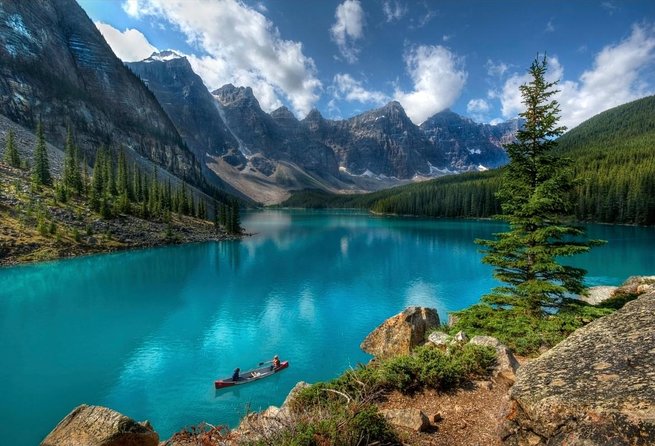
- One booking covers your vehicle: Up to 15 people can share the tour, making it excellent value for a family or small group.
- Start in either direction: Follow the route from Calgary to Lake Louise or from Lake Louise toward Calgary.
- Download before driving: The tour is designed to work without a signal or mobile data once downloaded.
- Stops are completely flexible: Pause for a town, lake, museum, hike, or meal, then continue when it suits you.
- Stories cover more than scenery: Expect information about Banff, Canmore, Kananaskis Country, mountain names, hot springs, tunnels, rivers, and local attractions.
- Trivia keeps the ride lively: Short multiple-choice questions add a playful break from the narration.
A flexible guide for the Calgary to Lake Louise drive
This experience turns your own car into a small tour vehicle. You supply the transportation, smartphone or tablet, fuel, and attraction tickets. Tripvia Tours supplies the audio route in English.
The tour lasts about two hours if you listen while driving without making long stops. That does not mean you have only two hours to use it. Once downloaded, it is yours to keep and use whenever you like, with no time limit for completing the route.
That flexibility matters in Alberta. A fixed tour can make a scenic drive feel rushed. Here, you can pause in Canmore, spend extra time near a lake, visit the Canmore Museum, or stop at a recommended attraction without losing your place. Start the commentary again when you return to the car.
The tour is private in the practical sense: only your group participates, and one purchase covers the vehicle rather than each person. For a couple, the price is already low. For a family or group of friends, the cost per person becomes almost negligible.
More Driving Audio Tours in Canada
- Cabot Trail: a Smartphone Audio Driving Tour
★ 4.5 · 118 reviews - Icefields Parkway: a Smartphone Audio Driving Tour
★ 4.0 · 118 reviews - Smartphone Audio Driving Tour between Banff and Calgary
★ 4.0 · 25 reviews
Download first, then leave the signal behind
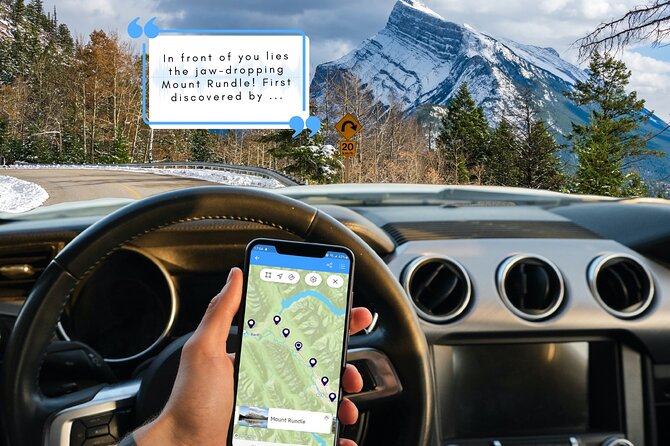
The most important preparation is technical, not scenic. You need a good mobile or Wi-Fi connection for the initial download. After that, the tour is intended to work without a signal and use no mobile data during the drive.
That point is especially important on this route. Mountain roads can have weak or missing service, so downloading at your hotel or before setting out is wise. Do not assume you can install or reload the tour beside a lake or in a national park.
There has also been a report of the audio stopping in the middle of a sentence and forcing repeated restarts. The provider said an updated version was released to fix that bug. I would still open the app, select the route, and test a few minutes of playback before leaving.
You should also let the driver handle the phone. The audio is meant to play in the background, and the trivia works best when a passenger manages it. Safe driving matters more than catching every question.
Calgary sets the tone with Stampede and mountain stories
Starting in Calgary gives the route a city-to-Rockies progression. One early story covers the Calgary Stampede, presented with a playful angle that imagines the event being explained by its inventor. It is a lighter opening than a dry list of dates and names.
From there, the commentary shifts toward the mountains and the communities on the way west. You hear about Kananaskis Country, a broad recreational area known for mountain scenery and outdoor access. The audio helps you notice the transition from the city to foothill country instead of treating the drive as a simple transfer.
The route also points out the last industrial building before entering or leaving Banff National Park. That is a small but useful detail. It gives you a visual marker and a sense of how quickly the character of the road changes as you approach protected mountain country.
The narration is designed for a moving vehicle, so do not expect a long lecture at each point. It gives short explanations that fit between landmarks. One listener found the information useful because learning the same material independently would have taken much more reading. Another felt the facts were too basic. Both reactions make sense: this is a road companion, not a university course.
Canmore and the Three Sisters add local character
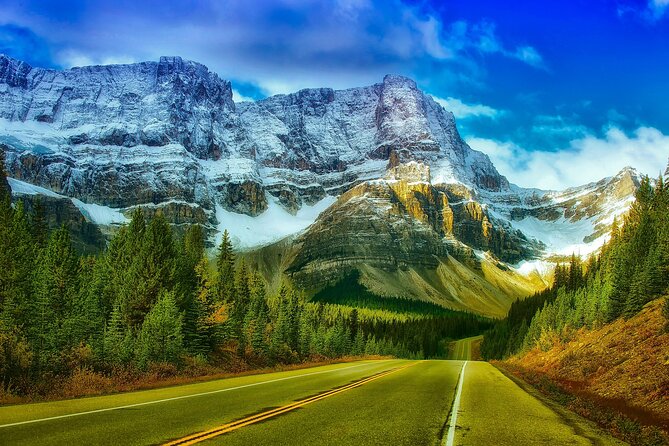
The highway takes you past Canmore, one of the best-known mountain towns along the route. The audio explains how Canmore got its name and points you toward the Canmore Museum. You can stop and visit, then resume the tour as you drive away.
That stop-and-start design is one of the experience’s strongest features. You are not forced to choose between listening and exploring. If a museum, café, or town walk catches your attention, you can give it time.
The Three Sisters are another major highlight. The tour identifies the distinctive mountain group and explains the names of the sisters. This is exactly the kind of information that improves a scenic drive. You may already notice the peaks, but a name and story give the view a stronger sense of place.
The route also points out several other mountains, including one named for its resemblance to a castle and another whose name is unusually literal. The descriptions supplied for the route use a playful tone, so expect a few jokes and casual remarks rather than formal interpretation.
Canmore is also useful as a practical break. The tour does not promise specific facilities or operating hours for every stop, so check attractions separately if you have a particular museum or activity in mind.
More Smartphone Audio Tours in Canada
- Halifax Churches, Gardens & Graveyards: a Smartphone Audio Walking Tour
★ 4.5 · 25 reviews - Halifax Boardwalk & Seaport: a Smartphone Audio Walking Tour
★ 4.0 · 19 reviews - Explore Halifax with 3 Unique Smartphone Audio Walking Tours
★ 4.0 · 16 reviews - Discover the Rockies: 6 Self-Guided Smartphone Audio Tour Bundle
★ 4.0 · 10 reviews
Kananaskis, ski areas, and mountain towns along the highway
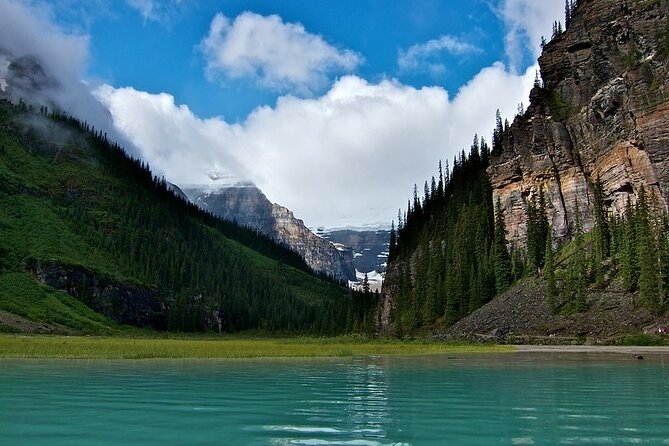
As you continue, the audio introduces more of the region’s recreation areas and ski resorts. One resort outside Banff is highlighted for having something the other nearby resorts do not, though the supplied tour information does not specify the feature. You will need to listen for the explanation on the route.
The commentary also points out a small mountain village and explains the unusual name of a highway settlement. These details are easy to miss when you focus only on famous parks and lakes. They make the drive feel connected to lived-in communities rather than a string of postcard views.
One attraction is mentioned as something you pass rather than a formal audio stop. That distinction matters. The tour can alert you to places worth considering, but it does not include admission, transportation, or a guarantee that a recommended site will be open.
Seasonal access is another concern. Attractions may be closed or inaccessible for reasons outside the provider’s control. Treat the audio as a flexible guide to possibilities, not a promise that every stop will be available on your travel day.
Banff National Park gets the longest stretch of attention
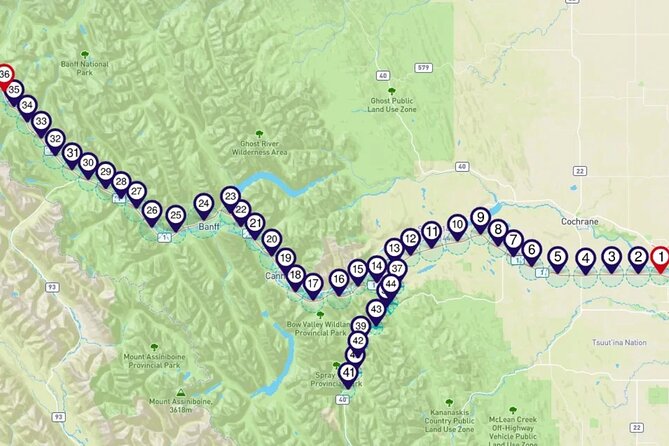
A large part of the route passes through Banff National Park, so the tour spends plenty of time explaining the park and its major sights. This is where the audio earns its small price most clearly. Instead of seeing a famous place with no context, you get background while the road carries you from one view to the next.
The route includes Banff itself, the iconic mountain town within the park. You hear about the town and can stop for as long as you like. If you are driving from Lake Louise toward Calgary, this can be a natural place to pause before continuing east.
The tour also covers the discovery of the upper hot springs. That story is a good example of how the audio works best: it tells you what happened, then gives you the option to stop and visit. Attraction admission is not included, so any visit requires your own planning and payment.
Tunnel Mountain receives a particularly memorable explanation. Despite the name, the mountain does not have a tunnel through it. The audio explains where the name came from and covers the related history, including what went wrong during the tunnel project. This was singled out as an entertaining part of the experience, and it is easy to see why. A slightly misleading place name becomes a small mystery to solve.
You will also hear about campgrounds and places suitable for sleeping under the stars. The narration may tempt you to adjust your plans, but use it as an introduction rather than a camping reservation. Availability and access can change.
Lakes, rivers, and the views that need context

The route points out several lakes, including one with a name that sounds intimidating even though it is a pleasant mountain lake. The audio explains the name and the activities associated with the water. That kind of detail gives you a reason to look beyond the windshield when the guide identifies the shoreline.
Moraine Lake receives special attention, as do other major lakes along the drive. The tour cannot guarantee that a specific viewpoint or access road will be open. Still, being told what you are approaching can help you decide where to spend limited time.
You also hear repeatedly about a well-known mountain river that runs beside the route in several places. Without commentary, a river can become part of the background. With a name and a role in the area, it becomes a feature worth watching as it appears and disappears beside the highway.
Several mountains are identified by shape, name, or local story. One looks like a castle. Another has a name that says exactly what it resembles. A further peak receives its own audio point, with the guide encouraging you to look, listen, and enjoy the view. The tone is not formal, but it keeps the narration from becoming stiff.
What the quizzes add to the ride

The multiple-choice trivia is a modest feature, but it helps break up a long drive. The questions focus on sights and facts you have just passed or are about to see. They are described as silly by the provider, which is probably the right expectation.
Do not book this for serious academic interpretation. Book it if you want the driver and passengers to stay engaged. A quiz can prompt a quick discussion, make children pay attention to a mountain name, or give adults something to do between viewpoints.
The quizzes also make the experience feel less like a downloaded encyclopedia. The route still depends on audio narration, but the questions ask you to notice what is around you. That is useful on a drive where scenery can become repetitive after several hours.
Value at $8.22 per vehicle
At $8.22 per group, this is inexpensive even if you use it only once. The value becomes especially strong when several people share the vehicle, since up to 15 participants are covered by one booking.
You are not paying for a driver, a vehicle, entrance fees, or a live guide. That limits what the product can do, but it also keeps the price low and leaves you in control of the day. If you already plan to drive from Calgary to Lake Louise, the tour adds narration for the cost of a small snack.
The main question is not whether it is affordable. It is whether you want audio guidance at all. If you prefer silence, spontaneous conversation, or your own music, the commentary may become background noise. If you like knowing why a mountain has its name or how a town developed, the price is easy to justify.
Who will get the most from this tour
I would choose this for first-time visitors driving the route, families who want a simple activity in the car, and independent sightseers who dislike fixed schedules. It also suits people who want a little context but do not want to commit to a full-day guided excursion.
It is less suitable if you expect a live expert answering questions, detailed geology, or lengthy stories at every stop. The content has to fit a moving car, so explanations are short. One complaint described the voice as computer-like and the information as too basic. That criticism is worth keeping in mind.
The route is offered in English only. Most people can participate, and service animals are allowed. You need your own vehicle and your own smartphone or tablet. Attraction tickets are not included.
The booking allows free cancellation up to 24 hours before the experience start time. Changes or cancellations inside that 24-hour window are not refunded, based on the stated policy.
Should you book the Calgary and Lake Louise audio tour?
Book it if you are already driving this route and want low-cost, flexible commentary without a guide in the car. Download it on Wi-Fi, test the audio before leaving, and let a passenger handle the phone. Use it as a companion to your own stops, not as a replacement for planning park access and attraction hours.
Skip it if you need a live guide, high-detail interpretation, or guaranteed flawless technology. For everyone else, the combination of offline playback, free pacing, short stories, and playful quizzes makes $8.22 a sensible addition to a major Alberta drive.
FAQ
How much does the tour cost?
The tour costs $8.22 per group, with up to 15 people covered in one booking.
Can I start the tour from Calgary or Lake Louise?
Yes. You can begin from either direction and start at any point along the route.
How long does the audio tour take?
The listed duration is approximately two hours, though you can stop as often as you like and take as long as needed to finish.
Do I need mobile service during the drive?
No. You need a good mobile or Wi-Fi connection for the initial download, but no signal or mobile data is required during the tour.
What language is the tour offered in?
The tour is offered in English.
Do I need my own vehicle?
Yes. Transportation is not included, so you use your own vehicle for the drive.
Are attraction tickets included?
No. Admission to attractions is not included, and recommended places may be closed or inaccessible.
Can I pause the tour at a stop?
Yes. You can stop for as long as you like and resume the tour when you begin driving again.
What is the cancellation policy?
You can cancel at least 24 hours before the experience start time for a full refund. Cancellations or changes made less than 24 hours in advance are not refunded.
New audio tours around Canada
- Kelowna E-Bike Bee Tour, Tastings, Organic Lunch & Audio Guide★ 5.0 · 9 reviews
- Smartphone Audio Driving Tour between Kamloops & Revelstoke★ 3.5 · 8 reviews
- Jasper National Park Self-Guided Driving Audio Tour★ 4.0 · 4 reviews
- Smartphone Audio Driving Tour between Kamloops and Vancouver★ 3.5 · 5 reviews
- Smartphone Audio Driving Tour between Huntsville & Toronto★ 4.5 · 4 reviews
- Halifax Explosion Smartphone Audio Walking Tour★ 4.0 · 3 reviews
- Edmonton Self Guided Audio Experience★ 3.0 · 2 reviews
- Smartphone Audio Driving Tour between Collingwood and Toronto★ 4.5 · 3 reviews
Alberta Audio Tours, compared.
Discover the Lake Agnes Tea House Trail with an Audio Nature Tour
Read our review →
Ghosts of Drumheller: a Smartphone Audio Ghost Tour
Read our review →
Audio Tour for Self-Guided Drives in Waterton National Park
Read our review →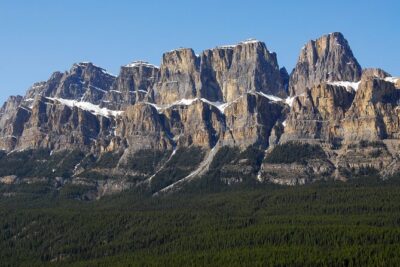
Browse the lists this tour appears in