
Review · SWITZERLAND
Basel: Sightseeing Bus Tour with Audio Guide
Basel’s story comes into focus when you ride from the Tinguely Fountain through the old town, across the Rhine area, past major pharmaceutical landmarks, and out to Dreiländereck, where Switzerland, France, and Germany meet. The audio guide adds useful context on art, politics, industry, and local characters, from Paracelsus and Bernoulli to Jean Tinguely and Fritz Hoffmann-La Roche.
I like the 12 stops, which let you treat the bus as more than a moving lecture, and I like the tablet-based guide, which pairs narration with pictures. The traditional Läckerli biscuit and onboard WiFi are nice extras. The main catch is weather: parts of the bus can feel hot in direct sun, and the audio or tablet may not always keep perfect pace with the sights.
Quick points before you book
- See old Basel and the modern city in one ride: The route covers cathedral streets, medieval gates, museums, pharmaceutical headquarters, and newer commercial districts.
- Use the 12 stops strategically: Get off at St. Johanns-Park or Dreiländereck for the planned photo breaks, then continue when you are ready.
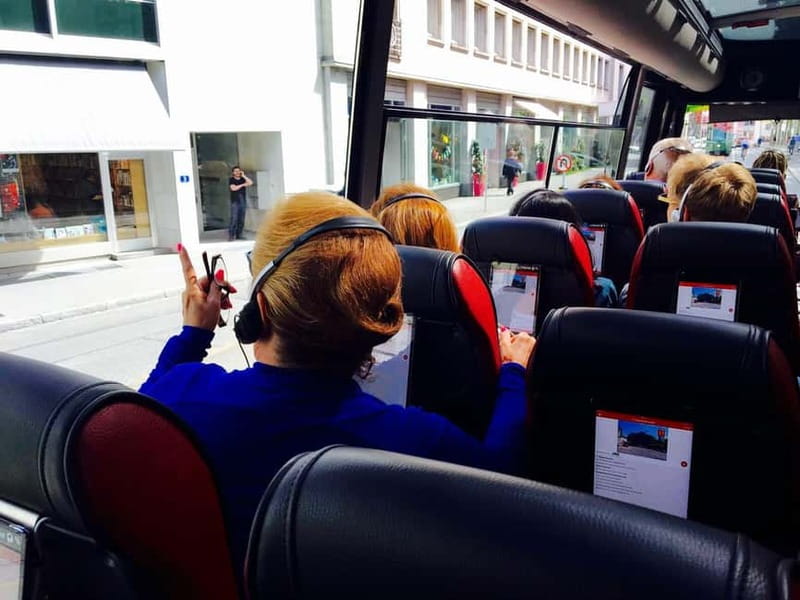
- The audio guide is visual as well as spoken: An iPad app adds images and descriptions in Chinese, English, German, Italian, Japanese, Arabic, French, and Spanish.
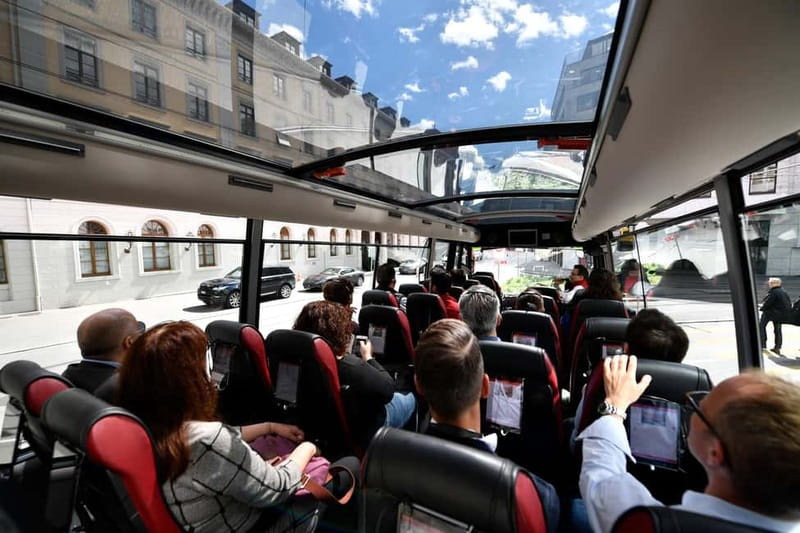
- Expect a covered but sometimes open-sided bus: It can work well on a rainy day, but hot weather and direct sun may make the ride uncomfortable.
- A small Läckerli is included: This traditional Basel sweet is part of the experience, though it has not always been available.
- The $25 price is fair for a first look: It is especially useful on your first day, when you want orientation before exploring on foot.
Basel in two hours, from medieval gates to Roche Tower
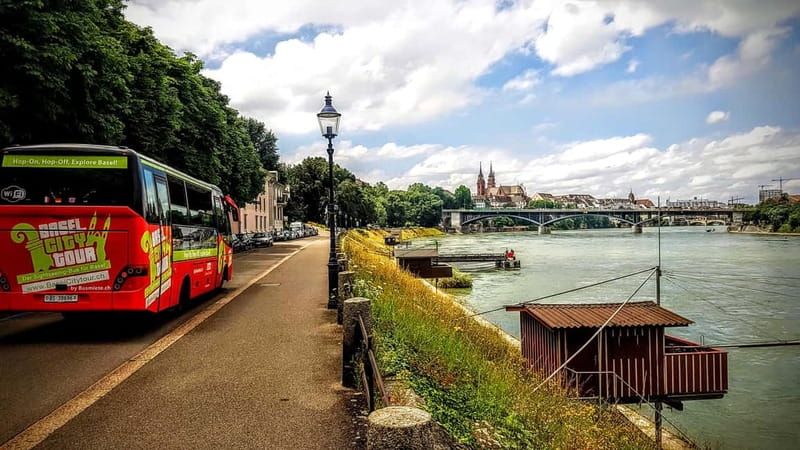
This is a city tour with a wide lens. You do not spend long inside any one sight. Instead, you get a guided sweep of Basel’s old center, Rhine crossings, museums, industrial districts, and border zone.
That range matters. Basel can first seem like a compact old town built around the cathedral and market square. The bus shows you the larger picture: a city shaped by universities, chemical companies, trade, art, migration, and its position at the meeting point of three countries.
The tour begins opposite the Tinguely Fountain, in front of Stadtcasino at Steinenberg 4. Look for the bus parking area rather than expecting a large, obvious terminal sign. One practical tip from the start: arrive with a charged phone, even though the tour provides an iPad and WiFi. Your own phone is useful for checking the meeting point and keeping track of your day.
The ride lasts about two hours. Because the bus pauses for photo stops and a brief food tasting, the amount of time spent actually moving past sights can feel closer to an hour on some departures. That is not a flaw, but it helps set expectations. This is an orientation tour, not a full-length visit to each museum or neighborhood.
More Bus Audio Tours in Switzerland:
- Zurich: City Bus Tour with Audio Guide and Lake Cruise
★ 4.3 · 1,195 reviews - Zurich: City Top Attractions Tour by Bus with Audio Guide
★ 4.3 · 282 reviews - Rome: City Sightseeing Hop-on Hop-off Bus with Audioguide
★ 4.0 · 16,045 reviews
The opening loop through Basel’s old center
The first section passes Markthalle, St. Paul’s Church, the Basel synagogue, the University of Basel, the Bernoullianum, Fischmarkt Fountain, Marktplatz, and the Basel-Stadt government area.
You will hear about people and subjects tied to Basel’s intellectual life, including the Bernoulli family, Paracelsus, C. G. Jung, and Hermann Hesse. The guide also touches on politics, education, medicine, architecture, and the city’s economic growth. This is where the audio system earns its keep. Without narration, several handsome buildings would pass as pleasant but unexplained scenery.
Marktplatz and the Town Hall area deserve special attention. The red sandstone Town Hall is one of the city’s clearest architectural symbols, but the bus does not give you a long walking visit there. If you want photographs of courtyards, painted details, or nearby lanes, return on foot later.
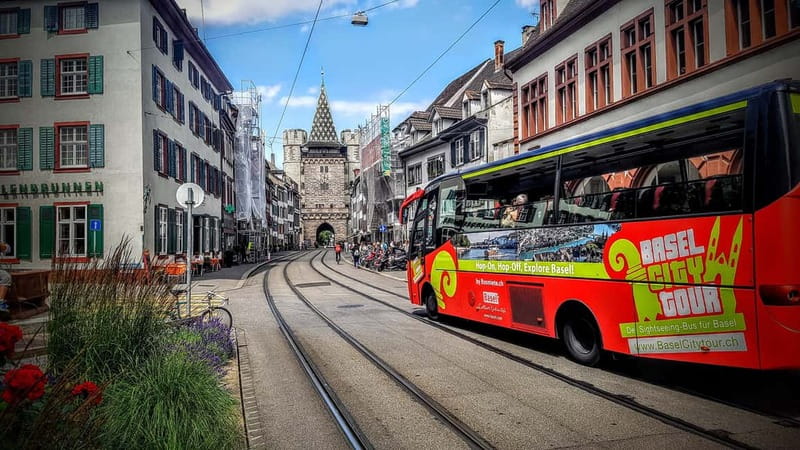
The route also includes Spalenberg and Spalentor in its wider account of Basel’s historic center. The old gate is a reminder that Basel was once protected by walls and controlled entrances. The bus gives you the setting, while a later walk gives you the details.
A taste of Läckerli and Basel’s local character
A short stop at Jakob’s Basler Leckerly Manufaktur adds a local food note. Läckerli is Basel’s traditional hard spice biscuit, made with a firm texture and a sweet, spiced flavor. The included tasting is small, so think of it as an introduction rather than a snack.
This part also connects with the tour’s stories about local businesses and familiar names such as Thomy. The presentation can lean into local products, and not everyone will enjoy the promotional side of that. One past rider felt the repeated attention to the biscuits and a Nestlé product was too much.
There is also a practical issue: the advertised Läckerli has not always been handed out. Some passengers found the box empty. I would treat it as a pleasant extra, not a reason to book the tour. If you want a full box, buy one separately at a Basel shop.
St. Johann, Novartis, and the three-country corner
The bus continues toward St. Johanns-Tor and St. Johanns-Park, with a planned photo stop of about seven minutes. This is one of the more useful pauses because you can get out, stretch your legs, and see part of the city away from the central shopping streets.
Next comes the Novartis Campus, the old gasworks area, and Dreiländereck. The Novartis section shows Basel’s modern economic power and its long connection with pharmaceuticals. The audio guide places companies and institutions within the city’s wider development rather than treating them as isolated office blocks.
Dreiländereck is the tour’s most distinct geographical stop. You get about ten minutes for photographs at the point linked with Switzerland, France, and Germany. Do not expect a long border walk. The value is the quick visual understanding of Basel’s position in the Upper Rhine region.
The route’s stories range widely here. You may hear about Lenin, Felix Sarasin, the Bank for International Settlements, Christoph Merian, and the city’s changing political and commercial life. That mix can feel scattered if you want a tightly focused historical story, but it gives you a useful sense of how many forces have shaped Basel.
More audio tours around Switzerland:
- Zurich City Tour with Audio Commentary
★ 4.0 · 372 reviews - Audioguided sightseeing cruise of Geneva
★ 3.5 · 144 reviews - Zurich: Audio Guided City Tour and Train to “Top of Zurich”
★ 4.2 · 65 reviews - The Many Faces of Geneva: Self-Guided Audio City Tour
★ 3.9 · 44 reviews
Stücki Park, Thomy, and Basel beyond the postcard
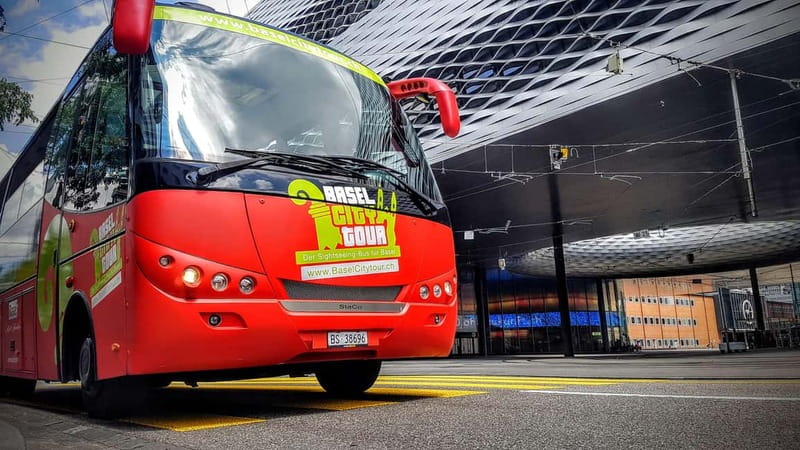
After Dreiländereck, the bus passes Stücki Park and the Thomy factory area before returning toward the Exhibition Center and Wettstein district. This section is less picturesque than the old town, but it answers an important question: what kind of city is Basel today?
The answer is not only medieval lanes and museum buildings. Basel is also a working center for science, manufacturing, trade fairs, finance, and design. The bus lets you see those pieces without spending half a day navigating local transit.
The route passes Tattoo Basel and the Exhibition Center, then crosses into the Wettstein side of the city. That change helps you understand the Rhine as a connector rather than a barrier. Basel’s two sides have different moods, and the tour gives you a quick look at both.
Some stops are better viewed from your seat than photographed. This is a busy urban route, and the driver cannot pull over wherever a building catches your eye. If photography is your main goal, plan a separate walking loop through the old town, around the Rhine, and near the museums.
Roche Tower, Tinguely Museum, and the art of Basel
The Hoffmann-La Roche section brings the route to one of Basel’s most recognizable modern landmarks, Roche Tower. The audio guide links the company to Fritz Hoffmann-La Roche and to Basel’s broader pharmaceutical identity.
This is a good example of what the tour does well. It places contemporary architecture beside older civic buildings, showing that Basel is not frozen in its medieval past. The contrast between the cathedral, city walls, laboratories, and high-rise headquarters is one of the ride’s best visual themes.
The bus then passes Museum Tinguely, the city wall, the Basel Paper Mill, Schöneck Fountain, the Fine Arts Museum, and Basel Cathedral. Jean Tinguely’s work fits Basel’s playful modern art reputation, while the Paper Mill points to the city’s craft and commercial past.
You will hear about Jean Tinguely, Herzog and de Meuron, art institutions, and the development of Basel as a cultural center. The tour does not replace a museum visit. It helps you choose one. If you have only one museum afternoon, this overview can help you decide between Tinguely’s kinetic art, the Fine Arts Museum, and the Paper Mill Museum.
Basel Cathedral is another place where the bus provides a preview, not a complete experience. You will see its position above the Rhine and hear about the old city around it. Return later for a slower look at the red stone, towers, and surrounding Münsterplatz.
The audio guide and tablet setup
The audio guide is provided through an iPad, with a headset for each passenger. It includes spoken material and visual images, which makes it easier to connect names with buildings. The language choices are unusually broad: Chinese, English, German, Italian, Japanese, Arabic, French, and Spanish.
The system received strong praise for clear sound and useful pictures. It is particularly helpful when the bus passes a building before you can identify it yourself. The narration covers art, architecture, economy, politics, local history, and well-known figures, including Goethe, Johann Peter Hebel, Theodor Herzl, Anne Frank, and Wolfgang Amadeus Mozart? No, Mozart is not listed in the tour information, so do not expect him. The named subjects include Goethe, Herzl, Hebel, Bernoulli, Paracelsus, Hesse, Jung, and others.
There are limits. A few tablets have not worked properly, and the recorded narration can occasionally fall out of sync with the bus position. On some departures, the driver begins speaking before the headset program has finished. If you miss a sentence, do not worry. The tour covers a lot, and the main purpose is to give you a framework for later exploring.
Comfort, weather, and the real value of the ride
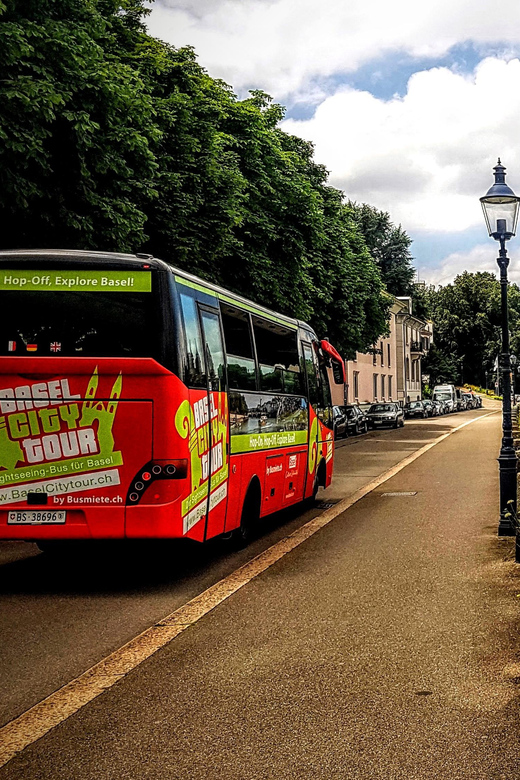
The vehicle is covered, but the windows may be open or lowered. That makes the bus useful in rain and on cool days, yet it can become warm in summer sun. One passenger found the bus uncomfortable after it had been parked in direct heat, while another appreciated the ride as a way to escape a hot afternoon.
Air conditioning has not always felt well adjusted. Bring weather-appropriate clothing and prepare for changing conditions rather than assuming the bus will solve every comfort problem. On a rainy day, this is one of the tour’s strongest uses. You can see much of Basel without walking continuously through wet streets.
The driver is part of the experience. The available feedback praises friendly, helpful drivers, including a kind female driver who gave clear support. There was also a reported bus breakdown, so allow a little flexibility if you have a tight connection afterward.
At $25 per person, I consider the tour good value for a first visit. You receive a two-hour panoramic ride, the audio guide, WiFi, 12 stops, and a small local tasting. The price is harder to justify if you already know Basel well or prefer to explore every sight slowly on foot.
How to use the 12 stops well
The stops are most useful if you plan your day around them. You can ride the full circuit first, then decide where to return. Or you can use the bus to reach an area outside your walking route, such as Dreiländereck or the St. Johann district.
The official route includes 12 boarding and alighting points, though the detailed path also names several pass-by sights. Do not assume you can get off at every building listed. The most clearly stated photo pauses are St. Johanns-Park for about seven minutes and Dreiländereck for about ten minutes.
I would use the tour this way:
- Ride the opening section without getting off so you hear the general story of the old center.
- Use St. Johanns-Park for a short break and photographs.
- Treat Dreiländereck as the main geographical stop.
- Note the museums and cathedral for a later walking visit.
- Keep the rest of the day open for the places that catch your eye.
The bus is also a sound choice for a first morning in Basel. You get a mental map before committing to a museum, ferry, old-town walk, or Rhine-side meal.
Who should book this Basel bus tour?
Book it if you want a broad introduction, prefer a seated city tour, or have only a short time in Basel. It suits families, older visitors, and anyone who wants history delivered in several languages without arranging a private guide.
It also fits a rainy or very hot day, with the weather caveats above. The visual tablet makes it more useful than a simple prerecorded bus narration.
Skip it if your priority is entering museums, taking detailed photographs, or hearing one tightly organized historical story. You will spend much of the ride looking from the windows, and the audio can occasionally lag behind the route.
For most first-time visitors, I would book it early in the stay. The city overview, the Rhine crossings, the industrial districts, and the three-country stop give you a useful base for exploring Basel on foot afterward. Just arrive at the Tinguely Fountain with a charged phone, dress for the weather, and treat the Läckerli as a bonus rather than a guarantee.
FAQ
How long is the Basel sightseeing bus tour?
The tour lasts two hours, including the ride and planned stops.
Where does the tour begin?
It begins at the bus stop at Steinenberg 4, opposite the Tinguely Fountain and in front of Stadtcasino, in the bus parking area.
Which languages are available for the audio guide?
The audio guide is available in Chinese, English, German, Italian, Japanese, Arabic, French, and Spanish.
What is included in the ticket?
The ticket includes the panoramic bus ride around central Basel, the iPad audio guide app, a free audio guide app download, WiFi onboard, a Läckerli biscuit, and 12 stops for boarding and getting off.
Does the tour stop at Dreiländereck?
Yes. The itinerary includes a photo stop at Dreiländereck lasting about 10 minutes.
Is there another planned photo stop?
Yes. The bus stops at St. Johanns-Park for about seven minutes.
Can I cancel the booking?
You can cancel up to 24 hours in advance for a full refund. A reserve now and pay later option is also available.
New audio tours around Switzerland
- Medieval Lausanne: A Self-Guided Audio Tour★ 3.5 · 3 reviews
- Unusual Audio Tour of Geneva★ 5.0 · 8 reviews
- Self-Guided Audio Tour to the Many Faces of Geneva★ 4.5 · 10 reviews
- Geneva Scavenger Hunt and Highlights Self Guided Audio Tour★ 5.0 · 5 reviews
- A Self-Guided Audio Tour of Geneva’s Old Town★ 4.5 · 7 reviews
- Audioguided sightseeing cruise of Geneva★ 3.5 · 144 reviews
- Self-Guided Audio City Tour in Bern★ 4.0 · 17 reviews
- Beautiful Bern’s Legends: A Self-Guided Audio Tour★ 4.5 · 7 reviews
Switzerland Audio Tours, compared.
Zurich: City Bus Tour with Audio Guide and Lake Cruise
Read our review →
Zurich: City Top Attractions Tour by Bus with Audio Guide
Read our review →

Zurich: Audio Guided City Tour and Train to “Top of Zurich”
Read our review →
The Many Faces of Geneva: Self-Guided Audio City Tour
Read our review →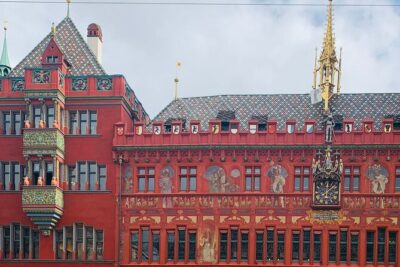
The Best of Basel’s Hidden Treasures: A Self-Guided Audio Tour
Read our review →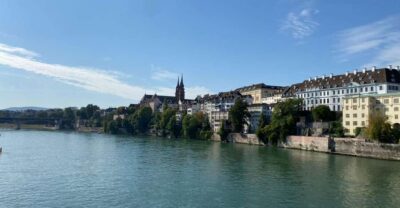
Browse the lists this tour appears in