
Review · CANADA
Discover Downtown Regina: a Smartphone Audio Walking Tour
Regina’s downtown is packed with old banks, churches, civic buildings, railway landmarks, and prairie stories that are easy to miss from the sidewalk. This smartphone tour turns that scattered collection into a roughly 90-minute to two-hour walk, with audio starting automatically as you reach each point.
I like the geolocation feature, which means you can keep walking instead of stopping to read a map. I also like the freedom to download the tour over Wi-Fi, then explore with your own group, at your own pace, with no guide or schedule to follow.
The main drawback is route reliability. Construction once forced a participant to miss about five stops, and part of the route passed through an area that felt uncomfortable. Check the streets ahead when possible, and be ready to skip or reroute a section.
Key points to know before you go

- Thirty downtown stops cover a lot of ground, from City Hall and Victoria Park to Union Station and Mosaic Stadium.
- The audio is brief and location-based, with each stop designed for about five minutes of commentary.
- You can download everything before leaving, so the tour does not require mobile data or Wi-Fi while walking.
- The tour is private to your group, making it easy to set your own pace and pause for photos, food, or coffee.
- Optional trivia questions give the walk a light game element without turning it into a formal quiz.
- Route conditions matter, since construction or changing street conditions can affect access to some stops.
A self-guided way to read downtown Regina
I like self-guided walks when a city has more stories than signs. Regina fits that bill. A building such as the Northern Crown Bank may look like an old commercial block at first glance, but the audio gives you a reason to stop and look closer.
This is not a tour built around long lectures. Each point is planned for about five minutes, so you get a quick explanation, a little context, and then a prompt to continue. That rhythm works well in downtown Regina, where the stops are spread among parks, offices, churches, public buildings, and former commercial sites.
You begin at Regina City Hall, at 2476 Victoria Avenue. The tour ends just north of the Halifax Street and 11th Avenue corner, at 1550 11th Avenue. The route is open any day between midnight and 11:30 p.m. during the stated operating period, so you can start in the morning, after lunch, or later in the day.
The listed price is $6.72 per person. That is a low-cost way to add structure to a city walk, especially if you are already downtown and do not want to pay for a scheduled group tour. You will need your own smartphone or tablet, and any attraction admission is extra, though the stops themselves are viewed from public places.
More Audio Walking Tours in Canada
- Halifax Churches, Gardens & Graveyards: a Smartphone Audio Walking Tour
★ 4.5 · 25 reviews - Halifax Boardwalk & Seaport: a Smartphone Audio Walking Tour
★ 4.0 · 19 reviews - Explore Halifax with 3 Unique Smartphone Audio Walking Tours
★ 4.0 · 16 reviews
City Hall, Sherwood, and Regina’s early public buildings
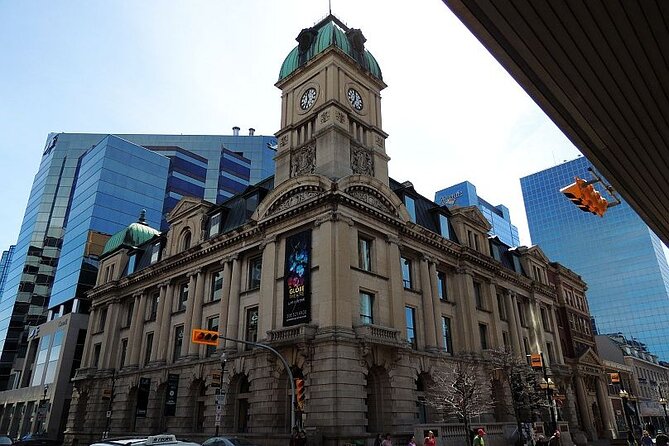
The opening stop takes you to Queen Elizabeth II Court and Regina City Hall, including the 16-storey office tower in the block. It is a useful starting point because the audio establishes Regina as a city where newer civic structures share space with older commercial and institutional buildings.
From there, the route moves to the former Sherwood Department Store. The point is not an admission visit. You are looking at the building and hearing about the store that once occupied it, which gives the street a commercial story beyond today’s businesses.
Next comes the Balfour Apartments, completed in 1930. The description calls it ominous, which hints at a different mood from the civic and retail stops. This is one of the reasons the audio format helps: a plain exterior can become more interesting once you know what to look for.
The route then reaches First Baptist Church, just south of Victoria Park. The church is large and visually obvious, making it an easy stop to find. After that, the Land Titles Building introduces provincial government history. It was the first public building commissioned by the new provincial government, and it now forms part of the Saskatchewan Sports Hall of Fame area.
At this point, you are getting a good mix of building types: apartments, churches, government offices, and retail history. You do not need to enter each one to understand the basic story, but you should expect an exterior-focused experience.
Hotel Saskatchewan and the government blocks
Hotel Saskatchewan is one of the better-known downtown stops. Built in 1927 for the Canadian Pacific Railway, it is now a municipal heritage property. The audio gives you a reason to study the hotel’s place in Regina’s railway-era development rather than simply passing by its entrance.
The Federal Building follows at the corner of Victoria and Scarth, directly opposite Victoria Park. Its prominent location makes it easy to pair this section of the walk with time in the park. The nearby Motherwell Building, at Victoria Avenue and Rose Street, adds another municipal heritage property to the route.
The Leader Building dates to 1912 and was the fourth home of the Regina Leader newspaper. This stop is especially useful if you like seeing how newspapers shaped downtown business districts. The audio keeps the explanation short, so you will not get a full account of the newspaper’s career, but you will understand why the building matters.
Conexus Plaza provides a contrast. It is a modern office building and home of Conexus Credit Union, so the route does not pretend that Regina’s story ended with its oldest structures. The Old Post Office, one of the oldest remaining buildings in downtown, then brings you back to earlier civic and commercial Regina.
Banks, skyscrapers, and the central business district
The Northern Crown Bank is one of the strongest stops for architecture fans. It is a provincial heritage building and the oldest commercial building in Regina’s central business district. That distinction is worth remembering as you walk through an area where newer office buildings can easily draw your attention away from the older facades.
The Willoughby and Duncan Building adds another piece to the city’s commercial core. This area contains the largest concentration of early commercial architecture in downtown Regina, so you can use the audio as a guide for looking at storefront proportions, masonry, and the way old buildings remain part of the working center.
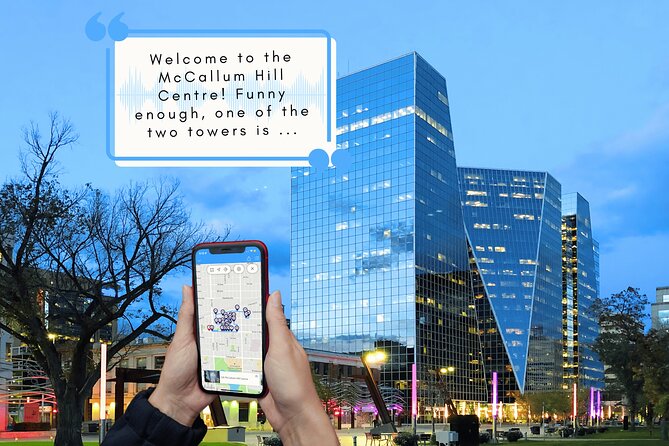
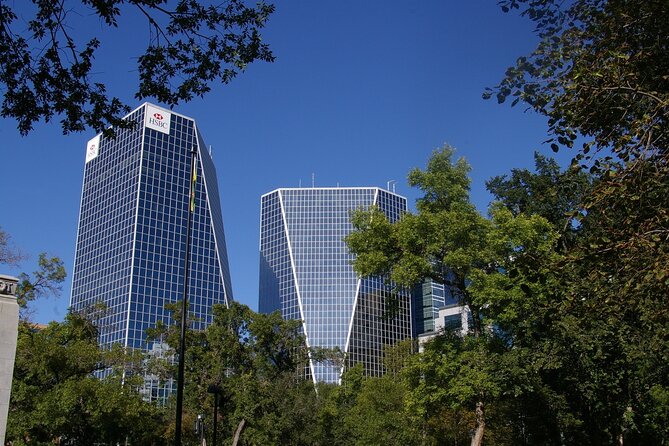
At Hill Centre Tower I, you hear about the twin towers that are among Regina’s most distinctive skyscrapers. Tower one sits on the site of the original McCallum Hill building, once Regina’s tallest building and first skyscraper. It is a quick lesson in how the city’s skyline changed as office needs changed.
The Regina Cenotaph shifts the focus from business to remembrance. It was built to honor Regina’s fallen heroes of the First World War. Nearby, the stop about Sir John A. Macdonald brings national political history into the walk, with the first Canadian prime minister presented as the Father of Confederation.
These stops work best if you pause for a proper look instead of treating the walk as a race. The audio may take only five minutes, but the buildings and memorials reward a little extra time.
More Smartphone Audio Tours in Canada
- Cabot Trail: a Smartphone Audio Driving Tour
★ 4.5 · 118 reviews - Icefields Parkway: a Smartphone Audio Driving Tour
★ 4.0 · 118 reviews - Smartphone Audio Driving Tour between Banff and Calgary
★ 4.0 · 25 reviews - Smartphone Audio Driving Tour between Lake Louise and Calgary
★ 4.0 · 15 reviews
Churches, art, and Victoria Park

Knox-Metropolitan United Church is an important heritage stop. It is home to two of Regina’s oldest congregations, so the building represents more than its exterior size and design. The short commentary gives you a clear reason to include it in your walk even if you are not visiting churches as a main interest.
The Dunlop Art Gallery brings a cultural note to the route. It has locations in the Central and Sherwood libraries and has been part of the Regina public library system since the 1960s. The tour points out the gallery, but the tour price does not include admission to any attraction, and opening access can vary.
Victoria Park is a natural place to pause. The land began as a two-block public reserve set aside in 1883 and later became a popular gathering place for families. I would plan a few extra minutes here, since the park gives you space to sit down, check the next direction, and let the city walk breathe.
Memorial Hall, connected with Royal Canadian Legion Branch 001, dates from 1947 to 1951. The branch was the first in Canada to receive a charter. It is a useful reminder that Regina’s memorial story extends beyond the cenotaph and includes postwar civic organizations as well.
Insurance, telephones, and provincial business
The Canada Life Assurance Company Building, built in 1914, once served as the Saskatchewan headquarters of the Ontario-based company. It is another example of how national firms used Regina as a regional base.
The Regina Telephone Exchange focuses on the expansion of telephone service in Saskatchewan. This is the kind of stop you might otherwise walk past without noticing, but the audio gives the building a practical place in the city’s growth.
The Saskatchewan Revenue Building has an agricultural connection. It was built by the Saskatchewan Cooperative Elevator Company, one of the first major agricultural cooperatives in the province. That link helps explain why downtown Regina was not only a government center, but also a business center tied to rural Saskatchewan.
St. Paul’s Cathedral was constructed in 1894 and replaced the first Saint Paul’s church. The church adds another early religious landmark to a route already marked by First Baptist and Knox-Metropolitan United Church.
Taken together, these stops give you a broad introduction to how Regina worked: government collected revenue, companies sold insurance, telephones connected the province, railways moved people and goods, and churches served established congregations.
Mosaic Stadium, SGI, and Union Station

Mosaic Stadium is home to the Saskatchewan Roughriders of the Canadian Football League. The audio includes a warning about attending a Roughriders game, so sports fans will find a familiar local thread here. If no event is taking place, this is primarily an exterior stop.
SGI, the Saskatchewan Government Insurance Company, was created in 1945 as a provincial Crown corporation. This is a concise stop, but it adds a distinctly Saskatchewan institution to the route and shows how provincial government reaches into everyday life.
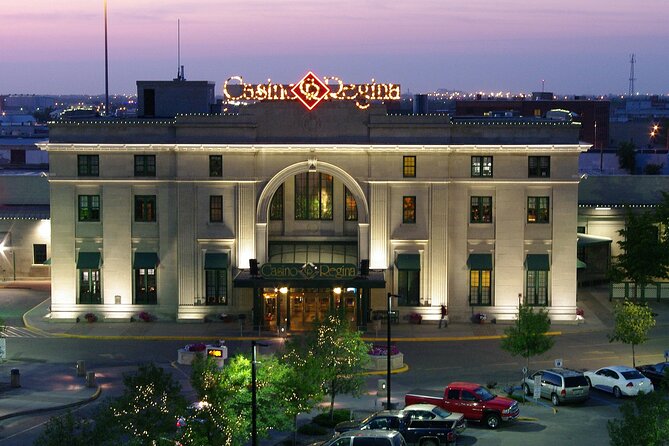
Union Station was constructed in 1911 by the Canadian Pacific Railway. It accommodated rail service as well as divisional headquarters, making it one of the clearest places to think about Regina’s connection to the railway network.
These three stops also show the range of the walk. One is sports, one is public administration, and one is transportation. You are not simply following a list of old buildings. You are moving through different parts of the city’s identity.
The Regina Riot and the final downtown blocks

The Regina Riot stop takes you to the Regina Police headquarters on Quance Street, identified as the originating location of the infamous 1935 Regina riot. This is one of the route’s more dramatic historical subjects, and it gives the walk a social and political edge.
The Old No. 1 Fire Hall was finished in 1921 and has a distinctive design. Fire halls are often easy to appreciate from the outside because their original purpose is visible in the building’s shape and scale.
The final listed stop is the Municipal Justice Building. At the time the audio was recorded, the building had been slated for destruction while local residents were trying to save it. That means access and even the building’s status may have changed, so treat this stop as a snapshot of a preservation debate rather than a guaranteed visit inside.
The route also includes additional points connected with Regina and the wider area, including an old stone castle, the Royal Canadian Mounted Police, Saskatchewan’s exploration and science institutions, Wascana Centre, Wascana Lake, and the Saskatchewan Science Centre. The supplied details do not explain the exact order or timing of these extra points, so do not count on every one being a full downtown stop in the same way as the 30 named locations.
How the app works on the street
Download the tour over Wi-Fi before you leave. This is the most important practical step. Once the content is stored, the tour is designed to work without data or a live Wi-Fi connection.
At each point, the commentary automatically plays when you reach the location. That is more convenient than constantly checking a screen, and the geolocation feature was particularly effective for one participant, who could simply walk down the street and let the audio start as sites came into range.
The optional trivia questions add a small challenge at each stop. You can ignore them if you want a quiet history walk, or use them to keep children and friends involved. The private format means only your group participates, so you can pause, repeat a section, or take a side trip without holding up anyone else.
Allow 90 minutes to two hours as a realistic estimate. The commentary itself is short, but photos, crossings, pauses in Victoria Park, and any route adjustments will add time.
Route cautions and who will enjoy it
The route is not completely protected from city conditions. Construction caused one participant to miss about five sites because it was unclear how to get around a closed street. A portion of the route also passed through an area that felt uncomfortable because of visible homelessness and drug use.
That does not make the tour unusable, but it does mean you should keep your phone charged, pay attention to your surroundings, and use common sense if a street feels wrong. The provider has customer service by phone and email, but the tour cannot instantly rewrite a blocked sidewalk.
This experience suits independent visitors, families, couples, and local residents who want a low-cost way to organize a downtown walk. It is less suitable if you want a live guide, long storytelling at each stop, interior visits, or a carefully managed route with someone handling every detour.
The tour is available in English. Service animals are allowed, public transportation is nearby, and most people can participate. Attraction tickets are not included, and recommended sites may be closed or inaccessible because of the season or circumstances outside the provider’s control.
Should you book Discover Downtown Regina?
Book it if you want a flexible introduction to Regina’s civic buildings, early businesses, churches, memorials, railway links, and local institutions for $6.72 per person. The automatic audio and downloadable format are the best reasons to choose it, especially if you prefer exploring with your own group rather than meeting a guide at a fixed time.
Skip it if you need a fully reliable, obstacle-free route or want detailed interpretation at every stop. Before starting, download the tour, check for construction, and leave room in your schedule for a detour. Used that way, this is a modestly priced and practical way to make downtown Regina more readable.
FAQ
How long does the Downtown Regina audio tour take?
The tour takes approximately one hour and 30 minutes to two hours, depending on your walking pace and how long you spend at the stops.
How much does the tour cost?
The listed price is $6.72 per person.
Does the tour require Wi-Fi or mobile data while walking?
No. You should download the tour over Wi-Fi before starting. The tour is designed to work without data or Wi-Fi along the route.
Where does the tour begin?
It begins at Regina City Hall, 2476 Victoria Avenue, Regina, Saskatchewan.
Where does the tour end?
It ends at 1550 11th Avenue, just north of the Halifax Street and 11th Avenue corner.
Is this a private tour?
Yes. Only your group participates, and you can create your own group with friends or family.
Is the tour available in languages other than English?
The tour is offered in English.
Can I cancel for a full refund?
Yes, if you cancel at least 24 hours before the experience start time. Cancellations within 24 hours are not refunded, and changes within that period are not accepted.
New audio tours around Canada
- Kelowna E-Bike Bee Tour, Tastings, Organic Lunch & Audio Guide★ 5.0 · 9 reviews
- Smartphone Audio Driving Tour between Kamloops & Revelstoke★ 3.5 · 8 reviews
- Jasper National Park Self-Guided Driving Audio Tour★ 4.0 · 4 reviews
- Smartphone Audio Driving Tour between Kamloops and Vancouver★ 3.5 · 5 reviews
- Smartphone Audio Driving Tour between Huntsville & Toronto★ 4.5 · 4 reviews
- Halifax Explosion Smartphone Audio Walking Tour★ 4.0 · 3 reviews
- Edmonton Self Guided Audio Experience★ 3.0 · 2 reviews
- Smartphone Audio Driving Tour between Collingwood and Toronto★ 4.5 · 3 reviews
Canada Audio Tours, compared.

A 7th-Gen Local’s View of Downtown Charlottetown: An Audio Tour
Read our review →

Halifax Churches, Gardens & Graveyards: a Smartphone Audio Walking Tour
Read our review →

Western Canada Self-Driving Audio Guide English and German
Read our review →Browse the lists this tour appears in