

Review · CANADA
The Sights of Canmore: a Smartphone Audio Walking Tour
Canmore’s best stories are tucked into ordinary corners: a coal cart by the railway, a small boardwalk, an old church, and a giant head that helps explain the town’s name. This GPS audio walk turns those details into a self-guided history lesson while you explore at your own pace.
I like the freedom to start and stop whenever you want, and I like the mix of mountain scenery, mining history, sculptures, and town life. The optional trivia game adds a little fun without forcing you to play. The main drawback is that you must supply your own phone, and automatic commentary depends on the app and your location working properly.
Key points to know before you go

- A 5-kilometre return route takes about 90 minutes to two hours, before adding time for shops, photos, or the museum.
- GPS-triggered commentary plays as you reach each point, so you can keep your eyes on Canmore rather than constantly reading a map.
- Coal-mining history shapes the walk, especially around the railway, coal cars monument, Miners’ Union Hall, and historic buildings.
- Mountain views arrive between town stops, with looks toward the Three Sisters, Mount Rundle, Mount Lady MacDonald, and other named peaks.
- The $8.22 price is low for a private experience, but admission to the Canmore Museum and Geoscience Centre is not included.
- Download the tour on Wi-Fi first, since no signal or mobile data is needed once the tour is stored on your device.
Why this Canmore audio walk works
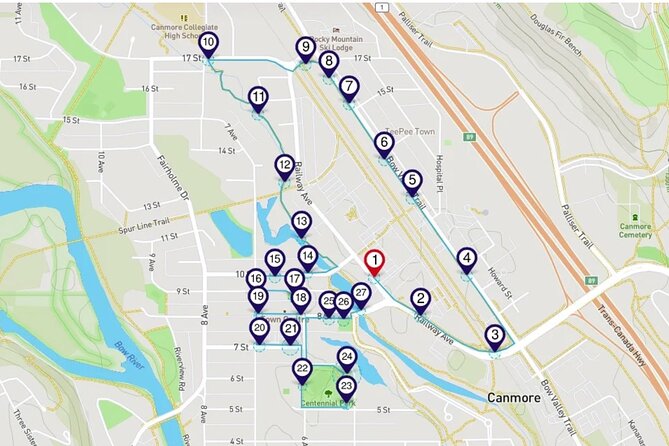
This is not a conventional walking tour with a guide holding up a sign. You meet at 909A Railway Avenue, download or open the Tripvia Tours app, and follow a route shown on a live GPS map. As you approach each point of interest, the commentary plays automatically.
That format gives you control. You can pause for coffee, stop to browse Main Street, linger at Policeman’s Creek, or spread the route across more than one outing. The tour is not limited to the date selected when you book it. You keep access and can use it at another time.
I find that especially useful in Canmore, where a short walk can easily turn into a longer stop for photographs or a meal. The advertised walking route is about 5 kilometres return, and the listed duration is roughly one hour and 30 minutes to two hours. Allow more time if you plan to enter the museum, explore shops, or sit in one of the parks.
The app also includes a location-based trivia game. After the commentary at a stop, you can tap your answer on the phone. It is optional, so you can treat the tour as a quiet audio guide or add a bit of competition for children and friends.
The tour is offered in English. It is a private activity for your group, not a shared walk with strangers. The price is $8.22 per person, and the number of people selected determines the number of devices that can download the tour.
More Audio Walking Tours in Canada
- Halifax Churches, Gardens & Graveyards: a Smartphone Audio Walking Tour
★ 4.5 · 25 reviews - Halifax Boardwalk & Seaport: a Smartphone Audio Walking Tour
★ 4.0 · 19 reviews - Explore Halifax with 3 Unique Smartphone Audio Walking Tours
★ 4.0 · 16 reviews
Starting by the railway and Three Sisters Gallery
The route begins at Three Sisters Gallery, at 909A Railway Avenue. This is a sensible starting place because the walk quickly connects present-day Canmore with its earlier life as a coal-mining and railway town.
Your phone provides the map, route, and narration. Since the audio is location based, keep the device accessible at the beginning so you can confirm that the map is tracking your position. Download everything over Wi-Fi before setting out. Once the tour is on your phone, the walk does not require a signal or mobile data.
The first stretch moves toward Bow Valley Trail and Railway Avenue. As you cross the railway tracks, the commentary explains the Canadian Pacific Railway and its role in Canmore’s development. This is one of the useful parts of the route because the tracks are not just a modern transport link. They help you understand why the town grew where it did.
Next comes the corner of Sidney Street and Bow Valley Trail, where you hear about a British red telephone box. It is a small detail, but that is part of the appeal here. The walk does not rely only on grand viewpoints. It asks you to notice the odd, familiar, and slightly unexpected objects scattered through town.
Bears, inukshuks, and mountain names
Several early stops focus on public sculptures. At Hospital Place and Bow Valley Trail, the tour points out a black bear sculpture and discusses black bears in Canmore and the Rocky Mountains.
A few minutes later, at Bow Valley Trail and 13 Street, you reach a grizzly bear sculpture. The commentary compares the two bears. These stops are brief, with about three minutes of audio each, so you will not be standing still for long.
At Bow Valley Trail and 15 Street, look north toward the mountains. The tour explains the names of Princess Margaret Mountain, Squaw’s Tit, Mount Charles Stewart, Mount Lady MacDonald, and Mount Grotto. This is a good moment to have your phone in hand for the map but your attention on the view. The names add a human layer to the peaks, though some may reflect older naming traditions that you might want to consider with a critical eye.
At Bow Valley Trail and 17 Street, the subject changes to a large inukshuk. The stop provides context for the form and its meaning. Since the tour includes both natural views and built objects, you get a broader picture of Canmore than you would from a simple point-to-point history walk.
Canmore’s coal-mining past beside the tracks

The coal cars monument on Railway Avenue is one of the most important stops for understanding the town. The commentary explains how mining shaped early Canmore and why the railway mattered to that industry.
This is where the route’s historical thread becomes clear. The shops, parks, and mountain views are the modern face of Canmore, but the town’s identity was built around work in the mines and the movement of coal. You do not need to visit a mine to grasp that connection. The monument gives you a physical reminder in the middle of town.
The route is strongest when it links modest objects to larger events. A coal car, a railway crossing, or a union hall can tell you more about local life than a broad statement about the Rocky Mountains.
More Smartphone Audio Tours in Canada
- Cabot Trail: a Smartphone Audio Driving Tour
★ 4.5 · 118 reviews - Icefields Parkway: a Smartphone Audio Driving Tour
★ 4.0 · 118 reviews - Smartphone Audio Driving Tour between Banff and Calgary
★ 4.0 · 25 reviews - Smartphone Audio Driving Tour between Lake Louise and Calgary
★ 4.0 · 15 reviews
Policeman’s Creek, the Bow River, and the Nordic Centre
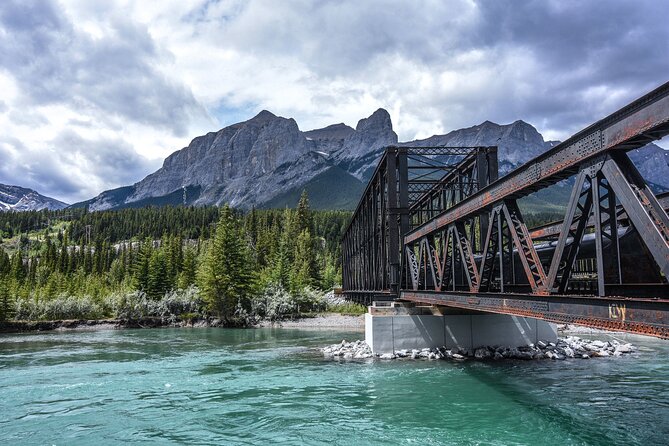
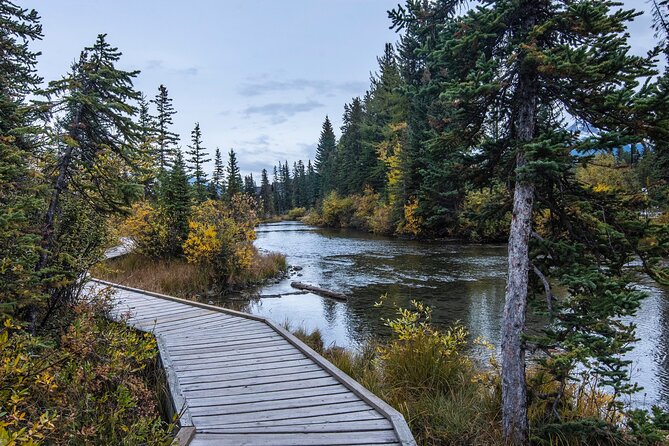
The walk then reaches Policeman’s Creek Boardwalk. This is one of the longer stops, with about 10 minutes of commentary and time to walk along part of the boardwalk.
The audio connects the creek area with the Bow River, the Canmore Nordic Centre, and local festivals and events. This gives you a change of pace after the roadside sculptures and railway history. You can listen while walking rather than stopping at a single marker.
The boardwalk is also a practical place to pause the tour. Since the route can be stopped and restarted, you do not have to rush through the scenic parts. If you want photographs or simply a quiet break, use the app’s flexibility.
After the boardwalk, the tour points out a view of Mount Rundle at 10 Street and 6 Avenue. This is one of Canmore’s defining mountain views, and the commentary focuses on the peak itself.
A mural of Isabelle Dube follows at 719 10 Street. The tour explains the tragic story connected with the mural. This stop adds a more personal and somber note to the walk. It is a reminder that local history is not only about railways, mines, and impressive peaks.
Museums, Friendship Park, and Main Street
The Canmore Museum and Geoscience Centre appears next. The museum holds more than 10,000 artifacts and has welcomed visitors since 1984. Admission is not included, so you will need to decide if you want to make a separate visit.
I like having the museum placed within the route rather than treated as a requirement. You can continue with the audio walk if the museum is closed, or pause the tour and return when it suits you. Recommended attractions may be closed or inaccessible because of the season or other conditions, so do not build your entire schedule around entering this stop.
Friendship Park introduces Canmore’s connection with the Japanese city of Higashikawa. The park is small, and the stop is brief, but it gives the route an international angle after so much local history.
The walk continues along Main Street at 8 Avenue and 6 Street. Here, the focus shifts to shops, restaurants, and galleries. This is a useful part of the tour for first-time visitors because it helps you get your bearings in the commercial centre. You can also pause the audio and return later to any shop or restaurant that catches your eye.
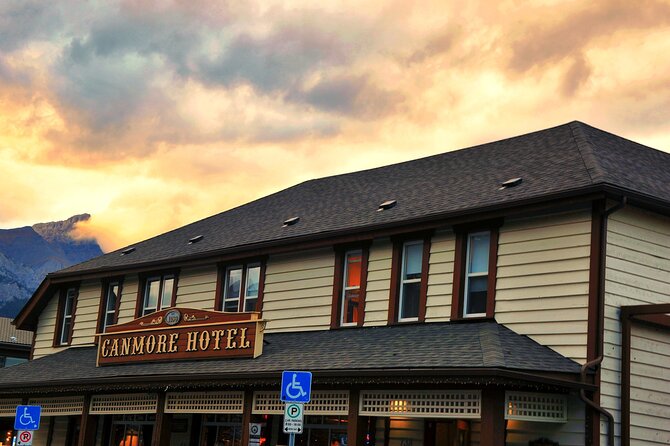
At Canmore Inn & Suites, the commentary points out a building dating to 1890 and connects it with Count Eugene de Rambouville. The stop helps you notice an older layer of the town while walking through a modern visitor area.
The Miners’ Union Hall and Centennial Park
The Canmore Miners’ Union Hall is one of the route’s key historical buildings. The tour explains its importance and the often contentious relationship between the town and its miners.
This stop gives the coal-mining story a human and political side. Mining was not simply an industry that employed people. It also shaped local power, working conditions, and community tensions. The union hall makes that story visible in a building you can see from the street.
Centennial Park offers another longer pause, with about 10 minutes focused on three subjects: views of the Three Sisters Mountains, the Stan Rogers stage, and annual events and festivals. The park works well as a midway or late-tour break because it combines scenery with public life.
You may want to pause here for a while. The audio gives you background, but the park is also a place to watch how Canmore uses its public spaces. Since the tour is not tied to a strict schedule, you can take that time without worrying about holding up a group.
Church, barracks, and the Big Head Sculpture
The Ralph Connor Memorial United Church is described as one of the earliest Presbyterian churches built in Alberta. The commentary also explains the mystery behind its name. It is a short stop, but it adds religious and civic history to a route otherwise dominated by mining and outdoor scenery.
The NWMP Barracks comes next. The audio explains how the barracks helped maintain law and order during Canmore’s rougher early years. This stop broadens the picture of the town once again. Canmore was not only a mining settlement and a railway stop. It also needed institutions to handle disputes and keep order.
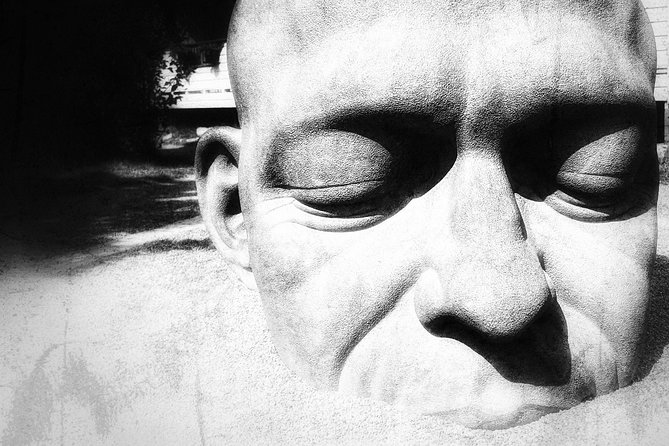
The final named stop is the Big Head Sculpture. The tour explains the unusual sculpture and its connection with the name Canmore. It is an entertaining finish because it brings together the town’s identity, public art, and a name that may not be obvious from simply walking through the streets.
The route ends back at the starting point. The supplied stop information also lists several nearby places that are not official points of interest, so you can spend extra time in the area if you wish. The important point is that the tour does not force you to leave as soon as the final commentary ends.
What the $8.22 price really gets you
At $8.22 per person, this is inexpensive for a private walking experience. A group can follow the same route without paying a guide by the hour, and you avoid the fixed departure time common to conventional tours.
The value comes from the structure: GPS navigation, automatic audio, historical commentary, and optional trivia. You also keep the tour and can use it at a flexible time. For a couple or family already planning to walk around Canmore, it is a low-cost way to add context.
There are limits. Your phone or tablet is not included, and attraction tickets are separate. The experience also cannot answer follow-up questions in real time, adjust the route for weather, or react to your interests like a live guide can.
Because the tour is audio based, bring headphones if you prefer not to play commentary aloud. Keep the phone charged, download the route on Wi-Fi, and allow enough time to stop when the town or scenery catches your attention.
Who should book this walk?
I would choose this for independent visitors who want structure without a group. It suits first-time visitors, couples, families, and anyone interested in the link between Canmore’s coal mines, railway, public buildings, and present-day town centre.
It is also a good fit if you like learning small facts while walking. The red telephone box, bear sculptures, inukshuk, coal cars, mural, church, and Big Head Sculpture give the route variety.
You may prefer a live guide if personal questions, long historical explanations, or a social group atmosphere matter to you. You should also think twice if you want a pure nature walk. This route includes scenic boardwalk and mountain views, but it spends substantial time on town streets and at historical sites.
Should you book The Sights of Canmore?
Book it if you want a flexible, affordable introduction to Canmore that mixes coal-mining history with mountain views. The optional trivia, automatic GPS audio, and ability to stop for shops or photographs make it easy to fit into your day.
Skip it if you need a guide in person, want included admission to the museum, or prefer a walk focused only on wilderness. For most independent visitors, the $8.22 cost is modest, and the tour gives you enough local context to make an ordinary stroll through Canmore much more rewarding.
FAQ
How long is The Sights of Canmore walking tour?
The tour takes approximately one hour and 30 minutes to two hours. The route is about 5 kilometres return, and you can take longer if you stop at parks, shops, restaurants, galleries, or the museum.
Where does the tour start?
The meeting point is Three Sisters Gallery at 909A Railway Avenue, Canmore, Alberta T1W 1P3.
Where does the tour end?
The activity ends back at the meeting point.
Does the tour require mobile data or a phone signal?
No. You should download the tour over Wi-Fi before starting. Once downloaded, the tour does not require a signal or use mobile data during the walk.
Is a smartphone or tablet included?
No. You need to provide your own smartphone or tablet.
What language is the audio tour offered in?
The tour is offered in English.
Are attraction admissions included?
No. Attraction tickets are not included. Admission to the Canmore Museum and Geoscience Centre is also not included.
Can I stop and restart the tour?
Yes. You can start and stop anywhere along the route and take as long as you like to complete it. The tour can also be enjoyed at a flexible time rather than only on the booking date.
Is the tour suitable for most people?
Most people can participate, and service animals are allowed. The activity is near public transportation and is private, so only your group participates. Recommended attractions may be closed or inaccessible because of the season or other circumstances.
New audio tours around Canada
- Kelowna E-Bike Bee Tour, Tastings, Organic Lunch & Audio Guide★ 5.0 · 9 reviews
- Smartphone Audio Driving Tour between Kamloops & Revelstoke★ 3.5 · 8 reviews
- Jasper National Park Self-Guided Driving Audio Tour★ 4.0 · 4 reviews
- Smartphone Audio Driving Tour between Kamloops and Vancouver★ 3.5 · 5 reviews
- Smartphone Audio Driving Tour between Huntsville & Toronto★ 4.5 · 4 reviews
- Halifax Explosion Smartphone Audio Walking Tour★ 4.0 · 3 reviews
- Edmonton Self Guided Audio Experience★ 3.0 · 2 reviews
- Smartphone Audio Driving Tour between Collingwood and Toronto★ 4.5 · 3 reviews
Canada Audio Tours, compared.

A 7th-Gen Local’s View of Downtown Charlottetown: An Audio Tour
Read our review →

Halifax Churches, Gardens & Graveyards: a Smartphone Audio Walking Tour
Read our review →
Western Canada Self-Driving Audio Guide English and German
Read our review →Browse the lists this tour appears in