
Review · AUSTRALIA
Explore Delightful Darwin: Self-Guided Audio Tour
Darwin’s story is one of destruction and rebuilding. This self-guided walk takes you from Chinese settlement and Aboriginal art to wartime memorials and the city’s oldest European building, with the harbour and tropical outdoor life close at hand. You control the pace, so you can stop for lunch or shopping rather than race after a guide.
I like the mix of culture and history, and I like the low price of $15.90 for a private walking experience. The main concern is technical: the audio may cut out, and it does not automatically detect your location. Download everything before you leave, and keep the map handy.
Key points to know before you walk
- Chinese settlement begins the route: The Chinese Temple and Museum Chung Wah offers a compact look at Chinese life in the Top End.
- Aboriginal art adds local depth: Mason Gallery displays paintings by artists from nearby regions.
- Darwin’s wartime story is outdoors: Bicentennial Park includes both the Cenotaph War Memorial and the Civilian Memorial.
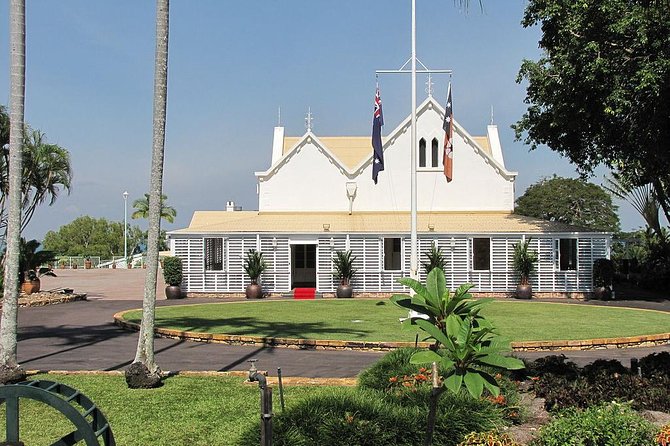
- Government House ends the listed route: The building dates to 1871 and is the Northern Territory’s oldest European building.
- You walk independently: The audio files and GPS map let you pause, change your pace, or stop for food.
- The technology needs preparation: The tour is English only, requires your own device and headphones, and has had a reported playback problem.
A two-hour walk through Darwin’s rebuilt story
This experience works best as a gentle introduction to central Darwin. You are not joining a group, following a flag, or waiting for a guide to finish taking photos. You download the audio files and map, put on your headphones, and set off.
The main route takes about two hours, though the full estimate is two to three hours. That extra hour matters. You may want more time at the Chinese museum, browse the art gallery, pause at the memorials, or stop for food along the way.
The city’s past gives the walk its shape. Darwin was affected by war and cyclones, and the tour explains how the settlement developed, suffered major damage, and was rebuilt into the Northern Territory’s present-day capital. That is more useful than a string of disconnected facts because you can see the changes in the city as you move.
The route begins at Survivors Lookout in Darwin City and ends at Government House on the Esplanade. The instructions also say you can choose your own starting and ending points, so treat those locations as a guide rather than a rigid appointment. The listed start time is 9:00 am, but the self-paced format gives you room to fit the walk around your day.
More Self-Guided Audio Tours in the world:
- Athens: Acropolis Ticket & Optional Self-Guided Audio Tours
★ 4.1 · 2,542 reviews - Gettysburg Battlefield Self-Guided Driving Audio Tour
★ 4.5 · 910 reviews - Joshua Tree National Park Self-Guided Driving Audio Tour
★ 4.5 · 762 reviews
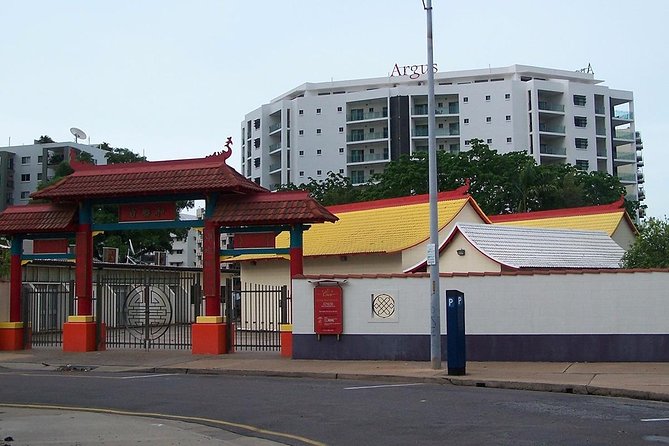
Chinese Temple and Museum Chung Wah: start with Darwin’s Asian story
The first listed stop is the Chinese Temple and Museum Chung Wah. You should allow about 15 minutes, though the time you spend inside depends on how closely you want to look at the displays.
This small museum focuses on Chinese settlement in the Top End. It gives the walk an important starting point because Darwin’s identity is not only about military history, government buildings, or tropical weather. Chinese communities played a part in the city’s development, and this stop gives you a chance to consider that contribution early in the route.
The admission fee is not included. That means the $15.90 covers the audio files and map, not entry to the museum. If you are watching every dollar, check the entry cost before you begin. The tour can still be used as a walking guide if you decide to skip an admission stop, but you will lose part of the cultural content.
I would give this stop your attention rather than treating it as a quick photo pause. A small museum can be easy to rush through, yet its value comes from the human details of settlement and community life. The audio should help frame what you are seeing, but you will need to manage the file yourself.
Mason Gallery: Aboriginal art from nearby regions
Next comes Mason Gallery, which displays paintings by Aboriginal artists from neighbouring regions. The planned visit is about 15 minutes, with admission again not included.
This is one of the more distinctive parts of the walk. Darwin is a useful place to encounter art from across the Northern Territory, and this gallery shifts the focus from the city’s built past to the living artistic traditions of the surrounding area. The information supplied for the tour does not list individual artists or specific works, so you should treat the gallery as a short introduction rather than a full art-focused visit.
The gallery may suit you if you want cultural variety without booking a separate museum tour. It also gives the route a change of pace. After learning about Chinese settlement, you move into Aboriginal art before reaching the public memorial spaces.
Keep in mind that the audio tour does not include admission fees. You may also want to leave time for browsing, since a 15-minute estimate is enough for a brief look but not necessarily for a careful examination of the paintings.
Bicentennial Park: memorials beside the harbour
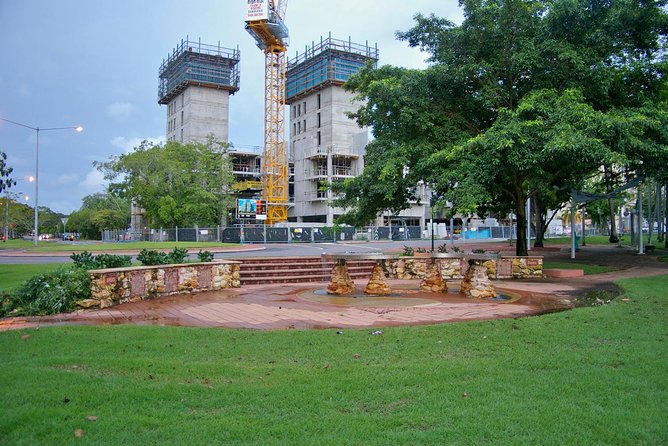
Bicentennial Park brings the walk into open public space. The park includes the Cenotaph War Memorial and the Civilian Memorial at its south-western end.
This section deals with Darwin’s wartime experience in a setting that allows you to pause and take in the surroundings. The tour’s wider story includes the devastation caused by wars and cyclones, so the memorials help connect those events to the city you see today.
The Cenotaph is the military focus, while the Civilian Memorial broadens the story beyond service personnel. That distinction is useful. It reminds you that wartime destruction affects ordinary people, homes, workplaces, and families as well as armed forces.
The park also gives you a practical break from enclosed spaces. You can pause the audio, look toward the harbour, and continue when ready. I like that freedom because historical information is easier to absorb when you are not being hurried from one stop to the next.
Do not expect a long guided ceremony or a formal interpretation session. This is an audio walk, so the quality of your experience depends on listening carefully and using the map to match the commentary with the places around you.
More audio tours around the world:
- Barcelona: Sagrada Familia Entry Ticket with Audio Guide
★ 4.6 · 105,312 reviews - Rome: Pantheon Fast-Track Ticket and Official Audioguide
★ 4.5 · 27,353 reviews - Barcelona: Casa Batlló Entry with Self-Audioguide Tour
★ 4.7 · 25,359 reviews - Rome: Colosseum & Forum with Audio Guide App -Optional Arena
★ 4.2 · 24,770 reviews
Government House: finish at Darwin’s oldest European building
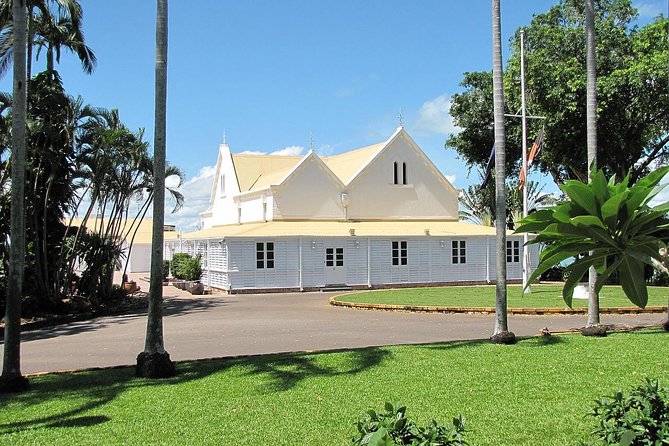
Government House is the final listed stop and the end point at 29 Esplanade. It has been home to successive government residents and administrators since 1871, making it the oldest European building in the Northern Territory.
That age gives the final stop weight. After the museum, gallery, and memorials, you arrive at a building tied to the territory’s administrative beginnings. It also provides a clear endpoint for a walk that has moved through community history, art, war, and redevelopment.
The tour does not say that entry inside Government House is included, and admission fees are generally excluded from the experience. Plan to hear the commentary from the public route and check any access details separately if you want to go inside.
Ending here also makes the walk easy to understand geographically. The route starts at Survivors Lookout and finishes on the Esplanade, giving you a simple line through central Darwin rather than a loop that returns you to the beginning. Since the experience is self-guided, you can continue exploring after the audio ends or arrange your own transport afterward.
How the audio guide actually works
You receive audio files and a GPS map. You use your own phone or other audio device, along with your own headphones. No physical guide or audio device is provided.
The instructions tell you to download the audio and have it ready before starting. Follow that advice. Darwin’s mobile coverage, your phone battery, and the condition of the downloaded file all matter when the tour depends on your device.
The GPS map is useful for orientation, but you should not assume the tour will automatically know where you are. One serious technical complaint described audio cutting out and restarting at the beginning when the listener lost their place. The same report also noted that the audio did not play automatically according to location.
That means you need to treat this as a playlist with a map, not a fully automatic navigation app. Before leaving, check that the files open, understand how to pause and resume, and note where each stop belongs. A portable battery would be a sensible precaution, though one is not included.
The provider refunded the customer who reported the failure and said it would examine ways to improve the experience. That response is helpful, but it does not remove the practical risk. If you dislike troubleshooting on holiday, a live guide or a more automated audio product may suit you better.
What $15.90 buys you
At $15.90 per person, the price is modest for a private walking route through central Darwin. You are paying for prepared commentary, a map, and the freedom to stop whenever you want. You are not paying for transport, meals, admission, headphones, or a person to guide you.
The value is strongest if you already plan to walk around the city and want structure without joining a group. A live tour usually gives you the chance to ask questions and recover quickly if you miss a turn. This option gives you privacy and flexibility instead.
Admission costs can change the total. The Chinese Temple and Museum Chung Wah and Mason Gallery both list admission as excluded, so check their current charges before budgeting. Food and drinks are also your responsibility, although the tour is designed to let you stop along the way.
The experience is booked an average of 53 days ahead, which suggests some people plan it well before arriving in Darwin. You do not need to treat that figure as a rule, but booking early is sensible if the walk is important to your schedule.
Timing, fitness, and the shape of the day
You need a moderate level of physical fitness. The tour is designed for walking, and the total duration is roughly two to three hours. The supplied information does not give a detailed distance or a full accessibility assessment, so you should not assume every surface or stop will suit every mobility need.
A 9:00 am start gives you a cool part of the day compared with later tropical heat, though the tour does not promise a particular weather condition. Carry what you normally need for an outdoor city walk and allow time to pause.
You can stop the audio when you want. That is useful if you want a meal, a drink, shopping time, or a closer look at a museum display. It also means you can divide the walk into shorter sections, although the experience is priced as one self-guided activity rather than separate visits.
The tour is available only in English. You need enough English to follow spoken historical commentary, and there are no translated audio files listed.
Who will get the most from this Darwin walk
I would recommend this experience to independent visitors who enjoy walking and want a light historical framework for the city. It suits solo visitors, couples, and small groups who do not want to match a guide’s pace.
It is also a good fit if you like combining several subjects in one outing. The route moves from Chinese settlement to Aboriginal art, then to war memorials and government history. That range makes the walk more interesting than a route focused only on buildings.
Families may appreciate the ability to pause, though the audio technology requires an adult to manage the files and map. Art lovers should note that Mason Gallery is one stop rather than the main purpose of the tour. People seeking detailed military interpretation may also find the memorial section too brief.
I would be cautious if reliable technology is essential to your plans. The rating is 3.5 from four submitted ratings, and the detailed technical complaint is specific enough to take seriously. Preparation can reduce the risk, but it cannot guarantee perfect playback.
Small practical details that make a difference
Download the files before you leave your accommodation. Do not wait until you reach Survivors Lookout.
Open the map and identify the order of the four listed stops. Because the audio does not appear to trigger automatically by location, knowing where you are matters.
Bring your own headphones and a fully charged phone. These are not supplied. Keep the audio paused while you cross streets or need to pay attention to your surroundings.
Remember that the walk does not include admission, transport, or food and drinks. Service animals are allowed, and the route is near public transportation, which gives you some flexibility before or after the walk.
Free cancellation is available if you cancel at least 24 hours before the local start time. Changes or cancellations inside that window are not accepted for a refund.
Should you book Explore Delightful Darwin?
Book it if you want an inexpensive, private introduction to Darwin and are comfortable managing audio files yourself. The combination of Chinese heritage, Aboriginal art, public memorials, and Government House gives you a useful first look at the city’s past and present.
Skip it if you expect a polished location-aware app, a personal guide, or guaranteed technical reliability. The smart approach is to download and test the material before setting out. For $15.90, the flexibility is appealing, but the experience depends heavily on your phone, your preparation, and your patience.
FAQ
How long does the Darwin audio tour take?
The walk takes approximately two hours, with an overall estimated duration of two to three hours. You can pause the audio for food, shopping, or extra time at a stop.
Where does the tour start and finish?
The listed start point is Survivors Lookout in Darwin City. The listed end point is Government House at 29 Esplanade, Darwin City. Since the tour is self-guided, you can choose your own starting and ending points according to your schedule.
What stops are included?
The listed stops are the Chinese Temple and Museum Chung Wah, Mason Gallery, Bicentennial Park, and Government House.
Are admission fees included?
No. Admission fees are not included. Food, drinks, transportation, and an audio device are also excluded.
Do I need to bring my own phone and headphones?
Yes. You need your own audio device and headphones. You should download the audio files and prepare them before starting.
Is the tour available in languages other than English?
No. The tour is available only in English.
Can I cancel for a full refund?
Yes, if you cancel at least 24 hours before the experience start time. Cancellations or changes made less than 24 hours before the start time are not accepted for a refund.
New audio tours around the world
- London Panoramic Open Top Bus Tour with Audio Guide★ 4.0 · 209 reviews
- London’s Alternative History: A Self-Guided Audio Tour★ 5.0 · 4 reviews
- London: British Museum Audio Guide & Small Group Entry★ 3.5 · 81 reviews
- London: National Gallery Audio Tour (No Entry Ticket)★ 3.5 · 11 reviews
- London: British Museum’s English Audio Tour with Free Reservation★ 3.0 · 15 reviews
- London: Churchill War Rooms Ticket & Political London Audio Tour★ 4.0 · 83 reviews
- London: British Museum Audio Tour with Free Guaranteed Entry★ 3.0 · 30 reviews
- Houses of Parliament Ticket & Political London Audio Guide★ 4.0 · 13 reviews
Australia Audio Tours, compared.
Mammoth Cave Self-guided Audio Tour (Located in Western Australia)
Read our review →



Sydney: Electric Bike Rental & Wheel Explorer Audio Guide
Read our review →
Self-Guided Audio Driving Tour of the Great Ocean Road, Australia
Read our review →
Rottnest Island – E-Rickshaw Tour with private guide
Read our review →
Browse the lists this tour appears in