
Review · PARIS
Montmartre Self-Guided Audio Tour: More Than Meets the Eye
Montmartre is best understood on foot, one crooked street and steep stairway at a time. This self-guided tour connects the neighborhood’s art studios, old cabarets, vineyard, windmill, cafés, and film-famous corners, ending at Sacré-Cœur. The audio uses GPS to tell you where to go and what you are seeing, so you can explore without keeping pace with a group.
I like the freedom to stop and restart whenever you wish, and the way the route links famous sights with less obvious stories. Lifetime access, offline maps, and audio add real value for a modest $14.99. The catch is physical: Montmartre is hilly, includes stairs, and the phone needs enough battery to run the app.
Key points
- A 1 to 2-hour route from Rue des Abbesses to Sacré-Cœur, with time to pause at cafés and viewpoints.
- Art history is the central thread, including Picasso, Modigliani, Renoir, Van Gogh, Utrillo, Dalida, and Toulouse-Lautrec.
- GPS-guided audio keeps you moving, with gentle redirection if you wander off course.
- Offline access helps with Paris data worries, though you still need a charged smartphone and headphones.
- The route includes unusual Montmartre sights, from the Wall of Love and a tiny vineyard to Le Passe-Muraille and an old windmill.
- The main drawbacks are hills, occasional navigation bugs, and a fixed route that may not match your priorities.
Montmartre by audio, from Abbesses to Sacré-Cœur
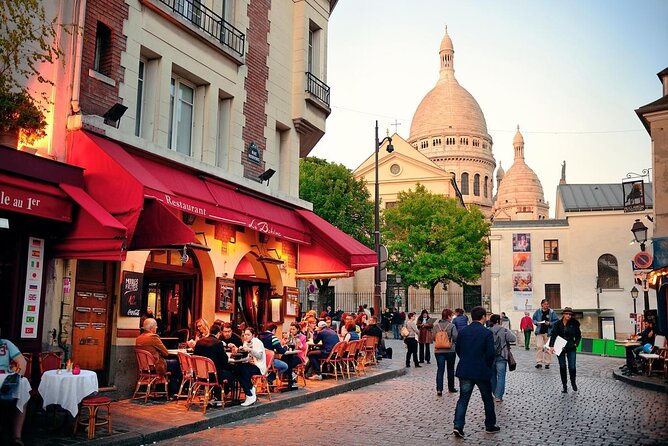
You begin at 22 Rue des Abbesses, a practical starting point in the lower part of Montmartre. The route then works uphill through a neighborhood that can feel like several different parts of Paris stitched together: lively streets, quiet lanes, old studios, artist cafés, and broad views from the basilica.
The audio is supplied through the VoiceMap app for Android and iOS. Once downloaded, the tour includes the sound, map, and location data for offline use. That matters in Paris, where you may not want to rely on a steady mobile connection while walking.
The narrator is described as clear, pleasant, and easy to understand. The tone mixes facts with humor, and the audio can be paused, replayed, or sped up. GPS normally starts the next section as you reach the right location. If you stray, the app can offer a gentle reminder to return to the route.
That system gives you something a scheduled group walk cannot: control. Stop for a coffee, linger over a view, or take a break on a staircase without holding anyone up. You can also split the route over more than one outing, though the tour itself is designed as a continuous walk.
More Self-Guided Audio Tours in France
- The Famous Graves of Père Lachaise – Self-Guided Audio Tour
★ 3.5 · 44 reviews - One Hour Père Lachaise Cemetery: A Self-guided Audio Tour
★ 3.5 · 26 reviews - Montmartre: Secret Stories of Paris – Self-Guided Audio Tour
★ 4.0 · 13 reviews
The Wall of Love and Montmartre’s old church
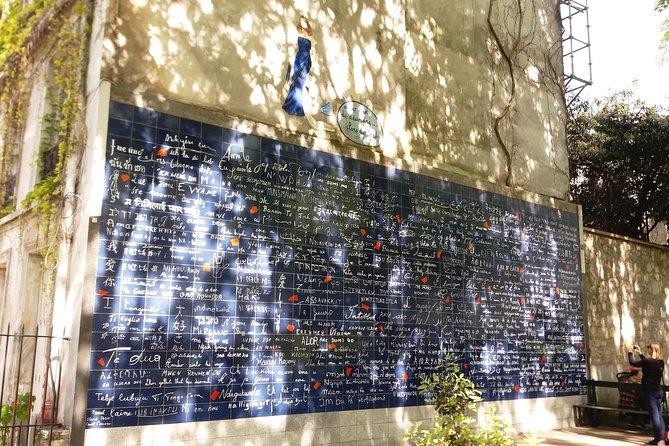
One early stop is the Mur des je t’aime, usually called the Wall of Love in English. Created in 2000 by Frédéric Baron and Claire Kito, the artwork uses tiles to write I love you in 311 different forms across 250 languages.
It is a quick stop, but a good one. The wall gives you a gentle introduction to Montmartre’s artistic side before the route moves into older streets and more serious art history. You can pause to look for familiar scripts and take in the small square around it.
The tour also brings you to a church with written records reaching back to 885. That makes it one of the oldest Christian sites in Paris. The importance here is less about a grand interior and more about the sense of time: Montmartre was a religious and village-like place long before it became a magnet for painters and visitors.
One practical warning applies to any GPS audio tour inside a church. If you enter and remain still, the app may sometimes interpret your position as a wrong turn or pause in an unexpected way. Keep an eye on the map, and do not panic if the audio needs a moment to catch up.
Picasso, Modigliani, and the studios of Montmartre
Art is the strongest reason to choose this route. You visit the workshop where Picasso lived from 1904 to 1909, a place also connected with Modigliani, Renoir, Juan Gris, Max Jacob, and Henri Rousseau.
The tour also passes Picasso’s first studio. These stops help you picture Montmartre as a working neighborhood rather than a museum display. Artists lived and painted in modest spaces, crossed paths in cafés, and shared the same steep streets you are walking today.
You should keep your expectations sensible. The tour passes these sites, but it does not include museum admission or promise access to private interiors. The value comes from placing the buildings and streets in context. Without the audio, you could easily walk past an ordinary-looking doorway and miss why it matters.
The route continues through Place Émile-Goudeau, another small square tied to the area’s artistic past. This is the kind of stop that suits an independent walker. You can pause, look around, and let the story connect the surrounding streets rather than rushing to the next major sight.
Dalida, a windmill, and Montmartre’s theatrical side
The route passes La Maison de Dalida, associated with the French-Italian singer who lived in Montmartre. It is one of several stops that broaden the story beyond painters. Montmartre has long attracted singers, writers, cabaret performers, and characters who helped give the neighborhood its particular personality.
Next comes one of Montmartre’s remaining windmills. Only two are left in the neighborhood. This one was built for grinding wheat and later became a restaurant, where artists including Renoir, Van Gogh, and Pissarro spent time.
Renoir’s Bal du Moulin de la Galette shows the party behind the famous façade rather than the windmill itself. Van Gogh painted several versions of the windmill, partly because his brother Theo lived nearby and the area was familiar to him. These details make the stop more useful than a simple photo break. You are seeing a real place tied to several paintings, not just a decorative relic.
The tour then passes Le Passe-Muraille, the statue of Saint-Denis, and the second Statue du Chevalier de la Barre. Le Passe-Muraille refers to the man who walks through walls, a playful literary figure commemorated in bronze. It is an amusing change of mood after the more solemn church and studio stops.
Same sights, a different narrator:
- Paris: Illuminations River Cruise with Audio Commentary
★ 4.3 · 12,340 reviews - Paris: Louvre Museum Hosted Entry and Mona Lisa Audioguide
★ 4.6 · 5,235 reviews - Paris: Orsay Museum Entry Ticket and Digital Audio Guide App
★ 4.4 · 3,170 reviews - From Paris: Giverny Day Trip with Audio Guide or Live Guide
★ 4.3 · 2,372 reviews
Rue de l’Abreuvoir and the pink house
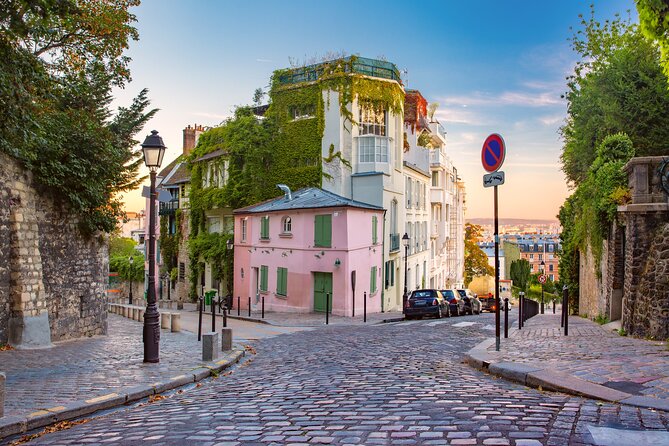
The walk goes down Rue de l’Abreuvoir, one of Montmartre’s most recognizable streets. The descent gives your legs a break after the earlier uphill sections, though the uneven pavement still calls for sensible shoes.
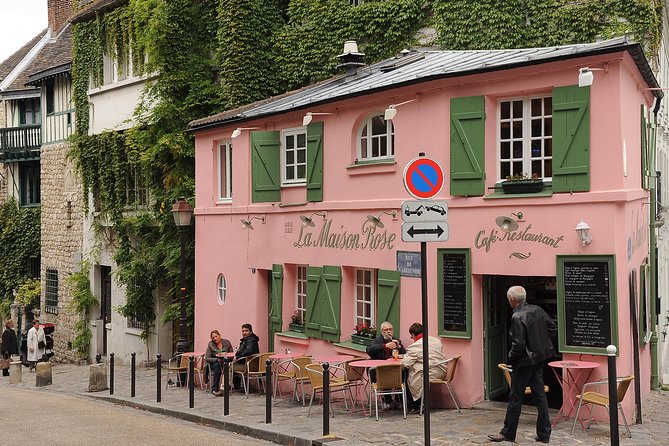
The Maison Rose is the pink restaurant seen in many photographs of Montmartre. Its fame grew through the painter Maurice Utrillo, and later it became a favorite of people connected with French music. Edith Piaf, Charles Aznavour, and Jacques Brel are associated with the place, and Albert Camus also enjoyed it.
This is a good example of the tour’s approach. It does not focus only on monumental buildings. It points out ordinary-looking houses and cafés, then explains how painters, singers, and writers turned them into part of the neighborhood’s public story.
You should expect the area around Maison Rose to be popular and photo-oriented. The audio gives you a reason to look beyond the camera angle. Notice the street, the slope, and the way the building fits into the small lanes around it.
Montmartre’s vineyard and Le Lapin Agile
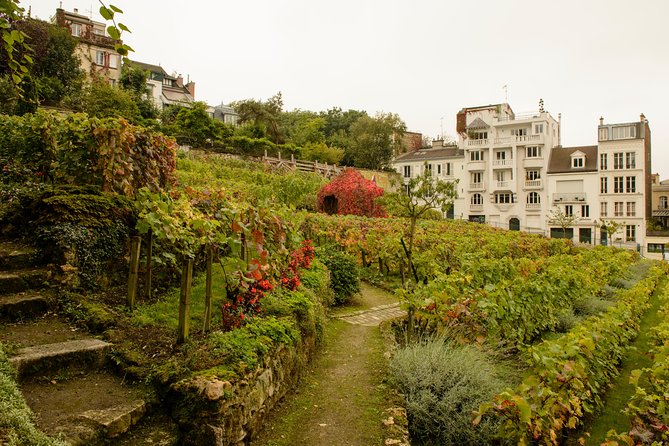
Paris once had many vineyards. Montmartre’s remaining vineyard is one of the few survivors, and it is small enough for one person to care for. You will not find a sprawling wine estate here. Instead, the point is to see a tiny piece of the old village that survived inside a modern capital.
The vineyard is especially meaningful because it contrasts with the grand image of Paris. Montmartre was not always a polished art district. It had farms, mills, drinking places, and working streets. The audio helps bring that older setting into view.
Nearby, Le Lapin Agile recalls the neighborhood’s cabaret past. It opened in 1795 as a cabaret and drinking establishment. Earlier names included Rendez-vous of Thieves and Cabaret of the Assassins. In 1880, caricaturist André Gill was asked to give the place a new look, producing the rabbit image that led to its current name.
This stop is useful for understanding why Montmartre attracted artists. The cafés and cabarets were not simply scenic backdrops. They were places where painters, writers, singers, and local regulars shared space. You can pass the building without entering, since admission and food are not part of the tour.
Place du Tertre and the artists’ square
The route passes Place du Tertre, the famous artists’ square. This is one of the most important stops for many people visiting Montmartre, so timing matters. If you want to browse the square at length, sketch, watch artists work, or take photographs, allow more than the advertised 1 to 2 hours.
One drawback of a GPS route is that it follows its planned order. You do not choose the first stop based on your own priorities. A fixed route can be helpful because it prevents you from missing the main sights, but it can also be frustrating if Place du Tertre is your top goal and you reach it late in the day.
The route includes a classic Montmartre restaurant whose name means simple and without ceremony. A restaurant has occupied the site since the 1500s, though the building has been rebuilt and renamed over time.
Painters and poets associated with the restaurant include Degas, Renoir, Monet, Cézanne, Sisley, and Toulouse-Lautrec. Van Gogh painted La Guinguette à Montmartre there in 1886. The audio gives you a clear link between the present-day dining scene and the painters who once made this neighborhood famous.
Finishing with Sacré-Cœur and the Paris view
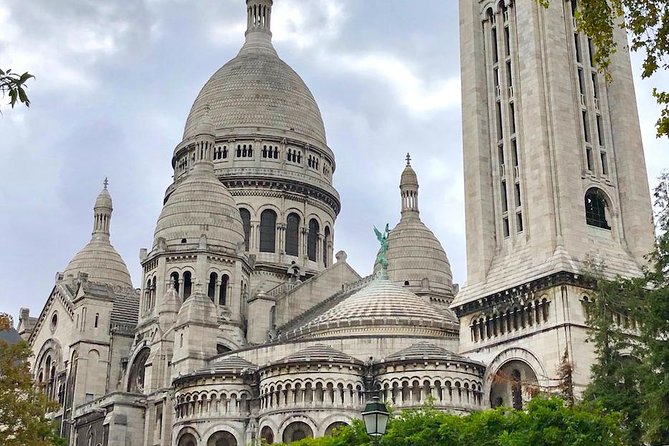
The tour ends in front of the Basilica of Sacré-Cœur at 35 Rue du Chevalier de la Barre. The final section includes a look inside the basilica, bringing the route back to Montmartre’s religious side after its long artistic detour.
Sacré-Cœur is also the natural finish because it gives the walk a sense of arrival. You have climbed through the neighborhood’s older streets and arrive at one of Paris’s most recognizable monuments. The basilica and its surrounding area can be crowded, so treat the endpoint as the beginning of your own visit rather than a signal to hurry away.
The tour does not include entrance fees to museums or other attractions. Food, drinks, transport, a smartphone, and headphones are also your responsibility. That is not unusual for an audio walk, but you should budget for the extras if you plan to stop at a café or visit somewhere along the route.
What the $14.99 price really buys
At $14.99, this is inexpensive compared with a private walking guide. You get lifetime access in English, not just one use on one day. If you return to Paris, you can use the route again, and the ability to replay sections is handy when a name or story goes by too quickly.
The strongest value is the combination of story and independence. Montmartre is easy to wander without a plan, but it is also easy to miss the connection between a windmill, a painting, a singer’s home, and a café. The audio gives those places a common thread.
The price is less attractive if you want a fully flexible sightseeing menu. You cannot simply select three favorite stops and skip the rest without managing the route yourself. It is also poor value if the app fails on your phone and you do not contact support. Make sure you redeem the correct voucher code, download the tour, and test the app before setting off.
Start with a full battery. A portable charger is sensible, especially if you plan to take photographs or use other apps. The tour includes offline access, but offline does not mean battery-free.
Who should book this Montmartre walk?
I would choose this tour if you prefer to walk alone or with your own small group. It suits solo visitors especially well, since the audio provides company without requiring conversation with a guide or a larger group.
It is also a good fit if you enjoy stories about artists and local characters more than a list of major monuments. The route gives you plenty of context for Picasso, Modigliani, Renoir, Van Gogh, Utrillo, Dalida, and the performers connected with Montmartre.
Families and anyone with limited mobility should think carefully about the hills and stairs. The walk can be taken slowly, paused, or split over multiple days, but the terrain remains part of the neighborhood. If you are already planning another long walking tour that day, schedule this one separately.
The app experience is generally straightforward, but GPS accuracy and navigation are not perfect in every situation. In a few places, directions may feel unclear or the app may think you have wandered when you are inside a church. Keep the route map open and allow time to recover if the audio does not trigger exactly as expected.
My verdict
Book it if you want an affordable, self-paced introduction to Montmartre and you are willing to walk uphill with a charged phone. The mix of art history, old cafés, literary oddities, a vineyard, Place du Tertre, and Sacré-Cœur gives you more than a basic monument walk.
Skip it if your priority is choosing stops in any order, avoiding stairs, or receiving live answers from a guide. For everyone else, the $14.99 price is fair, especially because access lasts for life and the audio, maps, and location data can be used offline.
FAQ
How long does the Montmartre audio tour take?
The estimated duration is 1 to 2 hours. If you stop for food, drinks, photographs, music, or longer visits at the sights, you should allow more time.
Where does the tour start?
It starts at 22 Rue des Abbesses, 75018 Paris, France.
Where does the tour end?
It ends in front of the Basilica of Sacré-Cœur at 35 Rue du Chevalier de la Barre, 75018 Paris, France.
Is the audio tour available in English?
Yes. Lifetime access to the tour is provided in English.
Do I need internet access during the walk?
The tour includes offline access to the audio, maps, and geodata. You still need a smartphone with the VoiceMap app, and you should begin with enough battery.
Is a smartphone included?
No. You must provide your own smartphone and headphones.
Does the price include food, transportation, or attraction tickets?
No. Food, drinks, transportation, museum tickets, and other attraction entrance fees are not included.
Is this a private tour?
Yes. Only your own group participates, and you follow the route independently rather than joining a scheduled group.
Can I cancel for a full refund?
Yes, if you cancel at least 24 hours before the experience start time. Cancellations or changes made less than 24 hours in advance are not refunded.
More Self-Guided Audio Tours in Paris
- Athens: Acropolis Ticket & Optional Self-Guided Audio Tours
★ 4.1 · 2,542 reviews - Gettysburg Battlefield Self-Guided Driving Audio Tour
★ 4.5 · 910 reviews - Joshua Tree National Park Self-Guided Driving Audio Tour
★ 4.5 · 762 reviews - Ultimate Acadia National Park Self-Guided Driving Audio Tour
★ 4.0 · 521 reviews
New audio tours around Paris
- The Tout Paris Private Rickshaw bike Tour with Audio Guide★ 4.6 · 8 reviews
- Seine River Cruise with Free Notre Dame Digital AudioGuide★ 4.2 · 7 reviews
- Paris: Rodin Museum Skip-the-line Entry Ticket with Audio★ 4.0 · 102 reviews
- Paris: Rodin Museum Ticket & Optional Digital AudioGuide App★ 4.7 · 56 reviews
- Paris: Museum of Decorative Arts Ticket and City Audio Tour★ 3.3 · 146 reviews
- Paris: Rodin Museum & Optional Audioguide or Seine Cruise★ 5.0 · 2 reviews
- Paris: Musee De L’Armee Ticket With Digital Audio Guide★ 4.2 · 39 reviews
- Paris: Panoramic Night Tour with Audio Guide and Host★ 3.2 · 220 reviews
Paris Audio Tours, compared.
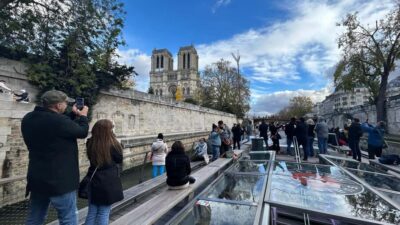
Paris: Illuminations River Cruise with Audio Commentary
Read our review →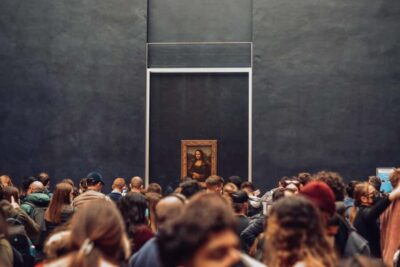
Paris: Louvre Museum Hosted Entry and Mona Lisa Audioguide
Read our review →
Paris: Orsay Museum Entry Ticket and Digital Audio Guide App
Read our review →
From Paris: Giverny Day Trip with Audio Guide or Live Guide
Read our review →
Paris: Eiffel Tower Access w/ Audioguide and Optional Cruise
Read our review →
Giverny and Monet’s House Half Day Trip from Paris Guide or Audio
Read our review →
Paris: Catacombs Entry & Seine River Cruise with Audio Guide
Read our review →
Paris: Tootbus Panoramic by Night Bus Tour with Audioguide
Read our review →Browse the lists this tour appears in