
Review · FLORENCE
Florence: Uffizi Official timed Entry Ticket & Audio Guide
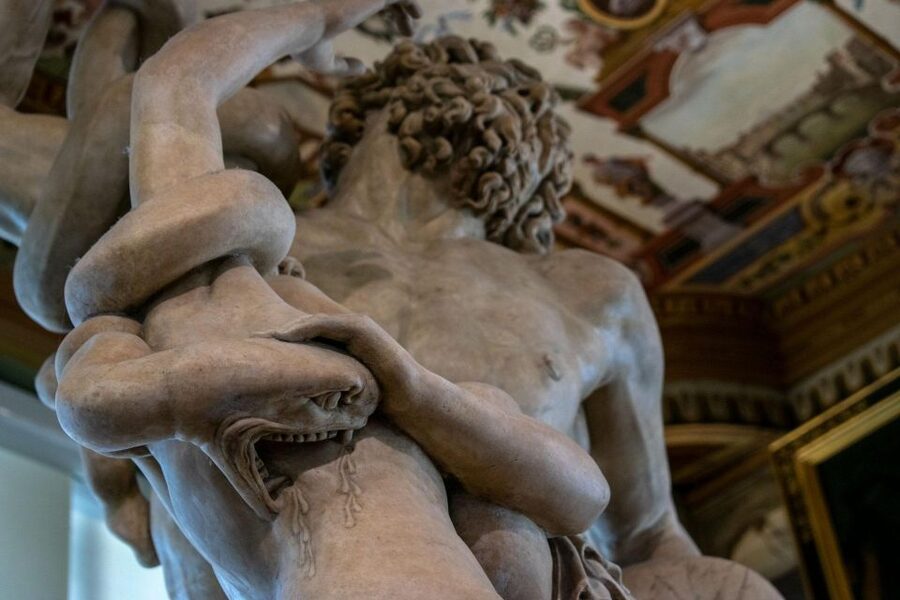
The Uffizi is one of those museums where a single hallway can contain Botticelli’s Birth of Venus, Leonardo’s Annunciation, Michelangelo’s Doni Tondo, and Caravaggio’s Medusa. This ticket gives you timed entry and a phone-based audio guide, so you can focus on the art instead of sorting out museum logistics.
I like the direct entrance process and the freedom to pause or replay the commentary. I also like the guide’s carefully chosen list of 73 works, which gives you a sensible route through a very large collection. The main drawback is that security can still add 15 to 30 minutes, and the ticket is non-refundable, so choose your time with care.
Key points to know before you go
- Go straight to Uffizi Entrance 1: Show the emailed ticket and your passport or ID. There is no voucher exchange.
- Plan around 73 audio stops: The guide is designed for about two hours, but you can stay until closing time.
- Bring your own headphones: Earphones are not included, and your smartphone needs a full charge.
- Expect a serious stair climb: The route to the second floor includes four long stair sections, though the museum is wheelchair accessible.
- Allow extra time for security: Even with a reserved slot, the security line can take 15 to 30 minutes at busy times.
- Look for the terrace café: You can pause over coffee or cappuccino with views toward Piazza della Signoria and Brunelleschi’s dome.
Why this ticket works well at the Uffizi
The Uffizi Gallery is not a quick stop where you glance at a few famous paintings and leave. It holds centuries of sculpture and painting, with the strongest concentration of Italian Renaissance art you are likely to see in one place.
That scale can be a problem. Without a plan, you may spend too long in the first rooms and reach Botticelli, Leonardo, and Michelangelo already tired. The included digital guide helps by selecting 73 works and giving you a route that fits a visit of roughly two hours.
I see this as a self-guided museum visit with structure, not a private tour. You do not have a live guide answering questions in the galleries. Instead, you use your own phone, listen when you want, and set your own pace.
That arrangement suits you if you like stopping for extra time at one painting, skipping a room that does not interest you, or returning to a favorite work later. It is less suitable if you want constant personal commentary or help navigating every turn.
More Museum Audio Tours in Florence
- Florence: Uffizi Priority Ticket & Masterpieces Audio App
★ 4.2 · 6,402 reviews - Florence: Uffizi Gallery Timed Entry Ticket & Audio Guide
★ 4.2 · 2,794 reviews - Florence: Uffizi & Accademia Priority Tickets with Audio App
★ 4.4 · 1,253 reviews
Arriving at Entrance 1 in Florence
The Uffizi sits in central Florence, close to Piazza della Signoria and the Palazzo Vecchio. For this booking, you go directly to Entrance 1 for pre-booked visitors on the date and time you selected.
You should arrive about 10 minutes early. Have the ticket ready on your phone, along with your passport or ID card. The ticket and audio guide may arrive by email, WhatsApp, or iMessage, so check your email inbox and phone before leaving your accommodation.
There is no need to find a tour leader or exchange a printed voucher. That saves a useful bit of time, particularly when the square is crowded and you are trying to match several similar-looking entrances.
The reserved time gets you into the entry process, but it does not remove the security check. At busy times, that check may take 15 to 30 minutes. A timed ticket is still useful, but do not schedule lunch, a train, or another museum immediately after the Uffizi.
The operator may send a ticket for a time up to 15 minutes later than the slot you selected. Check the final ticket carefully rather than relying only on the original booking time.
If you need help on the ground, assistance is available at the Slow Tour Tuscany agency at Via degli Alfani 115R. Most people using the direct-entry instructions should not need to stop there.
Getting started with the smartphone audio guide
The audio guide is downloaded to your smartphone with assistance from the agency. The information provided does not name a live guide, so you should think of this as an app-based guide rather than a guided group tour.
The commentary covers 73 works and is intended to fill about two hours. That is a useful target. You can follow the main sequence, listen only to the paintings you care about, or pause the guide while you study a detail.
The six language options are English, French, German, Italian, Spanish, and Chinese. Bring headphones, since they are not included. You also need a charged smartphone. A nearly empty battery could turn this convenient audio guide into a very quiet walk through the museum.
I recommend downloading or opening everything before you reach the entrance if possible, then checking that your headphones work. The ticket arrives digitally too, so keep both the admission QR code and the audio guide easy to find.
The guide cannot replace looking closely. Use the narration for context, then stop listening for a moment and notice the painting itself. Renaissance works often reward a quiet pause more than another minute of explanation.
The early galleries: Giotto to the Florentine Renaissance
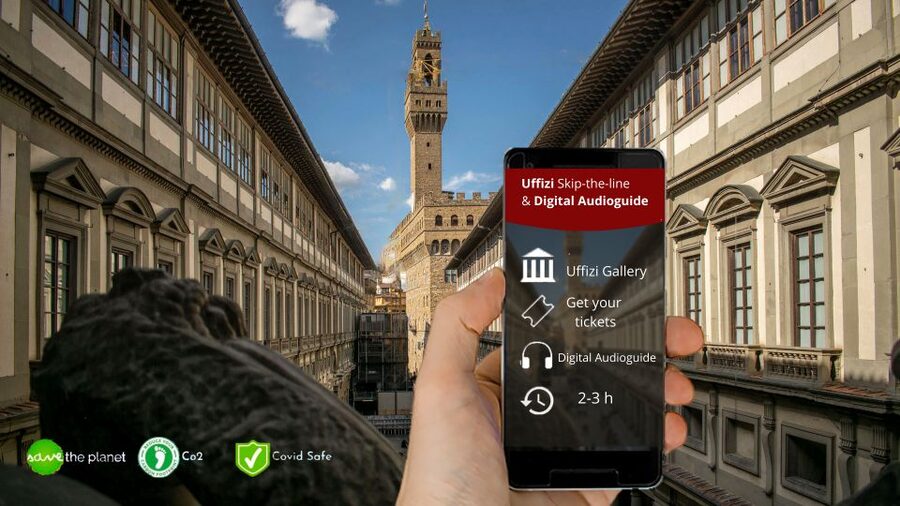
The selected route begins with early Italian painting, where you can see artists moving away from flat, symbolic figures toward more human faces, stronger space, and greater emotional detail.
Giotto’s Maestà is an important starting point. Its Madonna and Child still carry the formal weight of a devotional image, but Giotto gives the figures more presence and physical connection. The audio commentary can help you see why this work matters without requiring you to already know the technical story of Renaissance painting.
Simone Martini’s Annunciation offers a very different mood, with elegant lines and a refined, decorative surface. Then come works such as Giottino’s Pietà di San Remigio and Gentile da Fabriano’s Adoration of the Magi.
These rooms are easy to rush toward the famous Botticelli paintings. Try not to. They show the visual changes that make Botticelli and Leonardo easier to appreciate later. The Uffizi makes more sense when you notice the links between generations, rather than treating each masterpiece as an isolated star.
Piero della Francesca’s Montefeltro Diptych is another worthwhile stop. Its calm profiles and precise setting feel controlled and almost still. Filippo Lippi’s Madonna with Child and Angel brings a softer, more intimate feeling.
This section is especially good for you if you want more than a checklist of famous names. If you have only limited time, follow the audio guide’s selections rather than trying to inspect every painting in equal detail.
More Museum Audio Tours in Italy
- Florence: Uffizi Gallery Reserved Entry Ticket & Audioguide
★ 4.5 · 970 reviews - Florence Duomo, Baptistery & Opera Museum Audioguided Tour
★ 4.2 · 607 reviews - Florence: Accademia Gallery Reserved Entry & Audio Guide
★ 4.3 · 600 reviews - Florence: Uffizi Gallery Tickets with Optional Audio Guide
★ 4.1 · 503 reviews
Botticelli’s Primavera and Birth of Venus

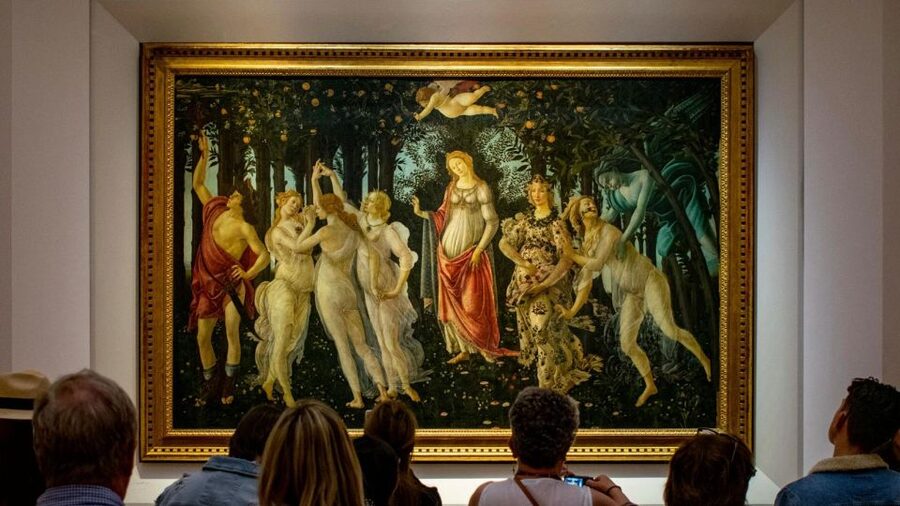
For many people, the central purpose of an Uffizi visit is seeing Sandro Botticelli’s Primavera and The Birth of Venus. They are among the museum’s most famous paintings, and the guide gives you a way to approach them with more than a quick photo.
Primavera is filled with figures, flowers, gestures, and mythological references. It is not the sort of work that yields everything at a glance. Look at the arrangement of the figures and the strange, dreamlike garden. The audio explanation can help organize the scene, but give yourself time to follow your own eye.
The Birth of Venus is more open and immediately readable, yet its pale figures and floating movement reward a slower look. You may find yourself drawn to the famous central figure, while the surrounding winds, flowers, and shoreline provide the painting’s sense of motion.
These are popular rooms, so you may need patience to get a clear view. The timed entry helps you reach the museum, but it does not guarantee an empty gallery. Stay calm, wait for a gap, and remember that a painting can be appreciated from a few steps back.
I like that the guide includes both works rather than treating Botticelli as a single-photo stop. Together, they show how much variety can exist within one artist’s work and the Florentine court culture that supported it.
Leonardo, Michelangelo, and Raphael
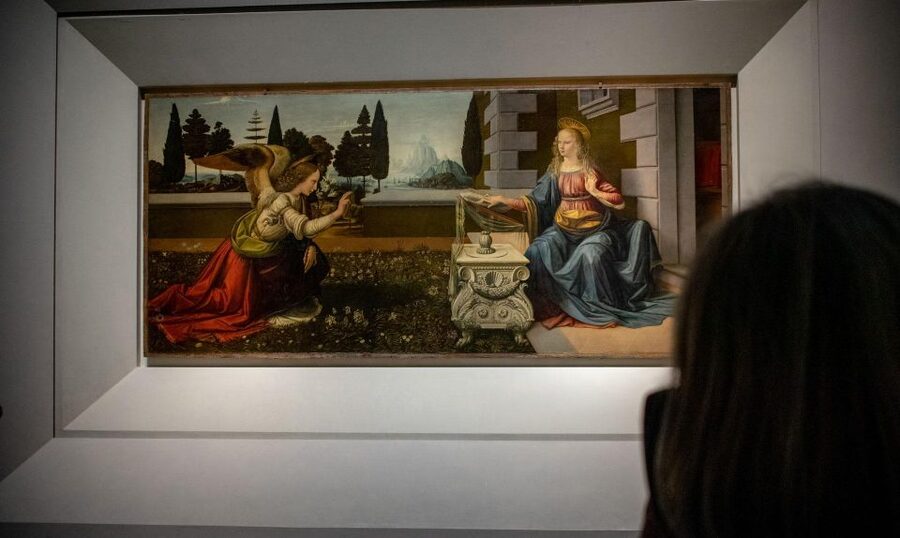
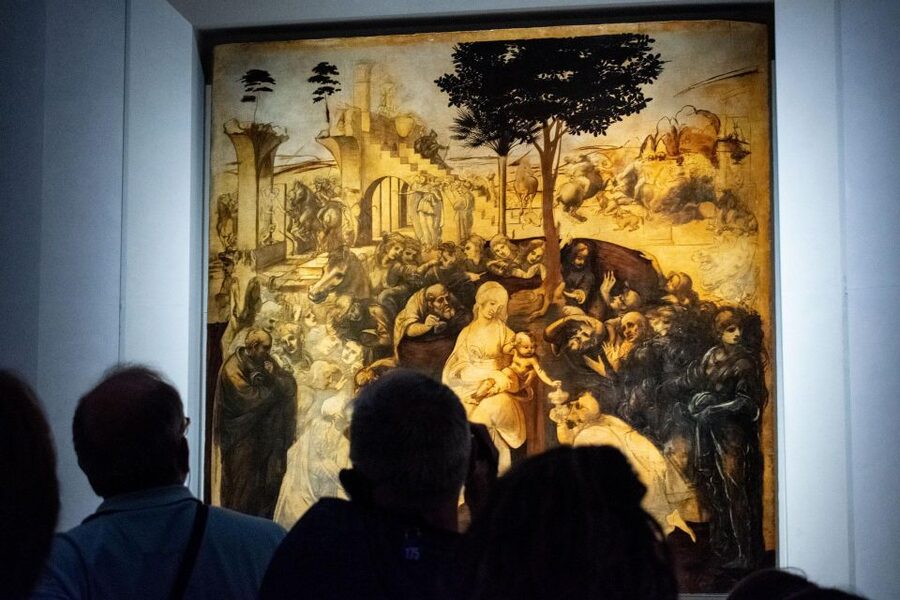
The Uffizi’s Leonardo selection includes The Annunciation, The Adoration of the Magi, and the Baptism of Christ. These works let you see different stages and aspects of Leonardo’s career.
The Annunciation is a key stop for observing careful detail, landscape, and the relationship between the figures. The Adoration of the Magi is unfinished, which makes it particularly interesting. You can see the process rather than only the polished result.
The Baptism of Christ, made with Verrocchio and other contributors, gives you a chance to consider workshop practice and artistic collaboration. The museum is not only a hall of finished masterpieces. It also shows how paintings were made, developed, and sometimes left incomplete.
Michelangelo’s Doni Tondo is one of the Uffizi’s essential works. Its round format, strong colors, and powerful figures feel different from the more delicate works nearby. Raphael’s portraits of Agnolo and Maddalena Doni and his Madonna of the Goldfinch offer another kind of pleasure, with attention to faces, clothing, and family relationships.
This group is where the audio guide earns its keep. The names are familiar, but the works are not interchangeable. The commentary helps you see why Leonardo’s unfinished surface, Michelangelo’s forceful bodies, and Raphael’s balance belong to different artistic worlds.
Later Renaissance drama: Titian, Artemisia, and Caravaggio
The Uffizi route continues beyond the early Renaissance. Titian’s Venus of Urbino is one of the collection’s best-known paintings, with a reclining figure, rich color, and an unmistakable sense of presence.
Artemisia Gentileschi’s Judith Beheading Holofernes brings a much harder, more forceful subject. It is a dramatic painting, and the audio guide gives you a useful reason to pause rather than treating it as just another large biblical scene.
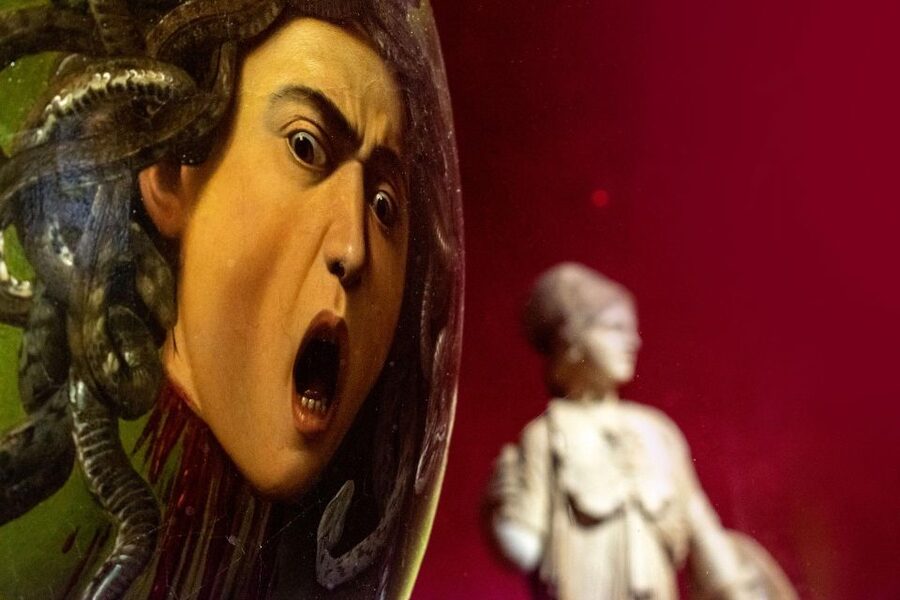
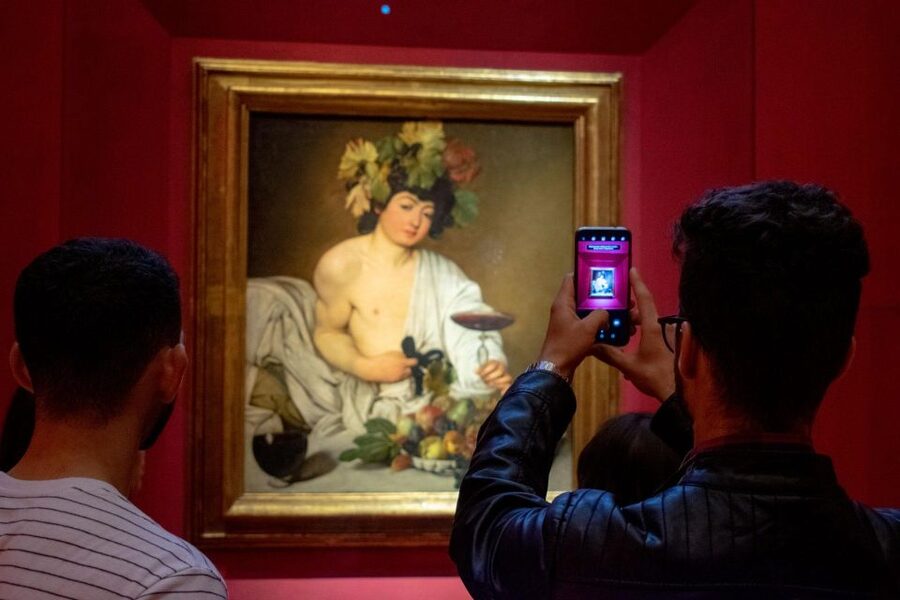
Caravaggio’s Medusa and Bacchus bring intense light, direct expression, and theatrical tension. Medusa is especially memorable because of its subject and circular support. It seems to confront you rather than politely hang on the wall.
You can also see Pontormo’s Supper at Emmaus, Rosso Fiorentino’s Spedalingo Altarpiece, Bronzino’s portrait of Eleonora of Toledo, and works by Rembrandt, including The Rabbi. These stops broaden the visit beyond the most famous Florentine names.
I appreciate this wider selection because it prevents the Uffizi from becoming only a Botticelli museum. If you have energy left after the Renaissance rooms, keep listening. Some of the later works may become your personal favorites.
A break above Florence
The Uffizi offers more than indoor art. From its windows, you can look across Florence, and the terrace café provides a place to stop for coffee or cappuccino.
The view includes Piazza della Signoria and, from the terrace, a fine sight toward Brunelleschi’s dome. This is a practical break as much as a scenic one. Two hours of paintings, stairs, and crowded rooms can wear you down, and a short pause may help you enjoy the final galleries.
You do not need to rush out after completing the 73 audio stops. The ticket allows you to remain inside until the gallery closes. You can wander, return to Botticelli, revisit a sculpture, or simply sit with a painting that caught your attention.
That freedom is one of the strongest parts of this arrangement. The audio route gives you a framework, but the final visit belongs to you.
Stairs, accessibility, and the physical effort
The Uffizi is wheelchair accessible, but the normal route to the second floor includes four very long stair sections. If stairs are difficult for you, ask for directions to the elevator before starting the climb.
This is more than a minor note. A visitor who needs to stop and rest may spend much of the first part of the visit managing the climb instead of looking at art. Build in extra time and ask staff for the lift route rather than assuming the main staircase is your only option.
Comfortable shoes will help, though the main requirement is a charged phone and patience with the building. Security lines can slow the start, and the museum’s size makes a focused plan useful.
Is the $33 price good value?
The listed price is $33 per person. The breakdown provided is 29 euros for the museum ticket, 9.40 euros in costs and taxes paid to online sellers, 6 euros for the audio guide, and 2.60 euros for ticket delivery and on-site assistance.
The value depends on what you need. If you only want the cheapest possible museum admission, the added cost may feel high. You are paying for a reserved time, digital ticket delivery, the audio guide, and a simpler arrival process.
For a first visit to Florence, I think the package makes sense if you value structure and want to avoid ticket pickup. The audio guide is also less expensive than arranging a private guide, while still giving you explanations in six languages.
The tradeoff is flexibility. This is a non-refundable booking, so select your day and time carefully. A reserved time also does not remove the security wait, and the final ticket may be up to 15 minutes later than your chosen slot.
Who should book this Uffizi visit?
I would choose this experience if you:
- Want to see the major Uffizi paintings without arranging a private guide
- Prefer listening on your own phone rather than joining a group
- Like pausing, replaying, or skipping commentary
- Need an audio guide in English, French, German, Italian, Spanish, or Chinese
- Have a firm sightseeing schedule and value a reserved entrance
- Want to stay beyond the suggested two-hour audio route
I would look for another option if you need a refundable booking, want a live art historian, or dislike using your phone in museums. You should also think carefully about the stairs if you have any difficulty climbing, and contact staff about the elevator route before heading upstairs.
FAQ
Where do I enter the Uffizi Gallery?
Go directly to Uffizi Gallery Entrance 1 for individuals with pre-booked tickets. Show the ticket received by email and your passport or ID card.
Do I need to exchange a voucher?
No. There is no voucher exchange. You go straight to the museum entrance with your digital entry ticket.
How early should I arrive?
Arrive about 10 minutes before the time shown for your booking. Allow extra time because security may take 15 to 30 minutes during busy periods.
What does the audio guide cover?
The smartphone audio guide covers 73 selected artworks and is designed for a visit of about two hours. You can pause or replay the information.
Which languages are available?
The audio guide is available in English, French, German, Italian, Spanish, and Chinese.
Do I need to bring headphones?
Yes. Earphones are not included. Bring your own headphones and a charged smartphone.
Can I stay in the museum after finishing the audio guide?
Yes. You can remain inside, revisit paintings, explore at your own pace, and stay until the gallery closes.
Is the Uffizi accessible by wheelchair?
The activity is listed as wheelchair accessible. The regular route to the second floor includes four long stair sections, so ask for directions to the elevator if needed.
Should you book it?
Book this ticket if you want a well-organized, self-guided Uffizi visit with the major Renaissance works clearly selected for you. The direct entrance process, 73 audio stops, multilingual options, and freedom to stay until closing make it a practical choice for a first visit.
Just arrive early, check your email and phone, bring headphones, and do not underestimate the security line or the stairs. If you need a refundable reservation or personal guidance from a live expert, this is not the best fit. For everyone else, it offers a sensible way to see Botticelli, Leonardo, Michelangelo, Raphael, Caravaggio, and much more without trying to plan the museum alone.
New audio tours around Florence
- Florence: Uffizi Gallery Timed Entry Ticket with Audio★ 3.0 · 3 reviews
- Florence: Uffizi Gallery Audio Guided Tour led by Tour Leader★ 3.5 · 6 reviews
- Uffizi Combined Ticket:UFFIZI, PITTI, BOBOLI & digital audioguide★ 4.0 · 26 reviews
- Uffizi Gallery Audio-Guided Visit with optional Accademia Gallery★ 3.5 · 42 reviews
- Florence: Uffizi Gallery Reserved Ticket & Digital Audio Guide★ 4.5 · 3 reviews
- Florence Walking Tour with Audioguide on Your Smartphone★ 4.5 · 9 reviews
- Florence: Accademia entry tickets + optional audio guide★ 4.0 · 228 reviews
- Accademia Gallery Skip the line Tickets with Audio Guide★ 4.0 · 10 reviews
Florence Audio Tours, compared.
Florence: Timed Entry to Michelangelo’s David + Audio App
Read our review →
Florence: Uffizi Priority Ticket & Masterpieces Audio App
Read our review →
Florence: Palazzo Vecchio Entrance Ticket & Audioguide
Read our review →
Florence: Uffizi Gallery Timed Entry Ticket & Audio Guide
Read our review →
Florence: Michelangelo’s David Entrance Ticket and Audio App
Read our review →
Florence: Uffizi & Accademia Priority Tickets with Audio App
Read our review →
Florence: Eco-Friendly Golf Cart City Tour with Audio Guide
Read our review →
Florence: Uffizi Gallery Reserved Entry Ticket & Audioguide
Read our review →Browse the lists this tour appears in