Review · ITALY
Agrigento: Valley of the Temples Ticket & App Audioguide
Agrigento’s Valley of the Temples is one of Sicily’s great ancient sights: a long ridge of Doric temples, aqueducts, and ruins with the sea and modern Agrigento beyond. The Temple of Concordia is the star, remarkably well preserved and especially striking when the site lights up after sunset.
I like the freedom of a self-guided visit, and I like that this ticket includes one-day entry plus a digital audioguide. The optional Pemcards photo postcard is a nice extra for friends at home. The catch is that skip-the-line does not always mean walking straight in: you must exchange the voucher for a paper ticket at the Temple of Juno office, and the audioguide received mixed marks.
Key points to know before you go
- Exchange your voucher at the Temple of Juno ticket office: This is the only stated location for changing your voucher into an entry ticket.
- Plan for a lot of walking: The site covers about 1,300 hectares, with little shade in places and warm conditions in summer.
- Visit near sunset if possible: The temples look impressive in evening light, and some are illuminated after dark.
- The digital audioguide is useful but not guaranteed to satisfy: Some people found it limited or difficult to use, so bring your own notes or use the site’s signs as a backup.
- Transportation is not included: You arrange your own way to the archaeological park, and the entry ticket allows one visit only.
- Check the price before booking: At $19 per person, the convenience may be worthwhile during busy periods, but buying at the site or choosing a combined ticket may offer better value in quieter periods.
Why Agrigento’s ancient ridge is worth your time
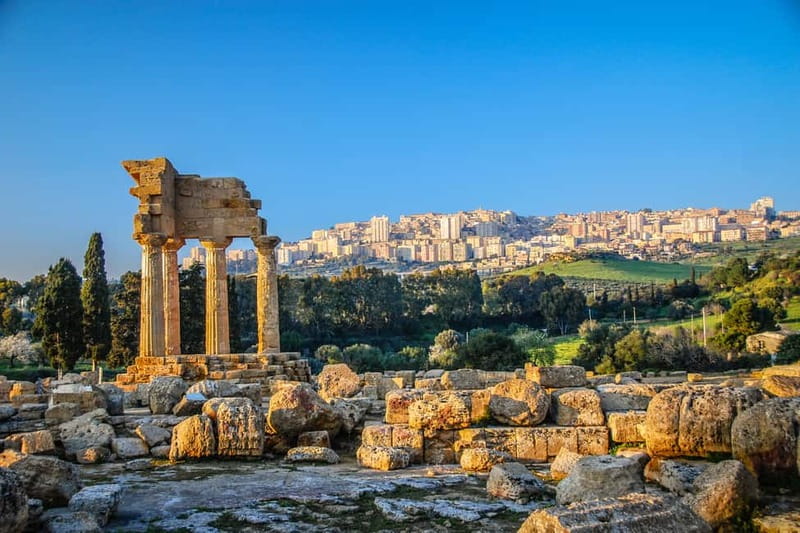
Akragas was founded in the sixth century BC as a Greek colony. In its prime, it was one of the major Greek cities on the Mediterranean, and the remains still give you a clear sense of its scale and ambition.
This is not a compact ruin where you see everything in half an hour. The archaeological area extends over roughly 1,300 hectares, with temples spread along terraced ground. You walk between ancient buildings, open spaces, aqueducts, and views across the Sicilian countryside toward the coast.
The setting is part of the appeal. The temples are not boxed into a museum. They sit in open air, with scrub, almond trees, stone paths, and broad views around them. That openness makes the visit feel more like a walk through an ancient city than a quick stop at a single monument.
The site can also be tiring. Summer afternoons are hot, shade is limited, and the main route requires steady walking. The distance is not described as strenuous, but you should bring water and wear sensible shoes. If you have children or limited mobility, plan your route rather than trying to see every corner.
More audio tours around Italy:
- Rome: Pantheon Fast-Track Ticket and Official Audioguide
★ 4.5 · 27,353 reviews - Rome: Colosseum & Forum with Audio Guide App -Optional Arena
★ 4.2 · 24,770 reviews - Florence: Timed Entry to Michelangelo’s David + Audio App
★ 4.6 · 19,496 reviews
Starting at the Temple of Juno entrance
Your visit begins at the Temple of Juno ticket office on Via Panoramica Valle dei Templi. This detail matters because the voucher can only be exchanged there. Do not assume every entrance can process the booking.
You still need to pass a security check. If you booked a reduced-price ticket, bring valid identification. Once inside, the ticket is valid for a single entry, so make sure you have everything you need before crossing the gate.
The ticket is marketed as skip-the-line access, and it can save time when the regular ticket queue is long. But the process is not always completely queue-free. You may need to wait briefly to exchange the QR code for the actual paper ticket, then deal separately with the audioguide arrangements.
That extra step is the main practical weakness. If the site is quiet, buying directly may be just as easy. If you arrive during a busy period, the shorter exchange queue may still be useful. Arriving early can also help with heat and crowds.
The Temple of Juno and the first views
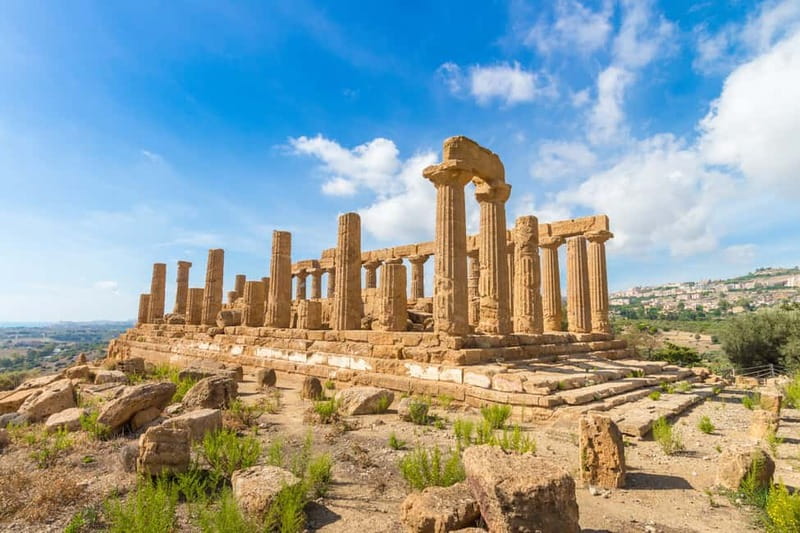
The Temple of Juno is a strong place to begin. It sits on the higher end of the ancient ridge, so you get an immediate sense of the route ahead and the scale of the site.
The temple is built in the Doric style, with the sturdy proportions and plain strength associated with Greek architecture. From here, the path leads through the main archaeological zone toward the better-preserved Temple of Concordia and other major remains.
Take a moment to look outward before focusing only on the stones. The views across the surrounding area are one of the pleasures of the visit, and the elevated position helps you understand why this ridge was such an important public and religious center.
The route is generally easy to follow with the site map, but some visitors would appreciate clearer signs and more information at certain points. The audioguide is meant to fill that gap, though its quality and ease of use may not be consistent for every phone or listener.
Temple of Concordia, the site’s finest monument
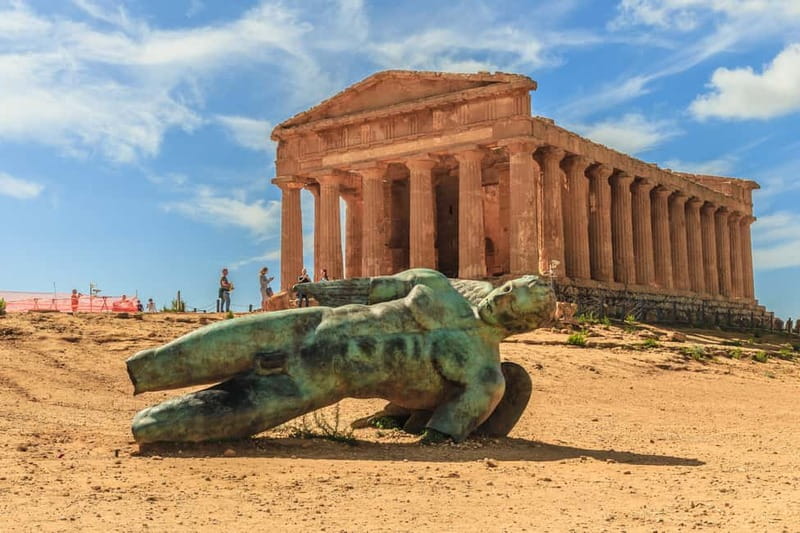
The Temple of Concordia is the main event. Its columns, steps, and overall form remain unusually complete, making it easier to picture an ancient Greek temple than at many other archaeological sites.
I find this is where the visit becomes most rewarding. At the Temple of Juno, you are getting the scale and setting. At Concordia, you can study the structure itself: the rows of columns, the heavy stone, and the careful balance of the Doric design.
The monument has the kind of presence that needs no elaborate presentation. Still, context makes a difference. Use the audioguide if it works well for you, or read the information panels and map. Without some explanation, it is easy to walk past ancient stones without understanding their original role.
The temple is also a good place for photographs. Morning light can be gentler, while late afternoon gives the stone a warmer color. A visit around sunset is especially appealing, though timing and daylight change by season.
Same sights, a different narrator:
- Rome: City Sightseeing Hop-on Hop-off Bus with Audioguide
★ 4.0 · 16,045 reviews - Pompeii: Entry Ticket with Audio Guide
★ 4.1 · 13,491 reviews - Venice: La Fenice Opera House Entry Ticket with Audio Guide
★ 4.6 · 11,742 reviews - Rome: Colosseum, Forum, Palatine Hill Entry & Audioguide App
★ 4.4 · 10,957 reviews
The Temple of Heracles and the Temple of Zeus
The Temple of Heracles, also known as the Temple of Hercules, is another major stop along the route. Its remaining columns and broken sections show both the strength of the original design and the damage caused by time.
Compared with Concordia, this is a more fragmentary monument. That is not a weakness, but it does require more imagination. Look at the spacing of the columns and the fallen blocks rather than expecting a complete building.
The Temple of Zeus gives you a different impression of ancient ambition. The site includes large architectural elements connected with this enormous temple complex, and the scale helps explain the power Akragas once held.
These stops are best taken slowly. You do not need to rush from one famous name to the next. Study the stonework, compare the preservation of each temple, and use the open views to understand how the buildings once related to one another.
The exact route and presentation may feel less polished than a modern museum. Some areas have limited explanation, and the audioguide may not always provide the depth you want. If you enjoy ancient architecture, bring a little background reading or use the signs as you go.
Aqueducts, terraces, and the old public center
The Valley of the Temples is not only a row of temples. The terraced levels once formed part of the public life of the Greco-Roman city, and the aqueducts show the practical side of ancient settlement.
These remains help you see Akragas as a functioning city rather than a collection of religious buildings. People needed water, roads, public areas, athletic facilities, and places for education and recreation. The wide site gives you room to consider all of those parts together.
The aqueducts are less instantly famous than Concordia, but they add depth to the visit. Look for changes in ground level and the way the archaeological remains spread across the ridge. You are walking through an urban area that once supported daily life as well as ceremonies.
This is also where heat can become a real factor. Much of the route is open, and an afternoon visit may feel harder than the distance suggests. Bring plenty of water, and consider a morning or evening time slot if you are visiting in summer.
The gymnasium and the final part of the route
The gymnasium was used for athletic, educational, and recreational activities. Its remains add another layer to the site because they show that Greek civic life was not limited to temples and worship.
I like ending with this section because it widens the story. After seeing the grand religious buildings, you get a glimpse of the institutions and activities that shaped ordinary public life.
The route can take as long as you choose within the day. A quick visit might focus on the major temples, while a slower visit gives you time for the gymnasium, aqueducts, terraces, photographs, and the views.
If you are walking with young children, divide the visit into sections. The route is manageable, but the combination of heat, open ground, and repeated stone ruins can wear them down. A cafe partway along the route may provide a useful break, though you should not rely on every facility being convenient or fully available.
How useful is the digital audioguide?
The digital audioguide is included, which makes the package more attractive than a bare entry ticket. It gives you a way to add context without joining a fixed group or following a live guide.
That flexibility suits independent visitors. You can stop when you want, take photographs, skip sections, and move at your own pace. You are not tied to a guide’s schedule or to the pace of strangers.
The weak point is reliability and content. Some people found the app audioguide disappointing, while others had trouble getting only one phone in a group to scan the QR code. There were also comments about the local audio equipment being more useful than the included option.
For that reason, treat the audioguide as a bonus rather than the sole reason to buy this ticket. Download or open everything before you begin if possible, and keep the map and written signs in play. If you are especially interested in Greek architecture, a live guide or a better-supported audio option may give you more detail.
There is no live guide included, so you should not expect personal explanations or help along the route. The tradeoff is privacy and freedom, which many people prefer at an archaeological site this large.
The Pemcards postcard extra
The ticket includes access to Pemcards, which lets you turn a digital photograph into a real postcard sent to an address anywhere in the world.
It is a charming idea, especially after photographing Concordia or the temples under evening light. You get a physical souvenir without carrying another object through the rest of your trip.
The practical issue is finding the Pemcards stand. Its location may not be obvious, and staff may not always be able to point you to it. If this matters to you, ask about it as soon as you enter rather than waiting until the end.
I would view Pemcards as a small extra, not a reason to choose the ticket. The temples and the entry access are the main purchase.
Choosing the best time to visit
Time of day can change the whole experience. Early morning usually gives you cooler conditions and a better chance of walking before the heat builds.
Late afternoon is another strong choice. The stone can take on warmer color, and an evening slot may let you see the temples first in daylight, then illuminated after sunset. The transition from sunlight to evening is one of the most memorable ways to experience the site.
The tradeoff is that later visits leave less daylight for the farthest sections. Check the available starting times and sunset conditions for your date before booking.
Avoid assuming that every summer afternoon will be comfortable. The site has open stretches and limited shade, so water, a hat, sunscreen, and light clothing matter. The walking is not described as strenuous, but the exposure makes it more demanding than a short urban sightseeing stop.
Price, access, and overall value
At $19 per person, this ticket sits in the convenience category rather than the cheapest-entry category. You are paying for advance booking, a skip-the-line arrangement, the digital audioguide, and access to the I Tesori d’Italia exhibition through December 31, 2025.
That can be fair value when the ticket office is busy or when you want your entry organized before arriving. The included audioguide also adds something for independent visitors.
But you should compare the current price carefully. Some people found the standard on-site entry cheaper, with one quoted price of about €13, and some preferred a combined ticket that also covered the museum. Prices and combinations can change, so check what is available for your date.
The skip-the-line claim also needs a practical reading. You may avoid the main ticket queue, but you still exchange the voucher for a physical ticket. In a quiet period, that may save little or no time.
The value is strongest if you visit during a busy season, want a prearranged entry, and appreciate having an audio option. It is weaker if you are visiting at a quiet time, do not need the app, or want a museum combination.
Getting there and moving around the site
Transportation is not included. You must arrange your own way to the archaeological area, so this ticket is best for people who already have transport plans.
A taxi from Agrigento’s old section has been cited at roughly €10 to €15, and the site can also work as a day trip by train with a taxi connection. If you drive, parking has been described as good value, but the entrance arrangement still matters because your voucher exchange point is specifically the Temple of Juno office.
The site has more than one access point, but the voucher exchange instruction applies to the Temple of Juno entrance. Follow that direction carefully rather than choosing an entrance only because it appears closer on a map.
A shuttle service can help with the return journey for about €3 each way, based on the information available. That may be useful if you walk downhill through the temples and do not want to retrace the route. Confirm the current operation and price when you arrive.
The activity is wheelchair accessible, but the broad archaeological setting and outdoor paths still make advance planning sensible. The ticket itself does not include a private vehicle or dedicated assistance.
Who should book this Agrigento ticket?
I would choose it if you want a simple, self-paced visit and prefer to arrange entry before arriving. It suits independent adults, couples, families who can manage outdoor walking, and anyone who wants to spend time photographing the temples without following a group.
It is also a good fit for a sunset visit, provided the available entry time works with your schedule. The chance to see the temples in daylight and under evening lighting adds real value.
I would pause before booking if you are looking for a detailed archaeological explanation from a person. There is no live guide, and the digital audioguide may not be enough for serious history or architecture enthusiasts.
I would also compare direct entry and combined museum tickets before paying $19. The convenience may justify the extra cost in a busy period, but it is not automatically the best deal on a quiet day.
Should you book it?
Book this ticket if the price is close to the current official entry cost, you want advance planning, and you value the chance to bypass the main queue. The Valley of the Temples itself is the reason to come: Concordia, Juno, Heracles, Zeus, the aqueducts, and the gymnasium create a powerful half-day or full-day visit.
Before buying, check three things: the current direct-entry price, the availability of a combined museum ticket, and the timing of your visit. If you arrive early or near sunset with water and good shoes, you will get more from the site than someone who turns up in the hottest part of the afternoon.
The audioguide and Pemcards are useful extras, but they should not decide the purchase. Choose this experience for the archaeological park, then treat the digital features as added convenience.
FAQ
Where do I exchange the voucher?
You must exchange the voucher at the Temple of Juno ticket office near the Temple of Juno on Via Panoramica Valle dei Templi. This is the only stated location for voucher exchange.
How long is the ticket valid?
The ticket is valid for one day. It allows a single entry into the Valley of the Temples.
Is a live guide included?
No. The experience includes a digital audioguide, but it does not include a live guide.
Is transportation included?
No. You must arrange your own transportation to the archaeological site. A taxi or other local transport is not part of the ticket.
Is the site wheelchair accessible?
Yes, the activity is listed as wheelchair accessible. The site is large and outdoors, so you should still consider the paths, walking distance, and heat when planning your visit.
Can I cancel the booking?
Yes. You can cancel up to 24 hours in advance for a full refund. A reserve-now-and-pay-later option is also available.
New audio tours around Italy
- Lecce Walking Tour with Audio and Written Guide by a Local★ 4.0 · 38 reviews
- Private Audio Guided Walking Tour in Lecce★ 4.0 · 7 reviews
- Private Audio Guided Walking Tour in Como★ 3.0 · 3 reviews
- Como Walking Tour with Audio and Written Guide by a Local★ 4.5 · 30 reviews
- Finance and Nobility: Explore medieval Genoa on a self-guided audio tour★ 4.5 · 7 reviews
- Genova Walking Tour with Audio and Written Guide by a Local★ 4.5 · 33 reviews
- Udine Walking Tour with Audio and Written Guide by a Local★ 4.0 · 2 reviews
- Florence: Uffizi Gallery Timed Entry Ticket with Audio★ 3.0 · 3 reviews
Italy Audio Tours, compared.
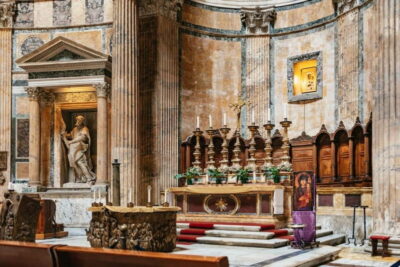
Rome: Pantheon Fast-Track Ticket and Official Audioguide
Read our review →
Rome: Colosseum & Forum with Audio Guide App -Optional Arena
Read our review →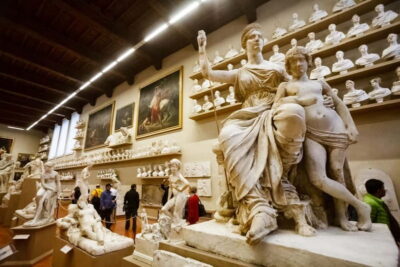
Florence: Timed Entry to Michelangelo’s David + Audio App
Read our review →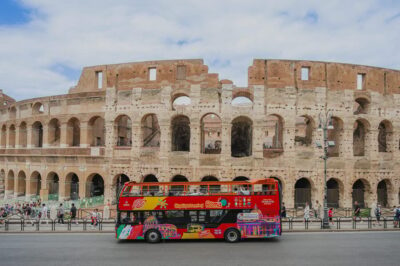
Rome: City Sightseeing Hop-on Hop-off Bus with Audioguide
Read our review →

Venice: La Fenice Opera House Entry Ticket with Audio Guide
Read our review →
Rome: Colosseum, Forum, Palatine Hill Entry & Audioguide App
Read our review →