Review · ITALY
Alghero: Anghelu Ruju Necropolis with Audio Guides
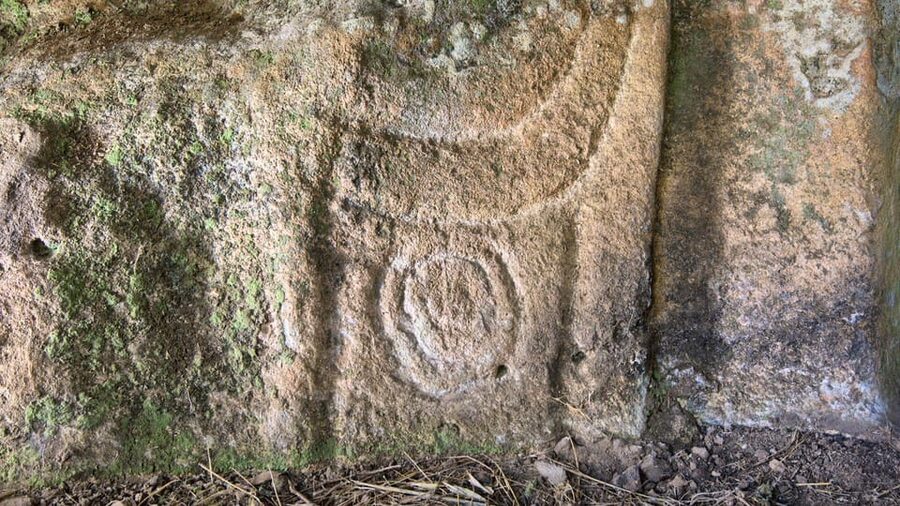
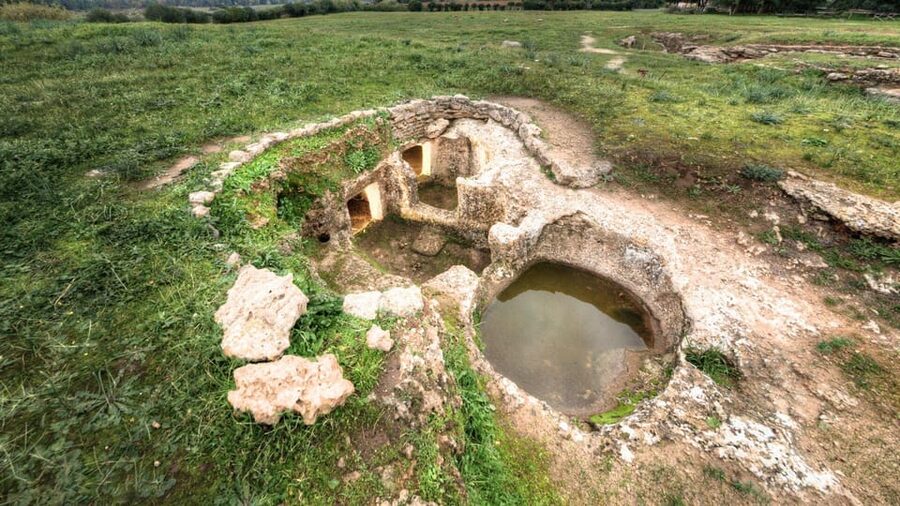
Anghelu Ruju is not a grand temple or a polished museum. It is a prehistoric cemetery cut into the rock, where small underground chambers copy the rooms and details of ancient homes. The most striking sights are the bull-head carvings, false doors, pillars, steps, and other symbols linked to Sardinian beliefs about death and nature.
I like the freedom of the self-guided audio tour, especially since you can stop at the tombs that interest you instead of keeping pace with a group. I also like the low $10 price and the chance to see one of Sardinia’s largest prehistoric cemeteries in only 45 minutes. The main drawback is that the visit depends on the audio tracks and site map, and reaching the site may be difficult if you have not planned your route carefully.
Key points to know before you go
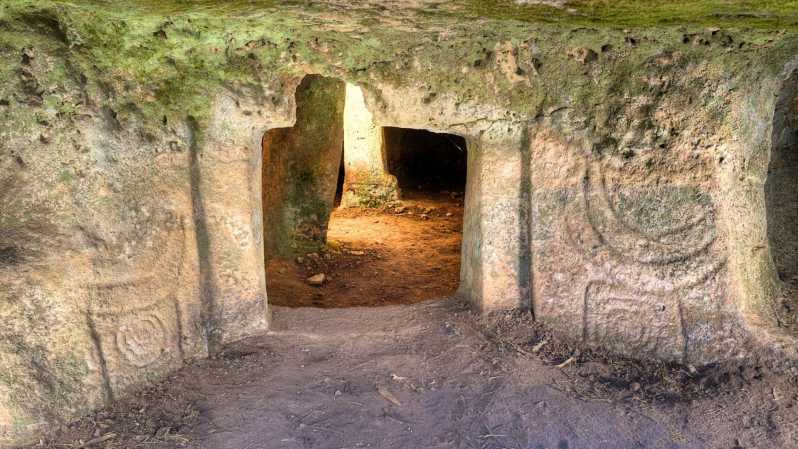
- Underground tombs from the Neolithic and Copper Age: Explore domus de janas, or fairy houses, built as burial chambers thousands of years ago.
- Audio guide instead of a live guide: Commentary is available in Italian, English, French, German, and Spanish.
- A map helps you follow the route: The ticket office gives you a detailed map with numbered listening points, but you must return it when leaving.
- Look for bull-head symbols: These ritual carvings offer clues to ancient Sardinian ideas about protection, fertility, and the natural world.
- Short, inexpensive visit: The experience lasts about 45 minutes and costs $10 per person.
- Bring your own headphones: You download the audio tracks to your phone using a QR code and password.
Why Anghelu Ruju is worth your time
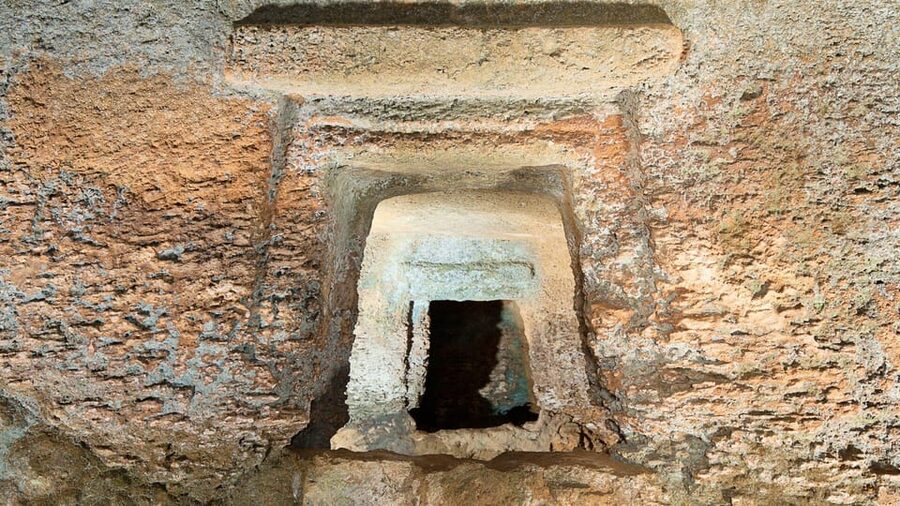
The Anghelu Ruju Necropolis gives you a close look at Sardinia before Roman roads, medieval towers, and seaside resorts. The site belongs to the island’s Neolithic and Copper Age past, when communities carved tombs into the stone and placed their dead in chambers modeled on familiar homes.
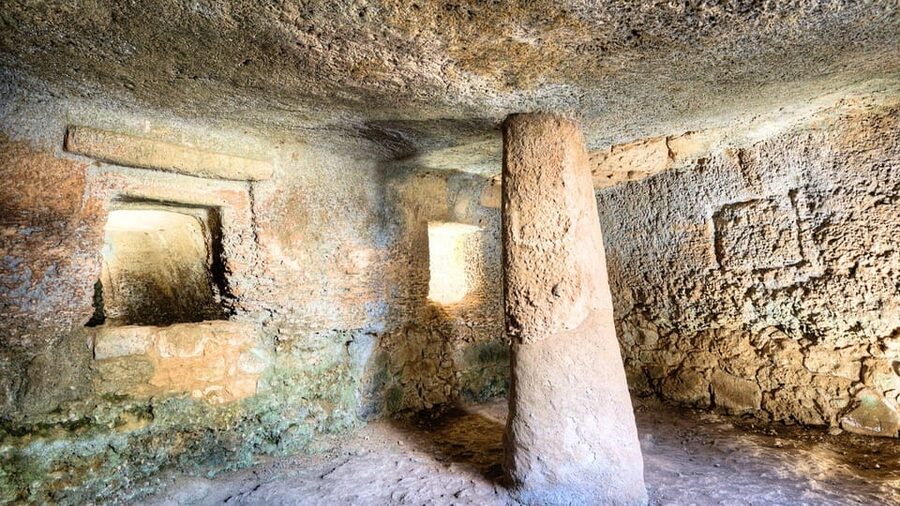
That design tells you something important. These were not just holes in the ground. The tombs include features such as steps, pillars, cornices, false lintels, false doors, and false windows. The builders repeated details from everyday houses, suggesting that the burial place was imagined as a continuation of life rather than a cold, separate realm.
The name domus de janas means fairy houses. It is a later Sardinian name for these underground tombs, not proof that the people who built them believed in fairies in the modern sense. The phrase does, however, capture the small scale and mysterious feel of the chambers.
I find the site most rewarding when I pay attention to the details rather than expecting a large monument. A carved bull’s head may occupy only part of a wall, but it connects the tomb to religious ideas shared across the ancient Mediterranean. The symbols appear to have served magical or propitiatory purposes, linked to requests for protection, fertility, or a safe passage for the dead.
More audio tours around Italy:
- Rome: Pantheon Fast-Track Ticket and Official Audioguide
★ 4.5 · 27,353 reviews - Rome: Colosseum & Forum with Audio Guide App -Optional Arena
★ 4.2 · 24,770 reviews - Florence: Timed Entry to Michelangelo’s David + Audio App
★ 4.6 · 19,496 reviews
Starting at the ticket office
Your visit begins at the archaeological site’s ticket office. Staff provide the entrance ticket, a multilingual audio guide, a QR code, and a password so you can download the audio tracks directly to your phone.
You also receive a detailed map. This is more important than it sounds. The map shows the route through the cemetery and gives the number of each audio track, along with the points where you should stop to listen.
Take a moment here to get your bearings. A verified booking experience in March 2025 described the arrival as difficult and the on-site service as unclear. Another visit in September 2025 found it hard to match the audio instructions with tomb numbers that were not clearly marked on the ground. Those problems do not make the archaeology less worthwhile, but they do make the map essential.
If the route is not immediately clear, ask the ticket-office staff to point out the first stop before you set off. You should also check that the audio tracks have downloaded properly while you are still near the entrance.
The map must be returned when you leave. Keep it flat and dry as you walk around, and do not assume you can take a photograph of it unless the staff allow it.
Following the 45-minute audio route
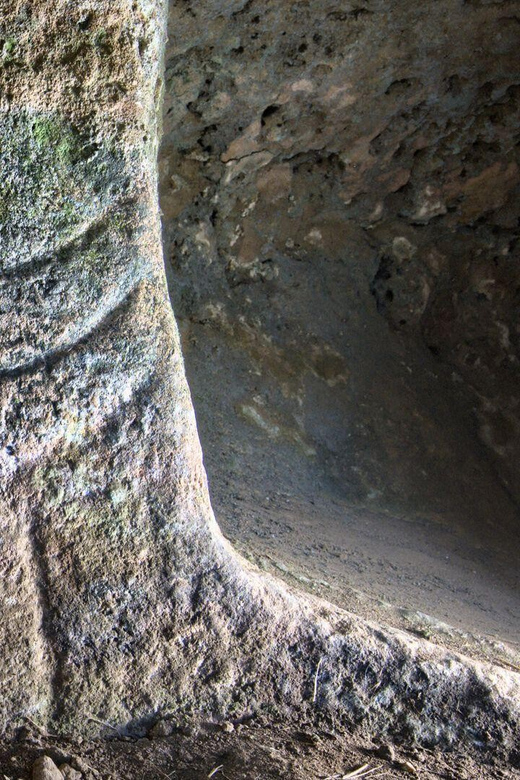
The visit is designed to take about 45 minutes. That is enough time for a focused look at the cemetery, but not enough for a slow archaeological study of every chamber.
The route moves between tombs of different sizes and designs. Some are simple, while others are more monumental. The contrast helps you see that the cemetery was not built all at once in one uniform style. Different tombs reflect different levels of effort, changing customs, or the needs of different communities.
At each marked point, open the matching audio track. The commentary is available in Italian, English, French, German, and Spanish. Since there is no live guide included, the audio provides the main explanation of what you are seeing.
This format suits you if you like setting your own pace. You can pause the track, look closely at a carved feature, and continue when ready. It is less suitable if you want to ask detailed questions or have someone point out every feature in person.
The numbered route is meant to keep the visit simple, but the numbering may not always be obvious on the ground. Keep the map open and match the track number before moving to the next chamber. Bring headphones, since the experience is designed for personal listening and the supplied information specifically advises using your own pair.
Reading the tombs as houses for the dead
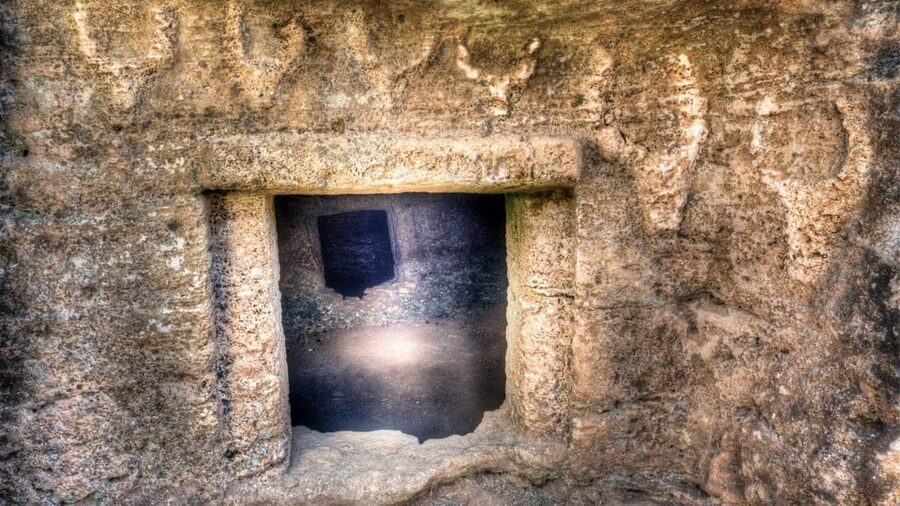
The most interesting part of Anghelu Ruju is the way the tombs imitate houses. You may see steps leading into a chamber, pillars dividing space, or false doors and windows carved into the walls.
These features were not needed for practical burial. Their purpose was symbolic. The tomb was shaped like a home, and the dead were placed inside with objects that had been useful or dear to them during life.
That detail changes the way you view the rooms. Instead of seeing bare stone chambers, you can imagine them as carefully prepared spaces with meaning for the community. The architecture expresses care for the dead and a belief that objects, familiar forms, and ritual actions could help preserve a connection between life and death.
The chambers are small, so you will get more from the visit if you look closely. Notice repeated shapes, carved lines, door forms, and the way the rooms are arranged. The audio commentary should help explain why an apparently simple mark matters.
Do not expect every chamber to be fully dramatic or easy to photograph. Some tombs are modest, and the main reward comes from understanding how they fit into a wider system of beliefs.
Same sights, a different narrator:
- Rome: City Sightseeing Hop-on Hop-off Bus with Audioguide
★ 4.0 · 16,045 reviews - Pompeii: Entry Ticket with Audio Guide
★ 4.1 · 13,491 reviews - Venice: La Fenice Opera House Entry Ticket with Audio Guide
★ 4.6 · 11,742 reviews - Rome: Colosseum, Forum, Palatine Hill Entry & Audioguide App
★ 4.4 · 10,957 reviews
Finding the bull-head symbols
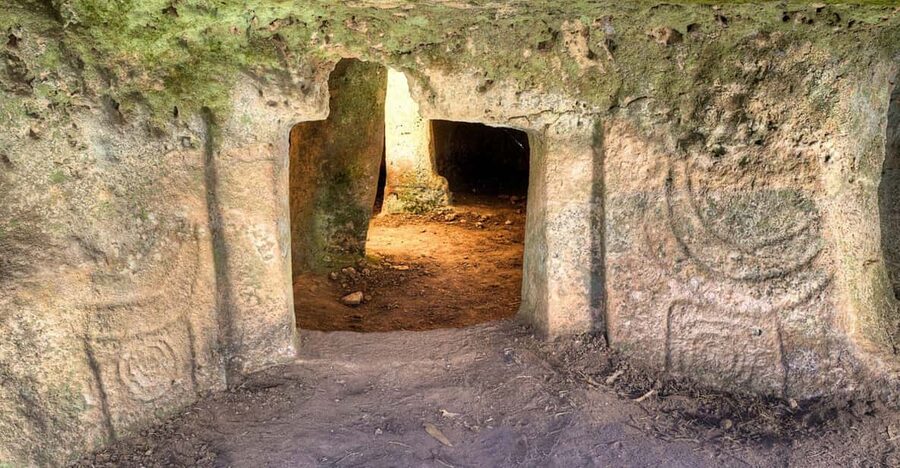
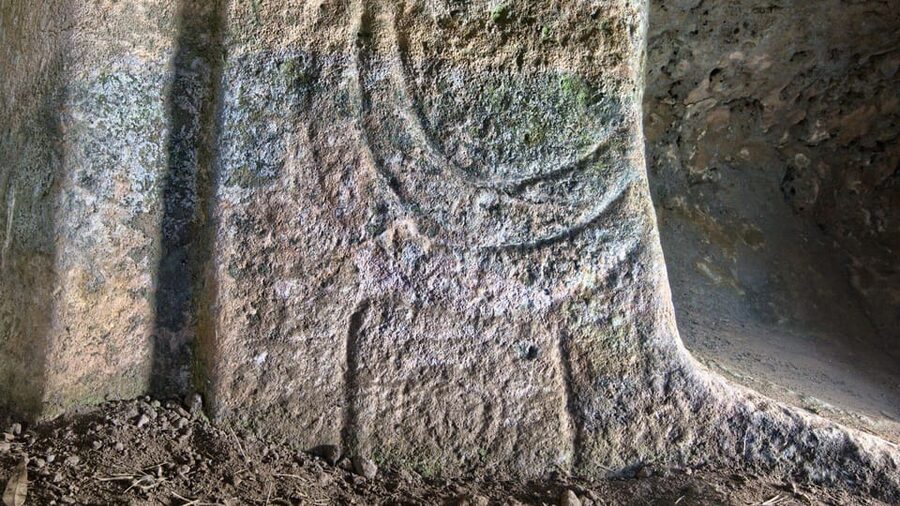
Watch for the bull-head designs and other enigmatic marks. These are among the most distinctive features at the site.
The bull held strong symbolic value in many ancient Mediterranean cultures. At Anghelu Ruju, the carved horns and head shapes are connected with ritual beliefs and propitiatory rites. You do not need to know every scholarly theory to appreciate what they show: the tombs were places of ceremony, not merely storage rooms for the dead.
The symbols also point to a close relationship between people and the natural world. Ancient Sardinian communities depended on animals, crops, weather, and the seasons. Their burial customs reflect a world in which nature had spiritual force.
The audio guide is particularly useful here because these carvings may not be obvious at first glance. Look at the wall before listening, then return your attention to the feature described. That small habit makes the visit more active and helps you remember what you saw.
What the price includes
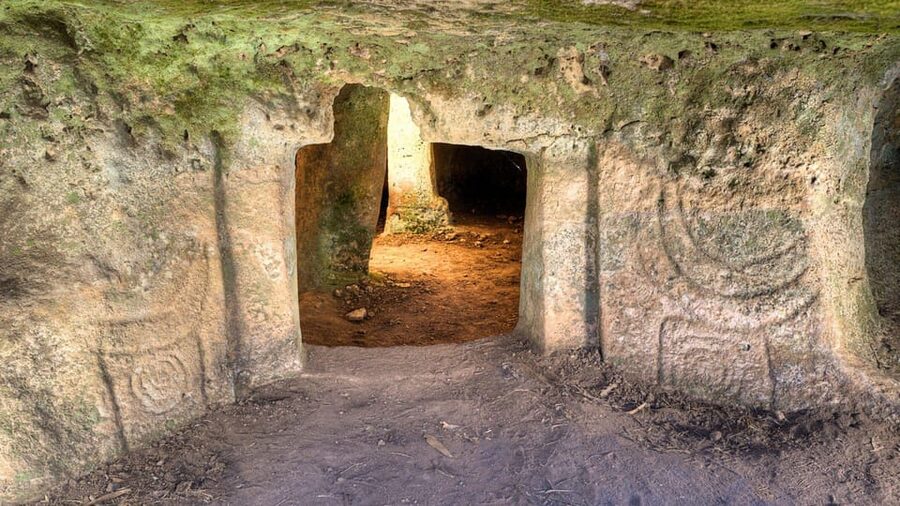
At $10 per person, this is a good-value short stop if you are already exploring the Alghero area. The price includes admission to the necropolis and the audio guide in five languages.
You are not paying for transportation, a private archaeologist, or a live walking guide. That keeps the cost low, but it also means the quality of your visit depends on your phone, headphones, the map, and your ability to follow the numbered route.
For a 45-minute experience, $10 is reasonable. It works especially well as part of a day focused on ancient Sardinia, rather than as the sole reason to travel a long distance. If you are making a special trip only for the site, take the arrival difficulty seriously and confirm your route before setting out.
The audio guide adds real value because the tombs can be difficult to interpret without context. You may recognize a doorway or chamber, but the explanation of burial objects, ritual symbols, and house-like design turns the visit into something more than a quick look at old stone.
Timing, comfort, and practical details
From November through March, the site is open from 10:00 a.m. to 2:00 p.m. From April through October, visiting hours run from 10:00 a.m. to 6:00 p.m. The experience is available on an hourly basis, so check the available starting time when booking.
Wear comfortable shoes and clothes. Bring a hat and sunscreen, since parts of the visit may be exposed to the sun. The site has one toilet for men, women, and disabled visitors.
The necropolis is wheelchair accessible. Still, the tombs themselves are underground spaces with carved entrances and compact interiors, so anyone with particular mobility needs should confirm how much of the route is accessible before arrival.
Small dogs may enter on a leash. Larger dogs require both a leash and a muzzle. The information provided does not give details about shade, seating, or transport, so plan around the short duration and arrive prepared.
Free cancellation is available up to 24 hours in advance, and you can reserve now and pay later. Those options are useful if your Sardinia plans are still shifting.
Who will enjoy this visit most
I would recommend Anghelu Ruju to anyone who likes archaeology, ancient religion, or places that reveal daily life through small details. It is also a good choice for visitors who want a short cultural stop away from the usual coastal sights.
Families with older children may find the fairy-house name and underground chambers appealing. The visit is brief enough to hold attention, and the bull-head carvings give children something specific to look for. Very young children may find the small chambers less engaging, especially if they cannot follow the audio commentary.
The experience suits independent sightseers who are happy to use a phone and map. If you prefer a guide who walks beside you, answers questions, and keeps the group organized, this may feel too hands-off.
Language should not be a barrier. Audio tracks are offered in Italian, English, French, German, and Spanish. Just remember that you need your own headphones.
The main drawbacks to weigh
The biggest concern is navigation. One recent visit found it difficult to reach the site, and another had trouble matching the audio numbers to tomb numbers in the cemetery. Since the experience is self-guided, confusion at the start can affect the whole visit.
The answer is simple but important: arrive early enough to download the tracks, study the map, and ask the ticket-office staff to explain the first stop. Do not walk off assuming the numbering will be obvious.
The second limitation is the lack of a live guide. The audio commentary gives you structure, but it cannot respond to questions or adjust its explanations to your interests. You will need to bring your own curiosity and pay attention to the map.
These are manageable drawbacks at $10, especially if you treat the visit as a short archaeological stop rather than a full guided tour.
Should you book Anghelu Ruju?
Book it if you want a low-cost, focused look at Sardinia’s prehistoric burial customs and you enjoy discovering meaning in carvings, symbols, and unusual architecture. The domus de janas are genuinely distinctive, and the bull-head motifs make this more memorable than a simple collection of old tombs.
Skip it if you want a polished guided experience, easy on-site orientation, or a long list of major monuments. The visit is short, self-guided, and dependent on the map and audio tracks.
For most independent visitors near Alghero, I think the $10 admission is worth it. Bring headphones, download the tracks at the ticket office, follow the map carefully, and give yourself enough time to understand the tombs rather than rushing through them.
FAQ
How long does the Anghelu Ruju visit take?
The experience lasts about 45 minutes.
How much does admission cost?
The price is $10 per person.
Is a live guide included?
No. The visit is self-guided with audio commentary. Staff at the ticket office provide the audio guide and site map.
Which languages are available for the audio guide?
Audio guides are available in Italian, English, French, German, and Spanish.
Do I need to bring headphones?
Yes. You should bring your own phone headphones to listen comfortably to the audio tracks.
What are the opening hours?
From November to March, the site is open from 10:00 a.m. to 2:00 p.m. From April to October, it is open from 10:00 a.m. to 6:00 p.m.
Is the necropolis wheelchair accessible?
Yes, the experience is listed as wheelchair accessible.
Are pets allowed?
Yes. Pets are allowed on a leash, and larger dogs must also wear a muzzle. Small dogs only need a leash.
New audio tours around Italy
- Lecce Walking Tour with Audio and Written Guide by a Local★ 4.0 · 38 reviews
- Private Audio Guided Walking Tour in Lecce★ 4.0 · 7 reviews
- Private Audio Guided Walking Tour in Como★ 3.0 · 3 reviews
- Como Walking Tour with Audio and Written Guide by a Local★ 4.5 · 30 reviews
- Finance and Nobility: Explore medieval Genoa on a self-guided audio tour★ 4.5 · 7 reviews
- Genova Walking Tour with Audio and Written Guide by a Local★ 4.5 · 33 reviews
- Udine Walking Tour with Audio and Written Guide by a Local★ 4.0 · 2 reviews
- Florence: Uffizi Gallery Timed Entry Ticket with Audio★ 3.0 · 3 reviews
Italy Audio Tours, compared.
Rome: Pantheon Fast-Track Ticket and Official Audioguide
Read our review →
Rome: Colosseum & Forum with Audio Guide App -Optional Arena
Read our review →
Florence: Timed Entry to Michelangelo’s David + Audio App
Read our review →
Rome: City Sightseeing Hop-on Hop-off Bus with Audioguide
Read our review →

Venice: La Fenice Opera House Entry Ticket with Audio Guide
Read our review →
Rome: Colosseum, Forum, Palatine Hill Entry & Audioguide App
Read our review →