
Review · BULGARIA
Audio Guide for Museum Paleontology and Historical Geology
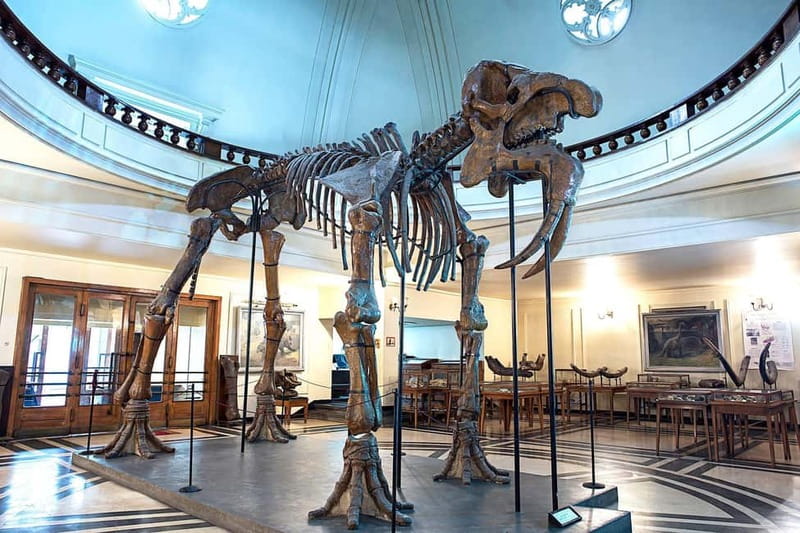
The museum’s main attraction is hard to miss: a 7-meter Deinotherium skeleton rising beneath the dome of Sofia University’s northern wing. More than 90% of its bones are authentic, giving this ancient mammal a stronger sense of presence than a display built mostly from replicas.
I like two things here. First, the museum gives you access to more than 200,000 fossil specimens, rock samples, and geological maps without the cost or time commitment of a large city attraction. Second, you walk through the corridors of Bulgaria’s oldest university while following your own audio guide in four languages.
The main drawback is that the audio guide is not a live tour. You need your own phone and mobile internet, and the museum entrance ticket costs extra. The university building is large, so finding the fifth-floor museum takes a little care.
Key points to know before you go
- The Deinotherium skeleton is over 7 meters long and 4.20 meters high, with more than 90% original bones.
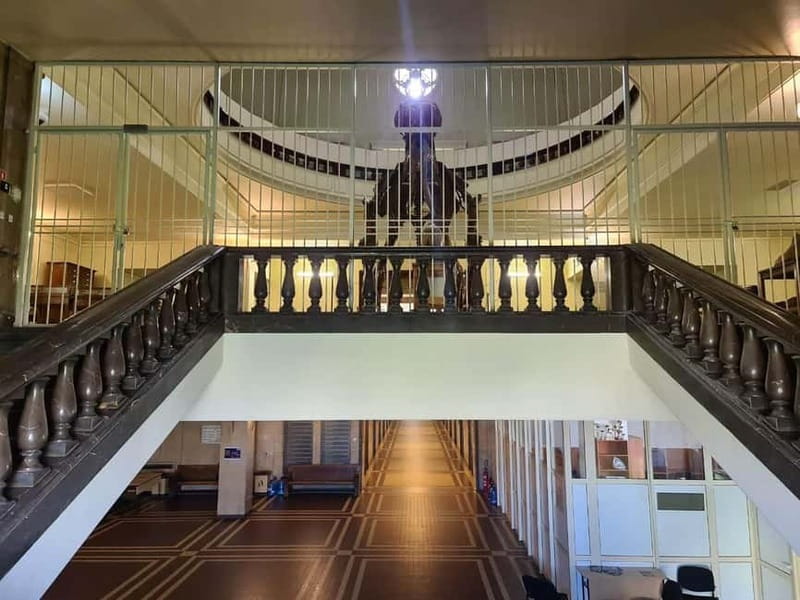
- The museum sits on the fifth floor of Sofia University, beneath the dome of the northern wing.
- The collection includes more than 200,000 items, including fossils, rocks, and geological maps.
- The audio guide activates for 24 hours on the date you choose and works without an app or download.
- English, Bulgarian, Italian, and Spanish recordings are available, making this a flexible choice for independent visits.
- The audio guide costs about $4.12 per person, while museum admission is separate at €1, or 2 BGN.
A giant Deinotherium under Sofia University’s dome
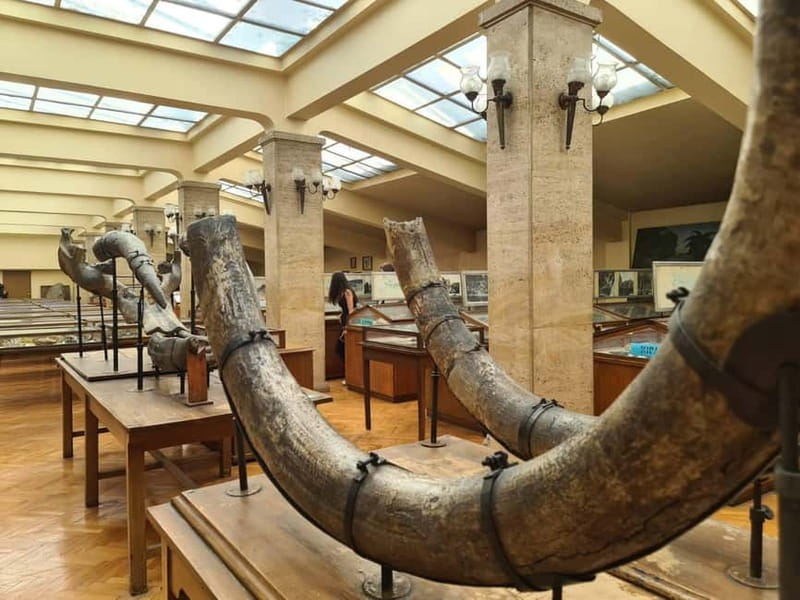
Begin with the skeleton directly opposite the entrance. Deinotherium thraciensis Nikolov was an enormous prehistoric relative of modern elephants, and the scale is the first thing you notice. At 7 meters long and 4.20 meters high, it fills the central space in a way that makes the rest of the museum feel like a supporting cast.
The important point is not only its size. More than 90% of the skeleton consists of authentically preserved bones. That gives you a rare chance to look at an ancient animal through a nearly complete original structure rather than a reconstruction made mostly from plaster or modern substitutes.
Take a moment to look at the arrangement from different angles. The museum places the skeleton in a central position, directly opposite the entrance, so you do not need to search for it. If your visit is short, this is the one display you should not miss.
The Deinotherium also gives the museum a clear focus. Fossils and rock samples can be difficult to understand when seen one by one. A huge skeleton provides an immediate connection between the geological material around you and the creatures that once lived during those distant ages.
More Museum Audio Tours in the world:
- Florence: Uffizi Priority Ticket & Masterpieces Audio App
★ 4.2 · 6,402 reviews - Paris: Louvre Museum Hosted Entry and Mona Lisa Audioguide
★ 4.6 · 5,235 reviews - Venice: St. Mark Basilica Ticket, Audioguide+History Gallery
★ 3.9 · 4,780 reviews
What the 200,000-item collection adds
The museum houses more than 200,000 fossil specimens, rock samples, and geological maps from Bulgaria and nearby territories. You should not expect to examine every item during a single visit. Instead, think of the collection as a broad introduction to the geology and paleontology of the region.
The fossils show how life changed over very long periods. The rock samples help explain the physical ground beneath Bulgaria and its neighboring areas. The geological maps add a useful geographic layer, showing that the museum is not only about extinct animals but also about the formation and structure of the region itself.
I find this mix valuable because it avoids making paleontology feel like a display of isolated bones. You get animals, minerals, rocks, and maps in one setting. The result is a wider view of how the natural world developed over geological time.
The museum’s size may also suit you if you prefer a focused cultural stop. You can spend time with the central skeleton, listen to selected audio tracks, and look through the displays without setting aside half a day. The stated duration is one day because the audio access remains valid for 24 hours, not because you need an entire day inside the museum.
Walking through Bulgaria’s oldest university
The setting is part of the experience. The museum is in Sofia University, Kliment Ohridski, described as Bulgaria’s oldest university. You will walk along university corridors before reaching the exhibition space on the fifth floor.
That approach gives the visit a different feel from entering a purpose-built museum. You are moving through an active historic academic building, then arriving at a collection linked to scientific study. The building itself helps explain why the museum feels more like an academic collection than a large tourist attraction.
The university is very large, so you should use the PDF guide supplied with your booking. Photos of the entrance are also provided to help you identify the correct way in. Do not treat the meeting point as simply the university address. You need the fifth floor and the museum entrance inside the building.
This is the one logistical detail worth taking seriously. The museum’s low price is appealing, but the visit is not designed around a prominent street-level entrance with obvious signs. Give yourself enough time to find the building entrance and make your way upstairs.
How the phone audio guide works
After payment, you receive an email with a link to the audio files. The link becomes active on the date you choose to visit and remains valid for 24 hours. You listen through your phone, so you need mobile internet during the visit.
There is no app to install and no audio download required. The player opens directly, and data use is described as minimal. That makes the system simple, especially if you do not want another travel app taking up space on your phone.
The tradeoff is that this is a self-guided visit. You control the pace, but you cannot ask a guide to explain a display or adjust the route for your interests. I see that as a benefit if you like stopping for photographs or reading at your own speed. It matters less if you prefer a person to lead you through the collection.
The four language choices are practical: Bulgarian, English, Italian, and Spanish. Check that your phone has a reliable connection before you begin. Since the access lasts 24 hours, you do not need to rush through the recordings in one sitting, although the museum visit itself remains subject to its opening arrangements.
More History Audio Tours in the world:
- Colosseum, Roman Forum & Palatine Hill with Audioguide App
★ 4.4 · 6,291 reviews - Rome: Colosseum, Ancient Rome Tour or AudioGuided Tour
★ 4.4 · 2,879 reviews - Colosseum, Roman Forum & Palatine Hill Entry and Audioguide
★ 4.1 · 2,475 reviews - Taormina: Ancient Theater Skip-the-Line Ticket & Audio Guide
★ 4.5 · 2,412 reviews
Making sense of the visit in one day
The best approach is to treat this as a compact museum stop rather than an all-day program. Start with the Deinotherium skeleton, then use the audio guide to orient yourself to the collection. Move on to the fossils, rocks, and maps with a clearer idea of how they connect.
You might spend more time with specimens linked to Bulgaria and the surrounding territories, or you might prefer the dramatic central display. The audio format lets you choose. There is no stated group size, fixed route, or meeting with a live guide, so your experience depends mainly on how much time you give the exhibits.
Because the museum is on the fifth floor, the visit may require more wayfinding than a standard street-level attraction. The supplied PDF and entrance photos are useful here. Keep them available on your phone until you have found the museum.
If your Sofia plans already include the city center and university area, the museum can fit neatly into a day of sightseeing. The information provided does not specify transport, opening hours, or accessibility details, so you should confirm those points before setting out if they affect your plans.
Is the $4.12 audio guide good value?
At about $4.12 per person, the audio guide is inexpensive for a specialist museum. You also pay the admission ticket separately, listed as €1 or 2 BGN. Even with both costs included, the visit remains a low-cost cultural activity in Sofia.
The value comes from the combination of price and independence. You are paying for access to explanations in your chosen language, not for a full-day guided program. If you want a short, self-paced visit centered on a rare fossil skeleton, the cost is easy to justify.
The audio guide is less useful if you only plan to enter, take a quick look at the Deinotherium, and leave. In that case, you may not listen to enough material to make the guide worthwhile. It also offers less flexibility than a live specialist who can answer questions.
I would consider booking it if you enjoy museums but do not want a large group or a long tour. The low admission fee keeps the financial risk small, and free cancellation is available up to 24 hours in advance. You can also reserve now and pay later, which helps if your Sofia schedule is still changing.
Who will enjoy this museum most?
This experience suits you if you have an interest in fossils, extinct animals, geology, or university collections. Families with older children may also find the giant skeleton an easy way into a subject that can otherwise seem abstract.
It is also a good choice for independent visitors. You set the pace, choose the audio language, and decide how much attention to give each section. The 24-hour audio access gives you some flexibility, although the museum visit itself is not described as a multi-day entry.
The museum may be less suitable if you want a polished, large-scale attraction with extensive visitor services. The information provided points to a university-based collection on the fifth floor, not a major modern museum complex. You should also think twice if your phone cannot use mobile internet.
For a first visit to Sofia, this is best seen as a specialized stop rather than the city’s main attraction. Its appeal is strongest when you want something different from the usual historic sights and appreciate the chance to see original paleontological material in an academic setting.
Practical tips for a smoother visit
Keep the email link and PDF guide easy to reach before entering the university. The building is large, and the fifth-floor location means a few minutes spent checking directions can save confusion.
Bring a charged phone and confirm that mobile data works. The audio player does not require an app or download, but the guide does need an internet connection. Data use is minimal, yet the phone remains central to the experience.
Select your language before you begin. Recordings are available in English, Bulgarian, Italian, and Spanish. If you are visiting with someone who prefers another language, remember that each person needs access to the audio player if you want to listen separately.
Plan around the 24-hour activation window. The link becomes active on your selected visit date, so choose the date carefully. You can cancel up to 24 hours in advance for a full refund, and the reserve-now, pay-later option keeps your plans flexible.
Should you book the Museum of Paleontology audio guide?
Book it if you want a low-cost, independent museum visit with one genuinely memorable centerpiece. The nearly complete original Deinotherium skeleton gives the experience a clear reason to exist, while the larger collection adds fossils, rocks, and maps from Bulgaria and nearby areas.
Skip it if you want a live guide, guaranteed street-level access, or a broad tourist attraction with extensive practical details already built into the visit. You will need to find the fifth-floor museum inside a large university and use your own phone for the commentary.
For most people interested in natural history, the price is modest enough to make the visit worthwhile. Give yourself time to find the entrance, keep mobile internet available, and let the skeleton be your starting point rather than your only stop.
FAQ
Where is the Museum of Paleontology and Historical Geology?
The museum is inside Sofia University, Kliment Ohridski, in Sofia Province, Bulgaria. It is located on the fifth floor beneath the dome of the university’s northern wing.
What is the main exhibit?
The main exhibit is a restored Deinotherium thraciensis Nikolov skeleton. It is 7 meters long, 4.20 meters high, and made from more than 90% authentically preserved bones.
What else is in the museum?
The collection contains more than 200,000 fossil specimens, rock samples, and geological maps from Bulgaria and neighboring territories.
How much does the audio guide cost?
The listed price is about $4.12 per person. The museum admission ticket is not included and costs €1, or 2 BGN.
Is museum admission included in the audio guide price?
No. The admission ticket must be purchased separately.
Which languages are available?
The audio guide is available in Bulgarian, English, Italian, and Spanish.
Do I need to download an app?
No. The audio guide opens through a link, and no app or download is required.
How long does the audio guide remain valid?
The link becomes active on your selected visit date and remains valid for 24 hours. You need mobile internet to listen to the recordings.
New audio tours around the world
- London Panoramic Open Top Bus Tour with Audio Guide★ 4.0 · 209 reviews
- London: British Museum Audio Guide & Small Group Entry★ 3.5 · 81 reviews
- London: National Gallery Audio Tour (No Entry Ticket)★ 3.5 · 11 reviews
- London’s Alternative History: A Self-Guided Audio Tour★ 5.0 · 4 reviews
- London: British Museum’s English Audio Tour with Free Reservation★ 3.0 · 15 reviews
- London: Churchill War Rooms Ticket & Political London Audio Tour★ 4.0 · 83 reviews
- London: British Museum Audio Tour with Free Guaranteed Entry★ 3.0 · 30 reviews
- Houses of Parliament Ticket & Political London Audio Guide★ 4.0 · 13 reviews
Bulgaria Audio Tours, compared.
Sofia: City Monuments Guided Walking Tour with Audio Guide
Read our review →
Sofia: Rila Monastery & Boyana Church – Audio guided tour
Read our review →
From Sofia: Plovdiv with audio guide + free pick-up
Read our review →
Nessebar: Audio Guide Tour Nessebar + visit to the Winery
Read our review →
Plovdiv: Old Town Guided Walking Tour & Audioguide & Museum
Read our review →Browse the lists this tour appears in