Review · SELF-GUIDED AUDIO TOURS
Bangkok Self-Guided Audio Tour
Bangkok’s biggest sights are spread across several districts, and this self-guided audio tour gives you one simple way to connect them. You can begin anywhere, stop whenever you like, and listen only to the places that interest you. The route covers the gold Buddha at Wat Traimit, Chinatown, the Grand Palace, Wat Arun, museums, parks, and more.
I like the low $9 price and the freedom to explore alone. I also like having both a SoundCloud audio link and a Google My Maps route, since the map helps you find each stop while the audio gives basic historical context. The main drawback is that the commentary may feel too general, and some of the translation is uneven.
Key points before you book
- Twelve major sights: The route includes Bangkok’s best-known temples, royal landmarks, museums, a park, Chinatown, and two art centers.
- You set the schedule: Start and finish anywhere in Bangkok, take breaks, skip stops, or spread the experience across up to six days.
- Three hours is a brisk overview: The listed commentary is about 10 minutes per stop, before you add travel time, queues, meals, and time inside each attraction.
- Transport is your responsibility: Pick-up, drop-off, and transfers are not included, so plan carefully between districts.
- Admission costs extra: Several temples and museums require separate entrance fees.
- Basic rather than deeply researched audio: Expect focused background information, not the level of detail you would get from a live specialist guide.
What the $9 price really gives you
At $9 per person, this is an inexpensive way to add structure to an independent day in Bangkok. You receive a private access link to one audio playlist covering 12 attractions, plus a separate Google My Maps link with each location connected to its audio guide.
That matters because Bangkok can feel scattered on a first visit. The route gives you a list of places to aim for, and the map lets you see how the stops fit together. You do not have to wait for a group, follow a flag, or keep pace with a guide.
The price does not include temple or museum admission. It also excludes transport, earphones, internet or Wi-Fi, and food and drinks. That makes the tour best viewed as a low-cost orientation tool, not a full sightseeing package.
You should also budget for your own route between districts. The 12 sites are not all next to one another. A three-hour outing can give you a quick introduction, but seeing every location properly would take longer, particularly if you enter the Grand Palace, museums, or Wat Arun.
More Self-Guided Audio Tours in the world:
- Athens: Acropolis Ticket & Optional Self-Guided Audio Tours
★ 4.1 · 2,542 reviews - Gettysburg Battlefield Self-Guided Driving Audio Tour
★ 4.5 · 910 reviews - Joshua Tree National Park Self-Guided Driving Audio Tour
★ 4.5 · 762 reviews
How the audio and map work
On your selected date, before your chosen starting time, you receive two links by email. The first opens the audio content through a secure SoundCloud web link. You can play individual sections or listen through the full playlist before setting out.
The second link opens a Google My Maps route. Each marked location connects to the matching audio section, so you can use the map to find a stop and then start the relevant commentary.
This setup is easy to understand, but you need your phone, working access to the links, and your own earphones. The tour description says you can listen offline, though it does not explain the exact download process. I would check the audio before leaving your hotel and save anything the platform allows you to save.
The audio is designed to give you short, focused context while you look around. Each stop is listed at about 10 minutes. That is enough to explain why a place matters, but not enough for a detailed account of every building, ruler, ritual, or work of art.
This is also where expectations matter. The commentary may seem superficial if you already know Bangkok well or prefer long historical explanations. Some wording has been described as poorly translated, so you should treat the narration as a helpful starting point rather than the final word on every subject.
Wat Traimit and the gold Buddha
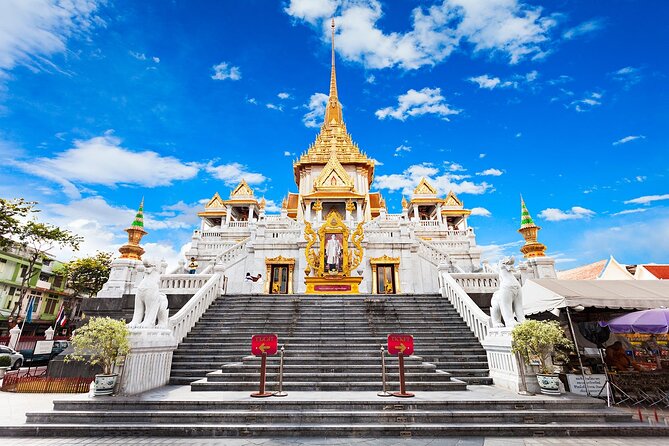
The route begins with Wat Traimit, also called the Temple of the Golden Buddha. Its main draw is a solid gold Buddha statue described as the largest of its kind in the world.
The unusual part is the statue’s accidental discovery. The audio explains how its true material was hidden for years before being recognized. That story gives the visit more weight than a quick photograph would suggest, and the temple also introduces the place of Buddhist worship in Bangkok.
The listed audio time is 10 minutes, while admission is not included. If you are already in Chinatown, Wat Traimit is a sensible first stop. Give yourself extra time if you want to enter, look around, and understand the setting rather than simply hear the explanation outside.
Chinatown’s food, markets, and Chinese heritage
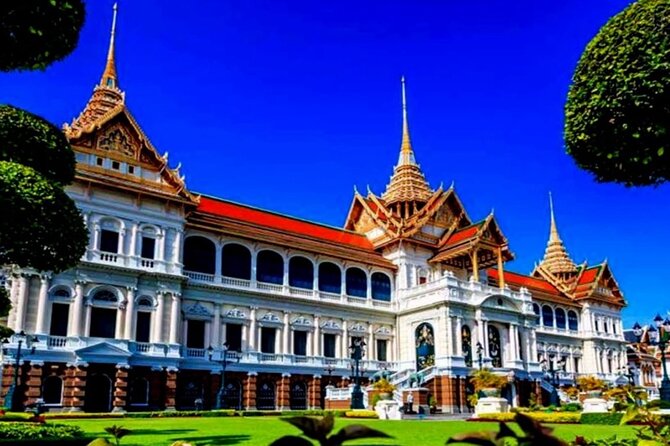
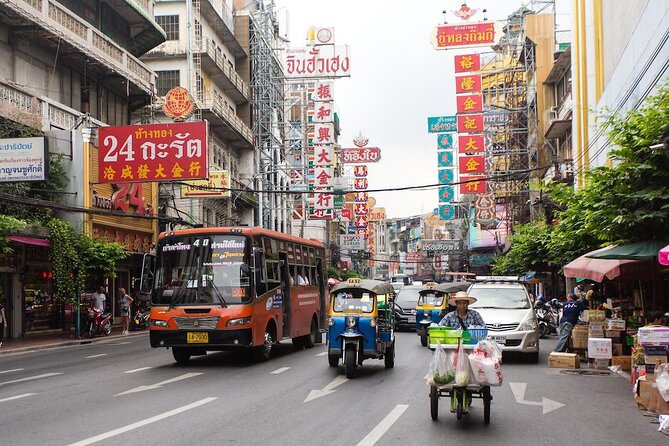
Bangkok’s Chinatown adds a different mood to the route. Here, the focus shifts from royal buildings and temple design to the city’s Chinese community, trade, local customs, markets, and street food.
The audio gives you a short cultural guide to the area. It can help you notice the connection between the neighborhood’s food stalls, religious sites, and commercial life instead of treating Chinatown as just a place to eat.
Ten minutes of narration will not cover every lane or market. You will need to choose how much time to spend exploring on your own. Food and drinks are not included, but this is one stop where an unscheduled break can easily become part of the experience.
More audio tours around the world:
- Barcelona: Sagrada Familia Entry Ticket with Audio Guide
★ 4.6 · 105,312 reviews - Rome: Pantheon Fast-Track Ticket and Official Audioguide
★ 4.5 · 27,353 reviews - Barcelona: Casa Batlló Entry with Self-Audioguide Tour
★ 4.7 · 25,359 reviews - Rome: Colosseum & Forum with Audio Guide App -Optional Arena
★ 4.2 · 24,770 reviews
Wat Pho and the Reclining Buddha
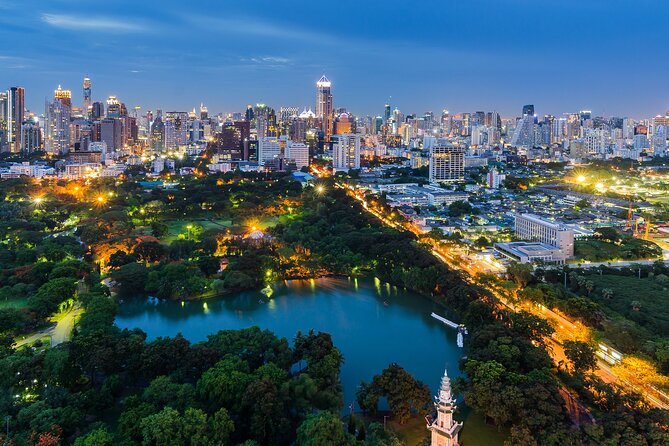
Wat Pho, formally Wat Phra Chetuphon Wimon Mangkhalaram Rajwaramahawihan, is one of the route’s strongest stops. It is described as Bangkok’s oldest and largest temple complex and is home to the famous Reclining Buddha.
The audio also explains the site’s connection with traditional Thai medicine and massage. That gives you more to look for than the enormous statue alone. Wat Pho is a place where religious practice, education, healing traditions, and Thai design meet.
Admission is listed as free for this stop, though you should still check current conditions when you arrive. Ten minutes of audio is enough to frame your visit, but the complex deserves more time if you want to look carefully at its buildings and details.
Wat Arun across the river
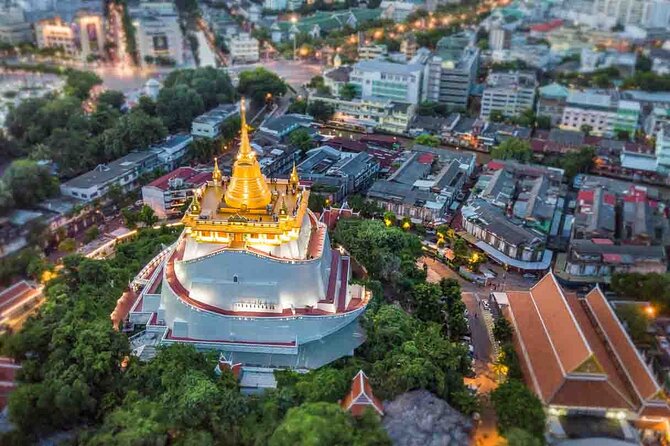
Wat Arun, the Temple of Dawn, is known for its tall central structure and detailed porcelain decoration. The audio focuses on the symbolism of the design, its connection to Thai Buddhism, and changes made over different periods.
This is a useful stop for anyone who wants more than a photo from the riverbank. The commentary helps you understand why the temple looks the way it does and how its decoration carries religious meaning.
Admission is not included. The route does not provide boat transport or a transfer plan, so you need to arrange your own way there. Build in time for getting to the temple, entering, and viewing it from more than one angle.
The Grand Palace and Wat Phra Kaew
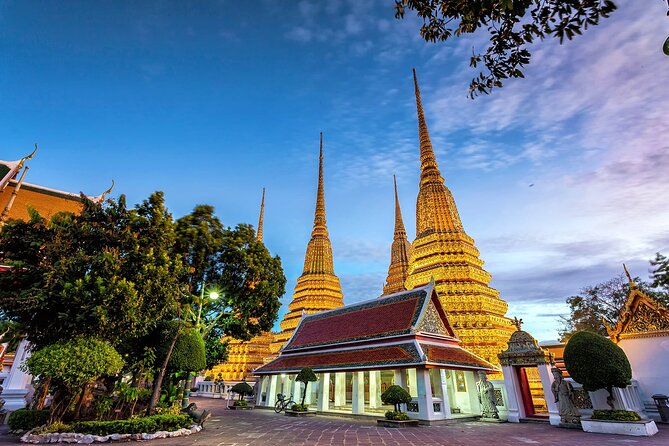
The Grand Palace and the Temple of the Emerald Buddha are listed as separate stops, but they occupy the same larger royal complex. You can think of them as one major visit with two layers of explanation.
At the Grand Palace, the audio covers the role of the complex in Thai royalty, government, and national history. The buildings are the focus, but the political story is just as important. This was not simply a royal residence. It also represented the center of power in Bangkok.
Wat Phra Kaew is Thailand’s most sacred Buddhist temple, according to the tour material. The audio introduces the legend of the Emerald Buddha and explains why the image carries such importance.
Both stops require careful planning. Admission is not included, and the palace complex can take more time than the 10-minute audio sections suggest. You should not expect to absorb the whole site while listening once. Use the audio for orientation, pause it when you want to look, and allow time for entry procedures.
The National Museum’s long view of Thailand
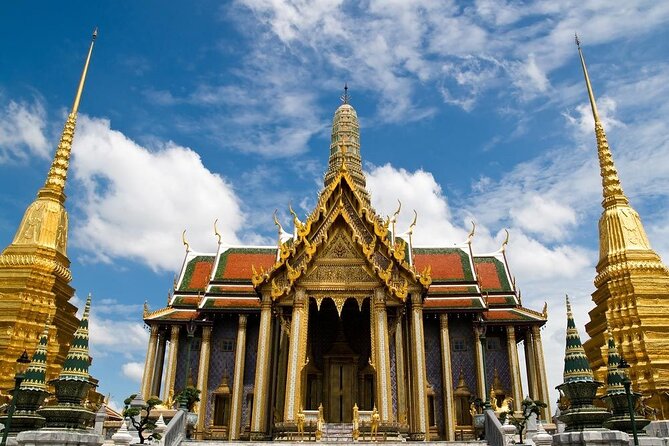
The National Museum Bangkok takes you beyond the familiar temple circuit. Its collections cover Thai history from prehistoric times through the Bangkok period, with artifacts providing the main evidence.
This is a useful counterpoint to the royal and religious sites. Instead of seeing Bangkok only through grand monuments, you get a chance to place Thai art and culture in a longer sequence.
Admission is not included. The 10-minute audio introduction can help you decide what deserves your attention, but a museum covering such a broad span cannot be properly represented in a short section. If museums are a priority, you may need to give this stop its own visit rather than squeeze it into a three-hour circuit.
The Golden Mount and Bangkok views
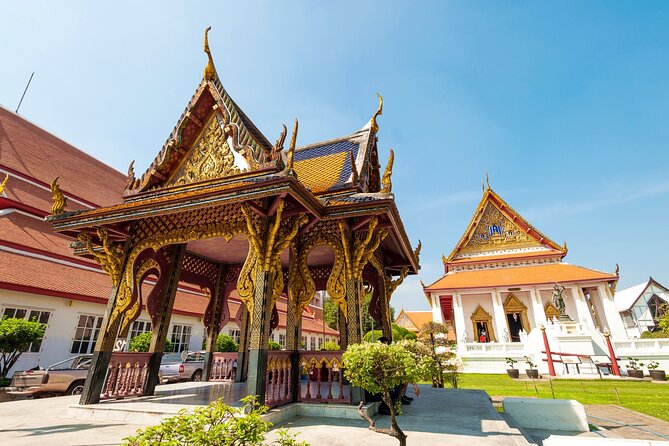
Wat Saket, known as the Golden Mount, rises on an artificial hill. The route explains its construction during the Ayutthaya period and its place in Thai Buddhist cosmology.
The climb is part of the appeal. At the top, you get panoramic views of Bangkok, giving this stop a visual change from the enclosed temple courtyards. The audio supplies the historical and religious setting, while the view gives you a quick sense of the city’s scale.
Admission is not included. Since the route does not specify how long the climb takes, allow more than the 10-minute commentary if you want to pause at the top or take in the city.
Wat Benchamabophit, the Marble Temple
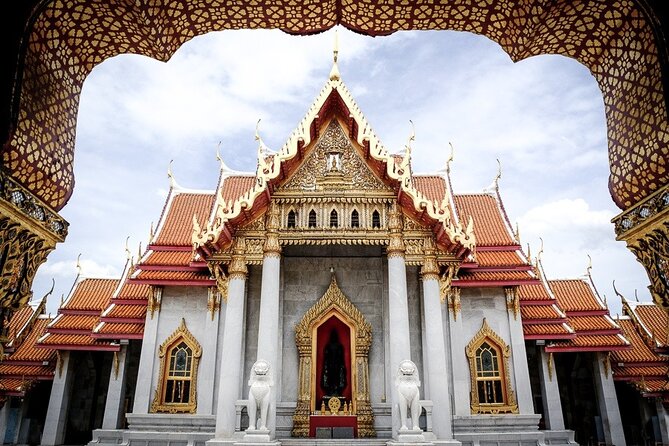
Wat Benchamabophit is a royal temple built with Italian marble. Its design blends Thai and European influences, making it one of the more distinctive architectural stops on the route.
The audio helps you notice that mixture rather than seeing the temple as just another ornate Buddhist site. This stop may appeal especially to you if architecture interests you more than museum displays or royal history.
Admission is not included. As with the other temples, the short audio gives you a framework, but you will need to spend your own time looking closely at the materials, proportions, and decorative details.
Bangkok Art and Culture Centre
The Bangkok Art and Culture Centre shifts the tour into modern Thailand. It is presented as a contemporary hub where you can consider the country’s changing art scene and its place in international contemporary art.
Admission is listed as free. That makes it an attractive flexible stop if you want to break up a day of temples. You can listen to the 10-minute section, then decide how long to spend with the current exhibitions.
The audio cannot predict every exhibition or explain every artwork in a short segment. Its value is in giving you context for the building and the wider art scene before you look around.
Lumpini Park’s city retreat
Lumpini Park offers a pause from Bangkok’s monuments. The audio explains its origin as a royal gift to the city and its role as a recreational space for local residents.
This stop is less about a single object and more about how Bangkok uses open space. You can take a break here, reset after several indoor or religious sites, and listen while walking at your own speed.
Admission is free. The tour does not include food or drinks, so plan any refreshments separately. Since the route includes other distant points, do not assume the park will fit neatly into a single short loop with the temples.
MOCA and modern Thai art
The Museum of Contemporary Art, or MOCA, is described as Thailand’s largest private contemporary art museum. The audio introduces modern artistic movements in Thailand and their cultural meaning.
This is another stop where your interests should guide your choice. If you want only the central temple district, MOCA may be too far out of the way for a short outing. If modern Thai art interests you, it gives the route a useful final contrast with Bangkok’s older religious and royal sites.
Admission is not included. You should allow far more than 10 minutes if you plan to view the museum properly. The audio works best as an introduction, not as a substitute for time inside the galleries.
Can you really do all 12 stops in three hours?
You can listen to the 12 sections in roughly two hours, since each is listed at about 10 minutes. That leaves about an hour for movement between stops, which is a tight schedule for a route covering temples, museums, Chinatown, a park, and art centers across Bangkok.
For a quick city overview, the timing can work if you select only a few locations or listen while moving between them. For a full visit to all 12, plan to spread the experience across more than one day. The access links remain valid for up to six days, and the tour specifically allows you to take breaks, change the order, or skip stops.
This flexibility is the strongest practical feature. You can focus on the Grand Palace and Wat Phra Kaew one day, then visit the Marble Temple, Lumpini Park, or MOCA later. You are not paying again for a second day.
Who should book this audio tour?
I would consider it best for an independent first-time visitor who wants a clear list of major sights without paying for a private guide. It also suits couples or small groups who prefer to stop for food, take photographs, or change plans without holding up anyone else.
It is less suitable if you want a detailed history lesson, expert answers on the spot, or transport arranged for you. The audio offers no live guide, and you must manage the phone, map, entry fees, and route yourself.
The experience is private, meaning only your group participates. That is useful if you dislike group tours, but it also means there is no guide beside you to explain a confusing detail or solve a navigation problem immediately.
Final verdict: a cheap framework, not a full guided tour
Book this if you value freedom and low cost more than depth. For $9, the map and 12 short audio sections can save you from wandering without a plan, especially on a first day in Bangkok.
Do not book it expecting a polished, highly detailed substitute for a live historian. The general commentary and uneven translation may frustrate you if you want rich explanation at every stop. My practical choice would be to use it selectively: pick the Grand Palace, Wat Phra Kaew, Wat Pho, Wat Arun, Chinatown, and one museum or park, then use the six-day validity to cover the rest at a sensible pace.
FAQ
How long does the Bangkok Self-Guided Audio Tour take?
The stated duration is approximately three hours. Each of the 12 attraction sections is listed at about 10 minutes, but transport, entrance lines, sightseeing, and breaks take additional time.
Where does the tour start and finish?
You choose both the starting point and the ending point. The tour begins and ends in Bangkok, but no fixed meeting point is required.
Are transportation and hotel pick-up included?
No. Pick-up, drop-off, and transportation are not included. You are responsible for moving between the attractions.
Are entrance fees included?
No. Entry fees are not included wherever they are required. Wat Pho, the Bangkok Art and Culture Centre, and Lumpini Park are listed with free admission, while several other stops have admission excluded.
How do I access the audio guide?
You receive an email with two links on your selected travel date before your starting time. One link opens the SoundCloud audio playlist, and the other opens the Google My Maps route with the attraction locations and matching audio links.
Can I split the tour across several days?
Yes. The tour allows you to take breaks, change the order, skip stops, and spread your visits across multiple days. The private access links are valid for up to six days.
Do I need to bring earphones or internet access?
Yes, you need to provide your own audio device, earphones, and internet or Wi-Fi access. Food and drinks are also not included.
New audio tours around the world
- London Panoramic Open Top Bus Tour with Audio Guide★ 4.0 · 209 reviews
- London: British Museum Audio Guide & Small Group Entry★ 3.5 · 81 reviews
- London: National Gallery Audio Tour (No Entry Ticket)★ 3.5 · 11 reviews
- London’s Alternative History: A Self-Guided Audio Tour★ 5.0 · 4 reviews
- London: British Museum’s English Audio Tour with Free Reservation★ 3.0 · 15 reviews
- London: Churchill War Rooms Ticket & Political London Audio Tour★ 4.0 · 83 reviews
- London: British Museum Audio Tour with Free Guaranteed Entry★ 3.0 · 30 reviews
- Londinium’s Footprint: Explore London’s Roman wall on a self-guided audio tour★ 5.0 · 3 reviews
Self-Guided Audio Tours, compared.
Athens: Acropolis Ticket & Optional Self-Guided Audio Tours
Read our review →


Ultimate Acadia National Park Self-Guided Driving Audio Tour
Read our review →

Santorini: Akrotiri Ticket with Optional Self-Guided Audios
Read our review →