
Review · COPENHAGEN
Danish Design Classic and Modern Style Self-Guided Audio Tour
Copenhagen’s design story begins with Arne Jacobsen’s SAS Royal Hotel, where smooth lines, practical furniture, and modern Danish style come together in one landmark building. From there, this GPS-guided walk leads you through royal squares, churches, museums, canals, and grand public buildings before ending at Designmuseum Danmark.
I like two things right away: the precise geolocation helps you know where to go, and the audio format lets you stop, look around, or repeat a section without waiting for a guide. The main drawback is the pace. Seventeen listed points in about 70 minutes means many stops are brief, and admission fees, transport, food, and headphones are not included.
Key points to know before you go
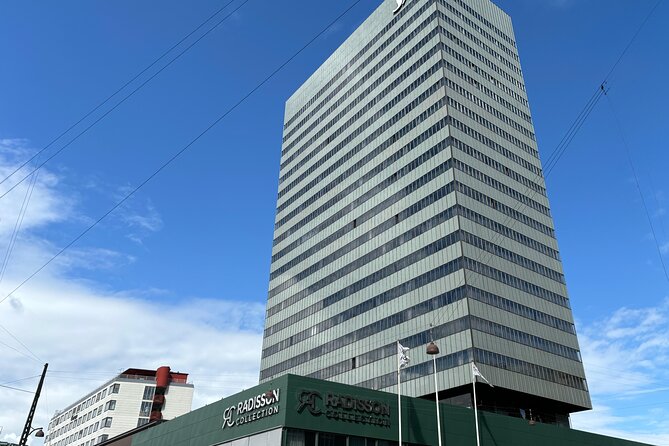
- Start at Arne Jacobsen’s SAS Royal Hotel: The former SAS Hotel, now the Radisson Collection Royal, is the clearest introduction to modern Danish design.
- Finish at Designmuseum Danmark: The route ends at Copenhagen’s main museum for Danish and international design and crafts.
- GPS guidance works offline: Download the VoiceMap app, audio, maps, and geodata before setting out.
- Seventeen points create a broad design tour: You move from Viking metalwork and Neoclassical sculpture to Rococo, Art Nouveau, and modern furniture.
- You set the pace: This is a private tour for your group, not a scheduled walk with a live guide.
- The $11.99 price buys repeat access: You receive lifetime access, so you can return to sections later or split the route across visits.
Starting with Arne Jacobsen at the SAS Royal Hotel
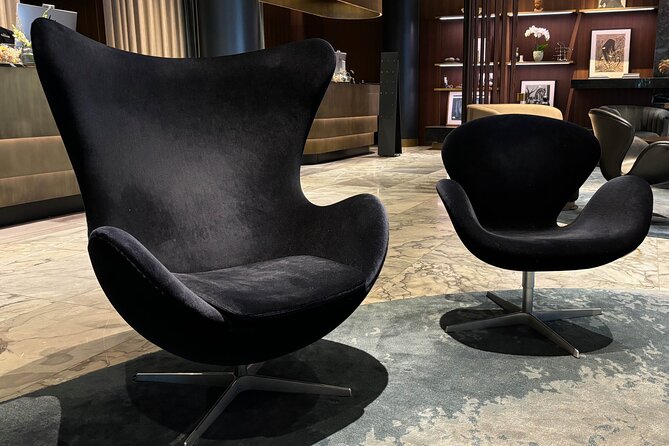
The tour opens at Hammerichsgade 1, outside the Radisson Collection Royal Hotel. This building was completed in 1958, when Arne Jacobsen helped define the clean, practical style now closely linked with Denmark.
That starting point gives the walk a clear theme. Danish design is not only about handsome chairs or neat interiors. It is also about how a building works, how people move through it, and how simple forms can serve daily life.
You will hear about Jacobsen’s smooth, organic approach and his role in shaping modern Danish design. The hotel is an especially useful first stop because the story begins with one designer and one major building rather than with a loose collection of city sights.
You should expect an exterior-focused start unless you choose to visit parts of the hotel independently. The tour does not include admission fees, and no interior visit is promised. Still, the opening location is easy to identify and near public transport, which makes the first step practical.
More Self-Guided Audio Tours in the world:
- Athens: Acropolis Ticket & Optional Self-Guided Audio Tours
★ 4.1 · 2,542 reviews - Gettysburg Battlefield Self-Guided Driving Audio Tour
★ 4.5 · 910 reviews - Joshua Tree National Park Self-Guided Driving Audio Tour
★ 4.5 · 762 reviews
Tivoli, the Glyptotek, and Copenhagen’s older design language
From the modern hotel, the route connects with several of central Copenhagen’s major landmarks. Tivoli Gardens brings a very different visual mood, with its elaborate Neoclassical stone entrance and long history as one of the world’s first amusement parks.
Tivoli opened in 1843 and has continued operating ever since. The audio commentary uses the entrance and the park’s design as part of the larger story, showing how public entertainment can also reflect architectural taste.
The tour also points you toward the Glyptotek, a museum focused on art from before the 20th century. Its winter garden and café give the building an appeal beyond its collection, while the museum itself grew from Carl Jacobsen’s personal collection. Carl was the son of the founder of the Carlsberg brewery.
This portion is useful if you want to connect Danish design with art, collecting, and public culture. Keep in mind that the walk is only about 70 minutes, so you will not have time to explore every museum along the way. Treat these stops as visual and historical signposts, then return later if a particular building catches your interest.
Viking craft and the roots of Danish design
The Danish National Museum adds an important correction to the usual idea of Danish design. The building itself may not be the most memorable stop from the outside, but the Viking objects inside include metalwork, jewelry, and other carefully made pieces.
That matters because design in Denmark did not begin with 20th-century furniture. Long before Jacobsen, craftspeople were making objects that had to work well, last, and carry meaning. Viking gold jewelry provides an early example of Danish skill in shaping useful or ceremonial items with a strong visual character.
The audio route can point you toward this connection without requiring you to spend hours in a museum. If you want to enter, remember that personal admission costs are not part of the tour price. The value here comes from the link between ancient craft and later Danish design, not simply from ticking another museum off your list.
Rococo elegance at Frederik’s Church
Frederik’s Church, commonly called the Marble Church, introduces a more formal side of Copenhagen. Its Rococo design was based on St. Peter’s Basilica in Rome, giving the building a grand scale and a clear connection to European architectural ideals.
This is a good place to notice how different Danish design can look across periods. The SAS Royal Hotel favors simple modern forms, while the Marble Church uses ceremony, symmetry, and decoration to make an impression.
You will not be walking through a single design museum with objects arranged in display cases. Instead, you read the city itself. Churches, squares, palaces, hotels, and civic buildings become examples of changing taste.
More audio tours around the world:
- Barcelona: Sagrada Familia Entry Ticket with Audio Guide
★ 4.6 · 105,312 reviews - Rome: Pantheon Fast-Track Ticket and Official Audioguide
★ 4.5 · 27,353 reviews - Barcelona: Casa Batlló Entry with Self-Audioguide Tour
★ 4.7 · 25,359 reviews - Rome: Colosseum & Forum with Audio Guide App -Optional Arena
★ 4.2 · 24,770 reviews
Designmuseum Danmark, the natural finish
The route ends at Designmuseum Danmark on Bredgade 68. This is the most direct place to continue the subject after the walk, with Danish and international design and crafts in one museum.
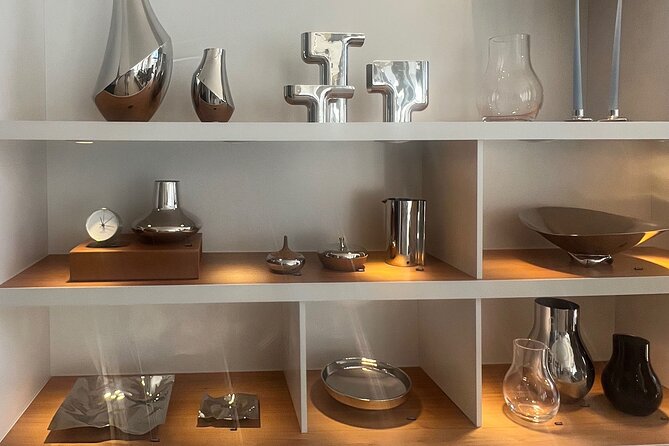
The collection includes work by major Danish names such as Arne Jacobsen, Jacob Jensen, and Kaare Klint. Ending here makes sense because the museum can give you more time with the furniture and objects that the city tour introduces from the outside.
The tour does not include museum admission, so check the cost before you go if you plan to enter. Even without going inside, the endpoint is useful. You finish with a clear option for extending the design theme rather than ending at a random street corner.
City Hall, the Royal Danish Theatre, and public style
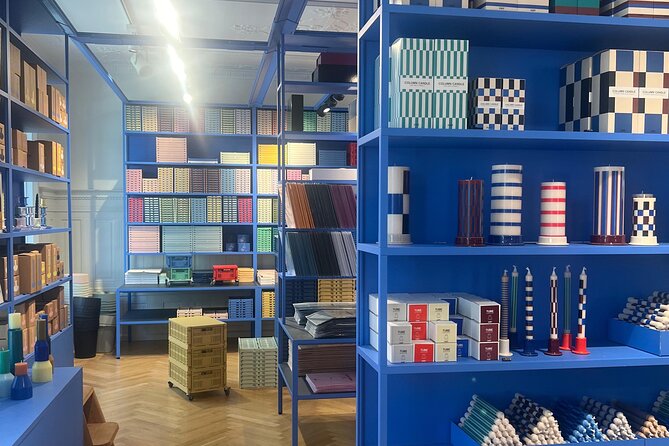
Copenhagen City Hall was completed in 1905 and is a strong example of National Romantic style, the Scandinavian version of Art Nouveau. This stop shifts attention from private furniture and museum objects to civic architecture.
City Hall shows how design can express a city’s identity. It is not just a government building. Its style was part of a wider Nordic effort to create architecture with a local character while still responding to modern European trends.
The Royal Danish Theatre offers another contrast. Its Neo-Baroque building is now used mostly by the Royal Danish Ballet. The theatre is described as rarely full, which gives you an interesting glimpse into the building’s present role rather than only its original purpose.
These stops are especially useful for you if you like architecture but do not want a tour limited to famous designers. The route keeps asking how design appears in everyday public places, not only in showrooms.
Russian Orthodox detail and Copenhagen’s main squares
The Alexander Nevsky Church is one of the route’s more unusual architectural stops. Its patterned façade and golden towers make it easy to distinguish from the surrounding buildings, and it is the only Russian Orthodox church in Copenhagen.
This church adds another cultural layer to the walk. It also gives you a sharper visual contrast after the restrained lines associated with modern Danish design.
Kongens Nytorv, or King’s Square, is another major Copenhagen hub. Squares such as this help you understand the city’s structure, since several important buildings and routes meet here. The audio commentary can give you context while you cross between sights, turning ordinary walking time into part of the tour.
GPS guidance matters most in sections like this. A precise location cue helps you know when to pause at a building and when to continue, especially in a busy central area with several nearby points of interest.
Thorvaldsen, Christiansborg, and changing taste
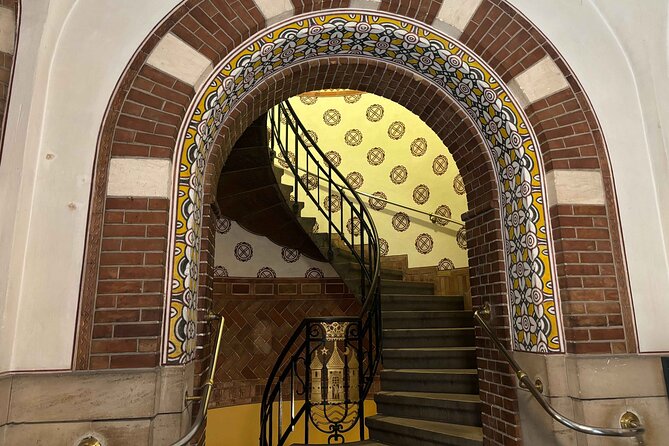
Thorvaldsen’s Museum represents a shift in fashion. Bertel Thorvaldsen was a Danish sculptor who went to Italy and learned to work in the Classical style. His museum reflects the period when ancient Greek and Roman ideals carried great authority.
The route uses Thorvaldsen as an example of how quickly artistic taste can change. Classical sculpture once represented the highest standard for many people, but later generations looked for other forms and ideas.
Christiansborg Palace brings the tour into present-day public life. It is used for state dinners and is home to Denmark’s Parliament, the Folketing. Here, design is tied to ceremony, government, and national representation.
These stops help prevent the tour from becoming a simple list of attractive façades. You get a story about fashion, politics, art education, and the way Copenhagen keeps older styles in active use.
Charlottenborg, Nikolaj Square, and buildings with second lives
Charlottenborg Palace was originally a private mansion for a king’s brother. It now houses the Royal Danish Academy for the Fine Arts, giving the building a direct connection to Danish art education.
That change of use is worth noticing. Buildings can outlive their original owners and purposes, then take on new roles without losing their historical character.
The church near Nikolaj Square has an even more unusual story. The current structure is a 1909 restoration of an older church that burned down, but the restored building was never used as a church. It served as a naval museum, later a library, and now functions as a modern art venue.
This is one of the route’s strongest reminders that a city is not frozen in one period. Copenhagen’s buildings have been repaired, reused, and reinterpreted. If you enjoy seeing how old architecture fits into current city life, slow down here and listen carefully.
The Odd Fellows Palace and a final look at changing use
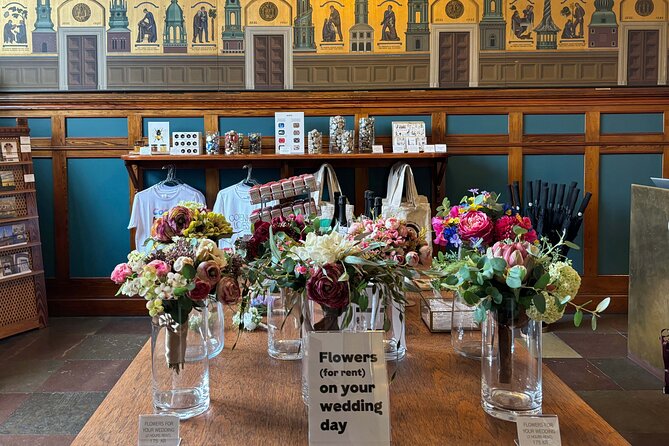
The Odd Fellows Palace takes its name from a Masonic Lodge that occupied it for many years. Today it is mainly used as a wedding and party venue.
You may not spend long at this stop, but it fits the tour’s wider subject. Design is shaped by function. A palace, lodge, museum, library, theatre, or hotel can look impressive, yet its meaning changes when people use it for a new purpose.
The route’s range is its greatest strength. In a short period, you move from old craft traditions to royal buildings, religious architecture, public institutions, and modern design. The tradeoff is that you will not receive a long treatment of every place.
How the VoiceMap format works in practice
You need your own smartphone and headphones. The package includes the VoiceMap application, offline audio, maps, and geodata, but it does not include a phone or listening equipment.
Download the material before you start. Offline access is useful if you want to avoid depending on a mobile connection while walking. GPS directions also lead you to the starting point, and the audio begins when you reach the right location.
The tour is private, so only your group takes part. You are not tied to a departure time or a live guide’s walking speed. You can pause for photographs, stop for coffee, enter a museum, or repeat a section.
The audio also provides tips along the way, not just historical narration. That makes the format more useful than a simple recorded lecture. The geolocation was praised as very precise, which is important in a self-guided walk where a missed turn can interrupt the whole experience.
Is $11.99 good value for 70 minutes?
At $11.99 per person, this is an inexpensive way to get structure and context while walking through central Copenhagen. A live private guide would normally cost much more, while a free walk would give you no built-in explanation or route support.
The best value comes from lifetime access. You can take the tour again, return to a section you rushed, or use it on a later Copenhagen visit. That changes the calculation if you prefer to split the route rather than complete all 17 points in one go.
The limits are clear. Transport is not included, and there are no meals, drinks, or museum admissions. You are paying for the audio content, GPS route, maps, and repeat access, not for a complete day of sightseeing.
I would choose this tour if you want a focused introduction to Danish design and prefer independence. I would choose a live guide instead if you want extended questions, a slower pace, or detailed access inside each museum and building.
Who should book this Copenhagen design walk?
This suits independent visitors, couples, families, and small groups who like learning while walking. It is also a good fit if your family does not want to be tied to a guide but still wants useful background and directions.
Most people can participate, service animals are allowed, and the route is near public transportation. The tour is available daily under the stated operating hours, from midnight to 11:59 p.m., which reflects the self-guided format rather than a fixed departure.
I would give yourself extra time beyond the stated 1 hour 10 minutes if you plan to pause at museums, take photographs, or explore the final design museum. The listed duration is best understood as the moving audio experience, not a full visit to every attraction.
Free cancellation is available if you cancel at least 24 hours before the start time. Cancellations made within 24 hours are not refunded, and changes during that period are not accepted.
Should you book this tour?
Book it if you want a low-cost, private way to connect Copenhagen’s buildings with the history of Danish design. The precise GPS guidance, useful narration, offline access, and lifetime use make it more practical than wandering without a plan.
Skip it if you want a long museum visit, a live expert, or detailed interior access at every stop. The route covers a lot in 70 minutes, so its strength is breadth and freedom, not slow examination.
For most design-minded visitors, the best plan is to use the audio walk as an introduction, then spend more time at Designmuseum Danmark or another stop that catches your attention.
FAQ
How long does the Danish Design Classic and Modern Style tour take?
The tour takes approximately 1 hour and 10 minutes.
Where does the tour start?
It starts at the Radisson Collection Royal Hotel, formerly Arne Jacobsen’s SAS Royal Hotel, at Hammerichsgade 1 in Copenhagen.
Where does the tour end?
It ends at Designmuseum Danmark, located at Bredgade 68, Copenhagen.
Is this a guided group tour?
No. It is a private, self-guided audio tour for your group only.
Which app does the tour use?
It uses the VoiceMap application.
Does the tour work offline?
Yes. Offline access to the audio, maps, and geodata is included.
Do I need my own smartphone and headphones?
Yes. A smartphone and headphones are not included.
Are museum admission fees included?
No. Personal admission fees are not included in the tour price.
Is transportation included?
No. Transportation is not included.
Can I cancel for a full refund?
Yes, if you cancel at least 24 hours before the experience start time. Cancellations within 24 hours are not refunded.
New audio tours around the world
- London Panoramic Open Top Bus Tour with Audio Guide★ 4.0 · 209 reviews
- London’s Alternative History: A Self-Guided Audio Tour★ 5.0 · 4 reviews
- London: British Museum Audio Guide & Small Group Entry★ 3.5 · 81 reviews
- London: National Gallery Audio Tour (No Entry Ticket)★ 3.5 · 11 reviews
- London: British Museum’s English Audio Tour with Free Reservation★ 3.0 · 15 reviews
- London: Churchill War Rooms Ticket & Political London Audio Tour★ 4.0 · 83 reviews
- London: British Museum Audio Tour with Free Guaranteed Entry★ 3.0 · 30 reviews
- Houses of Parliament Ticket & Political London Audio Guide★ 4.0 · 13 reviews
Copenhagen Audio Tours, compared.
Copenhagen: Hop-On Hop-Off Bus Tour with Audio Guide
Read our review →
Half Day Self-Guided Audio Walking Private Tour in Copenhagen
Read our review →
Monstour: A Self-Guided Audio Tour of Danish Folk Legends
Read our review →
The Philosopher’s Last Walk: An audio tour on the life of Søren Kierkegaard
Read our review →
Cool Nørrebro and Foodie Tips Self Guided Audio Walking Tour
Read our review →
Copenhagen Scavenger Hunt and Highlights Self Guided Audio Tour
Read our review →Browse the lists this tour appears in