
Review · FLORENCE
Florence Self-Guided Audio Tour
Florence is a city where a short walk can carry you from a railway station designed in the 1930s to a medieval bridge, a Medici palace, and Michelangelo’s David. This $9 self-guided audio tour links 21 major sights with a phone-based map, letting you choose the order, pace, and stopping points.
I like the clear Google My Maps setup, which can help you find places you might otherwise pass by, and the six-day access period, which gives you room to split the route over several days. The main consideration is that this is not a live guided walk. You need your own smartphone, headphones, internet access, and separate admission tickets for several sights.
Key points at a glance

- Twenty-one Florence landmarks: The route covers the Duomo complex, Michelangelo’s David, the Uffizi area, Santa Croce, San Miniato al Monte, and more.
- Google My Maps navigation: Each stop appears as a map point linked to its matching audio guide.
- Six days of access: You can listen and visit in one long outing or spread the route across several days.
- Flexible start and finish: Begin and end anywhere in Florence, rather than meeting a guide at a fixed point.
- Low upfront cost: At $9 per person, the tour is inexpensive, though museum and church tickets are extra.
- Private digital experience: Only your group uses the tour, with no set walking party or fixed departure time.
How this Florence audio tour works on the ground

Before your selected travel time, you receive two access links. One opens the audio content through a secure SoundCloud web page. The other opens a Google My Maps route showing all 21 locations.
You can listen to the full playlist before setting out, or play each stop as you reach it. The map is the more useful tool while walking. Select a location, follow the route, and then open the matching audio guide when you arrive.
That setup gives you control that a traditional group walk cannot. You can skip the Uffizi if you already have a timed museum visit, spend extra time at Santa Croce, or stop for lunch near Mercato Centrale. You can also use the six-day validity to break the route into shorter outings.
The suggested stops generally allow about 20 minutes each, with Palazzo Vecchio listed at 10 minutes. Those figures work as audio and orientation times, not as full museum visits. If you enter the Accademia, Uffizi, Palazzo Pitti, or another ticketed site, your visit will take much longer.
The route has no transport or hotel pickup. You make your own way between locations, using Florence’s central streets and your phone. A fully charged battery matters here. Downloading or opening the links before you leave your accommodation is sensible, and headphones let you hear the commentary without holding your phone up at every corner.
More Self-Guided Audio Tours in Italy
- Self Guided Tours Florence With 100 Captivating Audio Stories
★ 3.5 · 5 reviews - Florence Self Guided Audio Tour
★ 3.0 · 5 reviews - Florence: The curious Oltrarno, Self-Guided Audio tour
★ 3.5 · 4 reviews
From Santa Maria Novella to the Medici quarter
The tour begins at Firenze Santa Maria Novella railway station, a practical starting point for anyone arriving by train. The station’s 1930s design brings Italian rationalist architecture into a city better known for medieval and Renaissance buildings. It is a useful reminder that Florence’s story did not stop with Michelangelo.
From there, you reach the Basilica of Santa Maria Novella. Its geometric marble facade is one of Florence’s clearest examples of Renaissance balance, while the interior connects Dominican religious life with the work of Brunelleschi and Leon Battista Alberti. The audio stop is short, so you will need a separate ticket if you want to go inside.
Mercato Centrale provides a change of pace. The 19th-century iron-and-glass market hall occupies a traditional commercial area and gives the route a food-focused stop among all the art and architecture. Admission is listed as free, but you should allow extra time if you want to browse beyond the audio segment or eat there.
Basilica di San Lorenzo brings you into Medici territory. Brunelleschi’s work here helped shape Renaissance church design, and the church contains important Medici connections. The attraction requires a separate ticket, so treat the 20-minute audio portion as an introduction rather than a complete visit.
Museo di San Marco is one of the quieter choices on the route. Its former Dominican convent is closely linked with Fra Angelico, whose paintings were made for a religious setting rather than a grand public gallery. I like its inclusion because it gives the itinerary a calmer counterpoint to the famous sights. Admission is not included.
Michelangelo’s David and the Duomo quarter
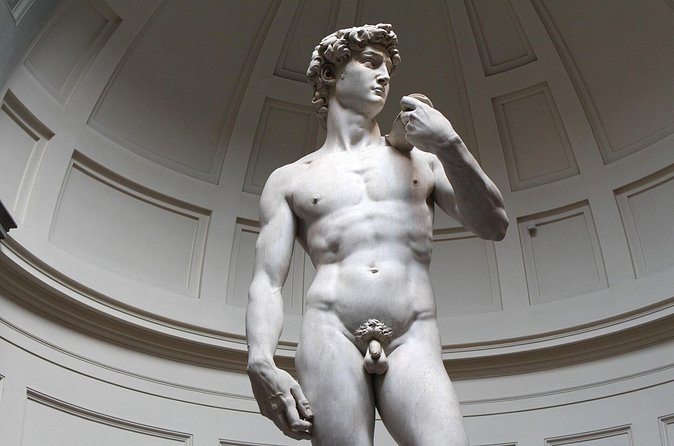
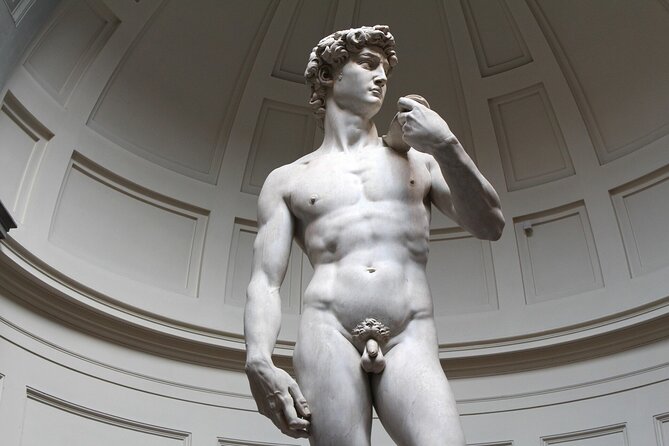
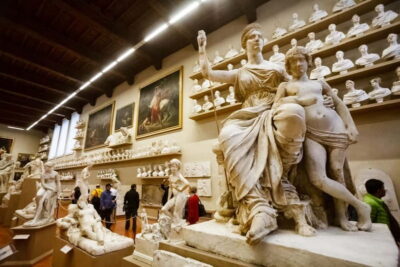
Galleria dell’Accademia is the stop most likely to require careful planning. Its central draw is Michelangelo’s David, along with unfinished works that show the sculptor’s process. The audio guide can explain why the museum matters, but it does not include entry. Plan your own ticket arrangements separately if you want to go inside.
The Museo dell’Opera del Duomo is a strong companion to the cathedral itself. It presents the art and engineering behind Florence’s religious center, including original works connected with the cathedral complex. I would not treat the 20-minute allocation as enough for the museum. It is better used as a preview before a longer visit.
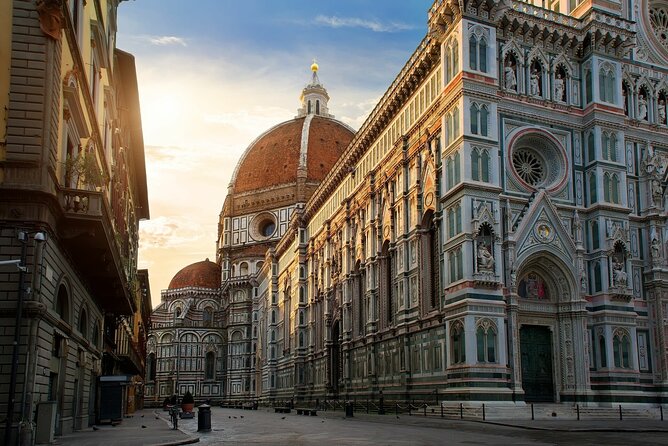
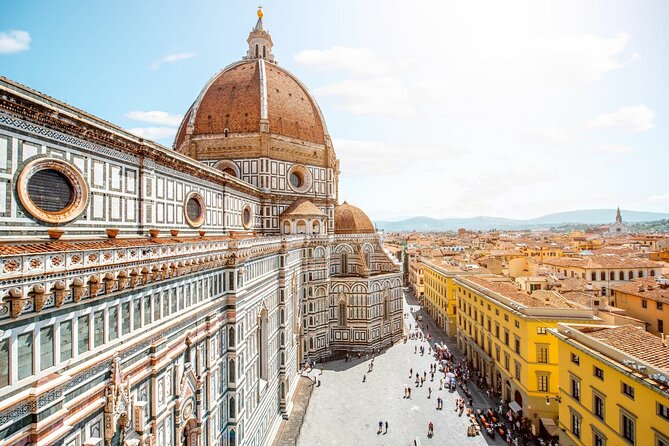
Next comes the Duomo, officially Cattedrale di Santa Maria del Fiore. The cathedral is free according to the tour details, while other parts of the complex require admission. The audio stop focuses on Brunelleschi’s dome and the ambition behind the building. You can use it to understand the exterior and plan what you want to see inside.
Piazza del Duomo gives you the best setting for seeing the cathedral, baptistery, and bell tower together. This is an important place to pause the audio and look around. The square can be crowded, and the map link is more useful here if you want to identify each building without repeatedly backtracking.
Campanile di Giotto is the route’s main vertical option. The colorful marble bell tower is a major Gothic work, and entry is not included. If you decide to climb it, allow far more than the suggested 20 minutes. If you prefer to stay at street level, the audio stop still helps explain how the tower fits into the Duomo group.
The Battistero di San Giovanni completes this section. Its octagonal shape, mosaics, and connection with Dante’s baptism give it a special place in Florence’s religious story. Admission is extra, so you can decide if the interior belongs in your day or if the exterior view is enough.
Renaissance palaces, the Arno, and the Uffizi
Palazzo Strozzi is a compact and useful stop between the Duomo area and the river. Its heavy stone exterior shows how a banking family used palace design to announce wealth and authority. The building also hosts exhibitions, but the tour price does not include entry.
Ponte Vecchio is free to cross and easy to fit into any version of the route. Its shops and medieval structure make it more than a simple bridge, while the river crossing connects the historic center with the Oltrarno side. I would listen to this section either before crossing or from one of the bridge approaches, where you can stop without blocking foot traffic.
Gallerie degli Uffizi is one of the places where a short audio stop cannot replace a museum visit. The gallery is tied to the Medici collection and contains major Renaissance works, but admission is extra. If you already have a reservation, use the audio guide as background before entering, then pause it while you explore.
Palazzo Vecchio and Piazza della Signoria work best together. The palace served as a center of political power, while the square functions as an outdoor display of sculpture and civic memory. The Palazzo Vecchio stop is listed at 10 minutes, making it more of a concise orientation. Entry is not included, but the square itself is free.
This section is especially useful for independent visitors because you can choose your level of detail. Someone interested in Renaissance art may spend hours inside the Uffizi and Palazzo Vecchio. Someone focused on street life and architecture can listen outside, cross the square, and continue toward Santa Croce without paying another admission fee.
More Self-Guided Audio Tours in Florence:
- Florence: Duomo & Bell Tower Self guided with Audio Guide
★ 4.0 · 3 reviews - Palaces and Piazzas: A Self-Guided Audio Tour of Florence
★ 5.0 · 2 reviews - Athens: Acropolis Ticket & Optional Self-Guided Audio Tours
★ 4.1 · 2,542 reviews - Gettysburg Battlefield Self-Guided Driving Audio Tour
★ 4.5 · 910 reviews
Santa Croce and the climb above Florence
Piazza Santa Croce offers a broad public space and a different mood from the tightly packed Duomo quarter. The square has hosted public celebrations and events, while the surrounding buildings frame the Basilica of Santa Croce.
The basilica is known as a major Franciscan church and a burial place for figures connected with Italian art and culture. Its Giotto frescoes are among the reasons to go inside, although the listed admission arrangement says the tour itself does not include a separate ticket. Check the current entry requirements when planning your day, since the audio product does not cover fees.
Basilica San Miniato al Monte requires the most effort in the itinerary because it sits above the city. The reward is a Romanesque church with patterned marble decoration and a quieter setting than the central squares. The tour identifies the stop as free, and you can decide how much time to give it based on your energy and the route you choose.
Piazzale Michelangelo is nearby and provides the broadest city view on this itinerary. From here, you can see Florence’s historic center, the Arno, and the dome from above. The audio stop adds context about the 19th-century planning of the terrace, but the view itself deserves time without headphones.
These hilltop stops are easy to leave out if you want a compact central walk. I would keep them if you have a full day, enjoy viewpoints, or want a break from indoor museums. If you are working with only a few hours, the Duomo, Ponte Vecchio, and Signoria area give you more sights with less uphill walking.
Palazzo Pitti and how to plan the full route
Palazzo Pitti is the final listed stop. The former Medici residence is a large palace complex that reflects the family’s wealth and changing taste. Admission is not included, and the 20-minute audio allocation should be viewed as an introduction. A full visit needs its own block of time.
The tour is described as lasting about three to nine hours. That wide range is useful because the route is not a forced march. If you only listen at the main outdoor sites, you can make a shorter circuit. If you enter the Accademia, Uffizi, Palazzo Vecchio, Palazzo Pitti, and several churches, you will need most of a day or several days.
I would plan the route by neighborhoods rather than follow all 21 stops in one sequence:
- Begin around Santa Maria Novella for the station, basilica, market, and San Lorenzo.
- Group San Marco, the Accademia, and the Duomo complex on a second outing if you want museum time.
- Walk from Palazzo Strozzi toward Ponte Vecchio, the Uffizi, Palazzo Vecchio, and Signoria.
- Finish with Santa Croce, San Miniato al Monte, Piazzale Michelangelo, and Palazzo Pitti according to your energy and location.
This approach makes the six-day access period useful. It also prevents the common mistake of spending the whole day rushing between audio points while barely seeing the interiors.
What the $9 price really buys you

At $9 per person, the cost is low for a route covering 21 important locations. The strongest value is not the amount of audio alone. It is the combination of a prepared itinerary, individual stop links, and a map that helps you organize a complicated city without paying for a private guide.
The price does not cover admissions, transport, or personal assistance on the street. That matters in Florence, where the Accademia, Uffizi, bell tower, churches, and palace interiors can add substantially to your day’s budget. You also need to manage your own timing and solve basic phone or internet problems.
Still, the format suits anyone who dislikes fixed group schedules. You can pause for coffee, skip a museum, return to a favorite square, and stop the commentary whenever you want. The lack of a guide is a weakness for anyone who prefers questions and live explanations, but a benefit for visitors who want privacy.
The available score is 3.3 from three ratings, so I would not treat the product as a proven replacement for a professional city guide. One clear strength is the Google Map layout, which helps point you toward sights that are easy to miss. That feature may be the most useful part for repeat visitors or anyone who already knows the headline attractions.
Practical details before you book

Choose your audio language carefully at booking. The language cannot be changed after confirmation. If your preferred language is not offered, you are told to contact the provider at least 48 hours ahead so a special arrangement can be prepared.
Bring headphones or earphones, a fully charged smartphone, and internet access. Because the audio is accessed through web links, do not assume you can manage the tour comfortably with a nearly empty battery or unreliable connection.
You can start and finish anywhere in Florence. There is no fixed meeting point, and the activity is private to your group. Most people can participate, and the route is near public transportation, but transport between stops is not part of the product.
The booking is non-refundable and cannot be changed for any reason. That makes it important to confirm your date, language, and group size before paying.
Who should book this Florence audio route?
I would choose this tour if you want a cheap orientation, prefer exploring alone, and enjoy deciding your own pace. It is particularly useful for a first visit when you want a sensible list of major sights without committing to a half-day group walk.
It also works for repeat visitors who want a map-based reminder of places they missed. The inclusion of San Marco, San Miniato al Monte, the market, and the railway station keeps the route from focusing only on the most famous museum doors.
I would look elsewhere if you want a live historian, skip the phone, dislike self-navigation, or need tickets bundled into one purchase. The audio can guide your day, but you remain responsible for admissions, directions, timing, and battery life.
FAQ
How much does the Florence Self-Guided Audio Tour cost?
The price is $9 per person.
How long does the tour take?
The estimated duration is about three to nine hours. You can also split the experience across several days because access remains active for six days.
How many attractions are included?
The audio guide and map cover 21 Florence attractions.
Is this a guided group tour?
No. It is a self-guided private activity for your group. You use your smartphone, headphones, audio links, and interactive map without a live guide.
Where does the tour start and finish?
You choose both the starting and ending points in Florence. There is no required meeting point.
Are entrance tickets included?
No. Entry fees are not included for attractions that require admission. Transport, pickup, and drop-off are also excluded.
What do I need to bring?
Bring a fully charged smartphone, headphones or earphones, and internet access.
Can I change the audio language after booking?
No. You select the language during booking, and it cannot be changed after confirmation. If your language is unavailable, contact the provider at least 48 hours in advance to request a special preparation.
Should you book it?
Book this tour if flexibility and low cost matter more to you than live commentary. The clearest benefit is the pairing of a well-organized Google map with audio for 21 sights, including several places you might not reach by following only Florence’s biggest names.
Use it as a planning tool rather than a full museum experience. Set aside separate time and money for ticketed attractions, charge your phone, and divide the route by neighborhood. With those expectations, this $9 option can give you a useful framework for discovering Florence on your own terms.
New audio tours around Florence
- Florence: Uffizi Gallery Timed Entry Ticket with Audio★ 3.0 · 3 reviews
- Florence: Uffizi Gallery Audio Guided Tour led by Tour Leader★ 3.5 · 6 reviews
- Uffizi Combined Ticket:UFFIZI, PITTI, BOBOLI & digital audioguide★ 4.0 · 26 reviews
- Uffizi Gallery Audio-Guided Visit with optional Accademia Gallery★ 3.5 · 42 reviews
- Florence: Uffizi Gallery Reserved Ticket & Digital Audio Guide★ 4.5 · 3 reviews
- Florence Walking Tour with Audioguide on Your Smartphone★ 4.5 · 9 reviews
- Florence: Accademia entry tickets + optional audio guide★ 4.0 · 228 reviews
- Accademia Gallery Skip the line Tickets with Audio Guide★ 4.0 · 10 reviews
Florence Audio Tours, compared.
Florence: Timed Entry to Michelangelo’s David + Audio App
Read our review →
Florence: Uffizi Priority Ticket & Masterpieces Audio App
Read our review →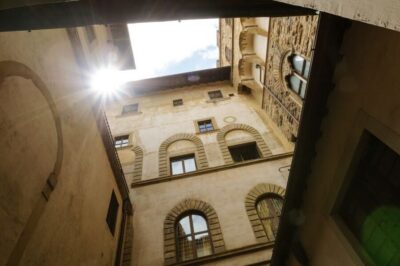
Florence: Palazzo Vecchio Entrance Ticket & Audioguide
Read our review →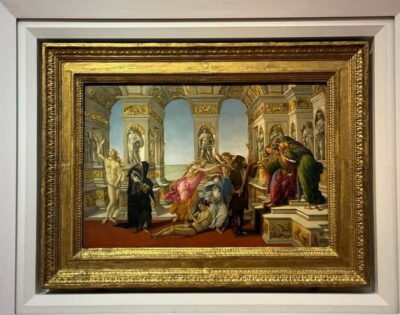
Florence: Uffizi Gallery Timed Entry Ticket & Audio Guide
Read our review →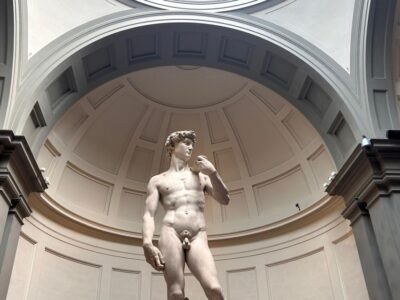
Florence: Michelangelo’s David Entrance Ticket and Audio App
Read our review →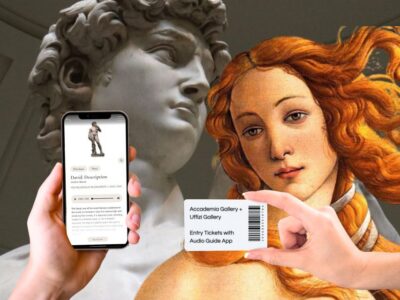
Florence: Uffizi & Accademia Priority Tickets with Audio App
Read our review →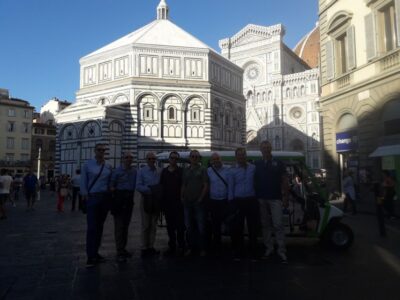
Florence: Eco-Friendly Golf Cart City Tour with Audio Guide
Read our review →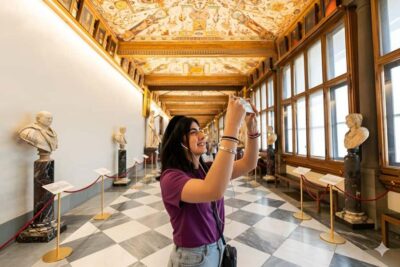
Florence: Uffizi Gallery Reserved Entry Ticket & Audioguide
Read our review →Browse the lists this tour appears in