
Review · GERMANY
Leipzig’s Communist Past: A Self-Guided Audio Tour
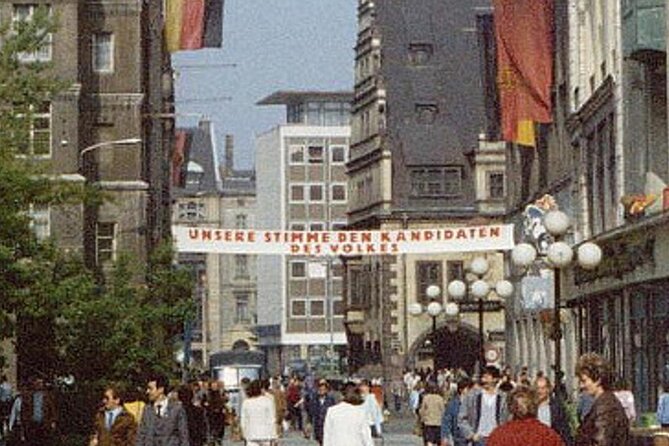
Leipzig’s Communist past becomes easier to grasp when you hear about it while standing in the same streets where people lived, worked, worshiped, and protested. This self-guided walk links the main city-center sights with stories about East German life and the 1989 Monday protests, including places connected with those events.
I like the freedom to start, pause, or finish when it suits you, and I like the practical offline access to maps, directions, and audio. The main drawback is simple: you need your own charged smartphone and headphones, and an audio tour cannot answer questions or adjust its pace for you.
Key points at a glance
- Former-local narration: Hear personal context about life in Leipzig under the East German regime.
- A walk through major landmarks: The route connects Hauptbahnhof, Nikolaikirche, Thomaskirche, Augustusplatz, and Moritzbastei.
- Strong protest-history focus: The Monday demonstrations are tied to real places along the route.
- About 60 to 75 minutes: The walk is compact enough for a first look at central Leipzig.
- Offline and flexible: Download the VoiceMap app, audio, maps, and geodata before setting out.
- Good value at $9.99: You get lifetime access in English, with no group schedule to fit.
Why this short walk matters in Leipzig
Leipzig’s story under East German rule is not confined to a museum room. It is spread across ordinary-looking streets, churches, squares, shopping arcades, and public buildings. That makes this tour useful: the narration gives a political and human frame to places you might otherwise pass without much thought.
The route is especially tied to the Monday protests that helped push East Germany toward change in 1989. The stops around Nikolaikirche and the city center give you a sense of how public space mattered. The audio also covers everyday life under the regime, so the experience is not only about famous events and political leaders.
I appreciate that the tour does not require a fixed departure time. You can begin after arriving by train, stop for lunch, pause inside a church or passage, and resume later. That flexibility is more valuable in Leipzig than it might sound, since the route passes several places you may want to enter or explore at your own speed.
The narration is in English and comes from a former local. Based on the available description, the personal connection is one of the better reasons to choose this format. You get local perspective without having to join a scheduled group or follow a guide holding up a sign.
More Self-Guided Audio Tours in Germany
- Lübeck Scavenger Hunt and Highlights Self Guided Audio Tour
★ 4.0 · 30 reviews - Freiburg Scavenger Hunt and Highlights Self Guided Audio Tour
★ 4.0 · 29 reviews - Heidelberg’s Altstadt: A Self-Guided Audio Tour
★ 4.0 · 26 reviews
From Hauptbahnhof to Brühl
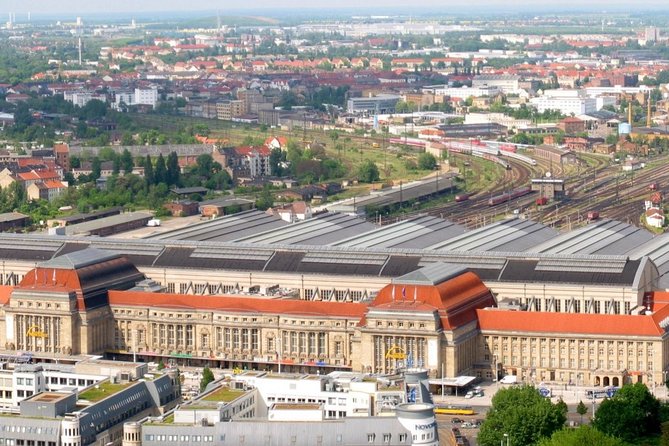
The tour begins outside Leipzig Hauptbahnhof, the city’s main railway station. This is a practical meeting point, especially if Leipzig is part of a longer Germany trip and you arrive by train.
Starting here also gives you a useful orientation. The route heads along Brühl, placing you in the central shopping and pedestrian area before moving through a series of historic and cultural stops. The first section should help you get your bearings without asking you to cross the whole city.
Your first consideration is traffic and city noise. The tour is taken through public streets, not a quiet museum setting, so you may need to lower the audio or pause at crossings. Download everything in advance and test the sound before leaving the station.
Brühl and Höfe am Brühl
Along Brühl, the modern city meets older layers of Leipzig. The tour passes Höfe am Brühl, a shopping complex that gives you a clear sense of how the center has changed since reunification.
This is one of the route’s useful contrasts. You hear about a controlled socialist state while walking through a present-day commercial district. The point is not that every building tells the whole story, but that Leipzig’s current streets carry several eras at once.
I would not expect a long architectural explanation at every stop. This is a compact political-history walk, not a dedicated shopping or design tour. Still, these early stops help place the Communist period in the city you see now.
Museum der Bildenden Künste and Reformierte Kirche
The route continues past the Museum der Bildenden Künste, Leipzig’s fine-arts museum, then by the Reformierte Kirche. These stops broaden the walk beyond protest sites and political squares.
The museum area gives you another public landmark for orientation. The Reformierte Kirche adds a religious setting to a tour that later reaches Leipzig’s two best-known churches, Thomaskirche and Nikolaikirche.
Churches matter here because religion and public life were closely linked during the final years of East Germany. The tour’s value is not only in naming buildings, but in explaining how a central city can hold religious, civic, and political meaning at the same time.
Same sights, a different narrator:
- Neuschwanstein Castle Skip-the-Line Ticket with Audio Guide
★ 4.4 · 1,388 reviews - Berlin: Solar Powered Sunset Catamaran Cruise & Audio Guide
★ 4.6 · 1,043 reviews - Berlin: Boat Sightseeing Cruise with Audioguide
★ 4.6 · 947 reviews - Füssen: Neuschwanstein Castle Express Ticket and Audio Guide
★ 3.9 · 788 reviews
Richard Wagner Platz and Thomaskirche
Richard Wagner Platz brings the route toward Thomaskirche, one of Leipzig’s most familiar landmarks. Thomaskirche is strongly associated with Johann Sebastian Bach, but on this walk it also helps you see the wider character of the city center.
You should allow yourself a little breathing room here. The audio lasts about an hour to an hour and fifteen minutes, but the stated duration is an estimate for the walking experience, not a command to rush past every sight.
The stop is useful for visitors who want history in place rather than a sequence of disconnected facts. You can look at the church, listen to the narration, and then decide if you want to pause before continuing. Since admission fees are not included, any ticketed entry or personal spending is your responsibility.
Naschmarkt and Leipzig’s central passages
From Thomaskirche, the tour reaches the Naschmarkt and then passes through the Mädler Passage. These are some of the most attractive parts of the central route, but they also serve a practical purpose: they help you understand how Leipzig’s commercial core is arranged.
Mädler Passage is a good place to slow down. Arcades and passageways can make a city feel more intimate than its main streets, and the tour uses that setting while continuing its account of Leipzig’s past.
The Naschmarkt gives you another central gathering point. I like this part of the route because it does not isolate political history from ordinary city life. Shops, passages, squares, and churches all become part of the setting.
The limitation is that you may be tempted to stop for food or browse the shops. That is perfectly fine, but it will lengthen the walk. Since you can pause the audio, the tour works well if you treat the route as a loose framework rather than a race.
Speck’s Hof and Nikolaikirche
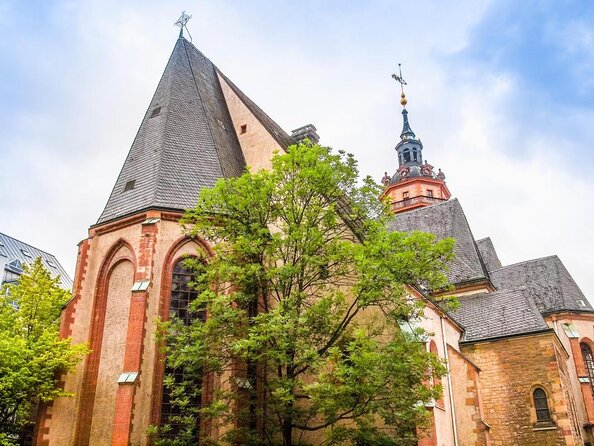
The route passes Speck’s Hof before reaching Nikolaikirche, the emotional center of the experience. Nikolaikirche is closely connected with Leipzig’s Monday demonstrations, and the audio places those protests at the physical locations where they mattered.
This is the point where the tour’s subject feels most immediate. You are not simply hearing that opposition grew in East Germany. You are standing near a church and city spaces linked with the gatherings that became a major force for change.
The available response to this section describes the stories around the Monday protests as especially moving because the walk takes place at the actual sites. That detail matters. Audio history can sometimes feel distant, but location gives it weight.
Take your time here. Listen carefully, and expect the area to be active with normal city life. You may not get silence, but that contrast can be meaningful: a place once associated with fear, courage, and public protest is now part of an open city center.
Augustusplatz and the Gewandhaus
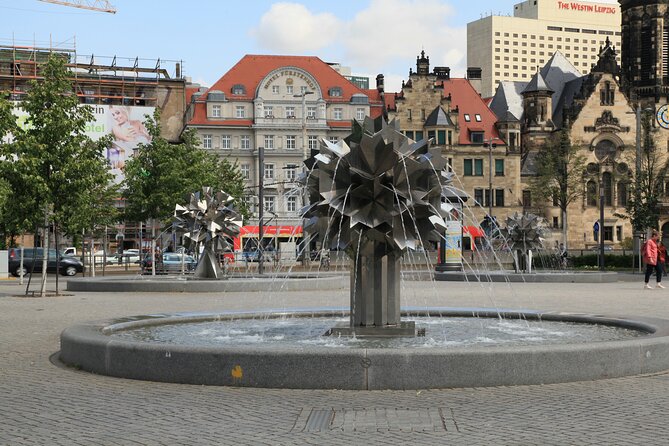
From Nikolaikirche, the route continues to Augustusplatz and the Gewandhaus. Augustusplatz is one of Leipzig’s major open spaces, giving the walk a change of scale after the tighter streets and covered passages.
The square helps explain how large public spaces function politically. The audio can connect the city’s physical layout with the history you have been hearing, while the Gewandhaus adds Leipzig’s long musical tradition to the picture.
You should not expect admission to the Gewandhaus or any other attraction to be part of the $9.99 price. The tour passes by the site. If you choose to go inside somewhere, pay any entry fee separately and keep in mind that the route’s audio timing may need to be paused.
This part of the walk is also useful for orientation. Augustusplatz is near public transportation, and the city center is compact enough that you can make your own plans around the audio route.
Finishing at Moritzbastei
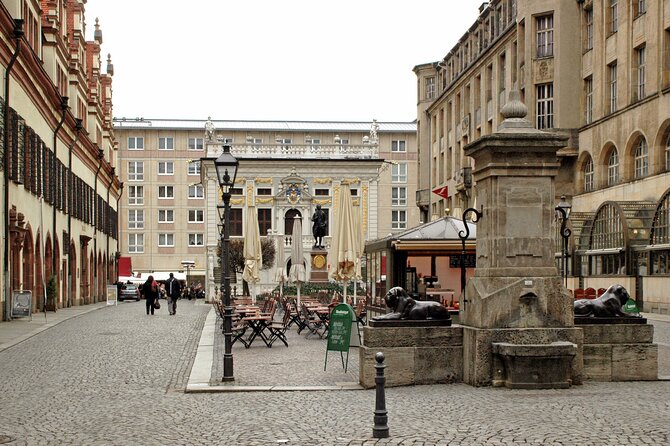
The tour ends by Moritzbastei, at Kurt-Masur-Platz 1. This gives you a clear finish near a recognizable Leipzig venue and leaves you in the central area rather than far out in a residential district.
Ending at Moritzbastei also makes practical sense. You can stop there, continue exploring, or use nearby public transport. The end point is not the same as the start, so plan for a one-way walk rather than expecting to return to Hauptbahnhof.
The route length is manageable for most people who can participate in a normal city walk. Still, comfortable shoes are sensible, and you should keep enough battery for the full audio, map, and GPS functions.
What $9.99 buys you
At $9.99 per person, this is inexpensive compared with a private guided walk. You do not pay for a live guide, transport, food, or attraction admission, but you do get lifetime access to the English tour through the VoiceMap app.
That lifetime access matters if you are planning a flexible trip. You can use the walk on the date that suits you, pause it for another activity, or return to a section later. The value is strongest if you prefer independent sightseeing and want a planned route without being tied to a group.
A live guide offers more interaction and can answer questions about Leipzig on the spot. This audio tour cannot do that. It also cannot change the route because you are especially interested in churches, music, architecture, or local politics.
For most people, the price is fair because the tour combines navigation with interpretation. You are not paying only for a map of Leipzig. You are paying for a structured story that connects the city’s Communist past with the streets in front of you.
How the VoiceMap format works
Download the VoiceMap app for Android or iOS before you begin. The tour includes offline access to the audio, map, and geodata, which is important if you do not want to depend on mobile service while walking.
The directions to Hauptbahnhof are included, and the tour begins when you reach the starting point. You can start, pause, and finish on your own schedule. This is a private activity in the sense that only your group uses it, not a shared walking group.
Bring a smartphone and headphones. Neither is supplied. Food, drinks, transportation, and personal expenses are also separate.
Because the experience depends on your device, check the battery before setting out. It is also wise to download the material in advance rather than waiting until you are standing outside the station.
Who should choose this tour?
I would choose this walk if I wanted a short introduction to Leipzig’s East German past before visiting museums or exploring the city on my own. It suits independent visitors, couples, families with older children, and anyone who dislikes fixed group departure times.
It is also a good fit if the Monday protests interest you. Nikolaikirche and the surrounding central stops give that subject a clear local setting instead of treating it as a distant chapter in a textbook.
You may prefer a live guide if you want extended discussion, spontaneous questions, or a more personal exchange. You may also want another tour if your main interest is Bach, art, shopping, or Leipzig’s medieval buildings. Those subjects appear as part of the route, but the central theme remains life under East German rule and the protests that challenged it.
The 94 percent recommendation rate and 4.8 rating from 16 reviews suggest a strong response, though the sample is small. The most praised elements are the accurate time information, the former-local perspective, and the emotional connection between the protest stories and the places where they happened.
Should you book it?
Book this tour if you want a compact, low-cost history walk with the freedom to set your own pace. The route covers a lot in roughly an hour, and the offline format is handy for a first day in Leipzig.
Skip it if you need a live expert, frequent conversation, or detailed entry inside each landmark. For everyone else, $9.99 is a sensible price for a focused introduction to Leipzig’s Communist past, especially if you plan to pause at Nikolaikirche, take your time around Augustusplatz, and let the city itself supply part of the lesson.
FAQ
How long does Leipzig’s Communist Past audio tour take?
The tour takes approximately one hour to one hour and fifteen minutes.
Where does the tour start?
It starts outside Hauptbahnhof in Leipzig, Germany.
Where does the tour finish?
It ends by Moritzbastei at Kurt-Masur-Platz 1, 04109 Leipzig.
Is the tour available in English?
Yes. Lifetime access to the tour is provided in English.
Do I need a smartphone and headphones?
Yes. You need to supply your own smartphone and headphones. The VoiceMap app is available for Android and iOS.
Can I take the tour offline?
Yes. You can download the audio, maps, and geodata for offline use before you explore.
Can I cancel for a full refund?
Yes. You can receive a full refund if you cancel at least 24 hours before the experience start time. Cancellations or changes made within 24 hours are not refunded or accepted.
New audio tours around Germany
- Discover Leipzig: Self-Guided Audio Tour★ 4.0 · 2 reviews
- Koblenz: City Walk with Audio Guide in 7 Languages on your Phone★ 4.5 · 5 reviews
- Laboe Naval Memorial: A Self-Guided Audio Tour★ 5.0 · 2 reviews
- Baden-Baden Self Guided Audio Tour in English★ 4.0 · 5 reviews
- Heidelberg: City Walk Audio Guide in 7 Languages on your Phone★ 3.0 · 2 reviews
- Heidelberg’s Altstadt: A Self-Guided Audio Tour★ 4.0 · 26 reviews
- Hamburg’s Historical Highlights: A Self-Guided Audio Tour★ 4.5 · 5 reviews
- Hamburg Scavenger Hunt and Highlights Self Guided Audio Tour★ 4.5 · 10 reviews
Germany Audio Tours, compared.

Neuschwanstein Castle Skip-the-Line Ticket with Audio Guide
Read our review →
Berlin: Solar Powered Sunset Catamaran Cruise & Audio Guide
Read our review →
Berlin: Boat Sightseeing Cruise with Audioguide
Read our review →
Füssen: Neuschwanstein Castle Express Ticket and Audio Guide
Read our review →
Neuschwanstein Castle Ticket With Audio Guided Tour
Read our review →
Spicy’s Gewürzmuseum Entry Ticket and Audio Guide
Read our review →
Berlin: Panoramic Boat Tour with Bilingual Audio Guide
Read our review →
Berlin: Französischer Dom Viewing Platform with Audio Guide
Read our review →Browse the lists this tour appears in