
Review · NAPLES
Naples: Pompeii Self Guided Audio Tour
Pompeii is easier to understand when the silent walls start speaking. This self-guided audio tour takes you from the amphitheater and House of the Vettii to the brothel, baths, taverns, frescoes, and mosaics, with more than 60 stops marked on an interactive map. I especially like the short audio tracks and the chance to explore at your own pace.
I also like the $4.70 price, which is less than the usual on-site audio guide cost, and the fact that you keep access for later visits. The main catch is the app. You must download the content before entering, and the map can take some getting used to, especially since it does not always show your exact position.
Key points
- More than 60 geolocated stops: Find major buildings, houses, art, and daily-life details with audio, text, and photos.
- Download before you go: Mobile reception inside Pompeii can be poor, so prepare the guide on Wi-Fi or with a strong signal.
- Explore at your own pace: The four-hour validity begins with activation, and there is no fixed meeting point or group schedule.
- Useful Roman details: Learn how the baths worked, what people ate, how bread was made, and why urine was used in wool processing.
- Five language choices: The app provides Italian, English, French, German, and Spanish audio.
- Good value with a few app quirks: The map is helpful, but it may zoom out after an audio track, and the app can restart if you leave it to take a photo.
Pompeii with your own soundtrack
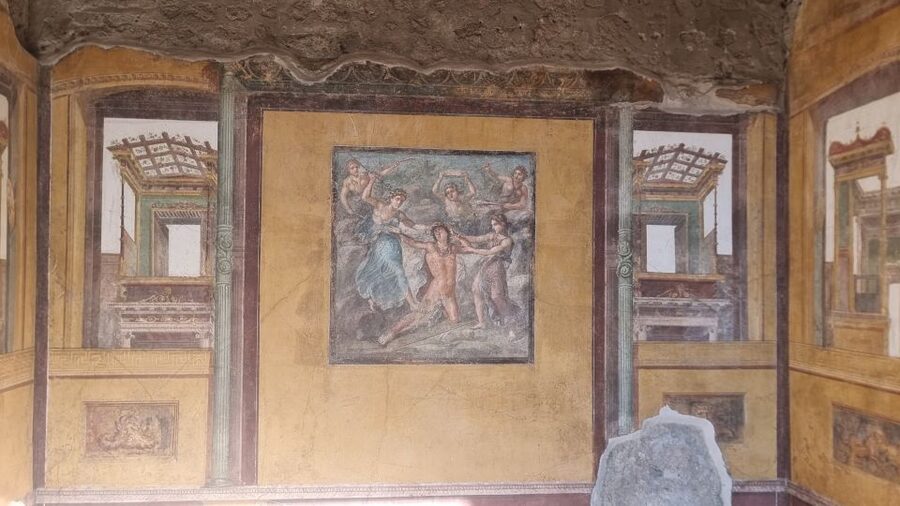
Pompeii is a large archaeological site, and it can feel confusing at first. Streets run in several directions, houses open and close depending on restoration work, and the best fresco or mosaic may be tucked behind an unremarkable doorway. A map with more than 60 marked points gives you a useful plan instead of leaving you to wander without context.
This is not a live tour. You do not meet a guide, join a group, or follow a set route. You enter Pompeii when the ruins are open, start the app, and choose the next point that interests you.
That freedom matters. You can spend longer at a house with striking paintings, skip a stop that does not appeal to your family, or replay an explanation without holding up anyone else. The four-hour validity begins at first activation, so do not start the guide while sitting at breakfast or waiting for the entrance gates.
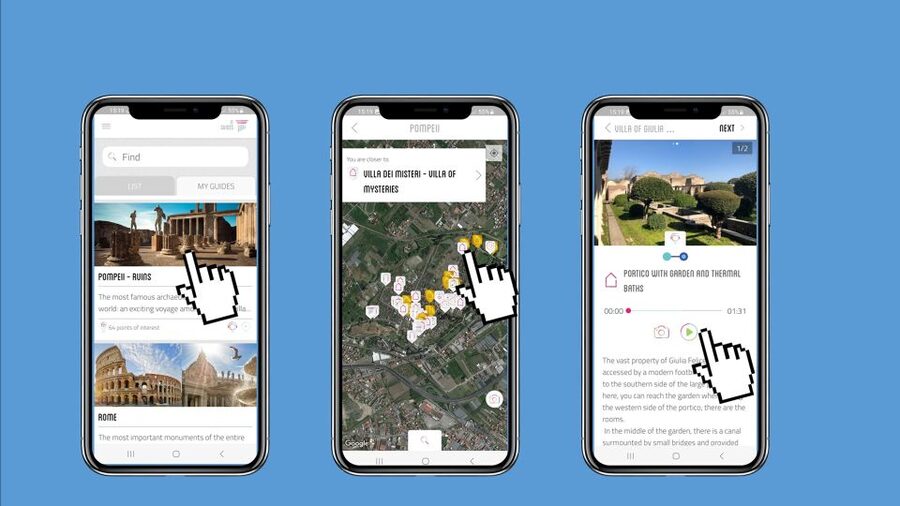
The app is called ITGUIDES. After buying, download it from your phone’s app store, find your user ID in the app, and send that ID along with your order number through the contact page. The guide is then activated for you. Instructions are supplied with the booking, and customer help is available through WhatsApp using the number shown in the app menu.
This setup is not quite as instant as picking up a rented device at the entrance. Still, assistance has been quick for many users, with one person reporting help from Vincenzo in about two minutes. Give yourself time to install and activate it before you reach the archaeological site.
More Self-Guided Audio Tours in Italy
- Matera: Sassi di Matera Historical Self-Guided Audio Tour
★ 3.6 · 183 reviews - Self Guided Audio Tour-Coliseum & the Gladiator’s Legends
★ 3.5 · 49 reviews - The city of Romeo and Juliet: A self-guided audio tour through Verona
★ 4.5 · 28 reviews
The amphitheater and Pompeii’s public life
The amphitheater is one of the obvious starting points for understanding Pompeii. The audio explains the building and the role it played in Roman entertainment, giving you more to notice than the stone seating and broad arena.
You can listen while looking around, then move on when you are ready. The tracks are short enough to keep your attention, rather than turning the visit into a lecture. This format works well in an open site where you may want to pause for photographs or simply take in the scale of the ruins.
The guide also helps connect public buildings with ordinary life. Pompeii was not only a collection of grand houses. It was a working city with places for bathing, eating, shopping, worship, and entertainment. The audio stops help you read those remains as parts of one community.
Restoration is ongoing, so you may find some buildings closed during your visit. The guide can still be useful, but a marked point is not a guarantee that every room will be open. Treat the map as a smart plan, not a promise that you can enter every location.
House of the Vettii and Pompeian interiors
The House of the Vettii is one of the key stops. Homes such as this are valuable because they show how status, decoration, and domestic space worked in Roman Pompeii. The app directs you toward important rooms and explains the details that are easy to miss when you are looking at walls, columns, and faded paint without help.
Pompeii’s interiors reward patience. A small painted panel can tell you more about taste and belief than a large courtyard, but only if you know what you are seeing. The guide uses audio, written descriptions, photographs, and links within the text to add background on gods, heroes, and technical terms.
That hypertext feature is a useful extra. If an explanation mentions a Roman deity or architectural feature you do not recognize, you can tap the term for more information. You are not forced to leave the app and search the internet, which helps you keep your place.
The map marks points you have visited, making it easier to see what remains. One small flaw appears when a location has two audio clips. Both may play, but the check mark does not always appear, so you should listen carefully and not rely entirely on the tick marks.
The brothel, baths, and the practical Roman city
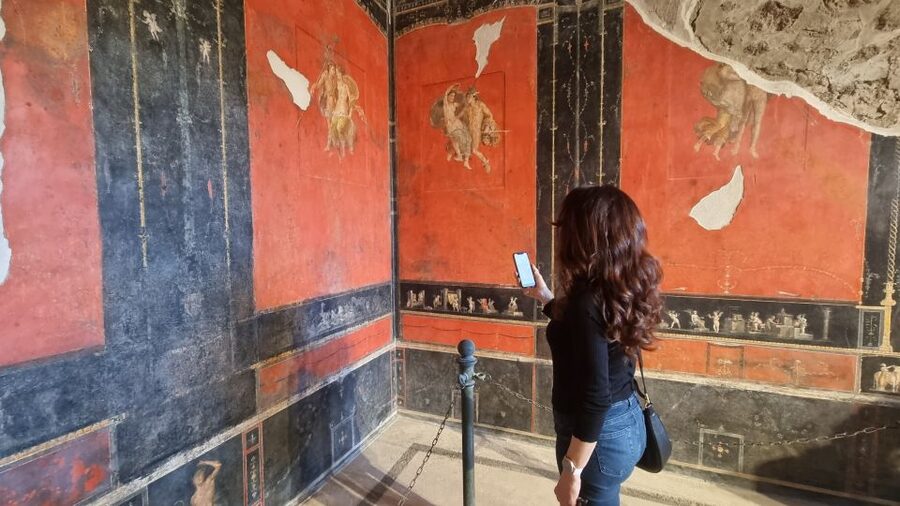
The lupanare, or brothel, is among Pompeii’s most talked-about stops. The audio gives it context within the city rather than treating it as a quick novelty. You will hear about the building and its place in Roman daily life, with the app guiding you to the relevant rooms and images.
The bath information is another strong part of the guide. Roman baths were more than places to wash. They involved a practical system of heated rooms and public routines, and an explanation helps you understand how the surviving structures fit together.
You also get some memorable details about Roman industry. The guide explains how urine was used in wool processing, a fact that sounds strange today but shows how little was wasted in the ancient city. It also covers bread making and the foods sold in Roman taverns.
These details give the ruins a human scale. A painted wall may be beautiful, but learning about bread, wool, food, and bathing shows you how people actually lived. I find this more useful than a guide that focuses only on emperors, disasters, and famous buildings.
More Self-Guided Audio Tours in Naples:
- Athens: Acropolis Ticket & Optional Self-Guided Audio Tours
★ 4.1 · 2,542 reviews - Gettysburg Battlefield Self-Guided Driving Audio Tour
★ 4.5 · 910 reviews - Joshua Tree National Park Self-Guided Driving Audio Tour
★ 4.5 · 762 reviews - Ultimate Acadia National Park Self-Guided Driving Audio Tour
★ 4.0 · 521 reviews
Frescoes, mosaics, and finding the best-preserved art

Pompeii’s best art is not always on the main path. The interactive map helps you seek out frescoes and mosaics, while the descriptions explain what makes each one worth seeing.
This is where the geolocation feature earns its small price. You can look at the map, select a nearby point, and receive audio, text, and photos connected to that location. You still need to orient yourself among the streets, but the marked stops reduce the chance of missing a notable house or decorative feature.
The map is not perfect. One user found it would have been better with a small dot showing their exact position. Without that, it can sometimes feel like using an old paper map, especially if you are standing at a crossroads and trying to work out which direction to take.
The app can also return you to the map after an audio track and zoom out too far. You may need to zoom back in before choosing the next nearby stop. That takes only a moment, but it interrupts the flow when you are moving through a large site.
A four-hour plan that leaves room to look around

The advertised duration is four hours from first activation. That is enough time to cover the marked points at a steady pace, but Pompeii itself can easily absorb longer than that. If you want to hear every recording, examine the art, take photographs, and pause often, you may need to choose your priorities.
A sensible approach is to download everything in advance, enter with the map ready, and start with the major points you most want to see. Then use the remaining time for nearby houses, art, and daily-life stops.
Do not expect the audio to create a fixed procession. The experience works best as a flexible map rather than a narrated march. You can select the amphitheater, move to a house, stop for the baths, and then follow the closest marked point.
The four-hour window also means timing matters. Since the clock begins at activation, wait until you are ready to enter the ruins. There is no meeting point, so you can begin at any entrance that suits your visit, based on opening hours and your own plans.
App handling, phones, and offline preparation
The most important practical tip is simple: download all audio and guide content before arriving. Reception inside the archaeological site is not reliable, and depending on a live connection can leave you standing beside an important building with no explanation.
Use a good Wi-Fi or cellular signal for the download. The guide can then work locally, which is also helpful if several people are sharing one phone or if you want to save mobile data.
The app includes a map, but keep your phone charged. The supplied information does not promise a separate audio device, so you will use your own smartphone. Headphones may make the recordings easier to hear, although none are supplied as part of the activity.
The app has a few operating habits worth knowing. If you leave it to take a photograph, it may restart when you return. After listening to a stop, it may send you back to the map and change the zoom level. These are small annoyances, but knowing about them prevents confusion.
The audio itself is available in Italian, English, French, German, and Spanish. The spoken tracks are generally clear, and the written descriptions provide a useful backup if you prefer reading or want to check a detail quietly.
Is $4.70 good value?

At $4.70 per person, this is a low-cost way to add structure to a Pompeii visit. The entrance ticket is separate, so you should include that in your overall budget. Even so, the audio guide costs less than the on-site audioguide price described with the activity, and you keep access for future visits.
That last point changes the value. You are not buying a one-time recording that disappears at the exit. You can reuse the Pompeii guide on another visit, and the ITGUIDES catalog also offers audio guides for other Italian archaeological and artistic sites.
The value is strongest if you want independence. A private guide or small-group tour can offer conversation and instant answers, but this app lets you pause, repeat, skip, and move at your own speed for a fraction of the cost.
The value is weaker if you dislike phone-based tours or want a person beside you. The app cannot respond to a question in the moment, and the map requires some attention. You also need to handle installation and activation yourself, although help is available through the app.
Free cancellation up to 24 hours before the activity and the reserve-now, pay-later option make it easier to fit into a changing itinerary. Those policies are useful, but the bigger decision is whether an audio app suits the way you like to visit ruins.
Who should choose this Pompeii guide?

I would choose this for independent visitors who want more context than the bare site signs provide. It also suits couples or families who do not want to stay with a guide’s pace, and anyone trying to keep the cost of a Campania day under control.
It is a good fit for repeat visits, too. You can use the recordings to focus on different parts of Pompeii each time, and the saved content means you do not have to buy another guide for a later visit.
Families may appreciate the stories about food, bread, baths, and wool processing. Those details can make ancient life easier to picture than a long explanation of political history. Parents should still plan for breaks, since four hours on foot among uneven archaeological streets can be tiring, though the activity itself is listed as wheelchair accessible.
I would hesitate if you have only a very short visit or want an expert to lead you from one point to the next. One person with only two hours wished for more time, and another found the app confusing at first. A live guide may be the better choice when you want a smooth route and immediate answers.
Should you book the ITGUIDES Pompeii audio tour?
Book it if you want a cheap, flexible way to make sense of Pompeii and are willing to prepare your phone before arrival. The best parts are the number of marked stops, the clear short recordings, the useful map, and the unusual details about Roman food, baths, bread, and wool production.
Do not book it expecting a personal archaeologist or a flawless navigation app. The map may not show your exact position, the screen can reset after audio or photos, and restoration may close some marked buildings.
For $4.70, I think it is a sensible add-on to a Pompeii entrance ticket, especially if you download everything first. You get structure without surrendering your freedom, and the guide remains available if you return to the ruins later.
FAQ
Is the Pompeii entrance ticket included?
No. The archaeological site entrance ticket is not included and must be purchased separately.
Is there a meeting point?
No. This is an independent smartphone activity with no meeting point. You can begin when you choose, according to the ruins’ opening hours.
How long is the audio tour valid?
The guide is valid for four hours from first activation.
How do I access the guide?
Download the free ITGUIDES app, then use the instructions supplied with your booking. You will need to send your app user ID and order number through the app’s contact page so the Pompeii guide can be activated.
Do I need internet access inside Pompeii?
You should download all guide content before entering. Mobile reception at the archaeological site may be poor, so use a strong Wi-Fi or cellular connection beforehand.
Which languages are available?
The guide is available in Italian, English, French, German, and Spanish.
Can I use the guide again?
Yes. The audio guide remains yours and can be reused on later visits.
Does the app include more than audio?
Yes. It includes an interactive map, geolocated points of interest, photographs, and written descriptions with links to additional information.
Is the activity wheelchair accessible?
Yes. The activity is listed as wheelchair accessible, though the entrance ticket and site conditions remain separate from the audio guide.
New audio tours around Naples
- National Archaeological Museum synchronized audioguided tour without QR or app★ 4.0 · 4 reviews
- Naples: National Archaeological Museum Tour & Digital Guide★ 4.2 · 177 reviews
- Naples: Royal Palace Entry Ticket with Digital Audio Guide★ 4.1 · 146 reviews
- Naples:Pompeii SkiptheLine Ticket audioguide Round-Trip Bus★ 4.1 · 18 reviews
- Naples: Herculaneum Entry Ticket with Digital Audio Guide★ 4.0 · 14 reviews
- Naples Audioguide – TravelMate app for your smartphone★ 4.6 · 7 reviews
- Naples from Above: Castel Sant’Elmo Ticket & Audio Guide★ 4.0 · 53 reviews
- Naples: daily/weekly transport ticket, map and audio guide★ 4.8 · 4 reviews
Naples Audio Tours, compared.

Mount Vesuvius: Skip-the-Line Ticket and Smart Digital Guide
Read our review →
Pompeii: Skip-the-Line Entry Ticket with Audio Guide or Tour
Read our review →
Herculaneum: Skip-the-Line Entry Ticket with Audio Guide
Read our review →
From Naples: Caserta Palace Ticket and Train with Audioguide
Read our review →
Naples: National Archaeological Museum Tour & Digital Guide
Read our review →
Naples: National Archaeological Museum audio guide
Read our review →
Naples: Royal Palace Entry Ticket with Digital Audio Guide
Read our review →
Naples from Above: Castel Sant’Elmo Ticket & Audio Guide
Read our review →Browse the lists this tour appears in