

Review · SKIP-THE-LINE AUDIO TOURS
Pamukkale and Hierapolis Skip-the-Line Tickets + Audio Guide
Hierapolis gives you two major sights in one visit: a Roman city spread across a high plateau and Pamukkale’s bright white mineral terraces below. I like the skip-the-ticket-line entry, which saves time at the ticket counter, and the offline audio guide, which lets you explore without roaming data or keeping pace with a group.
The main catch is that security lines cannot be skipped. You also need a charged smartphone, your own headphones, and enough energy for a walking route that can include uneven ground and slopes. At $51 per person, this is most useful if you want history explained as you go, rather than only an entry ticket.
Key points to know before you book
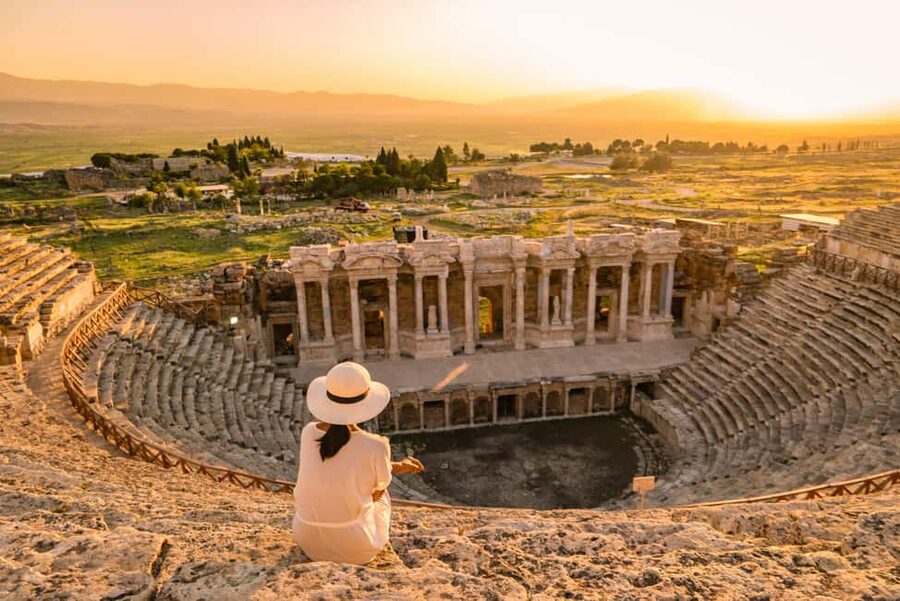
- Hierapolis combines Roman ruins and Pamukkale views: You can move from the theater and baths to broad views over the travertine terraces.
- The audio guide works offline: Download the narration, text, and maps before setting out, so you do not need mobile data at the site.
- Your ticket covers the main archaeological sights: Entry includes the ancient city, museum, theater, Roman bath, Plutonium, and Martyrium of Saint Philip.
- Ticket queues and security are different: You can bypass the ticket line, but every visitor must pass through security.
- Plan for walking: The route requires trekking, and suitable clothing, sunscreen, water, and a charged phone matter.
- This is self-guided, not a guided group tour: You choose your pace, but there is no live guide to answer questions on site.
Why Hierapolis and Pamukkale work so well together
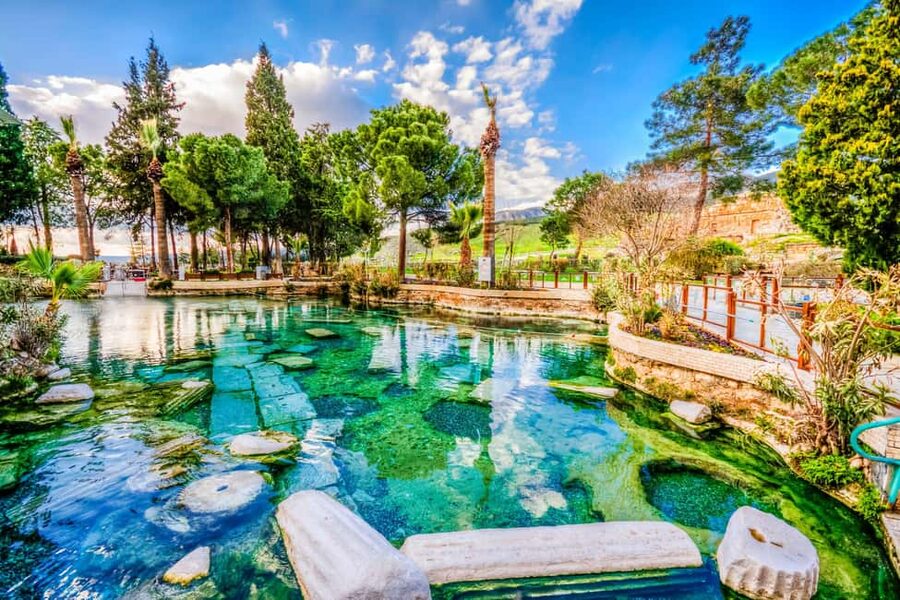
Pamukkale is often pictured as a wall of white terraces, but the ancient city above it gives the visit its deeper sense of place. Hierapolis was built around hot springs, and you can see how Roman public life, religion, health, and death all gathered around the same thermal setting.
I like this pairing because the scenery is not just a backdrop. The pale travertine slopes explain why people came here in the first place. The warm springs helped make Hierapolis a place for bathing and healing, while the high position gave the city broad views across the Aegean Coast region.
The ticket is valid for one day, so you have room to set your own rhythm. You can spend more time with the ruins, pause for photographs, or give the white terraces your full attention. There is no fixed group timetable pressing you onward.
That freedom also means you must manage the visit yourself. The audio guide gives you structure, but it does not replace a person who can adjust the route, answer follow-up questions, or point out a detail you might otherwise miss.
More Skip-the-Line Audio Tours in the world:
- Prague: Skip-the-line Castle Ticket and Optional AudioGuide
★ 4.3 · 11,121 reviews - Topkapi Palace and Harem Skip-the-Line-Tickets & Audio Guide
★ 4.3 · 4,745 reviews - Pantheon Reserved Entry Ticket with Audio Guide
★ 4.0 · 4,486 reviews
Arriving with a QR code and passing security
Your QR code ticket and audio guide access link are sent by Cosmic Tickets after 6 PM on the day before your visit. Same-day bookings are sent immediately. Keep an eye on your email, and have the ticket ready on your phone when you arrive.
The ticket lets you skip the regular ticket-buying line. This is helpful at a major archaeological site, especially if several groups arrive at once. It does not mean you walk straight through every checkpoint.
Security screening is mandatory, and a line may form there. The wording about express entry should not lead you to expect a completely queue-free arrival. Think of the benefit as avoiding the ticket counter, not skipping security or site rules.
The experience is listed as wheelchair accessible, but the audio tour also describes a route that requires trekking. If mobility is a concern, check the exact access conditions at the entrance and consider which parts of the archaeological area you want to visit first.
Getting started with the offline audio guide
The audio guide is delivered through an activation link connected to your QR code ticket. Before you begin walking, download the audio narration, written information, and maps while you have a reliable internet connection.
This small bit of preparation matters. Pamukkale and Hierapolis are open-air sights, and you should not count on a strong phone signal everywhere. Offline access also saves your data and keeps the visit from turning into a hunt for a usable connection.
Bring your own headphones. They are not included. A charged smartphone is just as important, since your phone is both your ticket and your guide.
The audio guide format suits independent visitors who like to stop and start. You can listen while walking between locations, pause when a view catches your eye, and return to a section if you want to hear it again. One practical point is that walking while listening requires some attention, so pause the narration when crossing uneven ground or moving through a crowded entrance area.
The theater, where Hierapolis becomes a city

The theater is one of the strongest stops in Hierapolis. Its scale helps you picture the city as a functioning Roman center rather than a scattered collection of stones.
You can use the audio guide to understand how the theater fit into public life and why its position mattered. The high setting also gives you a useful visual break from the closer archaeological details. Look outward as well as at the stonework, since the views help explain the city’s location above Pamukkale.
The drawback is that the theater is part of a walking visit, not an isolated monument reached by a short path from the entrance. The route can feel like a trek, particularly if you are trying to cover every included sight in one day.
Take your time here if you care about architecture or photography. The theater offers both close details and a wide view, which makes it one of the better places to pause rather than simply check off the list.
More audio tours around the world:
- Barcelona: Sagrada Familia Entry Ticket with Audio Guide
★ 4.6 · 105,312 reviews - Rome: Pantheon Fast-Track Ticket and Official Audioguide
★ 4.5 · 27,353 reviews - Barcelona: Casa Batlló Entry with Self-Audioguide Tour
★ 4.7 · 25,359 reviews - Rome: Colosseum & Forum with Audio Guide App -Optional Arena
★ 4.2 · 24,770 reviews
Roman baths and the Hierapolis Museum
The Roman baths show the practical side of a thermal city. Pamukkale’s springs were not only visually striking. They supported bathing and social life, and the bath complex helps connect the ruins to the natural hot water below.
The museum adds another layer by bringing archaeological material indoors. After walking through the open-air ruins, a museum stop can give you a quieter place to focus on objects and details that are harder to appreciate among the larger structures.
Both stops are included in the ticket, so you do not need to decide on separate admission once inside. Their value depends on your interests. If you prefer broad views and monumental ruins, you may spend less time in the museum. If you want a closer look at the city’s past, the museum helps slow the visit down.
The audio narration is particularly useful here because baths and museum displays can otherwise be easy to skim. Without a live guide, use the map and audio stops to decide how much time each section deserves.
The Plutonium and the city’s sacred springs
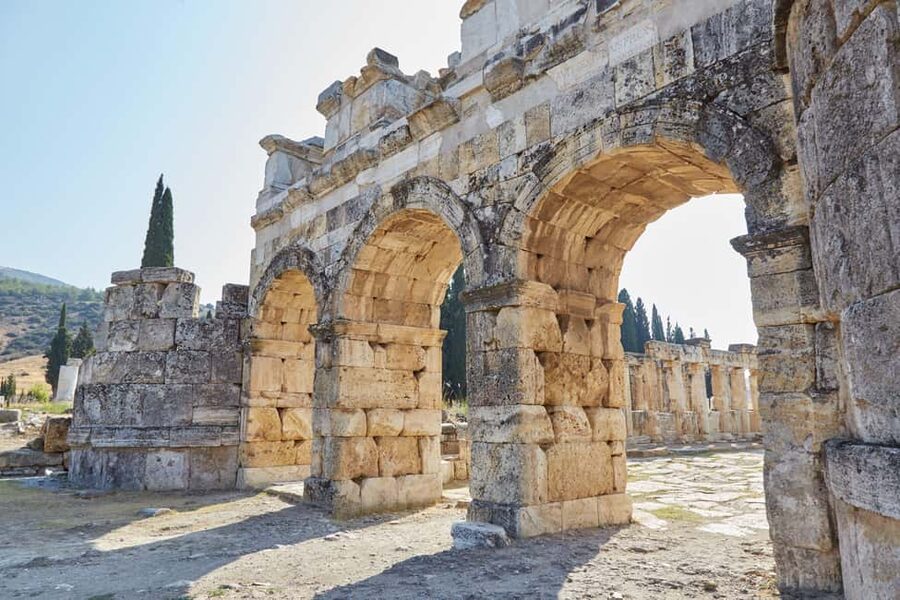
The Plutonium is one of the more unusual stops on the route. It was known as a Gate to the Underworld, tied to the gases associated with the thermal springs. That detail gives Hierapolis a strong religious side, not just a Roman civic one.
This is where the setting matters most. The hot springs were both a source of comfort and a place treated with caution and reverence. The audio guide can help you connect the physical site with the beliefs that grew around it.
Do not expect a modern attraction with dramatic effects. The interest comes from understanding why this particular spot carried such weight in the ancient city. The Plutonium is best appreciated when you pause, listen, and take in the setting rather than rushing through it.
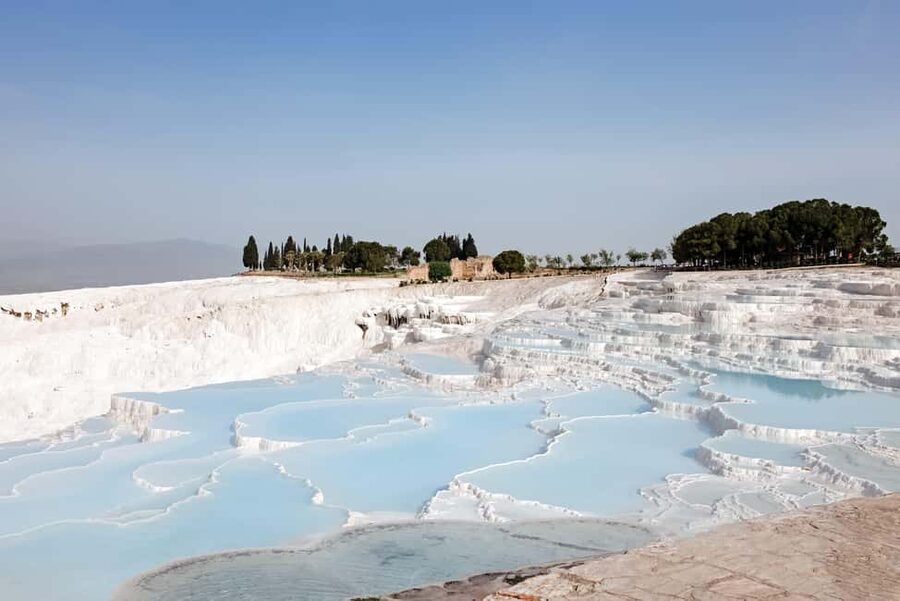
The same advice applies to the travertine formations. Their white terraces can look almost too polished from a distance, but seeing them alongside the ancient religious site gives you a clearer idea of why the springs shaped local life.
The necropolis and the Martyrium of Saint Philip
Hierapolis’ necropolis extends the visit beyond the city center. Its tombs show that the site was also a place where people came to spend their final years and be remembered.
A large cemetery can feel less immediately dramatic than a theater, but it gives the ancient city scale. You begin to see how long the route is and how many different parts of life were connected here. The audio guide is useful for giving meaning to a field of monuments that might otherwise blur together.
The Martyrium of Saint Philip adds a later Christian chapter. Its inclusion makes the route broader than a simple Roman ruins tour. You are not looking at one moment in time, but at a place whose religious importance changed over the centuries.
These areas also reinforce the need for sensible footwear and a steady pace. The visit involves walking between separate sights, and you will get more from it if you do not try to hurry through every stop.
The white terraces and views over Pamukkale
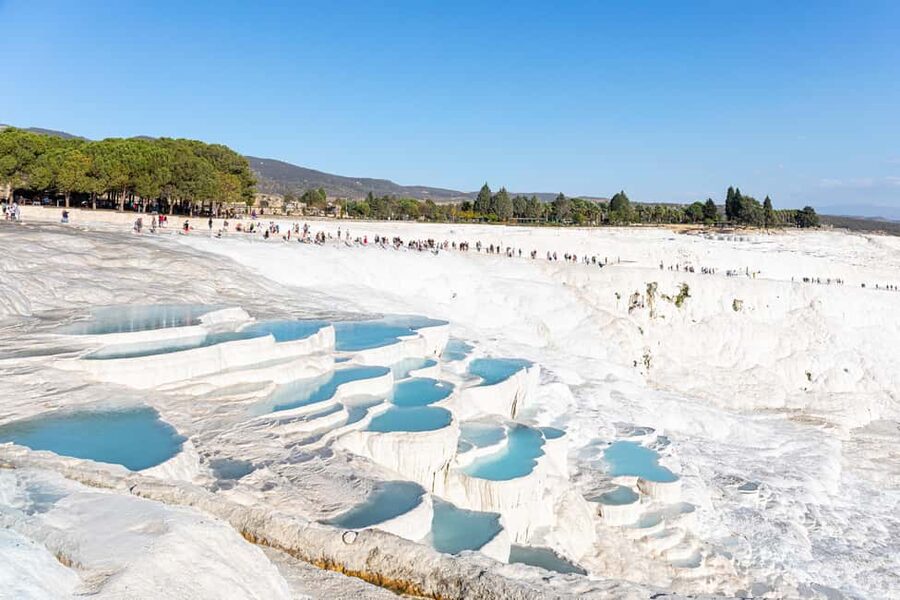
The travertine terraces are the visual payoff. Mineral-rich water formed the bright white slopes over time, creating the feature that made Pamukkale one of Turkey’s best-known natural sights.
You can look across the terraces from Hierapolis and understand the relationship between the ancient city and the springs. The view changes as you move, so keep your camera ready, but do not let photography crowd out the chance to simply watch the light and water patterns.
Bring biodegradable sunscreen. You may also want a change of clothes and beachwear, both of which are specifically recommended for the visit. The provided information does not promise that every area will suit swimming or bathing, so pack these items as practical backup rather than assuming a water activity is included.
The terraces can be bright and exposed. Sunglasses, water, and a hat would be sensible additions, although only biodegradable sunscreen, a camera, beachwear, and a change of clothes are specifically listed among the suggested items.
How much walking should you expect?
The route is self-paced, but it is not a short indoor attraction. One verified account describes the audio guide as easy to download and comfortable to use while completing a trek. That is a useful clue about the experience: the technology is simple, but your legs still do the work.
You should expect to walk between the theater, museum, baths, Plutonium, Saint Philip’s Martyrium, and other parts of the ancient city. Some sections may involve uneven ground or slopes. Wear practical shoes and keep your phone accessible without letting it distract you from where you are stepping.
Families, history fans, photographers, and nature lovers can all find something here. The best fit is someone who enjoys choosing their own pace and does not need a guide beside them at every stop.
If you prefer a short, tightly managed sightseeing visit, this may feel too spread out. If you like combining archaeology, religious history, and striking scenery in one day, the walking becomes part of the appeal.
What $51 includes, and what it does not
At $51 per person, the price is higher than a bare entrance ticket, but you are paying for more than access. The package includes entry to Pamukkale and Hierapolis, the theater, museum, Roman bath, Plutonium, and Martyrium of Saint Philip, plus the audio tour if you select the audio guide option.
The main value is convenience. You avoid the regular ticket line, receive digital access, and get explanations that help you make sense of a large archaeological area. You also avoid the cost and fixed schedule of a live guide, though that means giving up personal questions and on-the-spot adjustments.
Food, drinks, transportation, and headphones are not included. That makes the final cost higher if you need to arrange transport from another town or buy refreshments separately.
I would consider the price reasonable for an independent visitor who wants the main entry covered and prefers a self-guided history experience. I would think twice if you only want to see the terraces quickly or already have a detailed guidebook and do not need audio narration.
Booking details that matter
The activity offers free cancellation up to 24 hours before the visit, and you can reserve now and pay later. The ticket is valid for one day, with available starting times shown during booking.
The audio guide option needs careful attention when selecting your reservation. The included materials describe audio access if that option is chosen, so check that you have selected it if narration is important to you.
The service is provided by Cosmic Tickets & Audios. There is no live guide, no transportation, and no meal service. You are responsible for reaching the site, managing the route, and keeping your phone ready.
Who should book Pamukkale and Hierapolis this way?
I would choose this experience if you want freedom without giving up basic historical context. It works well for a solo visitor, a couple, or a family that does not move at one fixed speed.
It is also a good match for photographers. You can pause at the theater, turn toward the terraces, or spend longer at the museum without holding up a group. The offline map and narration give you enough structure to keep the day organized.
I would look for a different format if you want hotel pickup, a personal guide, included food, or a short transfer-based visit. None of those services is part of this package.
Should you book it?
Book it if your main goal is to explore both Pamukkale and Hierapolis independently, with the ticket line handled and an audio guide ready on your phone. The theater, baths, Plutonium, museum, and Saint Philip’s Martyrium give the day plenty of substance beyond the famous white terraces.
Skip it if you want a live expert, transport, or a completely queue-free entrance. The security line remains mandatory, and the walking route takes real time and effort.
For most self-directed visitors, the strongest reasons to book are simple: good coverage of the major sights, offline access, and the freedom to set your own pace. Just arrive prepared with headphones, a charged phone, sun protection, and comfortable clothes for a full day outdoors.
FAQ
Is transportation included?
No. Transportation to Pamukkale and Hierapolis is not included.
Can I skip the security line?
No. Security screening is mandatory for every visitor, and a line may form at the entrance. The skip-the-line benefit applies to the ticket line.
How do I receive my ticket?
You receive a QR code ticket by email from Cosmic Tickets after 6 PM on the day before your visit. Same-day bookings are sent immediately.
Is the audio guide included?
Audio access is included when you select the audio guide option. It provides audio narration, written content, and maps for offline use.
Do I need internet during the visit?
No. You can download the audio content, text, and maps for offline access. Download everything before you begin.
Are headphones provided?
No. You need to bring your own headphones.
How long is the ticket valid?
The ticket is valid for one day. Available starting times can be checked when you book.
New audio tours around the world
- London Panoramic Open Top Bus Tour with Audio Guide★ 4.0 · 209 reviews
- London: British Museum Audio Guide & Small Group Entry★ 3.5 · 81 reviews
- London: National Gallery Audio Tour (No Entry Ticket)★ 3.5 · 11 reviews
- London’s Alternative History: A Self-Guided Audio Tour★ 5.0 · 4 reviews
- London: British Museum’s English Audio Tour with Free Reservation★ 3.0 · 15 reviews
- London: Churchill War Rooms Ticket & Political London Audio Tour★ 4.0 · 83 reviews
- London: British Museum Audio Tour with Free Guaranteed Entry★ 3.0 · 30 reviews
- Houses of Parliament Ticket & Political London Audio Guide★ 4.0 · 13 reviews
Skip-the-Line Audio Tours, compared.

Prague: Skip-the-line Castle Ticket and Optional AudioGuide
Read our review →
Topkapi Palace and Harem Skip-the-Line-Tickets & Audio Guide
Read our review →
Pantheon Reserved Entry Ticket with Audio Guide
Read our review →
Rome: Borghese Gallery Skip-the-Line Ticket & Audioguide
Read our review →
Skip the Line: Vatican & Sistine Chapel Ticket with Audio Guide
Read our review →
Pompeii: Skip-the-line Entry Ticket with Audio Guide & Map
Read our review →
Mount Vesuvius: Skip-the-Line Ticket and Smart Digital Guide
Read our review →
Rome: Borghese Gallery Skip-the-Line Tickets with Audioguide
Read our review →Browse the lists this tour appears in