
Review · ITALY
Tivoli: Entrance Ticket to Villa Adriana & App Audioguide
Hadrian’s Villa is not a single grand building. It is a sprawling Roman estate, with more than 30 structures spread across roughly one square kilometer of Tivoli. The Maritime Theater, a round retreat with its own pool and artificial island, is the clever showstopper. The Canopo pool and its surrounding sculptures are another high point.
I like the freedom of a one-day ticket and the useful digital audioguide, which lets you explore at your own pace instead of keeping up with a group. I also like the value: at about $19, you get access to a major UNESCO World Heritage Site and enough ground to fill at least two hours. The main drawback is that transportation is not included, and the large open site can feel tiring in hot weather.
Key points to know before you go
- Hadrian’s private retreat: See the vast estate built for Emperor Hadrian outside Rome.
- The Maritime Theater: Visit a circular complex with an artificial island, pool, baths, library, and living rooms.
- The Canopo and Serapeum: Walk beside a long sculpted pool and view the unusual artificial grotto at its end.
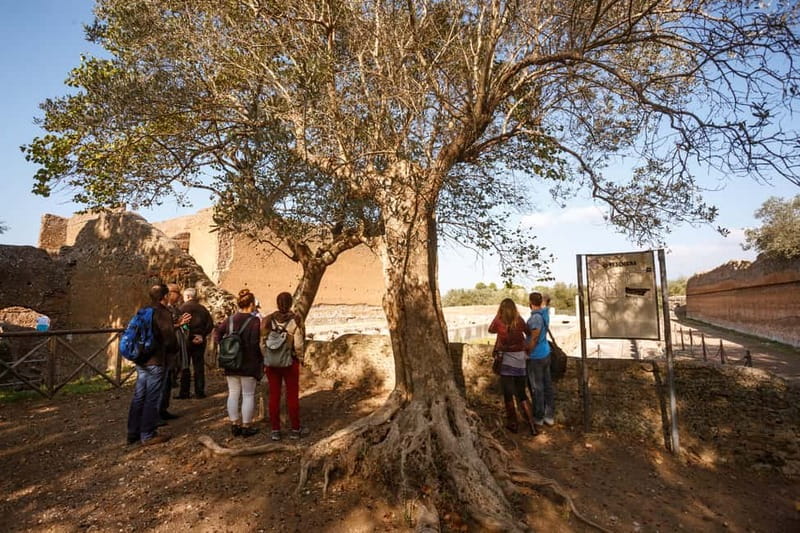
- Ancient details survive: Look for Roman mosaics, marble statues, fountains, heated floors, and bath remains.
- Self-guided freedom: Your ticket is valid for one day, with a digital audioguide rather than a live guide.
- Pack light: Security checks are required, and rucksacks, suitcases, and large bags are not permitted.
Why Hadrian chose this enormous retreat
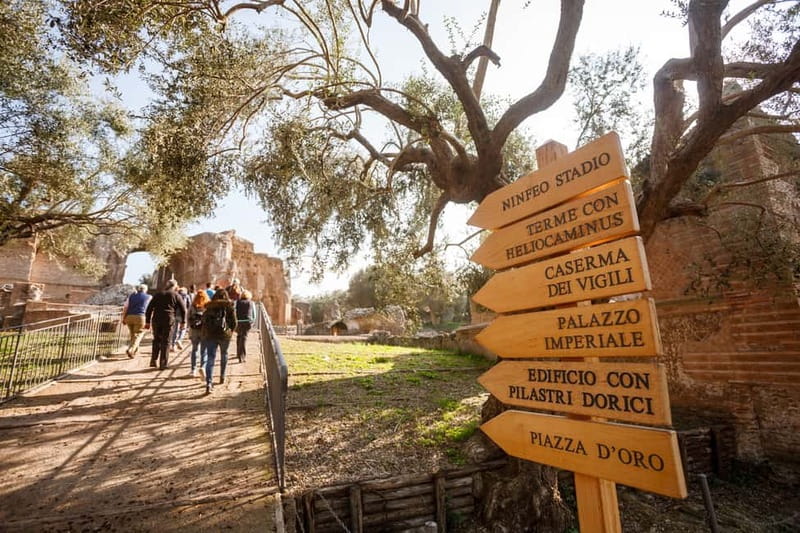
Hadrian’s Villa gives you a different view of imperial Rome. Instead of one palace crowded into the city, you get a vast country residence where the emperor could work, rest, entertain, and experiment with architecture.
The estate was built because Hadrian disliked the Palatine Hill in Rome. That small detail helps explain the scale of the place. He wanted room, privacy, gardens, water, baths, libraries, and buildings inspired by places across the Roman world.
I find the size more meaningful than any single ruin. You are not simply looking at one preserved monument. You are walking through the remains of a working imperial complex, much of which has still not been excavated. Every cleared wall hints at the buried sections beneath your feet.
The grounds cover about one square kilometer and contain the remains of more than 30 buildings. You will need time and energy to appreciate them. A rushed visit can turn into a long walk among walls, columns, and fragments, while a slower visit lets the layout begin to make sense.
The site is best for visitors who enjoy seeing how a place was organized. You can compare formal rooms with private retreats, bathing areas with grand pools, and practical engineering with decorative art.
More audio tours around Italy:
- Rome: Pantheon Fast-Track Ticket and Official Audioguide
★ 4.5 · 27,353 reviews - Rome: Colosseum & Forum with Audio Guide App -Optional Arena
★ 4.2 · 24,770 reviews - Florence: Timed Entry to Michelangelo’s David + Audio App
★ 4.6 · 19,496 reviews
The ticket, audio guide, and one-day visit
This experience gives you entry to Villa Adriana and a digital audioguide. There is no live guided tour included, so you control the pace and decide how much attention to give each part of the complex.
That arrangement suits me at a site this large. A live tour can provide structure, but it can also move on before you have finished looking. With the audio guide, you can pause, replay information, or spend longer at a mosaic or water feature that catches your eye.
The ticket is valid for one day. You need to exchange your voucher at the Villa Adriana ticket office, and a printed voucher is required. The booking information says you can skip the ticket line, but you should still allow time to exchange the voucher and pass through security.
At about $19 per person, the price is reasonable for the amount of site you can access. You are paying for a major archaeological area rather than a short visit to one building. The value is strongest if you enjoy ruins and can give the site at least two hours.
You can cancel up to 24 hours in advance for a full refund, and the reserve-now, pay-later option keeps your plans flexible. These terms are useful if you are arranging a Rome trip around changing weather or uncertain day plans.
The Maritime Theater and Hadrian’s private world

Make the Maritime Theater one of your first major stops. Its name can mislead you. This is not a theater for performances, but a round portico surrounding a pool with an artificial island.
The design feels wonderfully private. The circular portico has a barrel vault supported by pillars, while the island inside the pool could be reached across the water. It was a retreat within the retreat, a quiet place set apart from the rest of the estate.
The complex included a lounge, library, heated baths, three suites with heated floors, a washbasin, an art gallery, and a large fountain. Those details show how Roman luxury depended on engineering as much as decoration.
I like this stop because it makes Hadrian’s personality easier to imagine. The emperor did not merely need a large residence. He wanted separate spaces for work, reading, bathing, art, and quiet time, all arranged around water.
Look closely at the shape of the structure. The straight walls are remarkably precise, while the curved walls and domed forms show a high level of planning. You do not need to be an architecture expert to appreciate the contrast.
The Maritime Theater is also one of the easier parts of the villa to picture. Some ruins can seem like disconnected stone. Here, the pool, circular walkway, and island give you a clear sense of how people once moved through the space.
The Canopo pool and Serapeum grotto
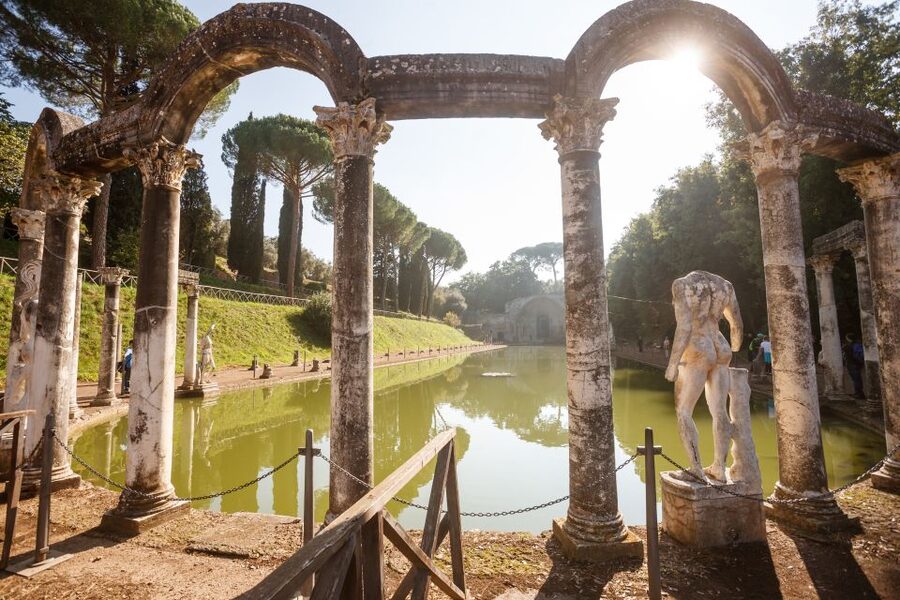
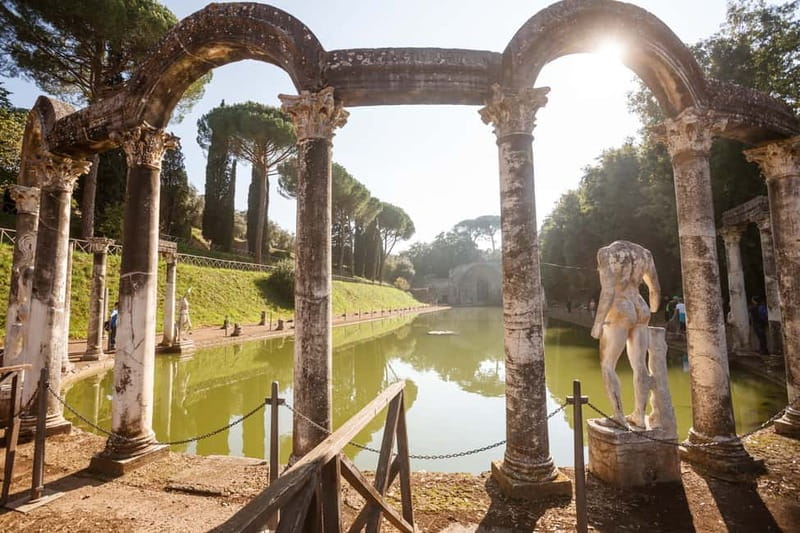
The Canopo is one of the most impressive open spaces at the villa. It is a large rectangular pool surrounded by sculptures, giving the area a formal, ceremonial feel.
Water was central to Roman villa design, and the Canopo shows how practical features could also become grand displays. As you walk around the pool, look at the relationship between the water, statues, columns, and surrounding buildings.
At the end of the Canopo, you will find the artificial grotto known as the Serapeum. Its design adds another layer to the area, turning the pool into a long visual sequence rather than an isolated body of water.
The Canopo is also a good place to slow down. The site covers a lot of ground, and it is easy to treat each stop as something to check off. Instead, take a few minutes to study the long axis of the pool and the repeated placement of sculpture.
Some statues and decorative pieces connected with the villa survive in museums or in fragmentary form, so do not expect every original detail to remain in place. Even so, the scale of the pool and the remaining architectural setting make this one of the site’s essential stops.
Same sights, a different narrator:
- Rome: City Sightseeing Hop-on Hop-off Bus with Audioguide
★ 4.0 · 16,045 reviews - Pompeii: Entry Ticket with Audio Guide
★ 4.1 · 13,491 reviews - Venice: La Fenice Opera House Entry Ticket with Audio Guide
★ 4.6 · 11,742 reviews - Rome: Colosseum, Forum, Palatine Hill Entry & Audioguide App
★ 4.4 · 10,957 reviews
Mosaics, statues, and Roman engineering
The villa’s surviving decorative details help you move beyond the broad walls and foundations. You can see mosaics from the baths and theater, along with artifacts dating from the period when the estate was built.
The mosaics are especially valuable because they preserve small signs of daily Roman taste. Patterns and fragments can tell you more about how rooms were finished than a bare wall ever could.
Pay attention to the engineering, too. Heated floors, fountains, baths, pools, and carefully planned water features required serious technical skill. A ruined wall may look simple at first, but its straight lines, curved sections, vaults, and drainage systems reflect careful design.
The remains associated with the bathing areas are another strong point. The complex was built for comfort as well as ceremony, and the heated floors show that luxury depended on systems hidden beneath the finished rooms.
You may also encounter marble statues of Antinous, Hadrian’s deified lover. Antinous was honored after his death, and his presence at the villa links the art here to Hadrian’s personal life as well as his public role.
Do not expect a museum-style display at every turn. This is primarily an archaeological park, so you will often see fragments, foundations, and partial structures in an open setting. The audio guide matters because it helps explain what each section once did.
Walking the grounds without rushing
The villa is large enough that pacing matters. The supplied experience information recommends allowing at least two hours, and I would treat that as a minimum for a meaningful visit rather than a strict timetable.
Two hours lets you see the main monuments and gain a basic sense of the site. If you like ancient architecture, mosaics, or Roman engineering, you may want longer. The grounds include water features, classical statues, baths, courtyards, and many structures beyond the best-known stops.
Wear comfortable shoes and carry only what you need. Large bags, suitcases, and rucksacks are not allowed, and you must pass a security check before entering. The rules are simple, but discovering them at the entrance can create an avoidable problem.
The open setting also affects your comfort. Much of the visit takes place outside, with little reason to hurry from one building to the next. A hot day can make the walk feel longer, so plan your pace around the weather and your interest in the ruins.
I recommend using the audio guide selectively. Listen fully at the Maritime Theater, Canopo, Serapeum, and major bath areas. In less familiar sections, take in the walls and layout first, then use the guide to fill in the story.
There is still a lot that has not been excavated. That can be frustrating if you want a fully preserved palace, but it is also part of the appeal. The villa gives you a sense of how much of the Roman world remains below ground.
Getting a souvenir with Pemcards
The experience includes the option to create a Pemcard, a digital photo that can be sent as a real postcard anywhere in the world.
This is a small extra, but it suits Villa Adriana well. The site offers plenty of images beyond the standard Roman ruin: the circular Maritime Theater, the long Canopo pool, statues, fountains, and the surrounding countryside near Tivoli.
You can follow the provider’s instructions for downloading and sending the digital postcard. Treat it as an optional memento rather than a central part of the visit. The archaeological site itself is the reason to come.
Who will enjoy Villa Adriana most
I would recommend this experience to you if you like ancient sites that require imagination. You will see impressive remains, but not a complete palace with every room intact.
It is a strong choice for anyone who has already seen Rome’s famous central monuments and wants a quieter setting outside the city. The villa offers more space and a clearer sense of an imperial retreat than many compact archaeological stops.
Families with older children may also enjoy it, especially if the children like Roman history, architecture, or puzzles. The Maritime Theater and Canopo give you concrete features to look at, while the audio guide can provide context without forcing the whole family into a fixed schedule.
You may want a different option if you prefer a short, highly structured tour with a live expert. This ticket does not include transportation or a guided tour. It also requires walking across a large archaeological area, with some sections that may seem repetitive if ancient ruins are not your main interest.
At $19, the ticket works best as a focused half-day outing rather than a quick add-on between other Tivoli sights. The combination of scale, engineering, mosaics, statues, and water features gives you enough to justify the time.
Should you book this Villa Adriana ticket?
Book it if you want to see a major Roman estate outside Rome and prefer exploring independently. The Maritime Theater, Canopo, Serapeum, mosaics, and bath remains give you a clear set of priorities, while the rest of the grounds reward patient walking.
The ticket is especially good value for visitors who can spend at least two hours on site and do not need transportation or a live guide included. Bring a printed voucher, pack light, and plan for an outdoor visit.
Skip it if your schedule is tight, large bags are unavoidable, or you want a guide to lead you from start to finish. For everyone else, Villa Adriana offers an unusually direct look at how an emperor lived, worked, entertained, and used Roman engineering to turn a country estate into a small world of its own.
FAQ
Where is Villa Adriana?
Villa Adriana is in Tivoli, in Italy’s Lazio region, east of Rome.
What does the ticket include?
The ticket includes entry to Villa Adriana and a digital audioguide.
Is transportation included?
No. Transportation to Villa Adriana is not included.
Is a live guided tour included?
No. The experience includes a digital audioguide, not a live guided tour.
How long is the ticket valid?
The ticket is valid for one day.
Do I need a printed voucher?
Yes. You need to exchange a printed voucher at the Villa Adriana ticket office.
Can I bring a large bag or suitcase?
No. Rucksacks, suitcases, and large bags are not permitted inside the attraction.
Is there a security check?
Yes. You must pass through security before entering Villa Adriana.
Can I cancel the booking?
Yes. You can cancel up to 24 hours in advance for a full refund.
New audio tours around Italy
- Lecce Walking Tour with Audio and Written Guide by a Local★ 4.0 · 38 reviews
- Private Audio Guided Walking Tour in Lecce★ 4.0 · 7 reviews
- Private Audio Guided Walking Tour in Como★ 3.0 · 3 reviews
- Como Walking Tour with Audio and Written Guide by a Local★ 4.5 · 30 reviews
- Finance and Nobility: Explore medieval Genoa on a self-guided audio tour★ 4.5 · 7 reviews
- Genova Walking Tour with Audio and Written Guide by a Local★ 4.5 · 33 reviews
- Udine Walking Tour with Audio and Written Guide by a Local★ 4.0 · 2 reviews
- Florence: Uffizi Gallery Timed Entry Ticket with Audio★ 3.0 · 3 reviews
Italy Audio Tours, compared.

Rome: Pantheon Fast-Track Ticket and Official Audioguide
Read our review →
Rome: Colosseum & Forum with Audio Guide App -Optional Arena
Read our review →
Florence: Timed Entry to Michelangelo’s David + Audio App
Read our review →
Rome: City Sightseeing Hop-on Hop-off Bus with Audioguide
Read our review →

Venice: La Fenice Opera House Entry Ticket with Audio Guide
Read our review →
Rome: Colosseum, Forum, Palatine Hill Entry & Audioguide App
Read our review →