
Review · BUCHAREST, ROMANIA
3-Days in Bucharest: Smart Audio Guide with Travel Instructions
Bucharest becomes easier to read when you move between its very different chapters: village life at the Dimitrie Gusti Museum, communist power at the Ceausescu Mansion and Uranus, and old-world churches and cafés in the center. This is a self-guided three-day route built around a phone app, not a traditional walking tour with a person beside you.
I like two things right away. First, the plan covers far more than the usual central sights, including Therme Bucuresti and Herastrau Park. Second, you can use one guide on several phones, while a human assistant remains available through WhatsApp. The main drawback is that admission tickets, food, transport, and mobile data are on you, and the schedule is full enough to require steady walking and careful timing.
Key points before you book
- A three-day route with wide variety: Museums, churches, parks, communist-era sites, a spa, shopping, cafés, and Romanian food all appear in the plan.
- Audio guidance through your phone: You receive access before the tour and may be able to start using it one day before arrival.
- Good for independent planning: You can move at your own speed instead of staying with a fixed group.
- Several stops need paid admission: The app provides the route and information, but entry fees are not included.
- Day 3 is the historic center day: Stavropoleos Monastery, Cărturești Carusel, CEC Palace, Calea Victoriei, and Caru’ cu bere form a strong final circuit.
- WhatsApp help is available at any hour: This adds useful backup if you need help finding a stop or using the app.
What the $12.09 price really buys you
At $12.09 per person, this is inexpensive for a three-day sightseeing plan. You are not paying for a private guide, transport, attraction tickets, meals, or spa access. You are paying for a customized route, audio information, travel instructions, and access to assistance through WhatsApp.
That distinction matters. If you want someone to explain Bucharest in person, answer questions as you walk, and handle the day’s logistics, this is not that product. If you prefer to stop for coffee when you want, linger in a museum, or skip a sight without holding up a group, the low price makes much more sense.
The best value comes from the planning. Bucharest’s attractions are spread across different districts, and the app is intended to arrange them into useful days. One person who used similar products in several European cities said the precise directions meant they no longer worried much about building their own itinerary. That is the real time savings here: less research before the trip and fewer decisions once you arrive.
You should still budget separately for admission tickets. Nearly every museum, church, mansion, and major indoor attraction lists entry as not included. Therme Bucuresti will also require its own ticket, and food at Caru’ cu bere is separate. The app can tell you where to go, but it does not turn a $12 experience into an all-inclusive tour.
More audio tours around the world:
- Barcelona: Sagrada Familia Entry Ticket with Audio Guide
★ 4.6 · 105,312 reviews - Rome: Pantheon Fast-Track Ticket and Official Audioguide
★ 4.5 · 27,353 reviews - Barcelona: Casa Batlló Entry with Self-Audioguide Tour
★ 4.7 · 25,359 reviews
Day 1, village life, a dictator’s home, and Bucharest’s green north
The first day begins at the Muzeul Național al Satului Dimitrie Gusti, an open-air museum that places traditional Romanian homes in the middle of the capital. You can expect houses, churches, farm buildings, tools, furniture, ceramics, fabrics, and technical installations from regions across Romania.
Allow about two hours here. This is one of the most useful stops for understanding the country beyond Bucharest. Instead of seeing only grand buildings and city streets, you get a sense of how rural communities were organized and what daily life looked like. The museum is spread out, so wear comfortable shoes and allow time between displays.
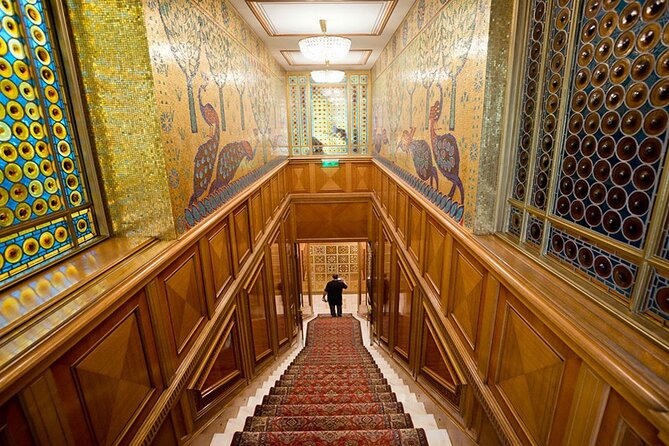
Next comes the Ceausescu Mansion, the former private home of Nicolae Ceausescu, his wife Elena, and their three children. The visit takes about an hour and shifts the mood sharply. You move from traditional village life to the private setting of Romania’s communist ruling family.
This stop is valuable because it puts a human scale on a political period that can otherwise feel abstract. Admission is not included, and the tour plan does not state the entry cost, so check current details before you arrive. The app’s background material should help you place the house within Romania’s recent past.
The National Theatre Ion Luca Caragiale is a shorter stop, listed at about 30 minutes. Its modern architecture makes it a quick contrast with the old churches and historic buildings found elsewhere in the city. You may want to treat this as a photo and orientation stop rather than a full theater visit, since no performance is included in the plan.
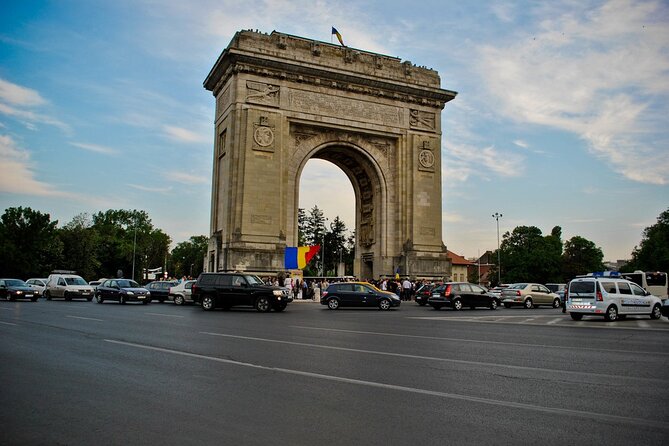
At the Triumph Arch, you have about 20 minutes to see Bucharest’s answer to the Parisian monument. It commemorates Romania’s victory in World War I and the union of territories inhabited by Romanians. The short visit works well as part of a wider route, but do not expect a long indoor museum experience from the information provided.
Herastrau Park, now also known as King Mihai Park, gives the day some breathing room. You have about an hour in one of Bucharest’s largest and most varied parks, and admission is free. This is a good place to slow down after several sightseeing stops, though the route does not specify a particular activity or meeting point inside the park.
The day ends at Manuc’s Inn, one of the city’s best-known historic inns. The word han refers to a roadside or city-edge lodging place where merchants could spend the night with horses and carts. Allow 90 minutes here. The setting connects food, trade, and old urban life, making it a fitting close to a day that began with traditional village buildings.
Day 1 includes roughly six hours of listed visits before you add travel, meals, and pauses. You can complete it, but you will need to start on time. If the Ceausescu Mansion or village museum holds your attention, shorten one of the brief architecture stops rather than rushing every location.
Day 2, fossils, communist power, and warm-water relaxation

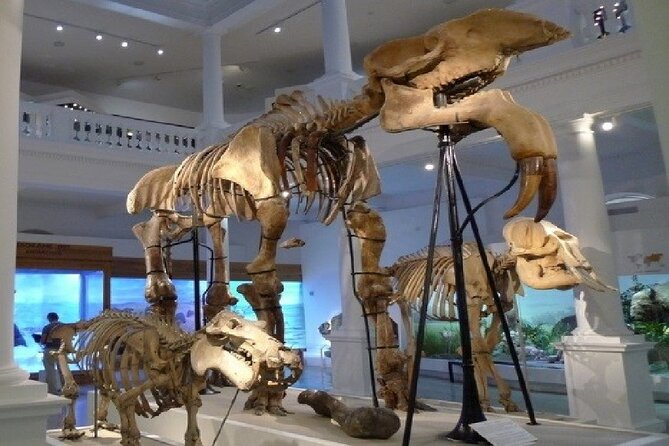
The second day opens at the National Museum of Romanian History. Its collections include a large Deinotherium giganteum skeleton dating from 7.5 to 8 million years ago, Egyptian mummies, geological and mineral collections, zoological and paleontological material, ethnographic displays, and a real cave.
Plan on two hours, though the range of subjects is broad enough that you could easily want longer. This is not a narrowly focused museum. It gives you a large sweep of natural and human history, with some unusual displays that are hard to predict from the museum’s name alone.
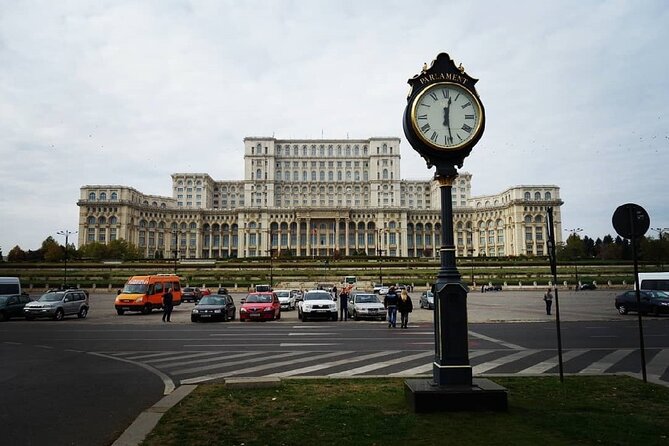
Uranus follows, with about 90 minutes. The description identifies the site as the second-largest administrative building for civilian use in the world after the Pentagon. The stop brings you back to the scale of the communist state and its grand building projects.
The route does not specify exactly which sections you enter or whether admission is included, so check the app’s current instructions before setting out. Uranus is best approached as a major architectural and political landmark, not a casual neighborhood stroll. The large scale may be striking, but it can also make this part of the day feel less intimate than the churches and old streets later in the trip.
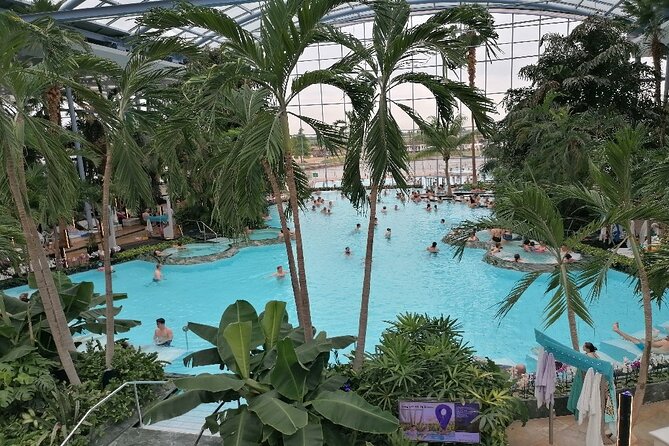
The longest stop is Therme Bucuresti, with three hours planned. This modern spa complex has indoor and outdoor thermal-water pools, pools with various salts, saunas, water slides, and a wave pool. It is the itinerary’s biggest change of pace.
I like the idea of placing Therme on a sightseeing trip because Bucharest can involve a lot of pavement and mental effort. Three hours gives you time to relax rather than simply pass through. If you want slides and a wave pool, there is something active here too. If you prefer quiet, the pools and saunas offer a slower option.
The spa is not included in the tour price, and the plan does not give transport details or entry fees. Treat this as a separately budgeted outing. You should also watch the clock. A three-hour spa visit plus travel can make the rest of the day tight.
Bulevardul Unirii is scheduled for about an hour and is free to visit. It is one of Bucharest’s main boulevards and an important transit route. This stop helps you understand the city’s broad, formal side, especially after Uranus, but it may feel more like an urban orientation walk than a traditional attraction.
The day finishes at Antim Monastery, built between 1713 and 1715 on the site of an older wooden church. Give it about an hour. Its age and Orthodox design provide a calmer finish after the scale of the boulevard and administrative buildings.
Day 2 has around eight and a half hours of listed activities. That is a demanding schedule even before you count travel and meals. I would keep the museum visit focused, confirm Therme’s opening and ticket details, and use the app’s customization feature if you would rather spend more time at one place than check every box.
Day 3, Bucharest’s old center and its grand boulevard
The final day begins at Valea Regilor, an Egyptian café in central Bucharest. The listed visit is only 30 minutes and admission is free. Think of it as a short cultural pause and a chance to see a more unusual café setting before moving into the old center.
Stavropoleos Monastery is one of the key stops. Built in 1724 by the Greek loanichie Stavropoleanulos, it is an Orthodox monastery in the Brâncovenesc style. Allow about 30 minutes. The visit is short, but this is the kind of compact historic site that rewards attention to architectural detail.
Cărturești Carusel comes next. The bookstore occupies an early twentieth-century building and is described as one of the largest and most beautiful in the city. Set aside an hour if you want to browse instead of simply taking a look inside.
This is a useful stop for independent visitors because it combines architecture with an everyday city activity. You are not only viewing a monument. You are seeing how an old building functions in present-day Bucharest. Admission is not listed as included, although a bookstore visit itself is not presented as a ticketed activity.
CEC Palace, or Palatul CEC, takes about 30 minutes. The CEC institution was founded in 1864 through a law initiated by Alexandru Ioan Cuza. The building is part of the city’s grand financial and civic face, and its location fits naturally with a walk through the historic center.
Then comes Calea Victoriei, the main event of the day. The plan allows three hours along Bucharest’s most celebrated promenade. You can expect boyar houses, churches, inns, hotels, luxury shops, cafés, and state institutions along the route.
This is where the city’s nickname Little Paris becomes easier to understand. The street carries several layers of Bucharest at once, from old residences and religious buildings to elegant commercial spaces. Three hours gives you time to walk, stop for a drink, and let the city unfold without treating every building as a quick photograph.
Caru’ cu bere closes the trip with a Romanian meal and traditional music and dancing. The planned time is 90 minutes, though dining pace can vary. Food and drinks are not included, so reserve money for the meal. This is also one of the itinerary’s most direct ways to connect sightseeing with local dining culture.
Day 3 contains about seven and a half hours of listed stops. The route is central and should feel more coherent than the first two days, but you still need to protect time for the meal. If you must cut something, make the adjustment before Calea Victoriei, since the boulevard and Caru’ cu bere form the strongest finish.
Same sights, a different narrator:
- Rome: Colosseum & Forum with Audio Guide App -Optional Arena
★ 4.2 · 24,770 reviews - Amsterdam: 75 Minute City Canal Cruise with Audio Guide
★ 4.4 · 19,938 reviews - Florence: Timed Entry to Michelangelo’s David + Audio App
★ 4.6 · 19,496 reviews - Amsterdam: City Centre Canal Cruise including Audioguide
★ 4.3 · 16,901 reviews
How the smart audio guide works in practice
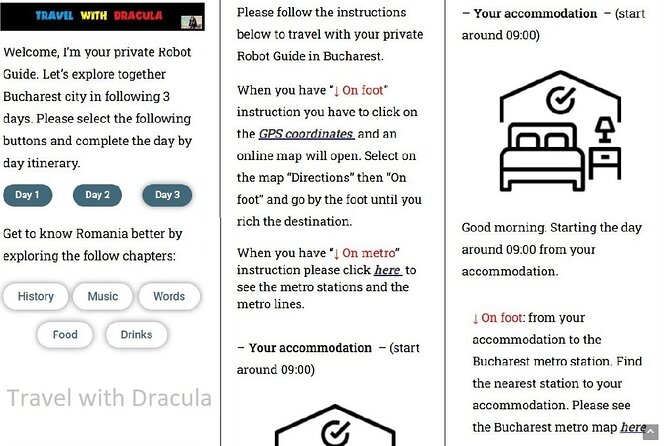
You receive access to a customized mobile application before the start of the experience. Access may be provided as early as one day before you arrive in Bucharest, giving you time to check the route and understand how the app works.
One guide can be used on multiple phones at the same time. That is practical for couples, families, or friends who want to listen together while keeping the route visible on separate devices. You need roaming or mobile data, and that cost is not included.
The experience is private because only your group participates, but it is not accompanied in person. The app handles the instructions and audio content, while a human assistant is available through WhatsApp around the clock. The supplier’s replies identify an assistant named Adrian, though the experience does not promise a personal guide named Adrian at each attraction.
The audio material includes history sections. That matters if you know little about Romania and want context as you move between sites. One particularly useful feature is precision: the route is designed to help you reach each attraction without building the whole plan yourself.
Still, keep your expectations clear. An app cannot adjust the route in the same way a local guide can respond to weather, closures, mood, or a sudden desire to stay longer. You get independence and low cost, but less live interpretation.
Who should choose this Bucharest plan?

I would choose this for a first visit if I wanted broad coverage at a low price and felt comfortable navigating with a phone. It suits solo visitors especially well because the app provides structure without requiring a group. One solo user found the details easy to follow and said the historical sections made Bucharest easier to understand.
It also works for couples and small private groups who dislike fixed departure times. The ability to use the same guide on several phones is a simple but useful feature.
You should think twice if you want a relaxed holiday with only two or three sights per day. The schedule is ambitious, and Day 2 is particularly packed. You should also be comfortable paying for many admissions separately and checking your own transport between stops.
Moderate physical fitness is recommended. No special accessibility information is provided, so contact the assistant before booking if mobility needs affect your ability to walk between sites or use stairs.
Free cancellation is available up to 24 hours before the start time for a full refund. Changes or cancellations made inside that window are not accepted or refunded.
Should you book it?

Book this experience if your priority is value, independence, and a ready-made route. At $12.09, it is a sensible planning aid for someone who wants museums, communist landmarks, churches, a spa, and Romanian dining without paying for a private guide.
Skip it if you want transport, tickets, meals, or a person walking beside you throughout the day. The best way to use it is as a strong framework, not a command to visit every stop at full speed. Keep the sights that matter most to you, use the WhatsApp support when needed, and leave room for Bucharest to surprise you between the scheduled points.
FAQ
Is this a guided tour with a person accompanying me?
No. You receive a customized mobile audio guide and travel instructions. Human assistance is available through WhatsApp, but an in-person guide is not described as part of the experience.
How long does the experience last?
The experience is designed for three days. The listed sightseeing time varies by day, with roughly six hours on Day 1, eight and a half hours on Day 2, and seven and a half hours on Day 3, before adding travel, meals, and breaks.
Can I use one audio guide on more than one phone?
Yes. One Smart Audio Guide can be used on multiple phones at the same time.
Do I receive the app before arriving in Bucharest?
Yes. Access is provided before the experience begins, and access may also be available one day before your arrival.
Are attraction tickets included?
No. Admission tickets are not included for the listed museums, mansion, monasteries, and other ticketed attractions. Food, drinks, and Therme Bucuresti admission are also separate.
Do I need mobile data?
Yes. You should have roaming or mobile data available for your phone. Those costs are not included.
Can I cancel for a full refund?
Yes, if you cancel at least 24 hours before the local start time. Cancellations or changes made less than 24 hours before the start time are not refunded or accepted.
New audio tours around the world
- London Panoramic Open Top Bus Tour with Audio Guide★ 4.0 · 209 reviews
- London: British Museum Audio Guide & Small Group Entry★ 3.5 · 81 reviews
- London: National Gallery Audio Tour (No Entry Ticket)★ 3.5 · 11 reviews
- London’s Alternative History: A Self-Guided Audio Tour★ 5.0 · 4 reviews
- London: British Museum’s English Audio Tour with Free Reservation★ 3.0 · 15 reviews
- London: Churchill War Rooms Ticket & Political London Audio Tour★ 4.0 · 83 reviews
- London: British Museum Audio Tour with Free Guaranteed Entry★ 3.0 · 30 reviews
- Houses of Parliament Ticket & Political London Audio Guide★ 4.0 · 13 reviews