
Review · ALBERTA
Lake Louise & Moraine Self-Guided Driving Audio Tour
The best part of this tour is the freedom to explore Banff’s famous lakes and mountain roads without being tied to a bus schedule. The 39-plus audio stories turn a scenic drive into a guided outing, while the app starts each story as you reach the right location.
I like the $14.99 price per group of up to four, and I like that the tour works offline after you download it. You can stop for photos, pause the narration, take a side trip, or spread the route over more than one day.
The main catch is that this is not a park shuttle, entry pass, or personal guide. You handle the driving, parking, reservations, and timing yourself. Download the tour while you have strong service, since the audio and maps need to be stored on your phone first.
Key points at a glance
- Moraine Lake’s Rockpile: Take the short half-mile walk to one of the area’s best-known viewpoints.
- More than 56 miles of scenery: The route links glacial lakes, waterfalls, river views, meadows, and mountain lookouts.
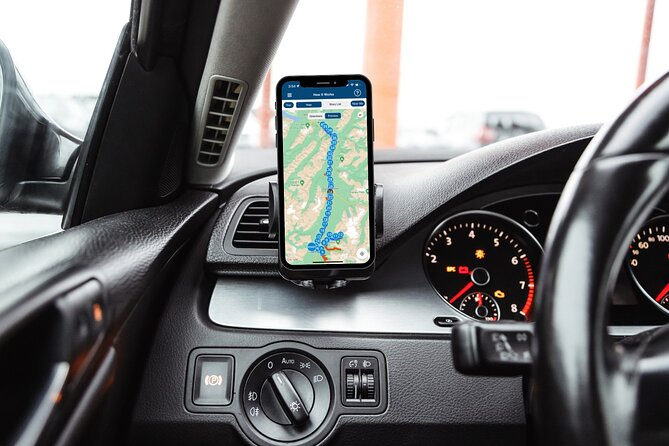
- 39-plus automatic audio stories: The app plays narration as you reach each marked point.
- A strong family or small-group value: One purchase covers up to four people in the same car.
- Flexible timing: The stated drive takes about two to three hours, but you can pause, skip stops, or continue on another day.
- Offline operation: Download the app, map, and tour before leaving reliable Wi-Fi or cellular service.
A self-guided route through Banff’s famous sights
This experience gives you a narrated road trip between Lake Louise and Banff-area viewpoints, with Moraine Lake and Lake Louise as its headline sights. The route covers more than 56 miles and includes over 39 audio stories, so the advertised two to three hours refers to the basic drive, not a full day spent hiking and taking photographs.
You begin at the Lake Louise Ski Resort and Summer Gondola, at 1 Whitehorn Road. The tour ends at Vermilion Lakes Viewpoint near Banff. No one meets you at either point. You open the Action Tour Guide app, enter the first story’s location, and let the GPS trigger the narration.
I like this setup for a national park road trip. You get useful context without needing to keep your eyes on a screen, and you can stop when a view catches your attention. The app also lets you pause or skip stories, which matters when parking is tight or you want to spend more time on a trail.
The route works best when you follow the suggested direction and the posted speed limit. If you rush ahead, the timing of the audio can become less useful. If you stop for hikes, simply pause the tour and restart it when you return to the car.
More Driving Audio Tours in Canada
- Cabot Trail: a Smartphone Audio Driving Tour
★ 4.5 · 118 reviews - Icefields Parkway: a Smartphone Audio Driving Tour
★ 4.0 · 118 reviews - Smartphone Audio Driving Tour between Banff and Calgary
★ 4.0 · 25 reviews
Moraine Lake and the short Rockpile walk
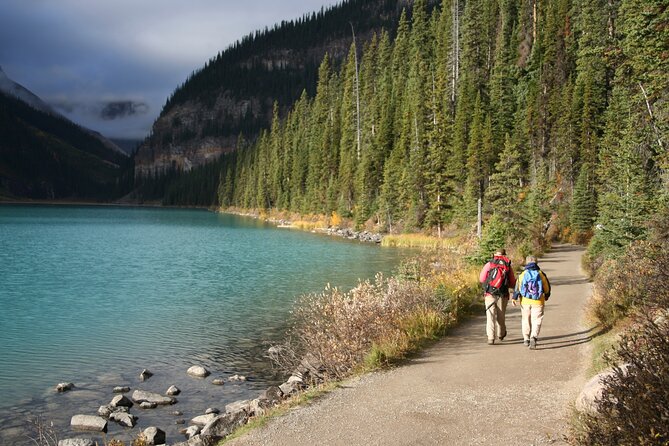
Moraine Lake is one of the main reasons to choose this experience. The audio points you toward the Rockpile, a half-mile trail that takes about 15 minutes to walk. The entrance is near the end of the parking area, and the path loops up over the rocks.
The reward is a broad view over the lake and surrounding peaks. The tour explains that the Rockpile is linked to Wilcox, whose climb helped draw attention to the viewpoint. That small detail gives the stop a human connection instead of treating it as just another photo stop.
This is one of the easiest walks on the route, but you still need to allow time beyond the stated 10-minute audio stop. The trail itself is short, yet you may want to linger at the top for photographs. The audio tour does not include attraction tickets, reservations, or transportation, so you need to sort out access to the lake separately.
That point is important. The tour starts at the ski resort, but the itinerary includes a stop at Moraine Lake. Read the current access rules for the dates of your visit before setting out. The app provides narration and route guidance, not guaranteed parking or admission.
Lake Louise, known for more than its color
A few minutes later, the narration introduces Lake Louise. The lake covers 222 acres and reaches depths of about 230 feet. Before the Canadian Pacific Railway brought more visitors into the area, the Stoney Nakoda fished here and called it Horâ Juthin Îmne, meaning Lake of Little Fishes.
That detail is one of the better reasons to use an audio tour. Without narration, you might simply admire the water and move on. With it, you get a small piece of the area’s Indigenous and railway-era story as you approach the lake.
The route begins at the ski resort, so you should be clear about your starting point before pressing play. The tour is designed to run from the Lake Louise area toward Banff, not as a walking tour around the lake shore. You will need to use the app’s directions and choose the correct version if more than one starting point or direction appears.
The audio also points out a location connected with Nicholas Morant, a Canadian Pacific Railway staff photographer. His mid-20th-century photographs helped make this view a familiar image in Banff advertising. That context helps explain why certain viewpoints became famous long before smartphone photography.
Castle Lookout and the cost of a serious hike
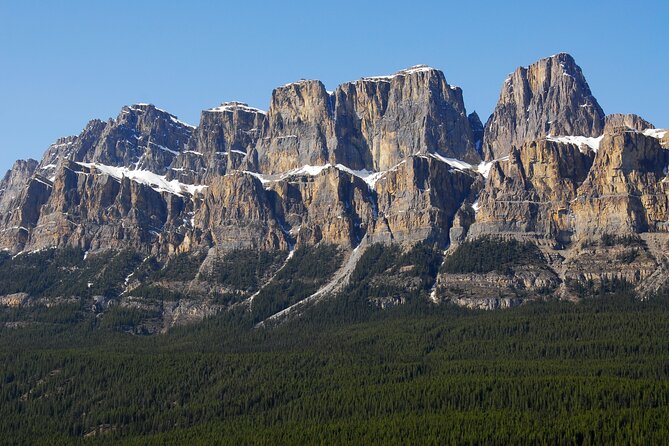
Castle Lookout Trail comes next. The trail is about five miles long and takes three to four hours, with a challenging climb up Castle Mountain. The payoff is a wide view over the Bow River and the Rockies.
The tour treats Castle Lookout as an optional stop rather than part of the basic drive. That is the right approach. The audio gives you enough information to decide if the hike fits your day, but you should not mistake the 10-minute stop marker for the total time needed.
If you want only a scenic drive, continue along the route. If you have the time and energy for a demanding hike, this is one of the route’s bigger commitments. The description places the viewpoint among Banff’s best panoramic sights, but getting there requires a real block of time and a willingness to climb.
This flexibility is where a self-guided tour can beat a scheduled excursion. A bus could not wait several hours while you hike. Here, you can pause the tour, leave the route, and return later.
More Self-Guided Audio Tours in Canada
- Self Guided Audio Driving Tour of the North Shore of PEI
★ 4.0 · 24 reviews - Self-Guided Audio Driving Tour in Icefields Parkway
★ 5.0 · 24 reviews - Self-Guided Audio Tours for the Canadian Rockies
★ 5.0 · 18 reviews - Icefields Parkway Self-Guided Driving Audio Tour
★ 4.5 · 16 reviews
Silverton Falls and a quick reward
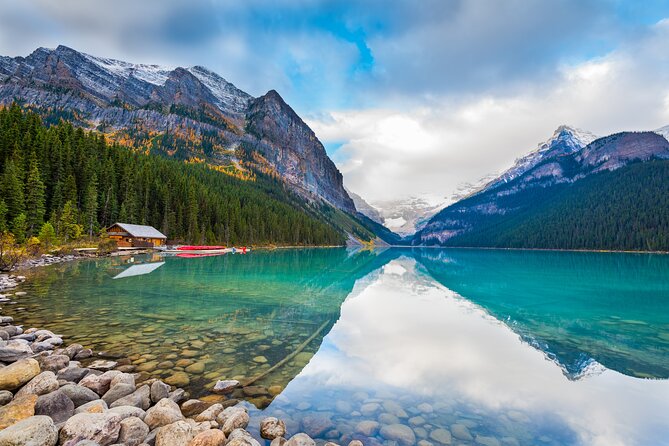
Silverton Falls offers a more manageable walking option. The trail is about one mile and takes roughly 30 minutes. The end brings you to a 160-foot waterfall, with Bow Valley views on the other side.
You turn left into the parking area ahead of the trail. The audio story gives you a clear reason to stop, while the short walk makes this a useful choice if you do not want to commit to Castle Lookout or the Ink Pots.
As with the other stops, the 10-minute tour marker describes the narration and suggested visit, not necessarily every minute you will spend on site. Add time for parking, the walk, and photographs. The route has several stops, so a couple of short walks can turn the basic two-hour drive into a much longer outing.
Moose Meadows and the climb to the Ink Pots
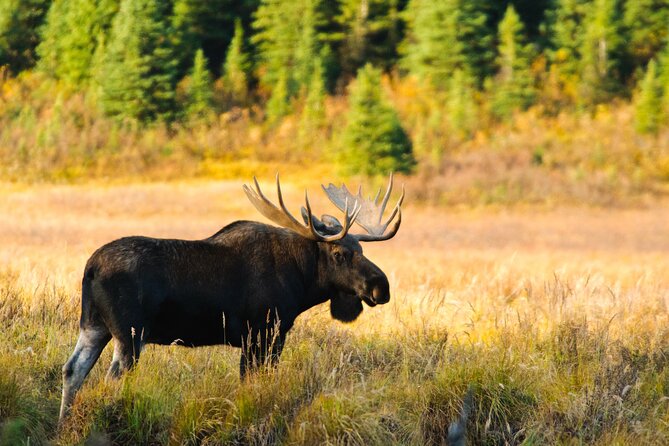
Moose Meadows introduces a more demanding hike toward the Ink Pots, a group of springs. The trail covers more than five miles, takes about three hours, and gains roughly 1,100 feet.
This is a good example of why you should scan the stop details before leaving. The audio makes the route sound inviting, but the elevation gain changes the nature of the outing. You need to decide if you want a drive with brief walks or a full day that includes a substantial mountain trail.
The tour itself does not require you to hike. You can listen from the car, stop for a shorter look, or continue. The value is in having the choice and knowing what lies ahead before you turn into a parking area.
Johnston Canyon, the easiest major walk
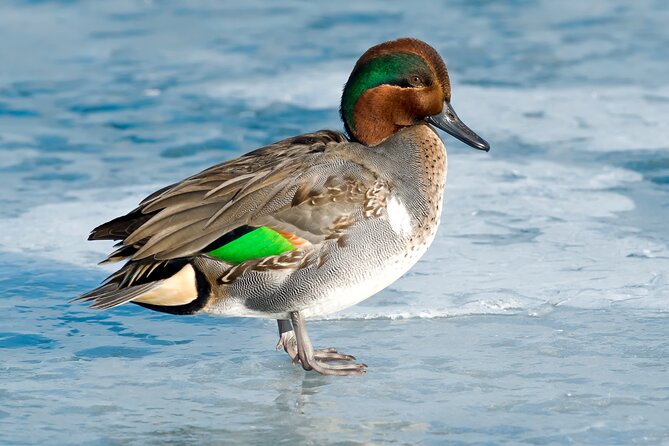
Johnston Canyon is described as the park’s most popular hike. The main walk is an easy one-mile trail through the canyon, named for a prospector who searched for gold and mapped the area instead.
This is likely to be one of the most useful stops for people who want a clear, low-effort walk. Compared with Castle Lookout and the Ink Pots, Johnston Canyon asks for far less time and exertion. You still need to allow for parking and the actual walk, but the route makes it easy to fit into a mixed-age group’s day.
The audio adds a bit of local character through the story of the unsuccessful prospector. That is the kind of small detail that makes a short stop more memorable. You are not only seeing a canyon, you are hearing how it entered local history.
Hillsdale Meadow and Backswamp viewpoints
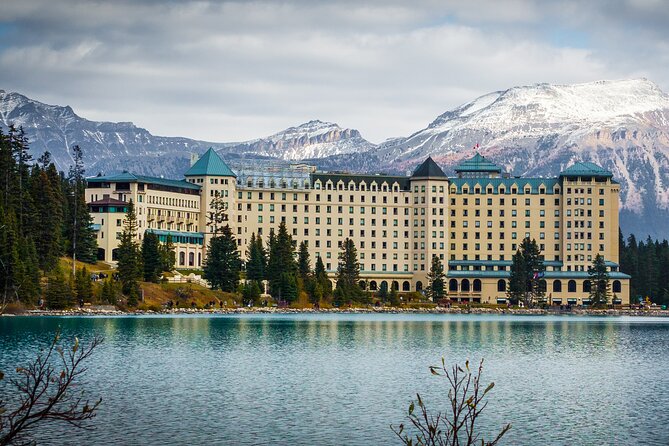
Hillsdale Meadow Viewpoint offers 360-degree mountain views, a wildflower meadow, Pilot Mountain in the distance, railway tracks, and the Bow River. You can pull into the turnout or continue straight if your schedule is tight.
This stop suits you if you want a broad view without committing to a long trail. The audio helps you identify what you are looking at, which is useful when several peaks and ridges fill the horizon.
Backswamp Viewpoint is another brief roadside stop. The name is not much of a sales pitch, but the view toward Mount Bourgeau is the real reason to pull over. The Bow River runs near the lookout, and you might see a train along the riverbank.
These stops show the strength of the route. It is not built only around the two famous lakes. It also gives you smaller places to pause, stretch your legs, and see how the river, railway, meadow, and peaks fit together.
Vermilion Lakes and the end near Banff
The drive ends at Vermilion Lakes Viewpoint, where three small lakes sit close together with Banff beyond them. This is a particularly useful final stop because the view changes with the time of day.
The audio suggests sunrise and sunset as good moments here, and the area can be a place to watch for loons, buffleheads, ospreys, elk, mule deer, and occasional moose. Wildlife is never guaranteed, so treat those sightings as a possibility rather than a promise.
Vermilion Lakes also gives the route a satisfying ending. You finish with water, mountains, the town of Banff, and the chance to pause before continuing your trip. If you do the route over more than one day, this viewpoint can also serve as a natural stopping point.
How the Action Tour Guide app works
After booking, you receive setup instructions and a password by email and text. Search your messages for audio tour if the instructions do not appear quickly.
You need to download the separate Action Tour Guide app, enter the password, and download the tour while you have strong Wi-Fi or cellular service. Once stored on your phone, the tour works offline. This is one of the most practical features because mountain roads may not provide a reliable signal.
At the starting point, open the app and launch the tour. If the app shows several versions, choose the one that matches your starting point and direction. The first story begins when you reach its GPS location, and later stories play automatically as you move along the route.
For the best results, use an iPhone with iOS 15 or later, an Android device running version 9 or later, or an iPad or tablet with GPS and cellular capability. Keep the phone accessible for navigation, but use the hands-free audio while driving.
Price, timing, and overall value
At $14.99 for a group of up to four, the tour is priced per car rather than per person. That makes it particularly appealing for a family or small group. Four people would pay less than $4 each, while a solo driver receives less financial advantage but still gets the flexibility of a private tour.
You are not paying for park admission, attraction tickets, reservations, shuttle service, or a human guide. Those costs and arrangements remain yours. The low price makes sense because the product is an audio guide and route tool, not a full transportation service.
You receive lifetime access with no expiry, and you can use it on more than one trip. That is useful if weather, road access, or your schedule forces you to split the route. You can also use it again on a future visit without buying another copy.
The basic route takes two to three hours, but I would plan more time if you want to stop at the viewpoints or walk Johnston Canyon, Silverton Falls, or the Rockpile. Castle Lookout and the Ink Pots can each turn the outing into a major hiking day.
The experience is offered in English only. It is a private activity for your own group, with no meeting time and no fixed departure. You can cancel up to 24 hours before the experience for a full refund.
Who should choose this driving tour?
I would choose it if you want context but do not want to join a scheduled bus or pay for a private guide. It suits drivers who enjoy stopping often, families who need control over breaks, and small groups sharing one car.
It is also a good match for repeat visitors who already know how to get around but want extra stories along the road. The narration adds structure without forcing you into a rigid plan.
I would think twice if you want someone else to handle transportation, parking, reservations, or access arrangements. It may also feel less suitable if you prefer a live guide who can answer questions as they arise.
Should you book the Lake Louise and Moraine audio tour?
Book it if your plans already include a car and you want an inexpensive way to add history, directions, and context to a famous mountain drive. The strongest points are the low group price, offline access, automatic narration, and freedom to spend five minutes or several hours at a stop.
Before booking, confirm current access rules for Moraine Lake and Lake Louise, download everything in advance, and allow far more than two hours if you plan to hike. If you treat it as a flexible audio companion rather than a complete park transportation service, it offers very good value.
FAQ
How much does the Lake Louise and Moraine audio tour cost?
The tour costs $14.99 per group, with up to four people included.
How long does the tour take?
The route is designed to take about two to three hours to drive. Extra time is needed for viewpoints, photographs, and hikes.
Where does the tour start and end?
It starts at Lake Louise Ski Resort and Summer Gondola, 1 Whitehorn Road, Lake Louise. It ends at Vermilion Lakes Viewpoint near Banff.
Does the tour include attraction tickets or reservations?
No. Attraction passes, entry tickets, and reservations are not included.
Do I need cellular service during the tour?
You need strong Wi-Fi or cellular service to download the app and tour before starting. After downloading, the tour works offline.
Is this a guided group tour?
No. It is a private, self-guided activity for your group. No guide meets you at the start.
Can I use the tour more than once?
Yes. The tour provides lifetime access with no expiry, so you can use it on any trip and as many times as you want.
New audio tours around Canada
- Kelowna E-Bike Bee Tour, Tastings, Organic Lunch & Audio Guide★ 5.0 · 9 reviews
- Smartphone Audio Driving Tour between Kamloops & Revelstoke★ 3.5 · 8 reviews
- Jasper National Park Self-Guided Driving Audio Tour★ 4.0 · 4 reviews
- Smartphone Audio Driving Tour between Kamloops and Vancouver★ 3.5 · 5 reviews
- Smartphone Audio Driving Tour between Huntsville & Toronto★ 4.5 · 4 reviews
- Halifax Explosion Smartphone Audio Walking Tour★ 4.0 · 3 reviews
- Edmonton Self Guided Audio Experience★ 3.0 · 2 reviews
- Smartphone Audio Driving Tour between Collingwood and Toronto★ 4.5 · 3 reviews
Alberta Audio Tours, compared.


Smartphone Audio Driving Tour between Lake Louise and Calgary
Read our review →
Discover the Lake Agnes Tea House Trail with an Audio Nature Tour
Read our review →
Ghosts of Drumheller: a Smartphone Audio Ghost Tour
Read our review →
Audio Tour for Self-Guided Drives in Waterton National Park
Read our review →Browse the lists this tour appears in