

Review · USA
Chicago’s Storied Neighborhood: An Audio Tour
Hyde Park is one of Chicago’s most distinctive neighborhoods, and this self-guided walk gives you a local voice to accompany its university buildings, public art, and parkland. Bill Ayers, a professor and activist with personal ties to the area, supplies the narration rather than a generic recorded guide.
I like the freedom to pause whenever you wish, and I like that the VoiceMap app starts the audio at the correct locations. Ayers’ personal stories add character to the University of Chicago and Hyde Park. The main drawback is the amount of quiet walking: the route can cover about three miles, while some stretches offer limited commentary.
Key points to know before you go
- Bill Ayers provides the voice: Expect personal observations from a local professor and activist, not a standard guidebook narration.
- The route links major Hyde Park sights: You pass the Laboratory Schools, Rockefeller Memorial Chapel, Robie House, University of Chicago buildings, Washington Park, and the DuSable Museum.
- Plan for a walk of roughly three miles: The stated audio time is 40 minutes to one hour, but the full route can take longer if you stop or walk slowly.
- You control the pace: Pause, replay, or stop for a break whenever you like.
- The app works offline: Audio, maps, and geographic data are available without a live connection after setup.
- The commentary is not continuous: If you want a tightly narrated walking tour with constant facts, this may feel sparse.
Hyde Park through one local voice
This tour works best as an introduction to Hyde Park rather than a packed lecture on every building you pass. The route connects the University of Chicago area with Washington Park and the DuSable Museum of African American History, giving you a broad look at the neighborhood’s academic, cultural, and civic sides.
The choice of Bill Ayers gives the experience a more personal tone. You are not simply being pointed toward a chapel or a famous house. You hear from someone identified with the local university, teaching, and activism. That perspective is the main reason to choose this audio walk over a basic map-based stroll.
Still, you should set your expectations correctly. This is not a museum tour, and it does not take you inside the University of Chicago’s original buildings. It also does not include admission fees, transportation, food, or headphones. You are bringing your own phone and listening equipment.
More audio tours around the USA:
- Los Angeles: Hop-On Hop-Off Bus Tour with Audio Guide
★ 3.7 · 2,030 reviews - City Sightseeing Hop-On Hop-Off Bus Tour with Audio Guide
★ 3.0 · 1,083 reviews - Medieval Torture Museum Ticket with Audio Guide and Ghost Hunting
★ 5.0 · 962 reviews
Starting at the University of Chicago Laboratory Schools
The walk begins outside the University of Chicago Laboratory Schools at 1362 East 59th Street. This is a useful starting point because it places you directly in the university district, where Hyde Park’s academic character becomes clear from the first few blocks.
The VoiceMap app is designed to trigger the narration at the right point along the route. That is helpful on a self-guided tour. You do not need to keep checking a printed map to know when a particular explanation begins, though you should still watch your route and surroundings while walking.
The opening section introduces the setting around the university and helps you understand how the campus fits into Hyde Park. If you are interested in education, architecture, or the relationship between a major university and its surrounding neighborhood, this is likely to be the strongest part of the walk.
Bring headphones and make sure your phone is charged. The tour includes offline audio, maps, and geographic data, but your smartphone and headphones are not supplied.
Rockefeller Memorial Chapel and the university district
The route passes Rockefeller Memorial Chapel, one of the best-known university landmarks on the walk. Even without entering, the chapel gives the route a strong architectural focus and a clear sense of the university’s scale.
You then continue past parts of the University of Chicago campus and its faculties and buildings. This is where the audio can help you notice connections that are easy to miss on an ordinary walk. A large campus can feel like a collection of impressive stone buildings unless someone explains why the spaces matter and how they relate to the city around them.
Do not assume that the tour includes entry into the university’s original buildings. It passes the campus buildings, but the experience is primarily outdoors. If your main goal is an interior tour of university facilities, you will need a separate plan.
The longer walking stretches are worth noting. The audio does not speak continuously, and there can be quiet periods between points of interest. Some people will appreciate the breathing room. You can look around, take photographs, or simply walk without a constant stream of facts. Others may find the silence disappointing, especially if they expect every minute to contain narration.
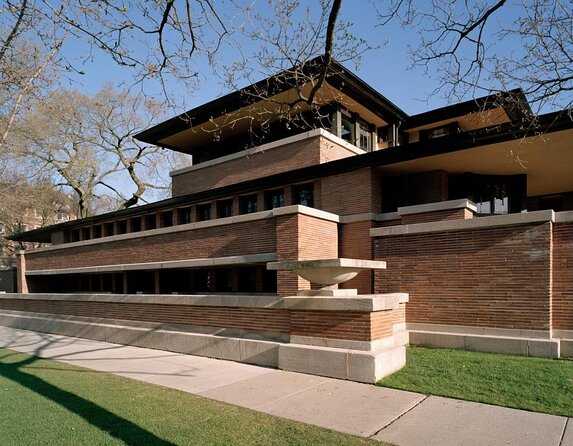
Frank Lloyd Wright’s Robie House
The route passes Frederick C. Robie House, a major architectural stop in Hyde Park. Its inclusion gives the walk a focused design highlight amid the broader university setting.
You should treat this part as an exterior encounter unless you arrange a separate admission. Entry fees are not included, and the tour does not promise an interior visit. That distinction matters because Robie House is the kind of place where the exterior may spark a desire to see more.
The audio tour’s value here lies in placing the house within the walk rather than asking you to find it on your own. You get a sense of how the architectural landmark relates to the university district and the rest of Hyde Park. If architecture is your main interest, allow extra time around this stop, but remember that added time may push the outing beyond the basic 40-minute-to-one-hour estimate.
Same sights, a different narrator:
- Gettysburg Battlefield Self-Guided Driving Audio Tour
★ 4.5 · 910 reviews - Joshua Tree National Park Self-Guided Driving Audio Tour
★ 4.5 · 762 reviews - San Francisco: Alcatraz, Ferry & Audio Tour w/ Night Option
★ 4.4 · 617 reviews - Ultimate Acadia National Park Self-Guided Driving Audio Tour
★ 4.0 · 521 reviews
The Nuclear Energy Sculpture and Hyde Park’s public spaces
The Nuclear Energy Sculpture provides a sharp change of subject. After university buildings and residential architecture, the route brings you to a work of public art tied to the nuclear age.
The sculpture is a useful reminder that Hyde Park is not only about old buildings. Scientific research, public debate, education, and political life all overlap here. Bill Ayers’ perspective is particularly relevant to a neighborhood with strong academic and activist associations, although the supplied details do not specify how long the commentary at this stop lasts.
This is another place where you may want to pause the audio and look carefully. A self-guided format gives you that option without holding up a group. You can take a photograph, replay a section, or continue when you are ready.
Walking through Washington Park
The route continues through parts of Washington Park, shifting the mood from the university campus to a large public green space. This is one of the longer outdoor sections, so it may feel more open and less tightly packed with sights.
Washington Park is also where the distance matters most. One review specifically described the route as about three miles, and an older participant found that too much. The experience information gives an audio duration of about 40 minutes to one hour, but that is not the same as a guaranteed total walking time. Stops, route finding, photo breaks, and a slower pace can add considerably to the outing.
If you have limited walking stamina, plan carefully. You can pause the tour, but the route is still designed as a connected walk from the university area toward East Hyde Park Boulevard. The self-guided format gives you control, yet it does not remove the distance between stops.
The quiet here may work well if you like to observe a neighborhood at your own speed. If you want nonstop interpretation about Washington Park, you may find the coverage too brief. This is an important weakness because the park is one of the largest portions of the route, and there is plenty to notice as you cross it.
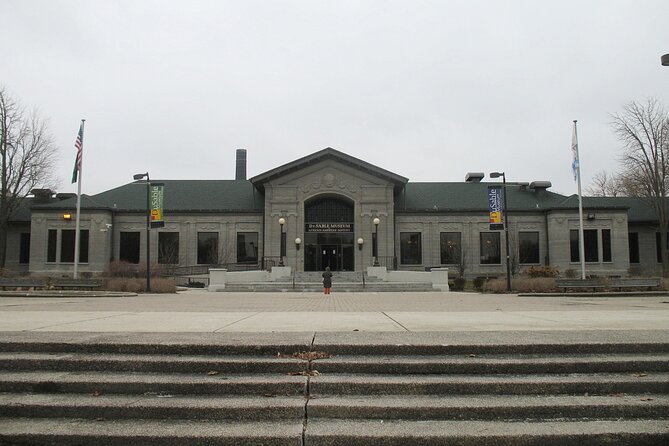
The DuSable Museum of African American History
The walk passes the DuSable Museum of African American History, a major cultural landmark on the route. Its presence broadens the tour beyond the University of Chicago and its architectural sights.
The museum is particularly important for understanding Hyde Park and the wider South Side through African American art, culture, and history. The tour passes the museum, but admission is not included. If you want to visit inside, check the museum’s current arrangements separately and allow additional time beyond the audio walk.
This is one of the points where the tour can serve as a useful orientation. It shows you that Hyde Park is not just a university neighborhood. The route connects academic institutions, public parks, architecture, political ideas, and African American cultural history within a single outing.
At the same time, passing a museum is not the same as touring it. If this is your main reason for coming, use the audio walk as a way to reach the museum and then make a separate visit.
Finishing at 1101 East Hyde Park Boulevard
The tour ends outside the apartments at 1101 East Hyde Park Boulevard. This gives the route a clear endpoint, but it does not return you to the University of Chicago starting point.
That one-way design affects your planning. Before starting, consider how you will continue from the endpoint, especially if you are relying on public transportation or have another reservation. The meeting information places both ends near public transportation, but no transportation is included in the experience.
The finish also makes the tour feel like a neighborhood crossing rather than a short loop. You begin near the university and finish farther east, after passing through campus areas, parkland, and cultural sites. That broader route is useful if you want an overview, but less convenient if you prefer a compact walk with your starting point nearby.
How much value do you get from the audio format?
The strongest value comes from the combination of local narration and complete independence. You can take the tour privately with only your own group, pause whenever you like, and use the route whenever it suits your schedule. Lifetime access in English means you can also return to the audio later instead of treating it as a one-time appointment.
The value is weaker if you judge a tour by the amount of spoken content per minute. The recording includes quiet walking sections, and some people may feel they are paying for a route with too little explanation. Since no price is provided here, I cannot judge the exact cost against competing tours. The practical question is whether you value a flexible introduction more than a tightly scripted, fact-heavy walk.
You also save the cost of a live guide, but you lose the chance to ask questions or request a shorter route. The private format means your group is not joined by strangers, yet the experience remains self-guided rather than personally led.
Who should choose this Hyde Park walk?
I would recommend it most to you if you:
- Want an independent introduction to Hyde Park
- Enjoy architecture, university districts, public art, or local cultural landmarks
- Like listening to personal stories rather than following a formal guide
- Are comfortable walking about three miles
- Prefer stopping, pausing, and restarting on your own schedule
- Already plan to use a smartphone and headphones
- Want to see several parts of the neighborhood in one outing
I would be more cautious if you need frequent seating, constant narration, or a short route. An 82-year-old participant found the distance too demanding, and that is useful guidance for anyone with mobility concerns. The tour is described as suitable for most people, but the route length and outdoor walking still deserve attention.
It may also disappoint you if you expect to enter the University of Chicago buildings or receive admission to Robie House or the DuSable Museum. Those sites are passed from outside, and admission fees are not part of the experience.
Practical planning for a smoother walk
Download and prepare the VoiceMap app before you arrive. Offline access covers the audio, maps, and geodata, which is useful if your mobile connection is unreliable. You still need your own smartphone and headphones.
Start with enough time for a relaxed pace. The stated duration is approximately 40 minutes to one hour, but the reported route length of about three miles suggests that some people will need longer. Add time for photographs, pauses, and any separate museum or house visit.
The tour is available Monday through Sunday at all hours during the stated operating period, from July 22, 2020, through March 7, 2027. That flexibility is one of its better features. You can choose a time that fits your day rather than matching a scheduled group departure.
Free cancellation is available if you cancel at least 24 hours before the experience start time. Changes or cancellations made within 24 hours are not refunded.
Should you book Chicago’s Storied Neighborhood?
Book it if you want a flexible Hyde Park orientation led by Bill Ayers, especially if personal stories and neighborhood context matter more to you than constant narration. The route covers a useful mix of University of Chicago buildings, Rockefeller Memorial Chapel, Robie House, the Nuclear Energy Sculpture, Washington Park, and the DuSable Museum.
Skip it if you want a dense historical lecture, a guided interior visit, or a short walk. The quiet stretches and roughly three-mile route are the key tradeoffs. For the right listener, the freedom and local voice make this a pleasant way to get your bearings. For someone expecting nonstop commentary, it may feel like too much walking for too little audio.
FAQ
How long does the Hyde Park audio tour take?
The stated audio tour duration is approximately 40 minutes to one hour. The full outing can take longer because the route may cover about three miles and you may stop along the way.
Where does the tour start?
It starts outside the University of Chicago Laboratory Schools at 1362 East 59th Street, Chicago, Illinois 60637.
Where does the tour end?
The tour ends outside 1101 East Hyde Park Boulevard Apartments at 1101 East Hyde Park Boulevard, Chicago, Illinois 60615.
Who narrates the audio tour?
The tour is narrated by Bill Ayers, described as a local professor and activist.
What sights does the route pass?
The route passes Rockefeller Memorial Chapel, Frederick C. Robie House, University of Chicago faculties and buildings, the Nuclear Energy Sculpture, parts of Washington Park, and the DuSable Museum of African American History.
Does the tour include entry to the University of Chicago buildings?
No. The route passes university buildings, but admission or interior access is not included.
Is admission to Robie House or the DuSable Museum included?
No. Personal admission fees are not included in the experience.
Do I need my own phone and headphones?
Yes. A smartphone and headphones are not included. The VoiceMap app is available for Android and iOS.
Can I use the tour without an internet connection?
Yes. The experience includes offline access to the audio, maps, and geographic data through the VoiceMap app.
Can I cancel for a full refund?
Yes, if you cancel at least 24 hours before the experience start time. Cancellations made less than 24 hours in advance are not refunded.
New audio tours around the USA
- Beaches, Bites and Bavaria in Leavenworth: A Self-Guided Audio Tour★ 3.5 · 3 reviews
- Welcome to Fabulous Las Vegas Sign Self-Guided Audio Tour★ 5.0 · 2 reviews
- Las Vegas Day Trips: 3-Day Self-Guided Audio Tour★ 5.0 · 2 reviews
- Hoover Dam and Lake Mead Self-Guided Audio Tour★ 5.0 · 3 reviews
- Driving Lake Tahoe: A Self-Guided Audio Tour From Tahoe City to Incline Village★ 5.0 · 10 reviews
- Las Vegas Neon and Secrets: Self-Guided Audio Tour★ 5.0 · 3 reviews
- Baton Rouge Historic Downtown Self-Guided Audio Walking Tour★ 4.0 · 19 reviews
- Ultimate La Jolla Self-Guided Driving & Walking Audio Tour Bundle★ 3.5 · 9 reviews
USA Audio Tours, compared.

Los Angeles: Hop-On Hop-Off Bus Tour with Audio Guide
Read our review →
City Sightseeing Hop-On Hop-Off Bus Tour with Audio Guide
Read our review →
Medieval Torture Museum Ticket with Audio Guide and Ghost Hunting
Read our review →


San Francisco: Alcatraz, Ferry & Audio Tour w/ Night Option
Read our review →
Ultimate Acadia National Park Self-Guided Driving Audio Tour
Read our review →
Browse the lists this tour appears in