
Review · USA
French History Tour of Detroit A Self-Guided Audio Tour App
Detroit’s French story begins long before the automobile factories that made the city famous. This self-guided audio tour follows that earlier chapter by car, from Ste. Anne de Detroit and the Detroit River to Belle Isle, old cemeteries, Grosse Pointe, and three cultural institutions. You’ll hear about Antoine Cadillac, Father Gabriel Richard, Chief Pontiac, the Fox Indians, and the French families who shaped the settlement.
I like the way the route joins French and Native American history, rather than treating Detroit’s French period as a few isolated dates. I also like the freedom to stretch the tour into a full day or shorten the driving portion to two or three hours. The main drawback is practical: the app may not line up neatly with GPS, and parking can be difficult at some stops.
Key points to know before you go
- A car is central to the experience: The route links downtown, cemeteries, Belle Isle, Mariner Park, Grosse Pointe, and museum stops.
- The narration has a local focus: The unnamed narrator is a Detroit historian and author who explains the city’s French and Catholic roots.
- The route covers more than 200 years: Expect stories of French settlers, Native American nations, British troops, epidemics, fur trading, and early Detroit families.
- Museums make the tour flexible: The Detroit Historical Museum, Detroit Institute of Arts, and Detroit Public Library can turn a short drive into a full cultural day.
- Admission costs are separate: The audio tour is listed at $20 per person, while admission is not included at Ste. Anne, the Detroit Historical Museum, or the Detroit Institute of Arts.
- Plan the calendar carefully: Some museum and library stops may not be open on Monday or Tuesday.
Detroit’s French beginning at Ste. Anne de Detroit
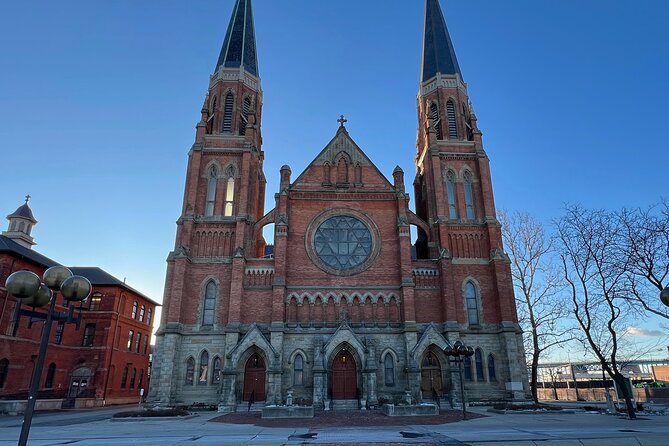
Start at the Basilica of Sainte Anne de Détroit, at 1000 St. Anne Street. This is the right place to begin because the parish was founded by Antoine Cadillac and Father Constantin De L’Halle, linking the modern city to its French colonial beginning.
The opening section places Detroit on the edge of Louis XIV’s French empire, far from the centers of power in Europe. You’ll hear why this was not simply a French outpost, but a meeting point for French settlers and Native American nations. That connection is one of the tour’s strongest ideas.
The stop is scheduled for about 15 minutes, and admission is not included. Since the tour is self-guided, you control the pace, but you should not assume that every stop will work like a formal guided visit. The audio provides the story, while you decide how long to remain on site.
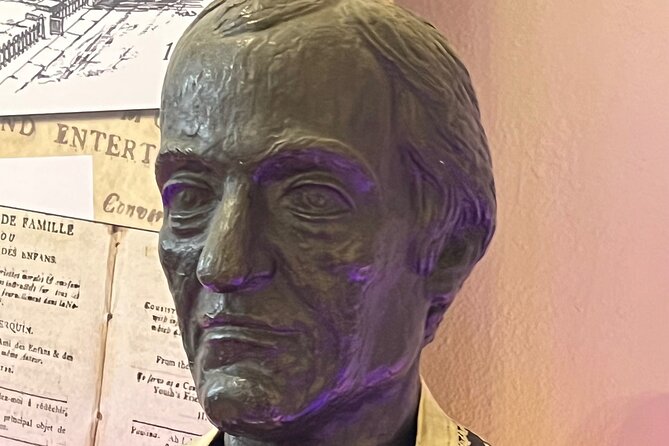
The church also connects to Father Gabriel Richard, whose resting place is part of the story. This gives the opening stop a personal scale. Instead of hearing only about military forts and imperial borders, you also encounter the clergy and settlers who helped create an enduring community.
More History Audio Tours in the USA
- Santa Fe Historic Downtown Smart Phone Audio App Self Guided GPS Walking Tour
★ 4.5 · 112 reviews - Savannah’s Historical District: A Self-Guided Audio Tour
★ 4.5 · 69 reviews - Salida History Audio Tour l A Self-Guided Wild West Experience
★ 5.0 · 41 reviews
Hart Plaza and the river that made Detroit possible

From Ste. Anne’s, the route moves toward Riverside Park and Hart Plaza. The Detroit River is not just scenery here. It explains why this site mattered for settlement, trade, transportation, and military control.
At Hart Plaza, the audio introduces the Wendat and other Native American peoples who lived in relative peace with the French. You’ll also learn why Fort Pontchartrain was built at this location. The story helps you picture Detroit before its later civic buildings and industrial identity took over the waterfront.
Hart Plaza is listed as a 15-minute stop with free admission. Parking is the main concern. You can see the river from the car, but getting out and walking around may take more planning than the short stop suggests. A downtown parking arrangement can help, and one useful option mentioned for the wider visit is a $10 payment that provided access to downtown venues.
The route then passes two of Detroit’s oldest houses, dating to 1826 and 1840. The discussion of ribbon farms adds an important piece of local geography. Early farms often ran in long, narrow strips, and some Detroit streets still preserve the names of the farms beside which they once ran.
Mt. Elliott Cemetery and Detroit’s lost markers
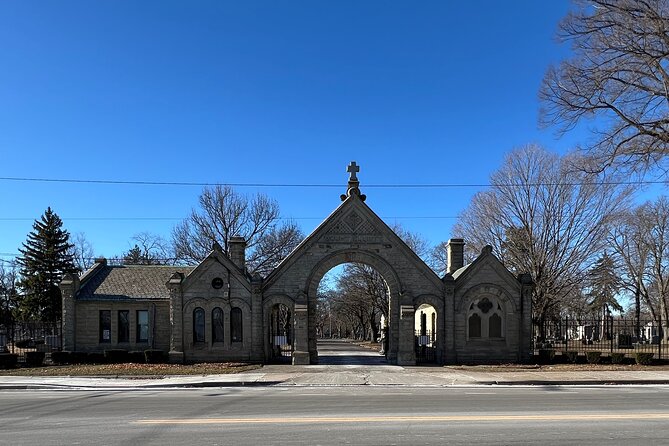
At Mt. Elliott Cemetery, the tour turns from broad colonial events to the people who lived through them. About 1,800 original settlers were first buried at Ste. Anne’s cemetery and later re-interred here.
The stop lasts roughly 20 minutes and is free. You’ll learn about the lost markers and visit tombs and family plots connected with French settlers and other notable Detroit figures. This is the kind of stop that rewards a slower pace, especially if you like reading names and connecting individuals to the larger story.
The cemetery also shows how easily a city can lose its physical memory. When bodies are moved and markers disappear, the past becomes harder to see. The audio helps restore some of that connection, but the experience still depends on your willingness to pause rather than simply listen from the car.
Elmwood Cemetery and the story of Bloody Run

Elmwood Cemetery adds one of the route’s most dramatic episodes. Here you’ll hear about Parent’s Creek, later called Bloody Run, where more than 100 British redcoats were ambushed and killed during the 1763 uprising led by Chief Pontiac.
The stop is planned for about 15 minutes and costs nothing to enter. It also includes tombs and family plots connected with French settlers. The contrast is striking: a cemetery can feel quiet and orderly, yet the audio reveals the violence tied to the ground beneath it.
This is a good example of how the tour handles Detroit’s past. The story is not presented as a simple French victory or British defeat. French settlers, Native American nations, and British forces were all tied to the struggle for control of the straits. You get a more useful picture of the competing interests than a quick list of dates would provide.
More Self-Guided Audio Tours in the USA
- Gettysburg Battlefield Self-Guided Driving Audio Tour
★ 4.5 · 910 reviews - Joshua Tree National Park Self-Guided Driving Audio Tour
★ 4.5 · 762 reviews - Ultimate Acadia National Park Self-Guided Driving Audio Tour
★ 4.0 · 521 reviews - Ultimate Lake Tahoe Self-Guided Driving Audio Tour
★ 4.5 · 435 reviews
Belle Isle, Swan Island, and the 1763 uprising

Belle Isle is the longest outdoor stop, at about 30 minutes. The island is circumnavigated, with notable sites pointed out along the way. The route explains its earlier names, including Swan Island and Hog Island, before the name Belle Isle took hold.
The island also connects to the first victims of the 1763 Native American uprising led by Chief Pontiac. That makes Belle Isle more than a pleasant pause beside the river. It becomes another place where geography and conflict meet.
You may have time to stop and enjoy the island, though the exact amount depends on traffic, parking, and how long you spend at earlier locations. I would treat this as one of the tour’s best chances to leave the car for a while. The route crosses an important international setting, with Canada visible across the water, while the narration fills in the French period that is easy to miss during a standard Detroit visit.
Mariner Park and the Fox Creek stories
The Mariner Park stop is brief, about 10 minutes, but it adds another layer to the route. You’ll stop near Windmill Pointe Lighthouse, one of Michigan’s oldest lighthouses, and hear about Fox Creek, named for the Fox Indian tribe.
The narration also covers Grand Marais and Fox Run. These names point to older waterways and places that have been altered by the growth of the city. After leaving the park, the route passes through the Grand Marais area on the way to Grosse Pointe.
Because this part of the tour is short and mostly viewed from the car, it may appeal more to people who enjoy connecting place names to past events than to those seeking a long sightseeing stop. Keep listening closely. The value is in the explanation of what these names once meant.
The Provençal House and Grosse Pointe’s early families
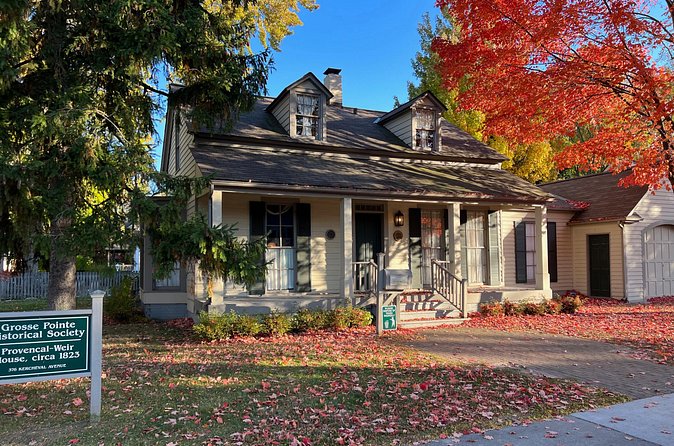
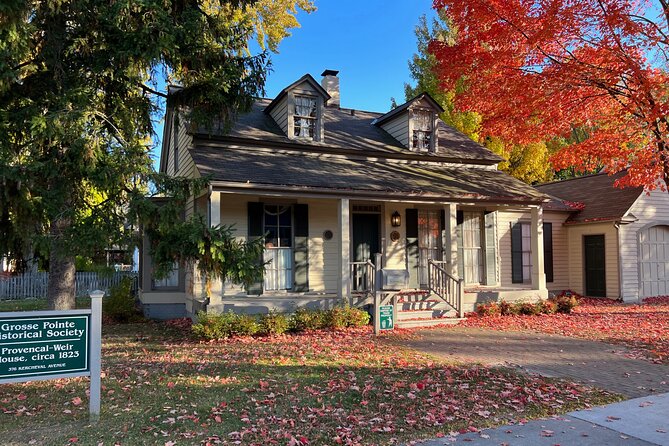
At 376 Kercheval Avenue, you’ll stop at the Provençal House, described as the oldest house in Grosse Pointe. It was built before Grosse Pointe existed as the community you know today.
The story centers on Pierre Provençal and his wife, Euphemia St. Aubin. Their work with orphans during the cholera epidemics of 1832 and 1834 gives the tour a humane, domestic focus. The couple’s generosity shows how early Detroit’s story was shaped not only by forts and political power, but also by families caring for people during public health crises.
The stop is about 10 minutes. Admission is not included and may not be available, so you should regard the house mainly as an exterior and audio stop rather than count on entering. That limitation is worth knowing before you build your schedule around it.
Three cultural stops that can fill the rest of your day
The driving route can take two or three hours if you move briskly. The final three stops are what turn this into a full-day outing.
Detroit Historical Museum
At the Detroit Historical Museum, spend about an hour with the Where the River Bends exhibit. It focuses on the French era of Detroit and gives you a chance to see material culture and displays after hearing the story from the car.
Admission is not included. This is one of the best places to slow down because the outdoor stops give you location and atmosphere, while the museum can provide objects and organized exhibits that make the period easier to understand.
Detroit Institute of Arts
The Detroit Institute of Arts stop is scheduled for two hours. The Fashionable Living exhibit covers furniture and furnishings belonging to French citizens in the 1700s.
This visit adds social detail. Forts and battles explain control, but furniture and household objects show how people lived, what they valued, and how French residents expressed status and taste. The museum has a separate admission charge, so include that in your budget.
The route presents the institute as a major museum, and it is a strong choice if you want the day to end with art rather than more driving. Two hours gives you time for the featured exhibit and some additional browsing, though your exact visit will depend on opening hours and admission arrangements.
Detroit Public Library and the Burton Collection
The final stop is the Detroit Public Library, where you can visit the Burton Collection. It is described as the world’s largest collection of books, documents, and maps relating to the French era in Detroit.
Admission is free, but access and opening hours still matter. This is a particularly useful finish for anyone who wants primary documents and maps rather than only a narrated overview. It also gives the tour a research-oriented ending, moving from the places where history happened to the records that preserve it.
How the audio app works in real conditions
The experience is offered in English and delivered through a mobile audio tour. You download or connect the audio to your car, then follow the route between stops. Connecting a phone to the vehicle’s audio system is a good idea because it makes the narration easier to hear.
The main practical weakness is navigation. The app may not coordinate perfectly with GPS, so you should study the route before setting out. Have the stop order and addresses ready, especially for Hart Plaza, the cemeteries, Belle Isle, Mariner Park, and the Provençal House.
This is described as a private activity, meaning only your group participates. It is not a live tour with a driver or guide sitting beside you. That gives you control over timing, but it also means you handle navigation, parking, and any changes in museum hours.
The tour is available daily from 9 a.m. to 9 p.m. during the stated operating period, from February 19, 2025, through December 10, 2026. Still, the museums and library may follow their own schedules. Monday and Tuesday can be poor choices for some stops, so check before you leave.
Is $20 per person a good value?
The listed price is $20 per person. Admission is extra at Ste. Anne, the Detroit Historical Museum, and the Detroit Institute of Arts, while Hart Plaza, the cemeteries, Belle Isle, Mariner Park, and the library are listed as free stops.
The value improves when several people share one car, though the published price is still given per person. You are paying for a long, specialized route rather than a short downtown audio walk. The narration covers French settlement, Native American nations, military conflict, cemeteries, family history, architecture, art, and archival material.
I would not choose it if you want a tightly managed sightseeing tour with simple parking at every stop. I would choose it if you want a strong historical framework and plan to use your own car. The option to complete only the driving section or add several museum hours gives you room to match the outing to your schedule.
Who will get the most from this tour?
This experience fits you best if you enjoy history, cemeteries, old buildings, and museum collections. It is especially useful if you already know Detroit mainly through its industrial era and want to understand the French and Native American periods that came first.
Families and small groups may appreciate the private format because nobody outside your party sets the pace. Most people can participate, and the route is near public transportation, though the multi-stop structure is clearly designed around a car.
You should be comfortable with some logistics. Parking is not equally easy at every stop, the app may require route preparation, and admission hours can shape the day. If you want to visit all three cultural institutions, plan for a full day rather than treating this as a quick audio walk.
Should you book it?
Book this tour if you want Detroit’s French past explained across real locations, not reduced to a paragraph in a city guide. The strongest parts are the local narration, the French and Native American focus, the cemetery stops, Belle Isle, and the way the museums extend the story.
Skip it if you want a guided ride with someone handling every turn and parking decision. For the right audience, $20 per person buys a useful foundation for Detroit’s early history, with enough flexibility to make the outing short, leisurely, or museum-heavy.
FAQ
How long does the French History Tour of Detroit take?
The tour is listed as approximately six hours. You can shorten the driving portion to roughly two or three hours, or spend the entire day by adding the museum and library stops.
What language is the audio tour offered in?
The audio tour is offered in English.
Where does the tour begin?
It begins at the Basilica of Sainte Anne de Détroit, located at 1000 St. Anne Street, Detroit, Michigan 48216.
Where does the tour end?
The activity ends back at the meeting point.
Is this a guided tour with a person in the car?
No. It is a self-guided audio tour app. The activity is private, so only your group participates, but you handle the driving and route.
Is the $20 price per person?
Yes. The listed price is $20 per person.
Are museum admissions included?
No. Admission is not included at Ste. Anne, the Detroit Historical Museum, or the Detroit Institute of Arts. The Detroit Public Library stop is listed as free.
Do I need a car?
The route is designed as a private auto tour and connects sites spread across Detroit, Belle Isle, and Grosse Pointe. A car is the practical way to follow the full route.
Can I cancel or change the booking?
No. The experience is non-refundable and cannot be changed after booking.
New audio tours around the USA
- Beaches, Bites and Bavaria in Leavenworth: A Self-Guided Audio Tour★ 3.5 · 3 reviews
- Welcome to Fabulous Las Vegas Sign Self-Guided Audio Tour★ 5.0 · 2 reviews
- Las Vegas Day Trips: 3-Day Self-Guided Audio Tour★ 5.0 · 2 reviews
- Hoover Dam and Lake Mead Self-Guided Audio Tour★ 5.0 · 3 reviews
- Driving Lake Tahoe: A Self-Guided Audio Tour From Tahoe City to Incline Village★ 5.0 · 10 reviews
- Las Vegas Neon and Secrets: Self-Guided Audio Tour★ 5.0 · 3 reviews
- Baton Rouge Historic Downtown Self-Guided Audio Walking Tour★ 4.0 · 19 reviews
- Ultimate La Jolla Self-Guided Driving & Walking Audio Tour Bundle★ 3.5 · 9 reviews
USA Audio Tours, compared.

Los Angeles: Hop-On Hop-Off Bus Tour with Audio Guide
Read our review →
City Sightseeing Hop-On Hop-Off Bus Tour with Audio Guide
Read our review →
Medieval Torture Museum Ticket with Audio Guide and Ghost Hunting
Read our review →


San Francisco: Alcatraz, Ferry & Audio Tour w/ Night Option
Read our review →
Ultimate Acadia National Park Self-Guided Driving Audio Tour
Read our review →
Browse the lists this tour appears in