

Review · USA
Harpers Ferry Audio Tour History, Ruins and River Views
Harpers Ferry packs an astonishing amount of American history into a small, steep town. This audio tour leads you from the Appalachian Trail and Civil War sites to river views, industrial ruins, and the former Storer College campus, using your phone to trigger stories as you walk. John Brown’s Fort and The Point are the two strongest anchors.
I like the freedom to pause at markers, read signs, and take in the scenery without keeping up with a guide. I also like the location-based audio, which starts when you reach many stops and helps connect what you see with what happened there. The main drawback is the route: some stops are far apart and uphill, and the app can take a little practice.
Key points to know
- GPS-triggered storytelling: Audio begins as you reach many locations, so you can walk at your own pace.
- Nineteen stops: The route covers major sites in Lower Town, along the rivers, and on surrounding heights.
- Bring your own phone: Download the app and tour before arrival because cell service can be poor.
- Two hours is approximate: The route includes steep sections, stairs, museums, overlooks, and several outlying sites.
- Strong value at $9.99: You receive unlimited access to the English audio tour for your private group.
- The African American history museum is closed: Its stop is part of the route, but the museum is currently unavailable during renovations.
Why Harpers Ferry works so well as an audio tour
Harpers Ferry is not a place you understand by looking at one building. Its story spreads across river junctions, steep hills, ruins, churches, rail tracks, and quiet streets. An audio tour is useful here because it gives those scattered pieces a common thread.
You begin at the Lower Town Train Station, at 182 Potomac Street. From there, the route moves through historic Harpers Ferry and beyond. The narration helps explain why this small community mattered to industry, transportation, abolition, the Civil War, Black education, and the Appalachian Trail.
I like the format for a simple reason: you can stop the audio when a view deserves more time. You can also read the historic markers, take photographs, or step aside while another group passes. This is not a guided walk with a fixed pace, and only your group participates.
The tour is offered in English and includes the app download, the audio guide, and unlimited use. You need to bring your own smartphone. Download everything before you arrive, since the local cell signal can be unreliable.
More History Audio Tours in the USA
- Santa Fe Historic Downtown Smart Phone Audio App Self Guided GPS Walking Tour
★ 4.5 · 112 reviews - Savannah’s Historical District: A Self-Guided Audio Tour
★ 4.5 · 69 reviews - Salida History Audio Tour l A Self-Guided Wild West Experience
★ 5.0 · 41 reviews
Starting with the Appalachian Trail and Harper Cemetery
The first stop is the Appalachian Trail Conservancy Headquarters, a natural introduction to the town’s modern outdoor identity. The Appalachian Trail runs for 2,190 miles, and Harpers Ferry is its symbolic midpoint. You spend about 10 minutes here, learning why hikers treat the location as a meaningful milestone.
This stop also gives you a useful contrast. The rest of the tour looks backward through war, industry, slavery, and social change. The trail headquarters brings the story into the present, showing how Harpers Ferry remains tied to long-distance walking and outdoor culture.
The route then points you toward the museum centered on African American life in Harpers Ferry. Its subject is essential: enslaved people, freed people, education, and resilience. At present, the museum is closed for renovations, so you should not expect to enter. The audio stop still signals an important part of the town’s story, but this is one place where the experience is less complete than the route suggests.
Harper Cemetery sits high above town and offers a quieter pause. In roughly five minutes, the narration introduces soldiers, residents, and other people connected with Harpers Ferry. The views are part of the appeal, but the uphill setting matters too. This is an early reminder that the route is not flat.
From the Armory Site to John Brown’s Fort
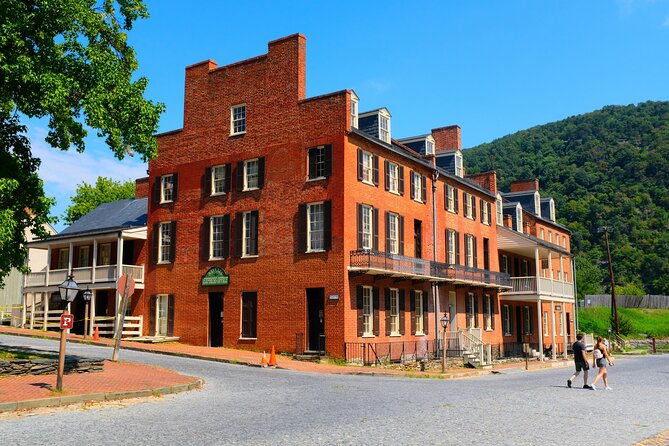
The US Armory Site is one of the tour’s key history stops. Harpers Ferry once had a major weapons factory, and the armory later became linked to John Brown’s raid. Today, you mainly see foundations and traces rather than a complete industrial complex.
That absence is worth understanding. The ruins require imagination, and the audio helps you picture the machinery, workers, weapons production, and tension that once filled the area. You are not just looking at old stone. You are standing where industrial power and political conflict met.
The Harpers Ferry Historical Museum adds a more personal scale. Its exhibits and artifacts cover everyday life as well as major events. The stop lasts about 10 minutes, making it one of the fuller indoor portions of the route. If you like objects and hands-on displays more than bare foundations, this may be one of your favorite stops.
Jefferson Rock provides one of the most memorable viewpoints. Named for Thomas Jefferson, the cliffside perch lets you look across the rivers and surrounding hills. The audio frames the view through Jefferson’s historical connection, while the setting gives you a clear sense of why Harpers Ferry mattered as a natural crossroads.
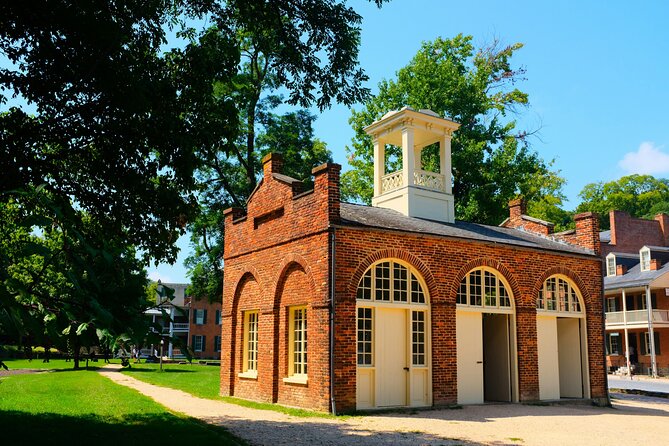
John Brown’s Fort is the emotional center of the route. This small brick fire engine house became John Brown’s final stronghold during his 1859 abolitionist raid. The building itself is modest, but the event changed the national conversation about slavery and helped push the country toward the Civil War.
Give this stop more than the suggested five minutes if the site is busy or the story catches your attention. The audio is most useful here when paired with the physical setting. You can look at the building, then consider how a small structure became linked with such a large national conflict.
Storer College, St. Peter’s Church, and Black education
Lockwood House introduces another layer of Harpers Ferry’s past. The building was used by Union officers and later connected with the leadership of Storer College. Its story brings together military administration and education after the Civil War.
St. Peter’s Roman Catholic Church sits on a dramatic hillside above town. Built to serve Irish immigrant families, it survived the Civil War and remains a place of worship and refuge. The stop is brief, but the church helps broaden the story beyond armies and politicians.
The former Storer College campus deserves careful attention. Founded after the Civil War to educate formerly enslaved people, Storer College became a center for learning, leadership, and civil rights. The site helps explain that freedom required more than emancipation. Education, opportunity, and organized community life were also central to the new future Black Americans were building.
You may find this section especially valuable if you want more than battlefield history. Harpers Ferry is often associated with John Brown and the Civil War, but the Storer College story shows how the town also became a place connected with Black education and later civil rights work.
The uphill routes around Lockwood House, St. Peter’s, and the college campus are part of the practical challenge. Wear shoes suited to walking and stairs. The activity is open to most people, but the route may be tiring if hills are difficult for you.
Same sights, a different narrator:
- Los Angeles: Hop-On Hop-Off Bus Tour with Audio Guide
★ 3.7 · 2,030 reviews - City Sightseeing Hop-On Hop-Off Bus Tour with Audio Guide
★ 3.0 · 1,083 reviews - Medieval Torture Museum Ticket with Audio Guide and Ghost Hunting
★ 5.0 · 962 reviews - Gettysburg Battlefield Self-Guided Driving Audio Tour
★ 4.5 · 910 reviews
The Point and the original ferry crossing
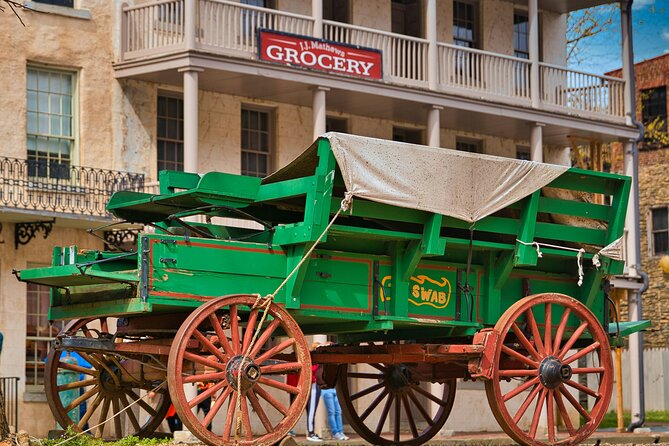
The Point is where the Potomac and Shenandoah Rivers meet. It is also where the town’s geography becomes easiest to understand. Rivers provided transportation, water power, and strategic access, while the surrounding heights gave military forces control over the area.
This is a good place to pause the narration and look closely. You can see why a ferry crossing, factory town, rail connection, and military target developed here. The view does more than provide a photo. It explains the town.
The original site of the Shenandoah River Bridge takes the story back to Robert Harper’s 18th-century ferry. That ferry gave the town its early purpose and helped turn a river crossing into a settlement. The stop ties the modern town to its first transportation network.
The Lower Town Train Station offers a later chapter. It remains active and recalls the period when Harpers Ferry was an important rail connection. The station is also your starting point, which gives the route a satisfying geographic loop, even though the story itself moves through many different eras.
The Appalachian Trail Staircase is one of the route’s most physical sections. Cut into the cliff, it connects Lower Town with the Appalachian Trail. It is steep, scenic, and symbolic of the effort required to move through Harpers Ferry.
Plan your energy rather than treating every stop as a quick photo stop. The supplied timing lists many locations at five minutes, but stairs, views, museum visits, and finding the next point can extend the total. Two hours is a useful estimate, not a promise that every group will finish in exactly that time.
Virginius Island and Harpers Ferry’s industrial ruins

Virginius Island gives you a different view of the town. This woodland area once held a busy industrial village powered by water. Today, moss-covered remains and trails reveal the rise and decline of Harpers Ferry’s manufacturing economy.
The ruins are less polished than the major historic buildings, and that is part of their appeal. You can see how industry depended on the rivers, then imagine how quickly a working settlement could fade. The audio supplies the missing context so the broken walls do not feel like random stones in the woods.
White Hall Tavern shifts the mood again. This 19th-century tavern served local people, visitors, and Union soldiers. It represents the ordinary social life behind the famous events: eating, drinking, debating, and passing through town.
The route’s variety is a major strength. Within a single outing, you move from a national trail headquarters to an old tavern, from an industrial ruin to a military site, and from a church to a river junction. The audio prevents these locations from feeling disconnected.
Murphy Farm, Bolivar Heights, and the wider view
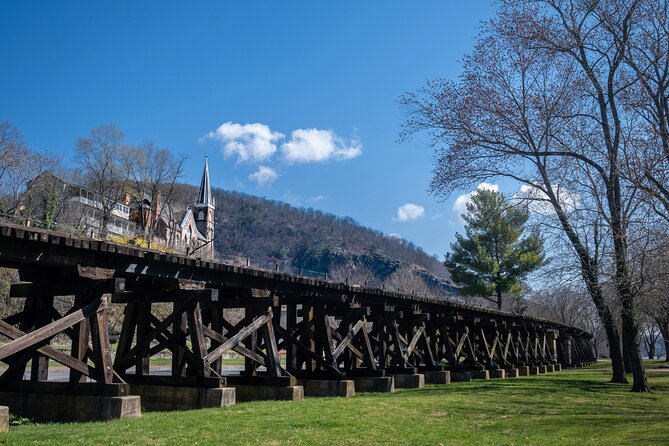
Murphy Farm carries both military and civil rights history. It was once a battlefield and later became a setting for important Civil Rights speeches. Today, it offers open views and room for reflection.
Bolivar Heights is another viewpoint with a military past. The ridge was fought over during the Civil War because control of the high ground meant control of Harpers Ferry. From here, the surrounding terrain makes the town’s strategic importance easier to grasp.
These stops also expose the biggest weakness of the experience: distance. One user found the route too far to walk but not practical to drive between all points. Another began the tour successfully, enjoyed the automatic audio triggers, but stopped before finishing because the uphill walking became too much.
That feedback should shape your expectations. This is not a compact Lower Town stroll with every stop around one square. The route reaches hills, overlooks, ruins, and outlying areas. You can start the narrative from another point in the app, but the story is designed to flow best in order.
Public Square, Arsenal Square, and the final chapters

Harpers Ferry Public Square has been a center of local life for generations. Markets, militias, protests, and parades passed through this space. It is a useful stop for imagining the town as a living community rather than only a collection of historic sites.
Arsenal Square returns you to John Brown’s raid. The former arsenal area is quiet now, but it once held a large weapons complex and witnessed the opening moments of the attack. The audio connects this open space with the better-known fort and armory remains.
Taken together, these stops explain why Harpers Ferry became so important. Transportation, weapons production, slavery, abolition, war, education, and civil rights all crossed paths here. The tour works best when you listen for those connections rather than treating the stops as separate facts.
The route ends back at the Lower Town Train Station. That is helpful if you arrived by rail or left your plans centered on Lower Town. It also means you finish where the walk began, with the station’s transportation story fresh in mind.
App controls, timing, and value at $9.99

At $9.99 per person, this is a low-cost way to add structure to a day in Harpers Ferry. You receive a two-hour English audio experience with unlimited access, and the private format means you do not have to match another group’s speed.
The strongest feature is the location-based playback. Once you reach certain sites, the audio can start automatically. That allows you to keep your attention on the town instead of constantly checking a timetable.
The app interface may take a few minutes to understand. The map is available through a button at the bottom of each screen, and you can technically begin from different locations. Still, the route makes more sense in its intended order, so I would start at the Lower Town Train Station and follow the sequence.
Download the tour before you go. Spotty service can make an on-site download frustrating, and the whole point of this experience is to let you focus on the place. Bring headphones if that suits you, though the provided information does not require any particular audio equipment.
Children 10 and under are free. Confirmation arrives when you book, and free cancellation is available until 24 hours before the scheduled start time. Changes or cancellations inside that 24-hour window are not accepted for a refund.
Who should book this Harpers Ferry audio tour?
I would choose this tour if you like history but prefer to set your own pace. It suits a couple, family, or small private group that wants background information without joining a scheduled guide.
It is also a good fit if you enjoy mixing major historic sites with quieter places such as Virginius Island, Harper Cemetery, Murphy Farm, and the river viewpoints. The audio gives you enough direction to connect those locations.
I would think twice if hills, stairs, or long walks are a serious concern. The route includes the Appalachian Trail Staircase, elevated cemeteries and churches, Bolivar Heights, and other stops that are not all close together. The African American history museum is also closed during renovations, so an important part of the planned experience is currently audio-only.
Should you book it?
Book it if you want an inexpensive, flexible way to understand Harpers Ferry beyond John Brown’s Fort and the main Lower Town streets. The best parts are the automatic location triggers, the freedom to stop and look, and the range of subjects covered, from the Appalachian Trail to Storer College and the river-powered factories.
Skip it if you want a short, flat walk or a live guide who will adjust the route for you. At $9.99, the value is strong, but only if you are ready for a hilly route and prepare the app before arrival.
FAQ
Where does the audio tour start and finish?
The tour starts at the Lower Town Train Station, 182 Potomac Street, Harpers Ferry, West Virginia. It ends back at the same meeting point.
How long does the tour take?
The estimated duration is about two hours. Your actual time may vary because the route includes museums, overlooks, stairs, ruins, and stops spread across Harpers Ferry.
Is the tour guided in person?
No. It is a private, self-guided audio activity for your group. The audio plays through the app, with location-based triggers at certain stops.
What do I need to bring?
You need your own smartphone. Download the app and tour before you arrive because cell service in the area can be spotty.
Is the African American history museum open?
No. The museum is currently closed for renovations. The location remains part of the planned route, but you cannot currently visit the museum interior.
Can I cancel for a refund?
Yes. You can cancel at least 24 hours before the scheduled start time for a full refund. Cancellations or changes made less than 24 hours before the start time are not refunded.
New audio tours around the USA
- Beaches, Bites and Bavaria in Leavenworth: A Self-Guided Audio Tour★ 3.5 · 3 reviews
- Welcome to Fabulous Las Vegas Sign Self-Guided Audio Tour★ 5.0 · 2 reviews
- Las Vegas Day Trips: 3-Day Self-Guided Audio Tour★ 5.0 · 2 reviews
- Hoover Dam and Lake Mead Self-Guided Audio Tour★ 5.0 · 3 reviews
- Driving Lake Tahoe: A Self-Guided Audio Tour From Tahoe City to Incline Village★ 5.0 · 10 reviews
- Las Vegas Neon and Secrets: Self-Guided Audio Tour★ 5.0 · 3 reviews
- Baton Rouge Historic Downtown Self-Guided Audio Walking Tour★ 4.0 · 19 reviews
- Ultimate La Jolla Self-Guided Driving & Walking Audio Tour Bundle★ 3.5 · 9 reviews
USA Audio Tours, compared.

Los Angeles: Hop-On Hop-Off Bus Tour with Audio Guide
Read our review →
City Sightseeing Hop-On Hop-Off Bus Tour with Audio Guide
Read our review →
Medieval Torture Museum Ticket with Audio Guide and Ghost Hunting
Read our review →


San Francisco: Alcatraz, Ferry & Audio Tour w/ Night Option
Read our review →
Ultimate Acadia National Park Self-Guided Driving Audio Tour
Read our review →
Browse the lists this tour appears in