
Review · USA
Kansas City Self-Guided Walking Audio Tour
Downtown Kansas City’s past comes alive through stories about theaters, jazz clubs, political power, clothing factories, Civil War violence, and a president who once sold men’s hats. I like that this 1.7-mile route turns ordinary streets into a walking history lesson, with more than 33 audio stories instead of a single speech from a guide.
I also like the freedom. You can start anytime, stop for food, pause the tour, or return another day because access never expires. The main drawback is that the route and app need a little care: construction has changed parts of downtown, and one review found the setup and navigation less easy than expected.
Key points to know before you go
- More than 33 audio stories: The route covers theaters, statues, skyscrapers, jazz, clothing production, and Kansas City politics.
- About 1.7 miles on foot: Plan on roughly one to two hours, depending on your walking speed and how often you stop.
- Strong historical range: You move from Harry Truman and the Garment District to Bloody Bill Anderson and the Civil Rights Movement.
- Offline and hands-free: Download the tour over a strong connection, then let location-triggered audio guide you.
- Lifetime access: Use it on a later trip, replay favorite stories, or split the route across several days.
- $14.99 per person: The price is reasonable for a private, flexible tour, especially if you value repeat use.
What this Kansas City audio walk actually feels like
This is not a live tour with a guide waiting at the corner. You meet no one. Instead, you download the Action Tour Guide app, enter the password sent by email and text, reach the starting point, and let the GPS-triggered narration lead you from story to story.
The route begins near KC Area Credit Union at 601 E. 12th St., Room G-61. The listed ending point is 1000 Locust St. The itinerary also includes 1000 Walnut St. and Ilus W. Davis Park, so check the route in the app before setting out and follow its directions carefully.
The audio plays automatically when you reach each location. That hands-free design is the best part of the experience. You can keep your phone in your pocket, look at the buildings around you, and listen without stopping to read a screen at every corner.
The pace is up to you. You can pause for photographs, stop for a snack, skip a story, or listen to extra material through the app. If you are in Kansas City for only one afternoon, complete it in one stretch. If you have more time, treat it as a loose downtown framework rather than a race.
More Audio Walking Tours in the USA
- Self Guided Classic Freedom Trail Location Aware (GPS) Walking Audio Tour
★ 4.5 · 258 reviews - Cape Cod & Provincetown Self-Guided Driving & Walking Audio Tour
★ 4.0 · 207 reviews - Santa Fe Historic Downtown Smart Phone Audio App Self Guided GPS Walking Tour
★ 4.5 · 112 reviews
Hotel Phillips and the story of Harry Truman
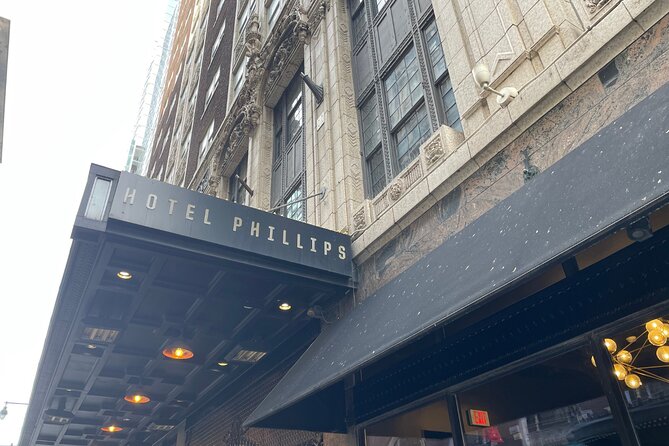
The first stop is Hotel Phillips Kansas City, Curio Collection by Hilton. In the early 1900s, this corner held the Glennon Hotel, which included a small haberdashery, an old-fashioned men’s clothing shop.
The memorable detail is the shop’s owner: Harry Truman. Before his presidency, Truman sold hats and ties here. That small fact gives the tour a useful human scale. Instead of meeting Truman only as a national political figure, you encounter him as a local businessman trying to make a living.
The hotel itself is also a good opening point because it places you in the older commercial center of downtown. The story helps you look past the modern hotel name and notice how the same corner has changed over time.
Courthouse architecture and Barney Allis Plaza
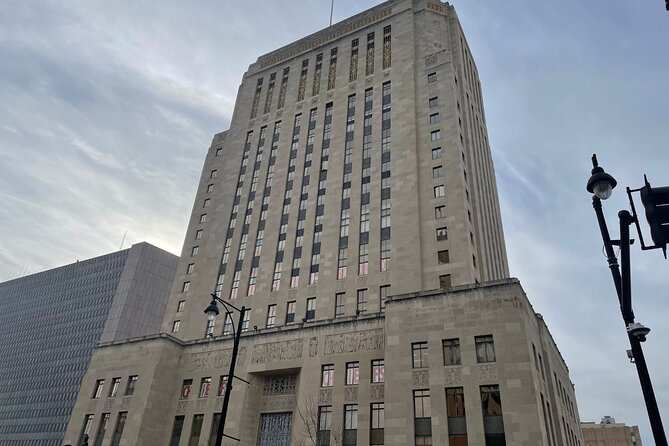
At the Jackson County Courthouse, built in 1934, the audio asks you to compare it with Kansas City’s City Hall. The same architecture firm designed both buildings, so the similarity is not accidental.
This is a short stop, but it teaches you how to read downtown architecture. Look for repeated shapes, materials, and formal civic details rather than treating the courthouse as just another large government building.
The route then reaches Barney Allis Plaza, where the story turns toward Kansas City’s entertainment past. When Barney Allis took over the Gayety to expand his hotel, the city lost one of its important jazz clubs.
That change matters because Kansas City’s jazz culture was not confined to one famous venue. Clubs, hotels, theaters, and streets all played a role. The audio gives you a sense of how urban development could bring investment while also erasing places that made the city distinctive.
The Folly Theater and a vanished theater row
The Folly Theater is one of the strongest stops on the walk because the building still survives. In the early 1900s, a stroll down 12th Street could take you past three different theaters: the Newman for movies, the Gayety for jazz, and the Folly for dramatic productions.
The Folly’s stage hosted Shirley Booth, Humphrey Bogart, and the Marx Brothers. Those names make the stop easy to picture, but the larger point is even better. This was once a full entertainment district, not just a single restored theater surrounded by unrelated buildings.
The route includes the Newman and Gayety in the wider story, but the Folly is the tangible place you can still see. Allow yourself time to look closely at the building. The audio lasts about 10 minutes here, giving you more room than the brief courthouse stop.
More Self-Guided Audio Tours in the USA
- Gettysburg Battlefield Self-Guided Driving Audio Tour
★ 4.5 · 910 reviews - Joshua Tree National Park Self-Guided Driving Audio Tour
★ 4.5 · 762 reviews - Ultimate Acadia National Park Self-Guided Driving Audio Tour
★ 4.0 · 521 reviews - Ultimate Lake Tahoe Self-Guided Driving Audio Tour
★ 4.5 · 435 reviews
Mark Twain, Tom Pendergast, and The Majestic
At the Mark Twain Statue, the focus shifts from local buildings to Missouri’s most famous writer. Twain grew up in Hannibal, Missouri, in a poor family, yet he later remembered his childhood with strong affection.
The story is a useful reminder that Kansas City’s public art often connects the city to the wider state. The statue is not simply a decorative stop. It points toward Missouri’s literary identity and the way personal memory can shape a public reputation.
The Majestic brings you back to Kansas City’s nightlife. The bar opened in 1911 after James Fitzpatrick decided that Quality Hill needed a proper place for a drink. His business ally was Tom Pendergast, the powerful political figure associated with Kansas City’s old political machine.
This stop adds a little edge to the tour. You are not just hearing about architecture or famous performers. You are hearing about the links between nightlife, business, and political power. If you enjoy local political history, this is one of the stops worth replaying through the extra audio.
The Garment District and Kansas City’s working city
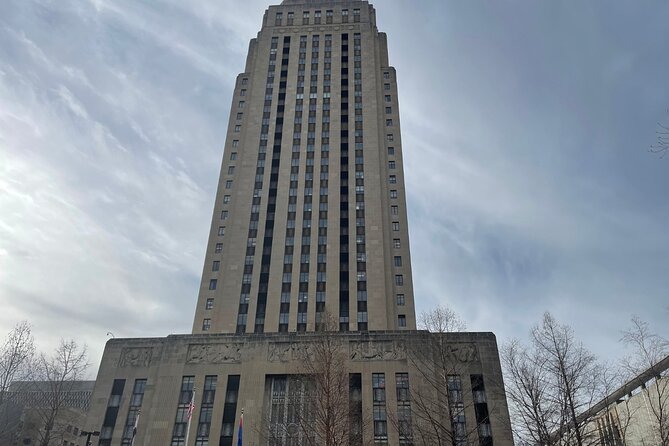
The Garment District is one of the most surprising parts of the route. During the 1930s, Kansas City’s clothing industry ranked second in the country behind New York. Nearly a quarter of clothing made in the United States came from Kansas City during that period.
That figure changes the way you see downtown. The city was not only a place of theaters, hotels, and political offices. It was also a workplace filled with factories and employees producing shirts, trousers, and dresses.
The audio describes workers moving between factories and helps you picture a city shaped by manufacturing. You might not see much of that activity today, which is exactly why the stop is valuable. It fills in a missing layer of Kansas City’s past.
The Savoy, Harry Truman, and the New England Building
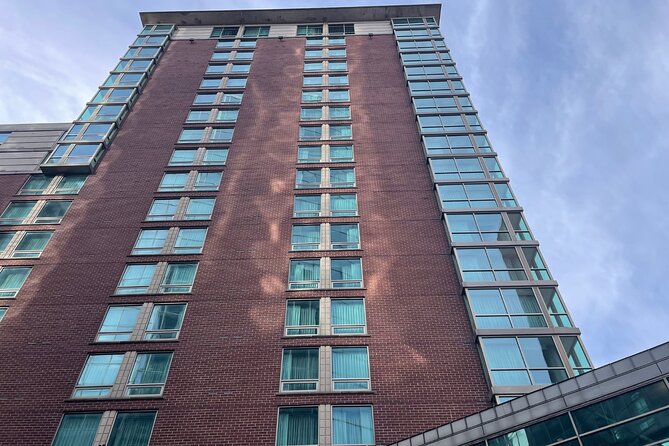
At the 21c Museum Hotel Kansas City, the story reaches back to the Savoy Hotel, once known for its steaks. After selling hats and ties at the Glennon, Harry Truman would walk a few blocks to the Savoy for lunch.
He reportedly favored Booth No. 4, where he ordered a well-done steak with light vegetables. Small dining habits can make a historical figure easier to imagine, and this is one of the tour’s most personable details.
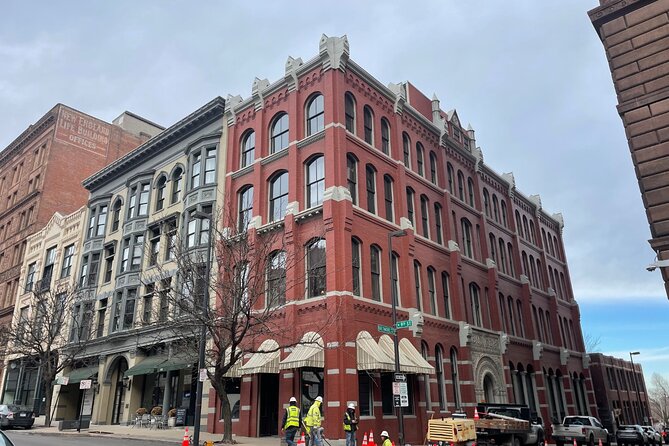
The New England Building offers a different kind of story. The brownstone apartment building was once Kansas City’s tallest structure. Today, that claim may be difficult to believe, but it gives you a quick lesson in how dramatically the downtown skyline has changed.
I appreciate this contrast. One stop asks you to picture a former president at lunch. The next asks you to compare an old high-rise with the much taller buildings that came later.
Kansas City’s first skyscrapers
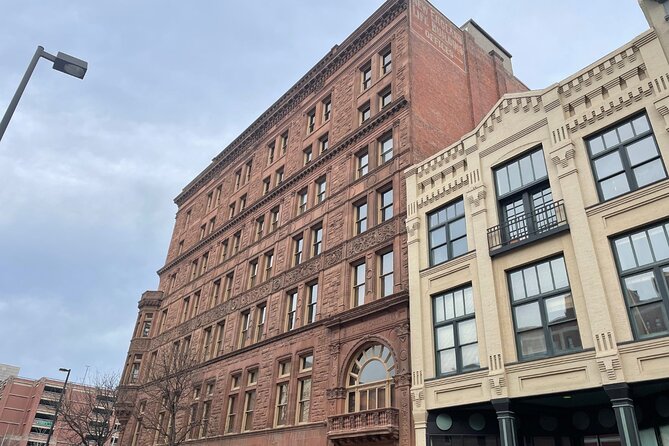
The New York Life Building became Kansas City’s first skyscraper when construction ended in 1890. Its brick and brownstone exterior gives the story a physical anchor, and the app offers additional material about how the building was constructed.
The tour then points out the city’s second-oldest skyscraper at 1000 Walnut Street. The audio uses the building as a setting for the story of William Anderson, known as Bloody Bill, one of Missouri’s most notorious Confederate bushwhackers.
This pairing is unusual and effective. You move from engineering and city growth to the violence of the Civil War era. It also shows that downtown history is not a neat sequence of business successes. The same streets connect commerce, architecture, war, and political conflict.
The Muse of the Missouri and Ilus W. Davis Park
The Muse of the Missouri is both a statue and a fountain. James Kemper commissioned it in 1962 to honor his son, who was killed while fighting the Nazis during World War II.
The figure is one of the Greek Muses carrying a fishing net. As with many Kansas City statues, water is part of the design. This is a quieter stop, but it gives the walk a personal and reflective pause after the skyscraper stories.
At Ilus W. Davis Park, the subject becomes civil rights and city leadership. Davis first won election as mayor in 1963. One of his major challenges came on April 9, 1968, only five days after Martin Luther King Jr. was murdered in Memphis.
This final portion gives the route modern weight. The tour does not stop with old hotels and theaters. It shows how Kansas City faced national grief and local pressure during the Civil Rights Movement.
How much time to allow
The advertised walking route is more than 1.7 miles and takes about one to two hours. The difference depends on your pace, how long you spend looking at buildings, and whether you stop for food or photographs.
The listed stop times add up to more than an hour, but the tour includes many short audio stories between the main stops. Give yourself closer to two hours if you want to listen carefully and look around.
You can also split it up. The app offers lifetime access with no expiry, so there is no need to finish in one go. That is useful if you want to fit the tour between meals, museum visits, or other downtown plans.
The app, phone setup, and route limits
Download the tour while you have strong Wi-Fi or cellular service. Search your email and text messages for the setup instructions and password, then install the separate Action Tour Guide app. The tour works offline after download.
Use headphones or earbuds if you have them. They make the automatic audio easier to hear and let you pay attention to the street around you. The recommended devices are an iPhone with iOS 15 or later, an Android phone running version 9 or later, or an iPad or tablet with GPS and cellular connectivity.
The app can be used on the same number of devices as the number of people booked. Couples may be able to share one tour by splitting headphones, which can lower the practical cost.
One important caution: the route may not match the street scene perfectly if downtown construction has changed sidewalks or access. Follow the app’s route and adjust with care rather than forcing a blocked path. If audio fails, contact support. A little preparation before leaving your hotel will save frustration.
Is $14.99 a fair price?
At $14.99 per person, this is a fair buy if you want flexibility and historical detail without arranging a scheduled group walk. You get more than a single one-hour recording because the app includes extra stories, offline maps, automatic playback, and lifetime access.
The price looks even better if you return to Kansas City or want to split the route across more than one day. You can also replay stories later, which is useful if the first walk leaves you wanting more about the Garment District, Truman, or Kansas City politics.
The value is weaker if you expect a live guide, current neighborhood commentary, or a strong focus on present-day Kansas City. The historical material is the main product. It does not replace a meal, museum visit, or local guide who can answer questions in real time.
Who should book this walk?
I would choose this tour for independent explorers, couples, history fans, and anyone with a free downtown afternoon. It works especially well if you dislike fixed departure times or prefer to pause for photographs.
It also suits repeat visitors because the access never expires. Families may like the short stories and freedom to skip material, though younger children may lose interest during the architecture and political sections.
I would hesitate if you need a fully guided experience, have difficulty using smartphone apps, or want a route built around current shops and restaurants. Construction can also make navigation less smooth than the basic route suggests.
Should you book it?
Book this Kansas City self-guided walking audio tour if you want a low-cost way to connect downtown buildings with the people and events behind them. The best moments include Harry Truman’s haberdashery, the vanished theater row, the Garment District, the first skyscrapers, and the Civil Rights-era story at Ilus W. Davis Park.
Download everything before you arrive, bring headphones, and allow two hours rather than rushing. At $14.99, the lifetime access and flexible pacing make it a sensible choice for a self-directed introduction to downtown Kansas City, as long as you are comfortable with an app instead of a live guide.
FAQ
How long is the Kansas City audio walking tour?
The route is more than 1.7 miles and takes approximately one to two hours, depending on your pace and stops.
How many audio stories are included?
The tour includes more than 33 audio stories covering the downtown route and its landmarks.
Where does the tour start?
The listed starting point is KC Area Credit Union, 601 E. 12th St., Room G-61, Kansas City, Missouri 64106.
Where does the tour end?
The listed ending point is 1000 Locust St., Kansas City, Missouri 64106.
Is a guide present at the meeting point?
No. This is a private, self-guided activity. You go to the starting point and use the Action Tour Guide app.
Does the tour work without mobile service?
Yes. You must download the tour while connected to strong Wi-Fi or cellular service. It works offline after the download.
Does the tour expire?
No. The tour offers lifetime access with no expiry, so you can use it on any day and on later trips.
Can I cancel for a refund?
Yes. You can receive a full refund if you cancel at least 24 hours before the experience start time. Cancellations within 24 hours are not refunded.
New audio tours around the USA
- Beaches, Bites and Bavaria in Leavenworth: A Self-Guided Audio Tour★ 3.5 · 3 reviews
- Welcome to Fabulous Las Vegas Sign Self-Guided Audio Tour★ 5.0 · 2 reviews
- Las Vegas Day Trips: 3-Day Self-Guided Audio Tour★ 5.0 · 2 reviews
- Hoover Dam and Lake Mead Self-Guided Audio Tour★ 5.0 · 3 reviews
- Driving Lake Tahoe: A Self-Guided Audio Tour From Tahoe City to Incline Village★ 5.0 · 10 reviews
- Las Vegas Neon and Secrets: Self-Guided Audio Tour★ 5.0 · 3 reviews
- Baton Rouge Historic Downtown Self-Guided Audio Walking Tour★ 4.0 · 19 reviews
- Ultimate La Jolla Self-Guided Driving & Walking Audio Tour Bundle★ 3.5 · 9 reviews
USA Audio Tours, compared.
Los Angeles: Hop-On Hop-Off Bus Tour with Audio Guide
Read our review →
City Sightseeing Hop-On Hop-Off Bus Tour with Audio Guide
Read our review →
Medieval Torture Museum Ticket with Audio Guide and Ghost Hunting
Read our review →
San Francisco: Alcatraz, Ferry & Audio Tour w/ Night Option
Read our review →
Ultimate Acadia National Park Self-Guided Driving Audio Tour
Read our review →
Browse the lists this tour appears in