
Review · AEGEAN COAST REGION, TURKEY, TURKEY
Ephesus Entry Ticket with Mobile Phone Audio Tour
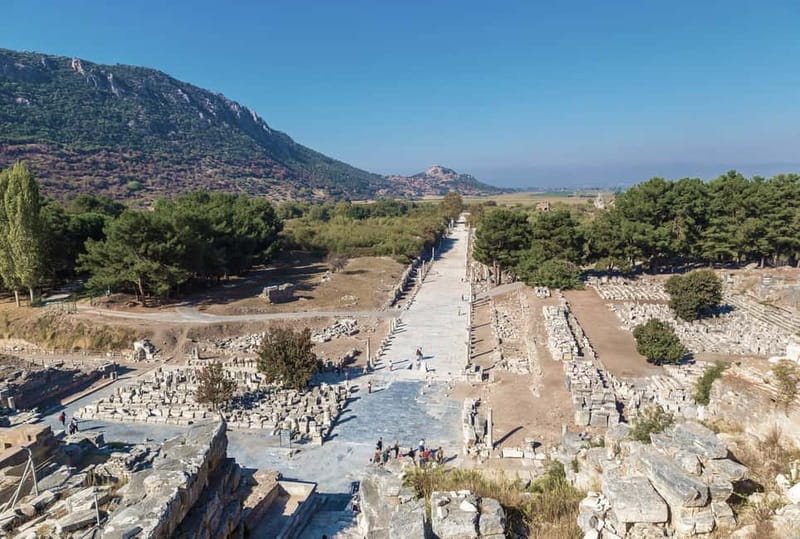
Ephesus is best understood on foot, and this self-guided audio tour gives you a clear route through one of Turkey’s great ancient sites. You enter at the Upper Gate, then walk downhill past the State Agora, Celsus Library, Grand Theatre, and Church of Mary while the app fills in the political, religious, and everyday details.
I like two things here: skip-the-line entry can save time at busy periods, and you can pause, replay, or ignore the audio as you please. I also like that the app works offline and includes an interactive map. The main catch is that this is not a live guided tour, and downloading the ticket or audio in advance is essential.
Key points to know before you book
- Start at the Upper Gate: The route is designed to begin near the Magnesia Gate, not at the lower entrance.
- Follow about 22 audio stops: The app covers the major sights, though the number of stops may differ from official site signage.
- Bring your own equipment: You need a charged Android or iOS phone, headphones, and roughly 100 to 150 MB of storage.
- The route runs downhill: You begin at the political center and finish near the Church of Mary, making comfortable shoes important.
- The Celsus Library and Grand Theatre anchor the visit: These are the most impressive stops, but the smaller ruins explain how the city worked.
- The $77 price buys convenience: It may be worthwhile when lines are long, but less so during quiet periods when entry takes only a few minutes.
Starting at Ephesus Upper Gate
The meeting point is the Upper Gate of Ephesus, near the Magnesia Gate. This matters. The audio route is arranged from the upper part of the site down toward the lower section, so arriving at the wrong entrance could leave you out of order or facing an uphill walk.
The easiest way to reach the entrance is by taxi from Kusadasi or Selcuk. Transportation is not included, so you need to arrange and pay for that separately. Hotel pickup, drop-off, food, and drinks are also outside the tour price.
Once you reach the entrance, use the electronic ticket sent by the local partner. That message arrives separately after booking, so check your spam folder if it does not appear quickly. I would download both the ticket and the audio content before leaving your hotel. You do not want to depend on a weak signal at the site.
The ticket offers skip-the-line entry. That is most useful during busy visiting hours and in the warmer months. In winter, the ticket queue may take less than five minutes, which makes the $77 price harder to justify if your only goal is faster admission.
More audio tours around the world:
- Barcelona: Sagrada Familia Entry Ticket with Audio Guide
★ 4.6 · 105,312 reviews - Rome: Pantheon Fast-Track Ticket and Official Audioguide
★ 4.5 · 27,353 reviews - Barcelona: Casa Batlló Entry with Self-Audioguide Tour
★ 4.7 · 25,359 reviews
What the self-guided audio tour is really like
This is a phone-based tour, not a person walking beside you. You listen in English or German through your own headphones while the app guides you from one point to the next.
The audio is designed to keep the visit moving. It explains what you are looking at, then points you toward the next stop. You can set your own pace, which is useful at Ephesus because some people want to pause for photographs while others want more time with the inscriptions and architectural details.
The app includes offline content and an interactive map. That is a practical advantage. Once the material is downloaded, you should not need mobile data for the basic tour.
There are about 22 audio stops. The official site may identify more points, with around 35 stops on its own material, so this tour does not explain every visible stone or secondary ruin. That is not a serious problem if you want the main story and the major landmarks, but it matters if you are a serious archaeology fan.
The audio can also be easy to miss at the beginning. Pay attention to where the first stop starts and keep the map open. A little orientation at the Upper Gate will save you from wondering if the narration has begun.
The State Agora and Bouleuterion
Your first major stop is the State Agora, the political heart of ancient Ephesus. This large square was more than an open space. It was a setting for civic business, public decisions, and formal gatherings.
The audio helps you picture the agora as a working part of the city rather than a pile of broken columns. Look for the remains of colonnades and surrounding structures as you move through the area. The scale gives you an early sense of Ephesus as an organized urban center.
Next comes the Bouleuterion, the meeting place of the city council. It may also have been used for artistic performances. This is one of the stops where the self-guided format works well because you can stand among the remains and listen without needing to keep up with a group.
I would not rush the opening section. The State Agora and Bouleuterion establish the civic side of Ephesus before the route moves toward its better-known monuments. If you only race toward the Celsus Library, you miss how the city was governed.
Temple of Domitian and the Curetes Way
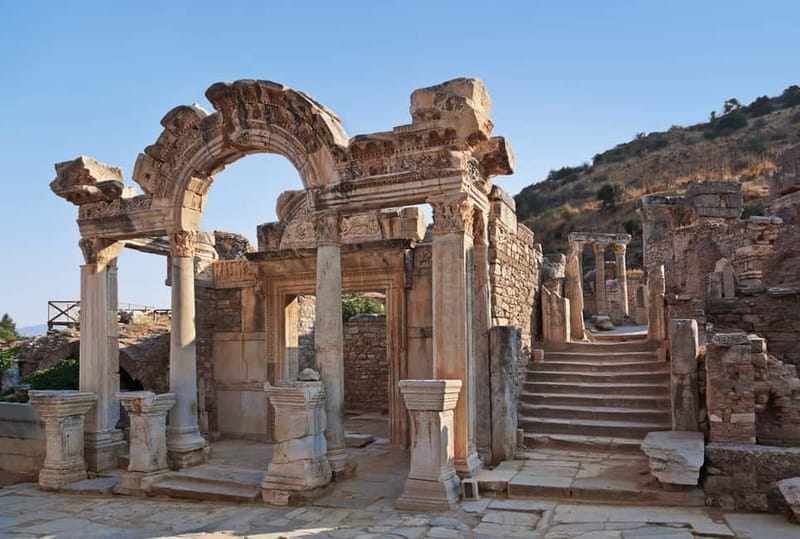
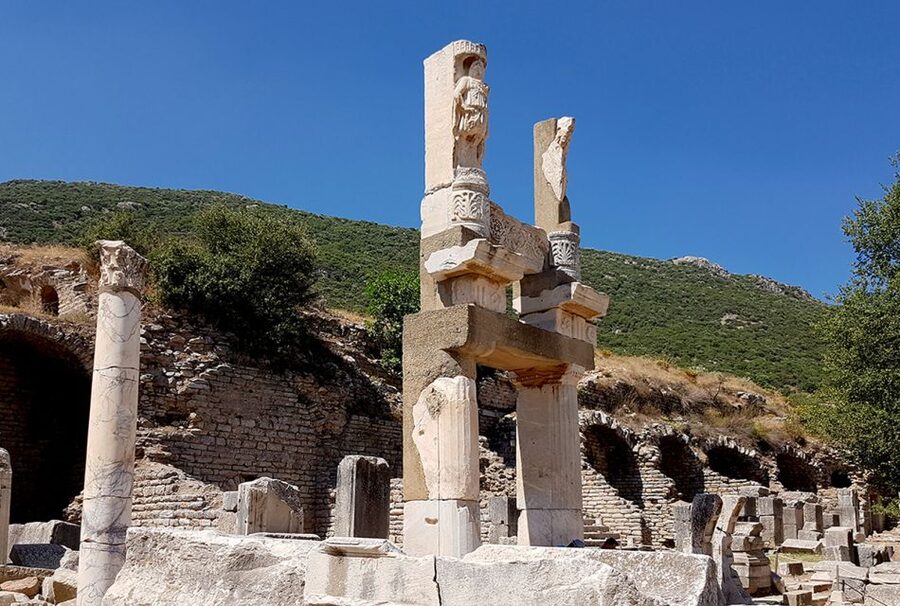
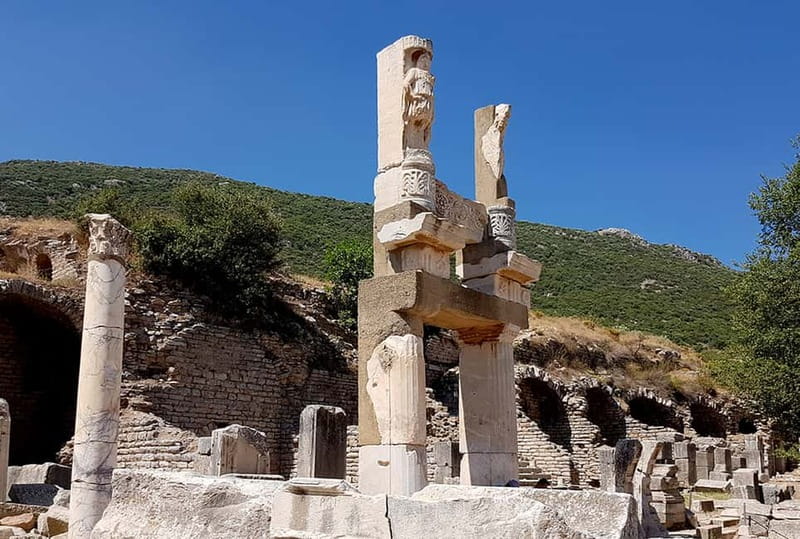
The route continues to the Temple of Domitian, where the unusual U-shaped altar gives the site a distinctive architectural detail. The audio explains the layout and gives you a reason to look beyond the main columns.
From here, you move onto the Curetes Way. This street connected the political part of Ephesus with its commercial center. In practical terms, this is where the visit begins to feel like a walk through an ancient city rather than a sequence of isolated ruins.
The Curetes Way is also one of the better places to appreciate the route’s downhill shape. You are moving through the site rather than doubling back, though the paving can be uneven. Wear shoes with good support, especially if you plan to stay longer than the stated two and a half hours.
The audio adds legends and stories about the people who used the street. That human detail is useful because the physical remains can otherwise look repetitive. A column, a doorway, and a marble pavement mean more when you understand who passed through the area and why the road mattered.
Same sights, a different narrator:
- Rome: Colosseum & Forum with Audio Guide App -Optional Arena
★ 4.2 · 24,770 reviews - Amsterdam: 75 Minute City Canal Cruise with Audio Guide
★ 4.4 · 19,938 reviews - Florence: Timed Entry to Michelangelo’s David + Audio App
★ 4.6 · 19,496 reviews - Amsterdam: City Centre Canal Cruise including Audioguide
★ 4.3 · 16,901 reviews
The Emperor’s Fountain and Scholastica’s Baths
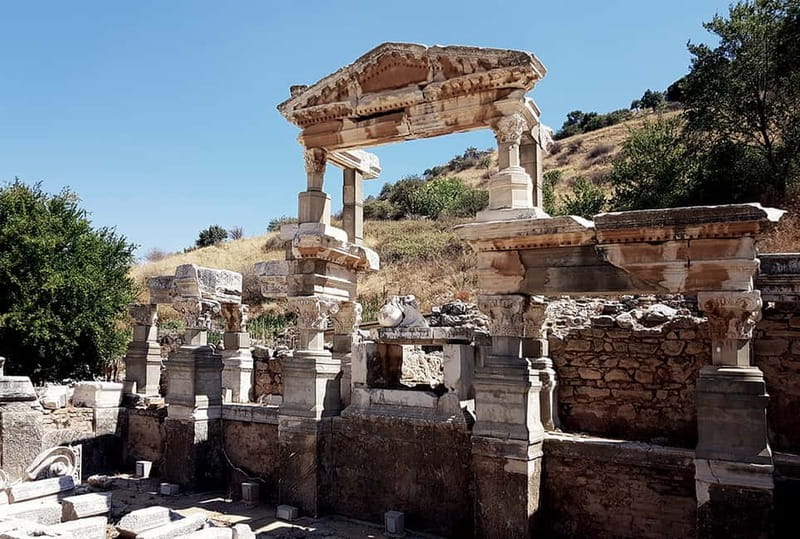
Along the Curetes Way, the tour points out the Emperor’s Fountain and the large bath complex associated with Scholastica. These stops reveal the public side of daily life in Ephesus.
The baths were not simply places to wash. They were social and civic spaces, and their scale shows how much effort went into public facilities. The marble latrines are a memorable detail. They are a reminder that ancient public life included very ordinary needs, handled in a communal setting.
This section rewards close listening because the structures are not always as instantly recognizable as the library or theatre. The audio gives the smaller ruins a clear purpose, helping you understand how the city functioned.
The route also leads toward the grave of Arsinoe, an Egyptian princess. This is an unusual connection between Ephesus and the wider eastern Mediterranean world. It gives the walk a personal detail before the grander monuments ahead.
Celsus Library, the image of Ephesus
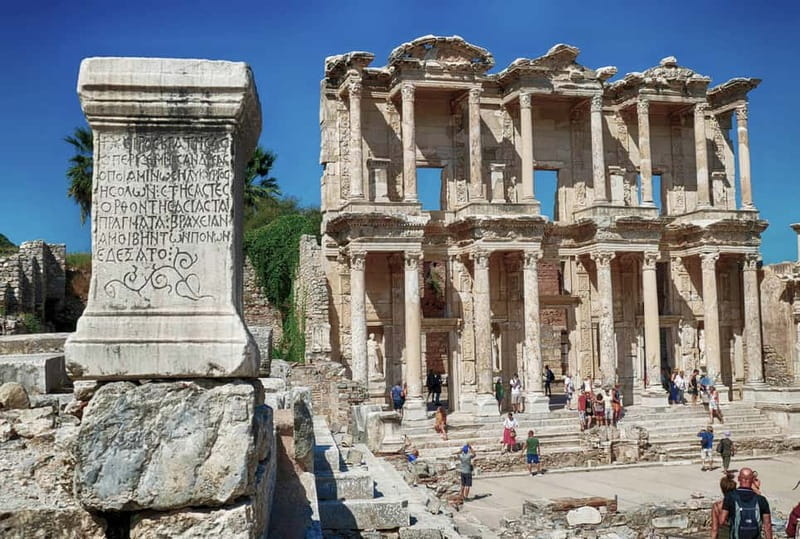
The Celsus Library is the visual centerpiece of the visit. Its restored facade, with columns and carved figures, is the monument most people associate with Ephesus.
This is where you will probably want extra time. The facade is impressive from a distance, but look closely at its layers, symmetry, and carved decoration. The audio explains why the building mattered and places it within the public life of the city.
I appreciate that the tour does not treat the library as a photo stop only. It connects the building to the city’s intellectual and civic identity. You can pause the narration, take photographs, then continue when you are ready.
The price of the ticket feels easier to defend if the audio helps you notice details you would otherwise walk past. If you already know the site well and mainly want entry, the value is weaker. If this is your first visit, the library is one of the places where the commentary earns its keep.
The Gate of Mazeus and Mithridates
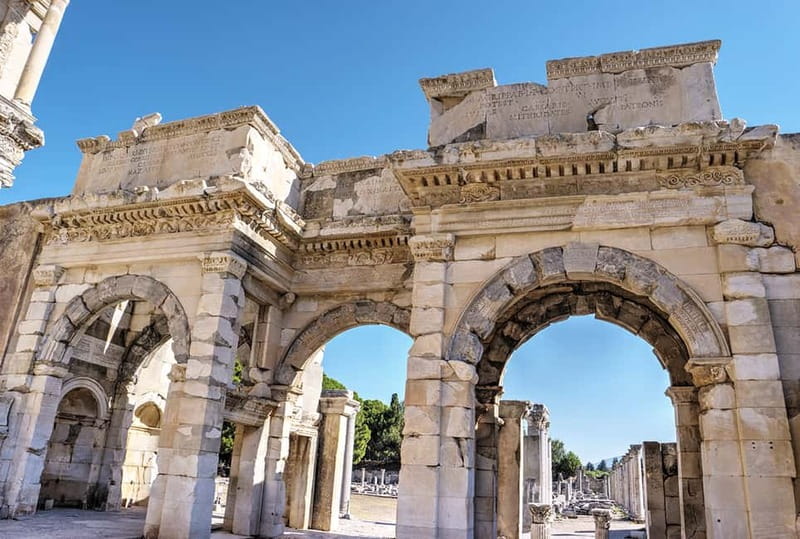
Beyond the library, you reach the Gate of Mazeus and Mithridates. This gate marked an important transition in the city and adds architectural context to the route between the library and theatre.
The gate is easy to treat as a quick passage, but the audio gives it a role in the city’s public spaces. It also helps you understand how Ephesus was arranged, with major roads and monumental buildings tied together rather than scattered at random.
This is another advantage of starting at the Upper Gate. The route gives you a sense of movement through Ephesus, from the civic center to the major street and then toward the entertainment district.
The Grand Theatre and Arcadiane
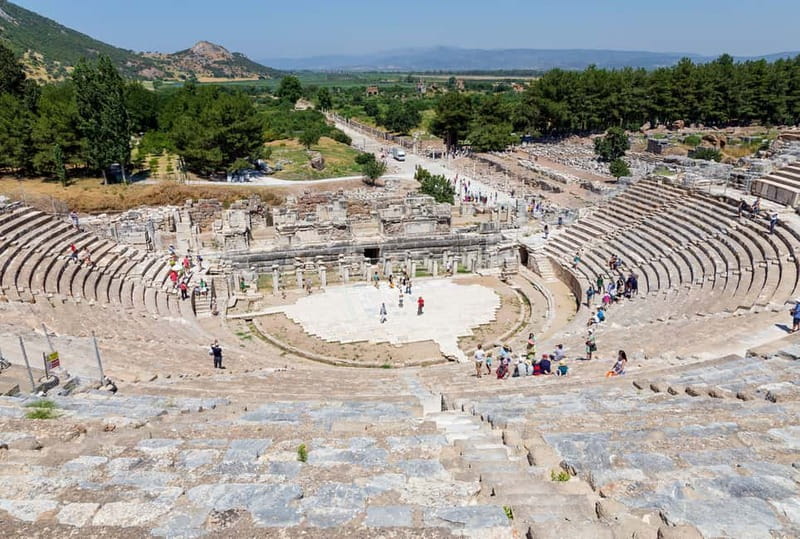
The Grand Theatre is the largest and most dramatic stop. Performances and gladiatorial games took place here, and the structure shows the scale of public entertainment in Roman Ephesus.
Stand where you can take in the full sweep of the seating and stage area. The audio explains how the theatre functioned and helps you imagine the noise and crowds that once filled it. You can also appreciate its position along the route toward the lower part of the site.
The theatre is a natural place to pause, but remember that the official duration is about 2.5 hours. If you listen to every section, take photographs, and stop often, you may need to move at a steady pace. The self-guided format lets you extend the visit, but the ticket does not include transportation afterward.
From the theatre, the route crosses the Arcadiane, a major street leading toward the lower city. This broad crossroads helps tie together the earlier parts of the visit. You are no longer looking only at individual buildings. You are seeing the bones of a city arranged around roads, squares, public services, and large gathering places.
Finishing at the Church of Mary
The final stop is the Church of Mary, reached by a smaller path from the Arcadiane. The ruins are large and impressive, and the building has an important connection to the Christian period of Ephesus.
This stop broadens the visit beyond Greek and Roman Ephesus. The city later became an important center for Christianity, and the church shows how its public and religious life changed over time.
The Church of Mary is less instantly familiar than the library or theatre, so the audio is particularly helpful here. Without context, you might see another field of stone. With an explanation of the site’s role, the final stop gives the route a clear ending.
Because the tour finishes at this end of the archaeological site, check your onward transport before you start. The ticket includes entry and the phone tour, not a ride back to Kusadasi or Selcuk.
Is $77 good value?
At $77 per person, this is a convenience purchase rather than a budget entry ticket. You are paying for admission, skip-the-line access, and a digital audio guide with offline maps.
The price makes more sense when Ephesus is busy and queues are long. It also works well if you prefer to explore privately without hiring a live guide. You can pause whenever you like, move ahead when a stop does not interest you, and spend extra time at the library or theatre.
The value is less convincing in a quiet season. If the ticket queue is only a few minutes, the main benefit becomes the audio content. One useful point is that bookings are made per device, not per person. If you plan to share one phone and one set of headphones, check the booking terms carefully before paying for several devices.
The audio includes the main sights, but it does not match every official stop. A visitor who wants a full archaeological explanation of every ruin may prefer a live specialist or a more detailed official guide. For a first visit focused on the major buildings, the coverage is adequate.
What to bring and who should book
Bring comfortable shoes, a hat, water, headphones, and a fully charged smartphone. The app needs about 100 to 150 MB of storage, and it is compatible with Android and iOS, with several older Apple devices excluded. Windows phones are not supported.
This experience suits you if you:
- Want to visit independently without joining a live group
- Prefer English or German commentary
- Like setting your own pace
- Want a mapped route through the main monuments
- Are visiting during a period when entrance lines may be long
It is less suitable if you do not have a modern phone, dislike listening through headphones, or want to ask questions as you go. It is also not the right choice if you expect transport from Kusadasi or Selcuk.
The site is wheelchair accessible, but the route includes ancient paving and uneven ruins. Children aged 0 to 8 and disabled visitors with one companion can enter free with the required documents, but those free admissions do not receive skip-the-line access.
Should you book the Ephesus mobile audio tour?
I would book it if you want a straightforward first visit and value freedom to explore at your own pace. The route covers the places you came to see, including the Celsus Library, Grand Theatre, and Church of Mary, while the offline map reduces the stress of finding your way.
I would skip it if you are visiting in winter, expect almost no queue, and mainly need an entry ticket. At $77, the convenience may not balance the cost. I would also choose a live guide if detailed questions, archaeology, and local interpretation matter more to you than flexibility.
For most independent visitors, the best plan is simple: download everything before arrival, start at the Upper Gate, keep the map open, and allow more than a quick photo stop at the library and theatre. That preparation turns a potentially confusing ruin field into a clear walk through the changing life of Ephesus.
FAQ
Where does the Ephesus audio tour begin?
It is designed to begin at the Upper Gate of the archaeological site, near the Magnesia Gate. Enter there and follow the route on the app.
How long does the experience last?
The stated duration is about 2.5 hours. Your visit may take longer if you pause often, take photographs, or spend extra time at the major monuments.
Is a live guide included?
No. This is a self-guided audio tour on your smartphone. A live person does not accompany you.
Which languages are available?
The audio tour is available in English and German.
What phone do I need?
You need an Android or iOS smartphone with enough storage for about 100 to 150 MB of content. Windows phones are not supported, and several older iPhone, iPod, and iPad models are incompatible.
Do I need to bring headphones?
Yes. Headphones are not included, so bring your own along with a charged smartphone.
Can children enter Ephesus for free?
Children aged 0 to 8 can enter free when the required passport is presented. Free admission does not include skip-the-line access, so those visitors must use the regular queue.
New audio tours around the world
- London Panoramic Open Top Bus Tour with Audio Guide★ 4.0 · 209 reviews
- London: British Museum Audio Guide & Small Group Entry★ 3.5 · 81 reviews
- London: National Gallery Audio Tour (No Entry Ticket)★ 3.5 · 11 reviews
- London’s Alternative History: A Self-Guided Audio Tour★ 5.0 · 4 reviews
- London: British Museum’s English Audio Tour with Free Reservation★ 3.0 · 15 reviews
- London: Churchill War Rooms Ticket & Political London Audio Tour★ 4.0 · 83 reviews
- London: British Museum Audio Tour with Free Guaranteed Entry★ 3.0 · 30 reviews
- Houses of Parliament Ticket & Political London Audio Guide★ 4.0 · 13 reviews