Review · SAVANNAH
Historic Savannah Self-Guided Walking Audio Tour
Savannah’s historic district is made for walking, and this GPS-guided audio tour gives you a broad route through its squares, churches, museums, literary landmarks, and riverfront. You start at the Savannah MLK Visitor Information Center and follow more than five miles of stops, with over 50 audio stories triggered by your location.
I like the freedom to stop and restart for lunch, shopping, photos, or a side trip. I also like the low $14.99 price, especially since access does not expire and the tour can be reused on later visits. The main drawback is navigation: the app depends on your phone’s GPS and map view, and one technical problem can interrupt the flow.
Key things to know before you book
- More than five miles on foot: The route covers a large section of central Savannah, so the advertised one to two hours requires a brisk pace.
- GPS-triggered storytelling: Audio begins as you reach each point, with extra stories available for places that catch your interest.
- Twenty-one notable stops: You pass churches, public squares, historic homes, museums, Forsyth Park, and the Savannah riverfront.
- Lifetime access: Download the tour once and use it on any day, any trip, and as many times as you like.
- No guide meets you: You use the Action Tour Guide app independently, with no scheduled group departure.
- Strong value for flexible walkers: At $14.99, it costs less than many live tours and lets you set your own schedule.
A self-guided route through Savannah’s historic core

This experience works best as a flexible walking companion rather than a tightly timed tour. You receive setup instructions by email and text, download the separate Action Tour Guide app, enter your password, and download the tour while you have a strong Wi-Fi or cellular connection.
Once you reach 301 Martin Luther King Jr Boulevard, open the app and begin at the first story point. The audio should play as you arrive at each location, then guide you toward the next one. You can also pause, skip stops, read the written material, or listen to bonus content.
The route includes more than 50 stories but lists 21 main stops. That makes the experience less like a short audio loop and more like a broad introduction to Savannah’s historic district. The stated duration is one to two hours, but the route runs over five miles. If you stop for photos, enter a museum, sit in a square, or eat along the way, plan on giving it more time.
More Audio Walking Tours in the USA
- Self Guided Classic Freedom Trail Location Aware (GPS) Walking Audio Tour
★ 4.5 · 258 reviews - Cape Cod & Provincetown Self-Guided Driving & Walking Audio Tour
★ 4.0 · 207 reviews - Santa Fe Historic Downtown Smart Phone Audio App Self Guided GPS Walking Tour
★ 4.5 · 112 reviews
Starting at the MLK Visitor Information Center
The Savannah MLK Visitor Information Center is a sensible place to begin. It gives you a clear starting point near public transportation and puts the tour in the context of Savannah’s past, architecture, and the people who shaped the city.
The audio begins with an overview rather than sending you straight into a single building. That helps you understand the route as a connected walk through public squares, religious sites, private homes, and places tied to African American history.
There is no admission charge for the starting point. You should arrive with your phone charged, headphones ready, and the app already installed. Downloading at the start can be frustrating if your signal is weak.
First African Baptist Church and Savannah’s African American story
The First African Baptist Church is one of the most important early stops. The audio focuses on the African American community in Savannah and its contribution to the wider American story.
This is a useful feature of the route because Savannah’s grand squares and historic houses can easily dominate a first visit. The church adds necessary balance. You are not only looking at old buildings and famous names. You are also hearing about the people and communities whose work, faith, and struggle shaped the city.
The stop is listed as free, but the tour does not include admission to any attraction. As with the other religious buildings on the route, check current opening arrangements if you hope to enter rather than simply view the exterior.
Reynolds, Johnson, and Wright Squares
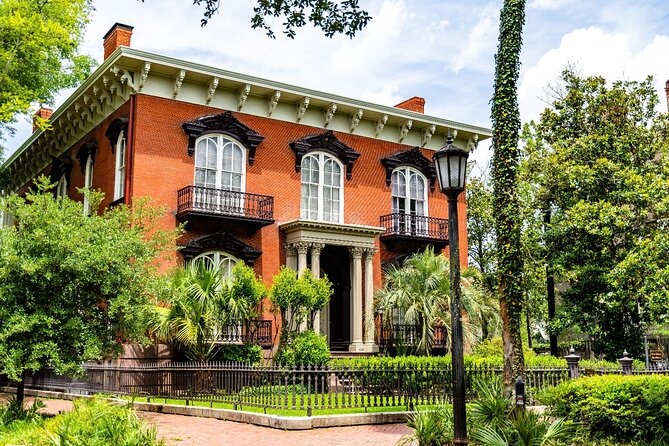
Savannah’s squares are the backbone of the walk. Reynolds Square introduces John Wesley, the founder of Methodism, and gives you a place to pause while the app explains his connection to the city’s religious story.
Johnson Square brings in James Oglethorpe, the founder of Savannah and the colony of Georgia. The square is also surrounded by historic buildings, including Christ Church Episcopal, an early church with an important place in Savannah’s story.
Wright Square shifts the focus to William Washington Gordon, connected with the Central of Georgia Railway. You also get the Mercer-Williams House from this area, a building many people recognize because of its connection to John Berendt’s Midnight in the Garden of Good and Evil.
I like this part of the route because the squares give your feet a break while keeping the history close at hand. You are not racing from indoor attraction to indoor attraction. The public spaces let you see how Savannah’s plan works, with architecture and city life arranged around shaded gathering places.
More History Audio Tours in the USA
- Savannah’s Historical District: A Self-Guided Audio Tour
★ 4.5 · 69 reviews - Salida History Audio Tour l A Self-Guided Wild West Experience
★ 5.0 · 41 reviews - Historic Bar Harbor Self-Guided Walking Audio Tour Guide
★ 4.5 · 38 reviews - Key West’s Old Town Treasures: A Self-Guided Audio Tour
★ 4.5 · 29 reviews
The Olde Pink House and Savannah’s restaurant history
The Olde Pink House is one of the city’s most recognizable buildings. Built in the 18th century, it began as a private residence and now houses a restaurant serving Southern food.
The tour treats it as a landmark, but the practical value is that it gives you a possible meal stop along the route. Since the audio tour does not include reservations or attraction tickets, you will need to arrange dining separately.
This is a good example of how to use the experience casually. Listen to the story, pause the tour, and decide if you want to eat nearby. You are not tied to a guide’s timetable or a group’s pace.
Owens-Thomas House and the realities of admission fees

The Owens-Thomas House and Slave Quarters is one of the route’s most important historic homes. Its architecture is striking, but the slave quarters are essential to understanding how the household and city operated.
Unlike many outdoor stops, this attraction may require admission. The ticket is not included in the $14.99 tour price. If you want to go inside, confirm opening hours, ticket costs, and tour availability separately before building your day around it.
That extra cost does not weaken the audio tour’s value. It simply clarifies what you are buying: an audio guide and route, not an attraction pass. The app can take you to the door and provide context, but it does not replace an entry ticket.
Chippewa Square and Savannah Theatre

Chippewa Square is tied to several architectural styles, including Federal, Italianate, and Victorian. The audio encourages you to look around rather than focus on one monument or facade.
Nearby, the Independent Presbyterian Church adds a Greek Revival building and a history that reaches back to the Civil War era. The church is one of the stops where the details of architecture matter as much as the basic date or name.
The Savannah Theatre dates to 1818 and is described as one of the oldest continuously operating theatres in the United States. Admission is not included, so treat it as an optional interior visit. Even if you only see the exterior, the stop helps show that Savannah’s historic district is not just a collection of houses. It has long been a place for worship, performance, commerce, and public life.
Harper Fowlkes House, the cathedral, and Old Sorrel Weed House
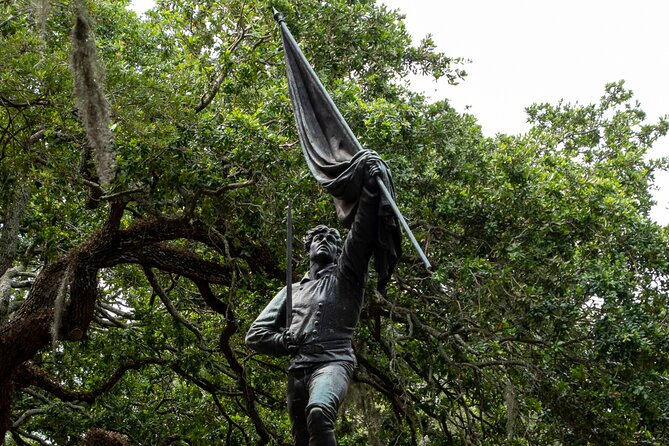
The Harper Fowlkes House was built in 1842 in the Greek Revival style. Its neoclassical details and garden offer another look at 19th-century Savannah’s upper-class residential architecture.
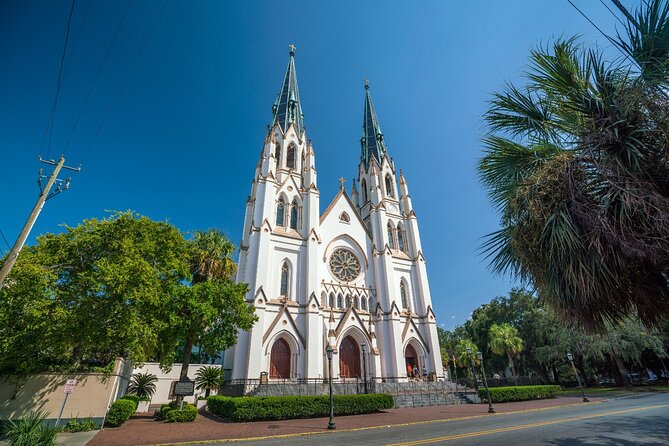
The Cathedral of St. John the Baptist brings a different mood. Built in 1876, it is known for French Gothic design, intricate details, and stained glass. The audio places the cathedral within the historic district, but you should check current access if you want to go indoors. The tour itself does not provide admission or reservations.
The Old Sorrel Weed House adds a mixture of architecture and ghost stories. This 19th-century mansion is known for Greek Revival design, guided tours, and reports of paranormal activity. I would treat the supernatural material as part of Savannah’s storytelling tradition, while still paying attention to the building’s actual history and interiors.
The house is another attraction where entry is separate. You can use the audio tour to reach it and decide on the spot if you want an additional paid tour.
Flannery O’Connor and the Massie Heritage Center
The Flannery O’Connor Childhood Home offers a literary stop with a more personal scale. O’Connor spent her formative years here, and the preserved house connects her early life with the settings and ideas that shaped her writing.
This is a worthwhile stop if you enjoy American literature, but the tour does not promise an interior visit as part of the $14.99 price. Check the museum’s own admission details before counting on entry.
The Massie Heritage Center occupies an 1856 school building and uses exhibits and programs to explain Savannah’s architecture, people, and past. It offers a useful change of pace after several private homes and churches. Instead of focusing on one famous household, it looks at the city’s wider development.
Forsyth Park and the Mercer-Williams House
Forsyth Park is the largest open-air pause on the route. The 30-acre park has walking paths, gardens, recreational areas, and its well-known central fountain.
This is where the five-mile route becomes more than a string of building facades. You can slow down, sit for a while, take photographs, and let the audio continue when you are ready. If the weather is hot, cold, or windy, the park can also reveal how much the season affects this walking experience. A cold day with wind off the river, for example, can make a long outdoor route feel much harder.
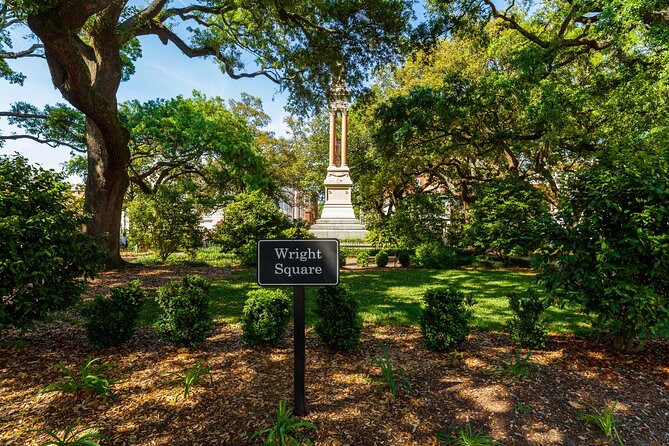
The Mercer-Williams House is another major literary and architectural stop. Its Italianate design, connection with Johnny Mercer’s family, and role in Midnight in the Garden of Good and Evil make it one of Savannah’s best-known houses.
The route information lists the stop as free, but the attraction itself may have its own entry rules. Treat all indoor access as separate from the audio tour unless you confirm otherwise.
The Ralph Mark Gilbert Civil Rights Museum
The Ralph Mark Gilbert Civil Rights Museum gives the tour its clearest focus on the civil rights movement. Named for a local activist, it uses exhibits and artifacts to explain the fight for racial equality in the region.
This stop matters because it connects Savannah’s older history with more recent struggles. It also keeps the tour from becoming a parade of architecture and famous homes. I would allow extra time here if you plan to enter, since a museum about civil rights deserves more than a quick look at the front.
Admission is not included in the audio tour. Use the app’s route for orientation, then check the museum’s own policies and hours.
The riverfront, Waving Girl, and Pirates’ House
The Waving Girl Statue brings you toward Savannah’s maritime past. It honors Florence Martus, who greeted ships for decades from the riverfront. The statue’s simple gesture gives the river a human story, not just a commercial one.
The Pirates’ House continues the nautical theme. Dating to the 18th century, it was associated with seafarers and later became linked with Robert Louis Stevenson’s Treasure Island. Today it functions as a restaurant and museum, combining food with old maritime tales.
These final stops help widen your sense of Savannah. The city is not only squares and mansions. Its riverfront shaped trade, work, travel, and local legends. If you want to eat at the Pirates’ House, make your own reservation or dining plan. The audio ticket covers neither food nor entry.
Davenport House and the route back to the starting point
The Davenport House Museum closes the main itinerary with a Federal-style home built in 1820. Period furnishings and guided visits offer a look at early 19th-century domestic life.
By this point, you will have crossed much of the historic district. The activity ends back at the starting point, but the route’s length and number of stops mean you should not assume the listed one to two hours includes long indoor visits or leisurely meals.
The experience is private in the sense that only your group uses the tour access. It is not a private guide waiting at each stop. You walk independently, with the app providing the narration and directions.
What the app does well, and where it can frustrate you
The strongest part of the technology is location-triggered audio. When it works correctly, you can keep your phone in your hand or pocket, listen through earbuds, and focus on the buildings around you.
Offline maps are another real advantage. Once the tour is downloaded, it can work without Wi-Fi or cellular service. The app also lets you read the text, preview locations, and return to stories later. Lifetime access means you can use the material again on another day or another trip.
The weak point is map handling. One user found that the map repeatedly collapsed and had to be reopened, even with a good signal. Another had trouble with the app landing on the wrong numbered stop. To reduce that risk, download the tour in advance, learn the app before arriving, and follow the planned route instead of jumping randomly between landmarks.
Use the same password on the same number of devices as the number of people booked. Headphones or earbuds are recommended, and the suggested devices are an iPhone with iOS 15 or later, an Android phone with version 9 or later, or an iPad or tablet with GPS and cellular connectivity.
Is $14.99 good value?
For $14.99 per person, this is a strong value if you want a broad introduction to Savannah and do not need a live guide. You receive a mapped route, automatic audio, written information, bonus stories, offline use, and lifetime access.
The price becomes even better if you use the tour more than once. You could do the main walk on one day, revisit selected stops later, or use the app as background information while exploring at a slower pace.
The value is lower if you expect museum tickets, reservations, or personal answers from a guide. Those are not included. You also need to supply your own phone, data or Wi-Fi for the initial download, and headphones.
The tour has a 4.4 rating from 16 reviews, which fits the overall picture: the concept is useful and flexible, but the app deserves a little preparation.
Who should book this Savannah audio walk?
I would choose this tour if you like setting your own pace, taking breaks, and mixing sightseeing with meals or shopping. It suits couples, families, and independent visitors who want more direction than a paper map but less structure than a scheduled group walk.
It is also useful for repeat visitors. You can skip familiar areas and spend more time on the Civil Rights Museum, O’Connor’s childhood home, the riverfront, or the historic houses that interest you most.
I would be cautious if you dislike phone-based navigation or want every stop delivered in a tightly controlled sequence. The route is long, the weather can affect your comfort, and GPS accuracy is important. On a cold or windy day, split the walk into sections rather than forcing yourself to finish in one push.
FAQ
Where does the tour start?
It starts at the Savannah MLK Visitor Information Center, at 301 Martin Luther King Jr Boulevard, Savannah, Georgia 31401.
Where does the tour end?
The activity ends back at the meeting point.
How long does the walking tour take?
The estimated duration is about one to two hours. The route is over five miles long, and extra time may be needed for photos, meals, side trips, or indoor attractions.
Is the tour guided in person?
No. It is self-guided. No one meets you at the starting point, and your group follows the app independently.
What language is offered?
The tour is offered in English.
Are attraction tickets included?
No. Attraction passes, entry tickets, and reservations are not included. The Owens-Thomas House, Savannah Theatre, and other indoor sites may have separate admission requirements.
Does the tour work without cell service?
Yes, after you download the tour. You must download it while you have strong Wi-Fi or cellular service, then it can work offline.
How long does access last?
Access is lifetime, with no expiry. You can use the tour on any trip and as many times as you like.
Should you book it?
Book this tour if you want low-cost, flexible sightseeing with plenty of historical context and no fixed departure time. Its best features are the broad route, automatic audio, offline maps, and lifetime access for $14.99.
Skip it if you want a live guide, guaranteed app-free navigation, or attraction admission bundled into the price. For most independent walkers, though, it is a practical way to get oriented in Savannah, with enough freedom to turn a two-hour route into a relaxed full-day outing.
More Self-Guided Audio Tours in the USA
- Gettysburg Battlefield Self-Guided Driving Audio Tour
★ 4.5 · 910 reviews - Joshua Tree National Park Self-Guided Driving Audio Tour
★ 4.5 · 762 reviews - Ultimate Acadia National Park Self-Guided Driving Audio Tour
★ 4.0 · 521 reviews - Ultimate Lake Tahoe Self-Guided Driving Audio Tour
★ 4.5 · 435 reviews
New audio tours around the USA
- Beaches, Bites and Bavaria in Leavenworth: A Self-Guided Audio Tour★ 3.5 · 3 reviews
- Welcome to Fabulous Las Vegas Sign Self-Guided Audio Tour★ 5.0 · 2 reviews
- Las Vegas Day Trips: 3-Day Self-Guided Audio Tour★ 5.0 · 2 reviews
- Hoover Dam and Lake Mead Self-Guided Audio Tour★ 5.0 · 3 reviews
- Driving Lake Tahoe: A Self-Guided Audio Tour From Tahoe City to Incline Village★ 5.0 · 10 reviews
- Las Vegas Neon and Secrets: Self-Guided Audio Tour★ 5.0 · 3 reviews
- Baton Rouge Historic Downtown Self-Guided Audio Walking Tour★ 4.0 · 19 reviews
- Ultimate La Jolla Self-Guided Driving & Walking Audio Tour Bundle★ 3.5 · 9 reviews
Savannah Audio Tours, compared.

Savannah’s Historical District: A Self-Guided Audio Tour
Read our review →
Ghosts of Savannah Self-Guided Haunted Audio Tour App/EMF Reader
Read our review →
Chippewa Square to Forsyth Park: A Self-Guided Audio Tour of Savannah
Read our review →