

Review · USA
Ultimate Gettysburg Battlefield Self-Guided Audio Bundle Tour
Gettysburg is best understood from the road, not through a bus window. This self-guided audio bundle lets you follow the battlefield in your own car while stories begin automatically near monuments, ridges, farms, and other key sites. The sequence follows the three days of fighting, making a complicated battle easier to grasp.
I especially like the GPS-triggered narration, which lets you keep your eyes on the road, and the freedom to stop for photos, lunch, heat breaks, or extra time at a monument. At $29.99 per vehicle for up to four people, it is also a strong value for a family or small group. The main caution is the app: some users have had trouble with GPS tracking, route changes, Android Auto, or roads closed by park work.
Key points to know
- Four tours in one purchase: Cover the main battlefield route along with additional Gettysburg themes, including Seminary Ridge, Devil’s Den, and battlefield ghost stories.
- Six to seven hours of content: Each route is more than 30 miles and generally takes two to three hours, though you can spread the bundle across several days.
- The battle unfolds day by day: McPherson’s Ridge introduces the first day, Little Round Top and the Wheat Field explain the second, and Pickett’s Charge brings the third to its grim climax.
- One price covers the car: The $29.99 rate applies to a group of up to four, not to each passenger.
- Download before you arrive: The tour works offline, but you need strong Wi-Fi or cellular service to download it first.
- Best connection method: Bluetooth, USB, or AUX usually makes more sense than relying on Android Auto, which is not yet fully supported.
Why a driving tour works so well at Gettysburg
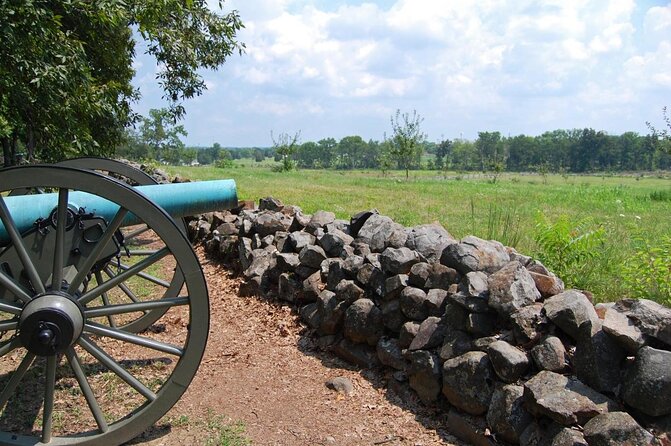
Gettysburg’s battlefield is spread across miles of roads, hills, farms, monuments, and cemetery grounds. You can walk some sections, but seeing the whole setting on foot would take far longer than most visitors have. This tour gives you the broad view from the car, then lets you get out when a place deserves more time.
The audio is designed to play as you approach each location. That means you are not constantly reading a screen or trying to match a monument to a printed map. The narration explains what happened, who fought there, and why the ground mattered.
I like the day-by-day structure. The first day begins at McPherson’s Ridge and the Railroad Cut, then the story moves into the desperate Union defense. Day Two takes you through Little Round Top, the Wheat Field, the Peach Orchard, and East Cemetery Hill. Day Three reaches Pickett’s Charge, the High Water Mark, the National Cemetery, and Lincoln’s Gettysburg Address.
That order gives you a useful framework before you tackle the smaller stories. Gettysburg has hundreds of monuments, and without some structure, the place can feel like a long parade of statues. Here, the monuments support the story rather than interrupt it.
More Self-Guided Audio Tours in the USA
- Gettysburg Battlefield Self-Guided Driving Audio Tour
★ 4.5 · 910 reviews - Joshua Tree National Park Self-Guided Driving Audio Tour
★ 4.5 · 762 reviews - Ultimate Acadia National Park Self-Guided Driving Audio Tour
★ 4.0 · 521 reviews
Starting at the Heritage Center or Visitor Center
You can begin at the Gettysburg Heritage Center on Steinwehr Avenue or at the Gettysburg National Military Park Museum and Visitor Center. The Heritage Center is a sensible first stop because its exhibits and film help explain what happened to the town and the surrounding farms.
The tour then joins the official Auto Tour route. Before setting off, download the Action Tour Guide app, enter the password sent by email or text, and select the tour that matches your starting point and direction. Do this at home or somewhere with a strong signal. The battlefield is not the place to discover that the audio files were never downloaded.
The Heritage Center is not simply a launch point. It gives you useful human context. Gettysburg was not an empty field waiting for armies. Families lived and farmed here, and the fighting damaged homes, animals, crops, roads, and the town itself.
McPherson’s Ridge and the first day of battle
At McPherson’s Ridge, the tour introduces the opening clash of July 1, 1863. Union and Confederate units moved into position here, and the rising ground helps you picture why commanders cared so much about roads, ridges, and lines of sight.
The Railroad Cut follows. This unusual setting became the site of a major first-day fight, and the audio uses it to explain battle plans and the decisions made by officers on both sides. The stop is short, but the setting rewards a pause if you want to look closely.
The nearby Oak Ridge Observation Tower offers a broader view. From above, you can connect the individual stops to the larger sweep of the battlefield. The tower is especially useful early in the tour, when the fighting can still seem like a collection of disconnected incidents.
At the 11th Pennsylvania Infantry Monument, listen for the story of Battlefield Sallie, the regiment’s dog mascot. The sculpted dog at the base is a small detail that is easy to miss when you are driving past. The narration also explains the role of drummers and military music, a good reminder that armies depended on more than rifles and generals.
Cemetery Ridge, the Eternal Light, and Day Two
The Eternal Light Peace Memorial marks the transition from the first day to the fighting that followed. Its materials carry a deliberate message: Maine granite and Alabama limestone represent the reunited country. You are not just hearing battlefield tactics here. You are also hearing how later generations tried to give meaning to the war.
The route then moves toward Day Two. From the Longstreet Observation Tower, you can look over ground associated with the fighting that made Gettysburg such a hard-fought contest. The optional detour to the Eisenhower National Historic Site adds a different chapter, linking the battlefield to President Dwight Eisenhower, who often stayed at the farm.
Warfield Ridge sets up the next action. Confederate troops prepared to attack while Union marksmen defended an important position. Then comes Little Round Top, one of the most important stops on the route.
Little Round Top is tied to a desperate Union defense on the second day. The road passes the hill and the Valley of Death, a name that tells you plenty about the violence of the fighting. At the time covered by the supplied tour information, Little Round Top had reopened, so you may be able to get out and explore it. Still, check current conditions before you go, since battlefield roads and access points can change.
Same sights, a different narrator:
- Los Angeles: Hop-On Hop-Off Bus Tour with Audio Guide
★ 3.7 · 2,030 reviews - City Sightseeing Hop-On Hop-Off Bus Tour with Audio Guide
★ 3.0 · 1,083 reviews - Medieval Torture Museum Ticket with Audio Guide and Ghost Hunting
★ 5.0 · 962 reviews - San Francisco: Alcatraz, Ferry & Audio Tour w/ Night Option
★ 4.4 · 617 reviews
The Wheat Field, Peach Orchard, and Devil’s Den
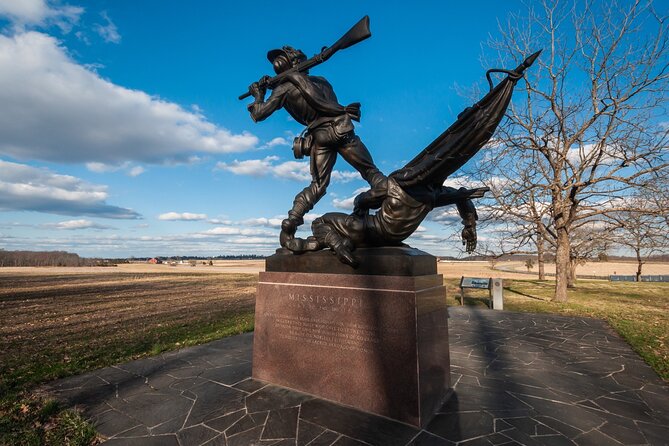
The North Carolina Memorial and Virginia Monument introduce the larger role of state monuments at Gettysburg. These memorials often honor units from a single state, giving the battlefield a strong personal and regional character.
At the Wheat Field, the audio returns you to one of Day Two’s major struggles. The open ground looks peaceful now, but the narration helps you understand how quickly a farm field could become a deadly tactical problem. A story about Union soldier JJ Purman adds a personal thread to the military action.
The Peach Orchard follows. Confederate and Union positions here shifted as commanders tried to make their plans work. You can stop at the monuments and viewpoints, then continue when you are ready. That freedom matters because some stops take only a few minutes, while others deserve a longer walk.
Devil’s Den offers a change of mood and terrain. Sharpshooters used the volcanic rocks for cover, firing on Union soldiers from protected positions. The rocks make the setting easier to understand than a flat map would. You can see how stone, elevation, and concealment shaped the fight.
The route continues to Plum Run and the George Weikert Farm. The farm became a battlefield hospital after the family fled, and the audio shifts from troop movements to military medicine and the effects of war on civilians. That shift is important. Gettysburg was not only about lines on a map. Homes and barns became medical stations, and families returned to scenes of destruction.
Pennsylvania’s monument and the end of Day Two
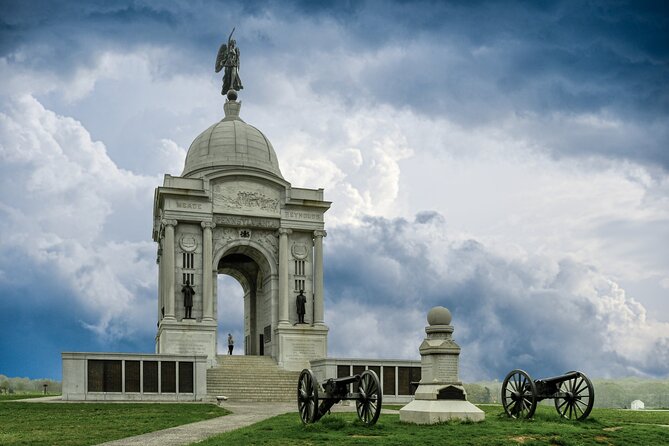
The Pennsylvania Memorial honors nearly 35,000 Pennsylvanian soldiers who fought at Gettysburg. The memorial has special force because many of these men were defending their own state. For you, it is also a useful place to pause and consider the scale of the battle beyond famous officers.
At the Abraham Trostle Farm, the story becomes even more domestic. The family left so quickly that dinner was still on the table. Details like this help you picture the sudden shock of combat better than numbers alone.
East Cemetery Hill brings Day Two toward its close. Confederate troops made a nighttime attempt to take ground near Culp’s Hill, bringing the Union close to a dangerous setback. The fight shows why Gettysburg was not decided by one famous charge. Small nighttime actions and stubborn defenses mattered just as much.
The route also includes Spangler’s Spring and Culp’s Hill. Culp’s Hill was vital to the Union position. If it fell, Cemetery Hill would be at serious risk. The Culp’s Hill Tower gives you a view over the surrounding woods, though admission to the tower is not included.
Pickett’s Charge and the High Water Mark
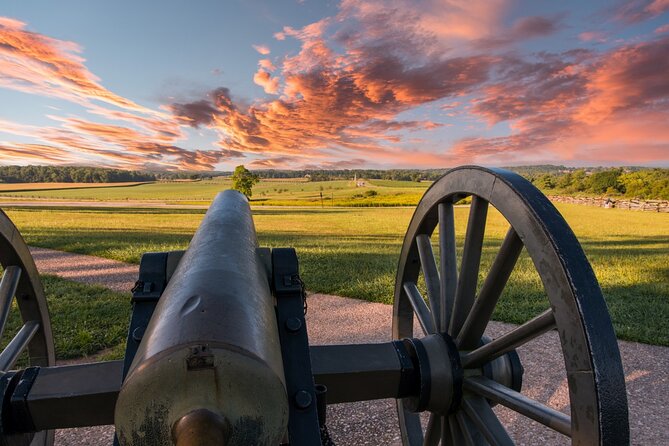
Day Three begins with the most famous movement at Gettysburg, Pickett’s Charge. From the appropriate viewpoint, you can look across the open ground Confederate troops had to cross toward Union defenses.
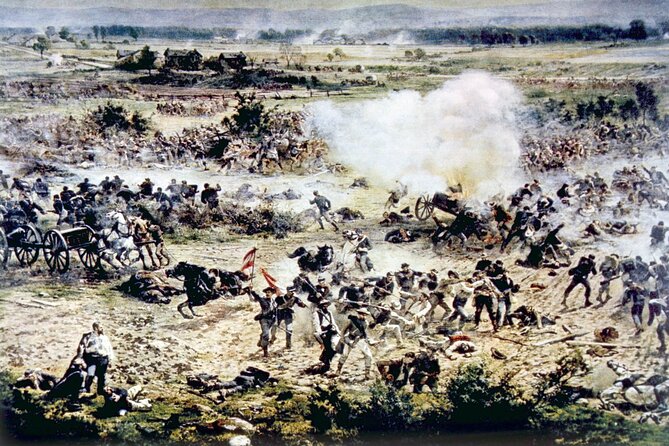
The audio explains the High Water Mark, the farthest point reached by Confederate forces during the charge. The phrase is useful because it connects this field to the wider war. Gettysburg was not the final battle of the Civil War, but the failed assault marked a major lost chance for a Confederate victory.
The High Water Mark of the Rebellion Monument helps you locate that point. Admission to some sites and structures along the route is not included, so plan to enjoy the outdoor stops without assuming that every building or tower is covered by the $29.99 purchase.
The National Cemetery follows. This is a quieter and more reflective part of the tour, and you should allow time to get out of the car. Lincoln’s Gettysburg Address was delivered here at the dedication of the Soldiers’ National Cemetery. The speech lasted only about four minutes, but its brevity was part of Lincoln’s intent. He wanted the focus to remain on the soldiers who had died.
The tour can end near the cemetery, though the supplied meeting information also identifies the 1st Delaware Infantry Monument on Hancock Avenue as an end point for one route. Follow the app’s selected version carefully, since the bundle contains different starting points and directions.
What the four-tour bundle adds
The main battlefield route is the heart of the experience, but the bundle gives you more than one pass through Gettysburg. The additional tours include Seminary Ridge, Devil’s Den, and ghost stories connected with the battlefield.
That makes the purchase more useful if you have a full day or a return visit. You can use one route in the morning, take a break, and return to another route later. You also receive lifetime access with no expiry date, so you can spread the material over more than one trip.
The bundle is not a private guide in the car. Nobody meets you at the start, and there is no live historian to answer questions. The benefit is control. You decide when to stop, what to replay, and how much walking you want to add.
Timing, price, and practical value

The price is $29.99 for up to four people. Split among four passengers, that is a modest cost for six to seven hours of material. Even for two people, it is often less expensive than paying separate admission for a guided vehicle tour, though the comparison depends on which attractions you add.
You should allow two to three hours for each 30-plus-mile route if you drive steadily. Add more time for museums, towers, monument walks, food, photography, and the Eisenhower detour. You can also complete the bundle across multiple days because the access does not expire.
The tour is especially useful for families, couples, and anyone who wants to avoid a fixed bus schedule. It also works well in hot weather because you can learn from an air-conditioned car and choose your outdoor stops. An older visitor or someone with limited stamina can see much of the battlefield without committing to long walks.
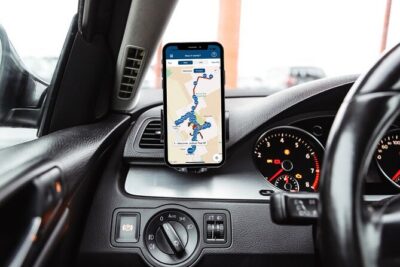
Download the app before arrival. Connect your phone with Bluetooth, USB, or AUX, and keep the phone’s GPS active. Apple CarPlay is compatible, while Android Auto support is still being developed. If you drive too quickly, the audio may reach the next location before the story is finished, so follow the suggested speed and replay anything you miss.
The app’s weak spots
The content is the strongest part of the experience, but the technology requires care. Some users have found the map unclear, with memorials easier to identify than major battlefield areas such as Cemetery Ridge or Culp’s Hill. At times, GPS tracking has placed the narration out of sequence or caused the app to jump ahead.
Road closures can also cause trouble. The tour has been updated for known closures, but conditions change. If the app sends you toward a blocked road, do not keep circling in frustration. Stop safely, check the route, and contact support if needed.
You may also encounter small presentation quirks. One audio segment uses an Irish accent for the Irish Brigade that some listeners find distracting. A few important figures, such as Joshua Chamberlain, may receive less attention than you expect. These are content preferences rather than reasons to reject the entire tour, but a live guide offers more room for questions and follow-up.
Should you book the Gettysburg audio bundle?
I would book it if you want a flexible, affordable way to see the battlefield in your own car. The strongest reasons are the clear day-by-day structure, the ability to stop whenever you wish, and lifetime access to several routes for one vehicle price.
I would not choose it if you need a live guide, flawless mapping, or guaranteed compatibility with Android Auto. Download the tour early, use a direct car connection, and treat the app as a helpful narrator rather than a perfect navigation system.
For a first visit, start at the Heritage Center or Visitor Center, begin a few hours before sunset if you want a dramatic finish at the cemetery, and keep the whole day open. Gettysburg rewards patience. This tour gives you the freedom to provide it.
FAQ
How much does the Gettysburg audio bundle cost?
The price is $29.99 per group of up to four people. You purchase access for the vehicle rather than paying separately for each passenger.
How long does the experience take?
The complete bundle takes about six to seven hours. Each individual tour is more than 30 miles and generally takes two to three hours, depending on stops and walking time.
How many tours are included?
The bundle includes four tours covering Gettysburg’s main battlefield and additional subjects, including Seminary Ridge, Devil’s Den, and battlefield ghost stories.
Can I use the tour more than once?
Yes. Access is lifetime and does not expire. You can use the tours on another trip and repeat them as often as you wish.
Does the tour work without cell service?
Yes, after you download the tour. You must download the app content while connected to strong Wi-Fi or cellular service, then it works offline.
Where can I begin?
You can start at the Gettysburg Heritage Center, 297 Steinwehr Avenue, or at the Gettysburg National Military Park Museum and Visitor Center. Select the app version that matches your chosen starting point and direction.
Is this a live guided tour?
No. It is a private, self-guided activity. Nobody meets you at the starting point. GPS-triggered audio begins as you reach the correct story locations.
Can I connect the audio to my car?
Yes. You can connect your phone to the car stereo with Bluetooth, USB, or AUX. Apple CarPlay is supported, while Android Auto support is still being developed.
Are admission tickets included?
No. Attraction passes, entry tickets, and reservations are not included. Outdoor battlefield stops are generally free, but admission to places such as the Culp’s Hill Tower is not included.
New audio tours around the USA
- Beaches, Bites and Bavaria in Leavenworth: A Self-Guided Audio Tour★ 3.5 · 3 reviews
- Welcome to Fabulous Las Vegas Sign Self-Guided Audio Tour★ 5.0 · 2 reviews
- Las Vegas Day Trips: 3-Day Self-Guided Audio Tour★ 5.0 · 2 reviews
- Hoover Dam and Lake Mead Self-Guided Audio Tour★ 5.0 · 3 reviews
- Driving Lake Tahoe: A Self-Guided Audio Tour From Tahoe City to Incline Village★ 5.0 · 10 reviews
- Las Vegas Neon and Secrets: Self-Guided Audio Tour★ 5.0 · 3 reviews
- Baton Rouge Historic Downtown Self-Guided Audio Walking Tour★ 4.0 · 19 reviews
- Ultimate La Jolla Self-Guided Driving & Walking Audio Tour Bundle★ 3.5 · 9 reviews
USA Audio Tours, compared.

Los Angeles: Hop-On Hop-Off Bus Tour with Audio Guide
Read our review →
City Sightseeing Hop-On Hop-Off Bus Tour with Audio Guide
Read our review →
Medieval Torture Museum Ticket with Audio Guide and Ghost Hunting
Read our review →

San Francisco: Alcatraz, Ferry & Audio Tour w/ Night Option
Read our review →
Ultimate Acadia National Park Self-Guided Driving Audio Tour
Read our review →
Browse the lists this tour appears in