
Review · BIG ISLAND
Hawaii Volcanoes National Park Self-Guided Driving Audio Tour
Kilauea is not a tidy, cone-shaped volcano. It is a broad, restless world of steaming ground, black lava, pit craters, old forests, and a road that runs all the way to the sea. This self-guided audio tour helps turn that long drive into a story, with more than 43 GPS-triggered stops over 24.5 miles.
I like the freedom to stop for a hike, skip a point, or pause the narration for photos. I also like the price: $16.99 covers a whole car of up to four people, not each passenger. The catch is setup. You must download the separate app and tour while you have strong service, and the route works best in its recommended direction rather than in reverse.
Key points to know before you go
- A full 24.5-mile route: Follow the road from the park entrance toward Holei Sea Arch, with more than 43 audio stories along the way.
- GPS-triggered narration: Stories begin as you reach each location, so you can keep your eyes on the road.
- Best value for families and small groups: One $16.99 purchase covers up to four people in one vehicle.
- Strongest stops: Kilauea Iki, Thurston Lava Tube, Pu‘u Loa Petroglyphs, and Holei Sea Arch give the drive its variety.
- Plan the app before arrival: Download the Action Tour Guide app, enter your password, and load the route on Wi-Fi or strong cellular service.
- A flexible, one-way experience: You can pause, repeat, skip, or take a short side trip, but the tour is designed for the entrance-to-sea direction.
What the $16.99 Hawaii Volcanoes tour actually gives you
This is not a bus ride, walking tour, or live guide waiting at the gate. You drive your own car, and the Action Tour Guide app supplies the narration through your phone and vehicle speakers. The audio plays automatically as GPS recognizes each point.
That format matters at Hawaii Volcanoes National Park. The road covers a large area, cell service may be weak, and the most interesting places are spread out. You can stop for a trail, sit quietly at an overlook, or continue driving without keeping up with a group.
At $16.99 per group, the math is favorable. A family of four pays about $4.25 per person, and a couple pays less than the cost of many guided excursions. You still pay the park entrance fee separately, and the tour does not include attraction passes, reservations, or other admission costs.
The audio is offered in English. It is designed to be informative without requiring you to read from a screen while driving. You can connect your phone to the car by Bluetooth, USB, or AUX. Apple CarPlay is supported for audio playback, while Android Auto support is still being added.
The usual drive takes about two to three hours, though a fuller visit can take three to four hours if you stop for walks and photos. You should not race through it. One useful tip is to stay near the posted speed limit so the stories have time to finish before the next point.
More Self-Guided Audio Tours in the USA
- Gettysburg Battlefield Self-Guided Driving Audio Tour
★ 4.5 · 910 reviews - Joshua Tree National Park Self-Guided Driving Audio Tour
★ 4.5 · 762 reviews - Ultimate Acadia National Park Self-Guided Driving Audio Tour
★ 4.0 · 521 reviews
Start at the entrance and get the app working first

Your starting point is the park’s Entrance Station near Volcano, Hawaii. No one meets you there. This is a private activity for your own group, so you need to arrive with the app ready and begin the first story yourself.
After booking, look for setup instructions and a password in your email and text messages. Search for audio tour if the message is hard to find. Then download the separate Action Tour Guide app, enter the password, and download the Hawaii Volcanoes route while you have strong Wi-Fi or cellular service.
Do this before reaching the park. A weak signal at the entrance is exactly the wrong time to troubleshoot an app. One person should handle the phone before the car moves, while another person drives.
The route can track your position if you make a small detour or visit a stop out of order. Still, the clearest experience comes from following the recommended route from the entrance toward the coast. The audio may not work as naturally in reverse, and the tour was not designed around a return trip.
You can use the tour on different days and return to it later. It has lifetime access with no expiry, so you are not forced to finish every stop in one afternoon.
Kilauea Military Camp and the park’s difficult past
The first named stop is Kilauea Military Camp, now a recreation facility for soldiers. The audio adds an important reminder that this place was not always about leisure.
During World War II, the site served as an internment camp for prisoners of war and Japanese citizens who had not committed crimes. That detail gives the early part of the drive a human story before the route turns toward volcanic features.
You can spend about ten minutes here, and there is no separate admission charge for the stop. It is a useful beginning because the park is not only about lava. Its land carries military, cultural, environmental, and geological stories at the same time.
Steam Vents and Sulphur Banks smell of the volcano
At Steam Vents, groundwater trapped below the surface is heated by Kilauea. That hot water rises as steam, giving you a visible sign of heat and activity below your feet.
The stop takes about ten minutes and is free after entering the park. Pay attention to the narration here because it explains a process that can be easy to miss when you simply see white vapor drifting from the ground.
Nearby, the short Sulphur Banks Trail offers an easy way to see more volcanic activity. The name is honest. The air can smell strongly of sulfur, so this is not a sweet-smelling stroll. That odor is part of the point: the ground is releasing volcanic gases, and your nose gets a more direct lesson than any photograph can provide.
More Driving Audio Tours in the USA:
- Ultimate Lake Tahoe Self-Guided Driving Audio Tour
★ 4.5 · 435 reviews - Scenic Newport, RI Self-Guided Driving Audio Tour
★ 4.5 · 325 reviews - Arches National Park Self-Guided Driving Audio Tour
★ 4.5 · 288 reviews - Kauai Adventure Bundle: 4 Epic Audio Driving Tours
★ 4.5 · 211 reviews
Kilauea Overlook gives you the first big view

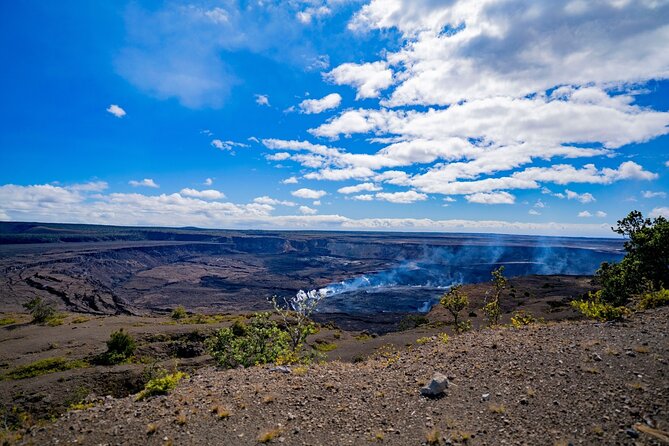
Kilauea Overlook is one of the route’s key pauses. The crater may not look like the classic pointed volcano from a schoolbook, but Kilauea is among the most active volcanoes in the world.
The audio helps explain what you are seeing instead of leaving you with a broad view and no context. Give yourself time here for the scale. The crater is not a quick roadside curiosity, and changing conditions can affect what is open or visible.
The tour’s narration is especially useful at viewpoints because it gives you something to listen to while you study the scene. You can repeat a story if road noise or a distracted passenger causes you to miss part of it.
Kilauea Iki and Thurston Lava Tube bring you closer
The Kilauea Iki Trailhead is one of the places where the tour and a short park visit can easily become a longer outing. The trail forms a 3.3-mile loop through Kilauea Iki Crater and takes about three hours, with elevation changes that can feel strenuous.
You do not need to hike the full loop to use the audio tour. The stop itself takes about ten minutes, so you can mark it for a later walk or simply learn what makes the crater special before continuing. If you do hike, allow extra time beyond the advertised two to three hours.
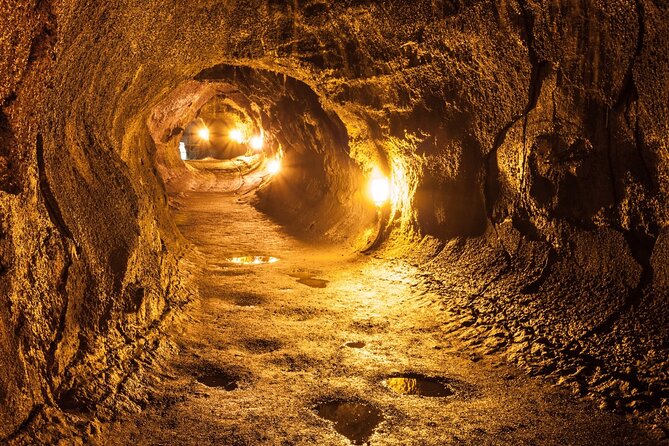
Next comes Nahuku, better known as Thurston Lava Tube. This cave formed when molten lava flowed through the area. The outside cooled and hardened while lava continued moving inside, leaving a tunnel that can be explored today.
This is one of the route’s most satisfying changes of pace. You move from open crater views into a formed lava passage, and the story explains how the cave came to exist. Conditions and access can change in a national park, so check the latest park information before setting out.
Luamanu, Puhimau, and Pauahi show three faces of volcanic change
Luamanu Crater once held dense forest, but that forest disappeared in a single day. The stop is a reminder that volcanic change can be sudden rather than gradual.
Puhimau Crater offers another look at volcanic formations. The audio gives the feature a place in the wider story of Kilauea, helping you understand that this road is not passing one volcano feature after another by accident. It is following a long record of eruptions and ground movement.
Pauahi Crater is a steep-sided pit crater about 330 feet deep and 1,000 feet across. Look for lava spatter deposits and fumaroles, where steam and gases escape.
These three stops are not all dramatic in the same way. Some are best appreciated with the explanation playing in your car, since the meaning of a crater can be hard to grasp from a quick glance. Plan about ten minutes for each audio stop, but do not feel pressured to linger if the view is not your priority.
Cinder cones and living islands at Pu‘u Huluhulu and Kipuka Puaulu
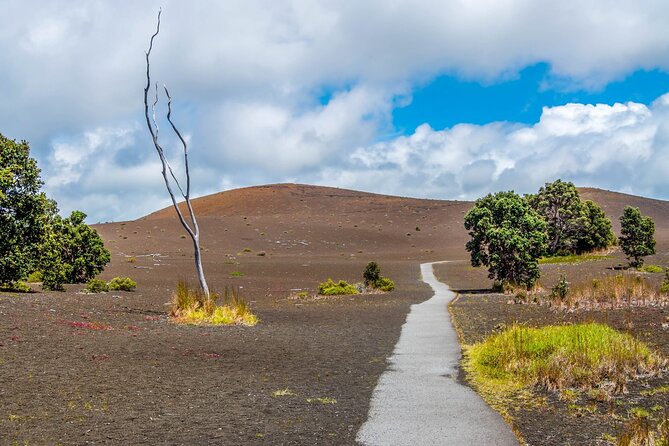
Pu‘u Huluhulu is a cinder cone, similar to Pu‘upua‘i. Its name means hairy hill, a reference to the low shrubs that cover it and give it a fuzzy look from a distance.
The stop adds texture to the drive. Not every volcanic feature is a smoking vent or a massive crater. Some are small cones shaped by loose volcanic material and later covered by plants.
Kipuka Puaulu Trail explains how life can survive inside a lava field. A kipuka forms when lava flows around an older patch of vegetation, leaving an island of living plants surrounded by newer, harsher ground.
This is a good place to slow down mentally. The park is not just a record of destruction. Older soil, moisture, and plant life can remain in pockets, creating a different environment from the surrounding lava. If you want to walk, allow more time than the basic audio route requires.
Mauna Ulu and Pu‘u Loa reveal lava and culture
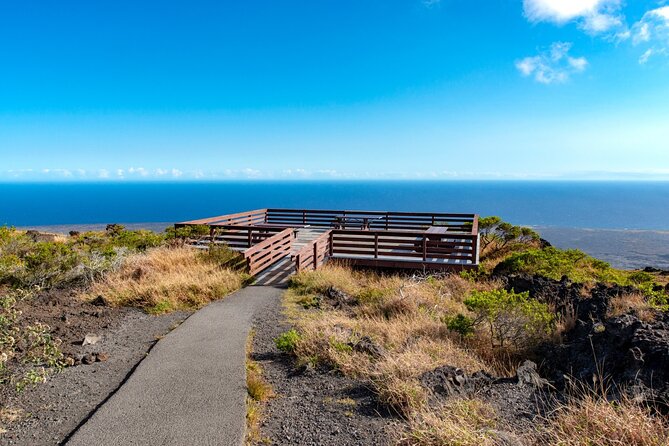
At Mauna Ulu Lookout, a raised platform gives you broad views of the Mauna Ulu lava flow. Much of the flow looks flat and gray, but the narration encourages you to search for toadstool-shaped formations.
That small instruction is useful. A wide field of hardened lava can look repetitive until you know what shape or detail to seek. The audio gives your eyes a task rather than simply naming the viewpoint.
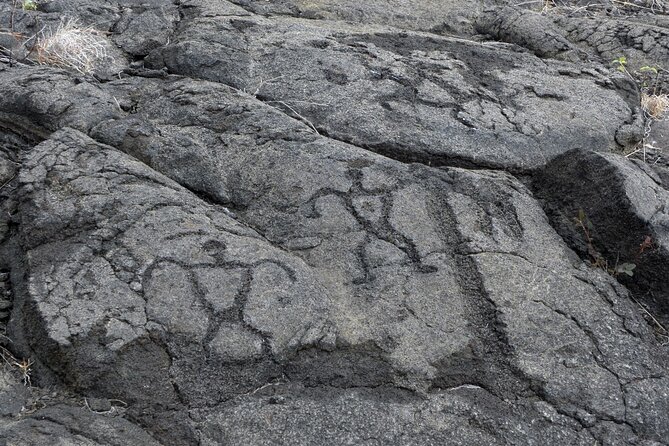
Pu‘u Loa Petroglyphs shifts the focus from geology to Hawaiian culture. More than 23,000 ancient petroglyphs are etched into hardened lava here.
Treat this as a place for careful attention. The marks are not decoration placed for modern viewing. They are an important historic and cultural record, so stay on designated paths and follow park guidance around the rock surface.
The pairing of Mauna Ulu and Pu‘u Loa is one of the tour’s strengths. In a short stretch, you move from the physical shape of a lava flow to the human stories carved into it.
Holei Sea Arch is the rewarding final stretch
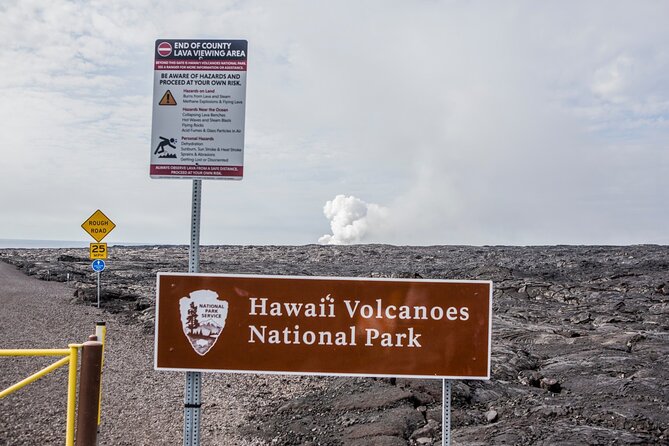
The route ends at Holei Sea Arch on Chain of Craters Road, near the coast. The arch is a natural opening in a sea cliff, shaped by the force of the ocean.
You should make an effort to reach this final stop if road and park conditions allow. The drive gives the tour a real sense of progression, from the upper park’s steam and craters down toward the sea. It also keeps the experience from feeling like a collection of disconnected roadside points.
The sea arch is a natural feature, so its condition and access can change. Check official park updates before your visit, especially if weather, volcanic activity, tsunami warnings, or government operations affect the road.
Volcano Art Center Gallery adds a human finish
Near the Visitor Center, look for the separate Volcano Art Center Gallery. It is a modest stop, but it gives you a chance to see work connected to Hawaii rather than spending the entire visit looking only at rock and steam.
The gallery suits you best if you enjoy fine art and want a quieter break. It is not essential to the driving route, and you can skip it if your time is short. Still, it helps round out the park experience with a creative response to the island.
How the narration and GPS work on the road
The app’s main advantage is timing. Once you reach a story point, the narration begins automatically, so you do not need to keep tapping the phone while driving.
You can pause the tour for food, photos, a trail, or a longer look at a crater. You can replay a story if it ended before you were ready, and you can skip content that does not interest you. A short hike does not necessarily ruin the route, since GPS can help you catch up when you return to the road.
The main weakness is that the experience depends on preparation. The app is separate from the booking platform, and a first-time user may find the setup less obvious than expected. Read the instructions before leaving your hotel, download the route fully, and test the audio connection with the car parked.
A passenger should handle navigation when possible. The tour is hands-free once working, but you should not be searching through email or app menus while driving.
Who should book this Hawaii Volcanoes tour
I would choose this tour if you have a rental car, want background information without a fixed group schedule, and prefer spending $16.99 per vehicle instead of paying per person for a guided outing.
It is especially useful for families, couples, and anyone with only one afternoon. You can focus on the main stops, then return another day because access does not expire. It also works well if you are planning your own hikes and want narration between them.
I would be more cautious if you dislike phone setup, have no reliable way to download the route before arrival, or want a live guide who can answer questions in the moment. The route also suits a forward drive better than a casual back-and-forth exploration.
The park entrance fee is extra, and official conditions matter. Check the national park website for closures, road access, volcanic updates, tsunami information, and operating changes before you go. Cancellation is free up to 24 hours before the experience start time. Inside 24 hours, the payment is not refunded.
Should you book it?
Book it if you want value, control, and useful context while driving. The strongest parts are the GPS-triggered stories, the low per-car price, the freedom to stop, and the range of sights from steam vents to petroglyphs and Holei Sea Arch.
Prepare the app before you reach the park, follow the recommended direction, and allow extra time for Kilauea Iki, Kipuka Puaulu, or any other walk. If you do that, this is a practical way to make a long volcanic road feel organized without turning your visit into a scheduled group tour.
FAQ
How much does the Hawaii Volcanoes National Park audio tour cost?
The tour costs $16.99 per group of up to four people. The national park entrance fee is separate and is not included.
How long does the tour take?
The driving route is about 24.5 miles and usually takes two to three hours. If you add hikes, longer photo stops, or side excursions, plan on three to four hours or more.
Where does the tour start?
It starts at the Entrance Station in Volcano, Hawaii. No guide meets you there because this is a self-guided activity.
Where does the tour end?
The listed end point is Holei Sea Arch on Chain of Craters Road, near Pāhoa, Hawaii.
What language is the narration offered in?
The tour is offered in English.
Do I need cellular service during the tour?
You need strong Wi-Fi or cellular service to download the app and tour before starting. After downloading, the tour works offline.
How do I access the audio tour?
Download the separate Action Tour Guide app, enter the password sent by email and text, and open the tour after arriving at the starting point. The stories begin automatically when you reach their GPS points.
Can I pause or use the tour on another day?
Yes. You can pause the experience, take breaks, skip stops, and use the tour on different days. The tour has lifetime access with no expiry.
Can I cancel for a refund?
You can receive a full refund if you cancel at least 24 hours before the experience start time. Cancellations or changes made less than 24 hours before the start time are not refunded or accepted.
More National Park Audio Tours in the USA
- Self-Guided GPS Audio E-Bike Tour Hawaii Volcanoes National Park
★ 4.5 · 131 reviews - Shenandoah National Park Self-Guided Driving Audio Tour
★ 4.5 · 109 reviews - Self-Guided Audio Driving Tour in Mesa Verde National Park
★ 4.5 · 86 reviews - Bryce Canyon National Park Self-Guided Driving Audio Tour
★ 4.5 · 71 reviews
New audio tours around the USA
- Beaches, Bites and Bavaria in Leavenworth: A Self-Guided Audio Tour★ 3.5 · 3 reviews
- Welcome to Fabulous Las Vegas Sign Self-Guided Audio Tour★ 5.0 · 2 reviews
- Hoover Dam and Lake Mead Self-Guided Audio Tour★ 5.0 · 3 reviews
- Las Vegas Day Trips: 3-Day Self-Guided Audio Tour★ 5.0 · 2 reviews
- Driving Lake Tahoe: A Self-Guided Audio Tour From Tahoe City to Incline Village★ 5.0 · 10 reviews
- Las Vegas Neon and Secrets: Self-Guided Audio Tour★ 5.0 · 3 reviews
- Baton Rouge Historic Downtown Self-Guided Audio Walking Tour★ 4.0 · 19 reviews
- Ultimate La Jolla Self-Guided Driving & Walking Audio Tour Bundle★ 3.5 · 9 reviews
Big Island Audio Tours, compared.


Self-Guided GPS Audio E-Bike Tour Hawaii Volcanoes National Park
Read our review →
Big Island North Island Jungle Adventure – Self-Guided Audio Tour
Read our review →

Browse the lists this tour appears in