
Review · USA
Self-Guided Audio Driving Tour in Death Valley National Park
Death Valley is a place where the road itself becomes the attraction. This self-guided audio tour leads you through salt flats, red rock, colorful mineral hills, high overlooks, sand dunes, and volcanic craters, with GPS-triggered stories playing as you drive. You can spend eight hours on the main sights or stretch the experience to 16 hours with longer side trips.
I like the freedom to set your own pace, and I like the value: one $19.99 purchase covers a whole vehicle of up to eight people. The main drawback is that you must manage your own driving, timing, fuel, water, and road decisions in a huge park with limited service.
Key points to know
- GPS-based commentary: Stories, directions, and tips begin automatically as you reach more than 220 points along the route.
- Excellent group value: One purchase covers everyone in your vehicle, up to eight people.
- Major sights included: Badwater, Zabriskie Point, Artist’s Palette, Dante’s View, Mesquite Flat Sand Dunes, and more are covered.
- Flexible timing: Start anywhere along the route, pause the audio, and return to it later without an expiry date.
- Offline operation: Download the tour before entering the park, since cell service cannot be relied on.
- Northern route warning: Ubehebe Crater requires a long side trip, and the road beyond it calls for a suitable 4×4 vehicle.
A self-guided way to understand Death Valley
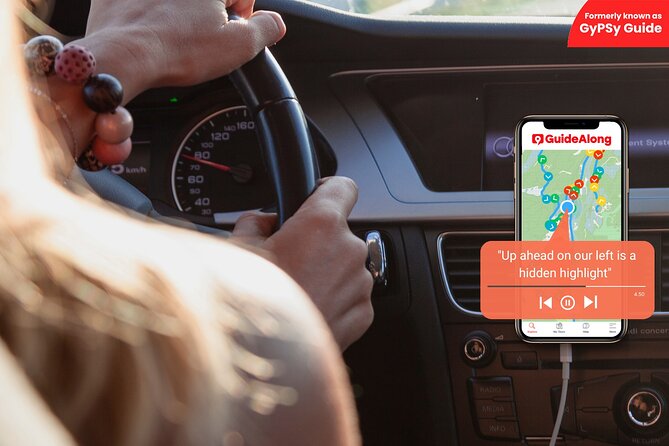
Death Valley National Park rewards a slow, curious drive. The distances are large, the scenery changes sharply, and the most useful context often arrives while you are between viewpoints. GuideAlong, also known as GyPSy Guide, fills that gap with location-based audio that plays through your phone.
You are not tied to a guide, a vehicle, or a fixed departure time. The app suggests routes, but you can change them to suit your interests. If you want to linger at Badwater, skip a side road, or return to a viewpoint later in the day, you can do so.
That freedom matters here. A short visit can focus on the central sights. A longer day can include Dante’s View, Father Crowley Vista Point, Mesquite Flat Sand Dunes, and perhaps the remote northern section. The stated duration is about eight to 16 hours, which gives you a useful sense of scale. Death Valley is not a compact park where every stop sits five minutes apart.
The audio is designed for drivers, not for a walking tour. It provides stories, directions, and practical advice as your phone’s GPS detects your location. One user who usually chooses in-person guides found the commentary and tips useful, especially because the pace remained fully flexible. That is the central strength of this experience.
More Self-Guided Audio Tours in the USA
- Gettysburg Battlefield Self-Guided Driving Audio Tour
★ 4.5 · 910 reviews - Joshua Tree National Park Self-Guided Driving Audio Tour
★ 4.5 · 762 reviews - Ultimate Acadia National Park Self-Guided Driving Audio Tour
★ 4.0 · 521 reviews
What the $19.99 price really gets you
At $19.99 per group, this is one of the more economical ways to add context to a national park drive. The purchase covers up to eight people in one vehicle, not one person at a time. A full carload pays very little per person, while a solo driver still gets a private audio guide for less than the cost of many organized excursions.
You also receive access without an expiry date. You can use it on a different day if your plans shift, and free updates are included. That is handy in Death Valley, where heat, road conditions, and personal energy can change your plans.
The national park entrance cost is separate. An optional park pass is listed at $30 per vehicle, with the final amount depending on the length of your stay, ages, and group size. Check the current fee before you go.
The value is strongest if you want interpretation but dislike being rushed. It is less suitable if you want a human guide handling every turn, coordinating stops, and answering questions in real time.
Start with the full park drive, not just one viewpoint
The main Death Valley route can fill a full day, and the audio works best when you allow room for stops. The app lets you preview the suggested route and start points before setting off. Since you can begin anywhere along the route, your entry point does not have to match another person’s schedule.
Death Valley is the hottest, driest, and lowest national park in the United States. It is also the largest national park in the contiguous country. Those facts are more meaningful once you see how the basin, mountains, salt flats, and high viewpoints fit together.
The tour’s 220-plus audio points are useful because the park changes constantly. You may hear commentary about a formation as you approach it, then continue with directions and background while driving toward the next stop. Download everything first over Wi-Fi or cellular data. Once the tour is stored in the app, no internet or cell signal is required.
Bring a USB or car charger. You will be using your phone’s GPS and audio for much of the day, and a long park drive is not the place to discover that your battery is low.
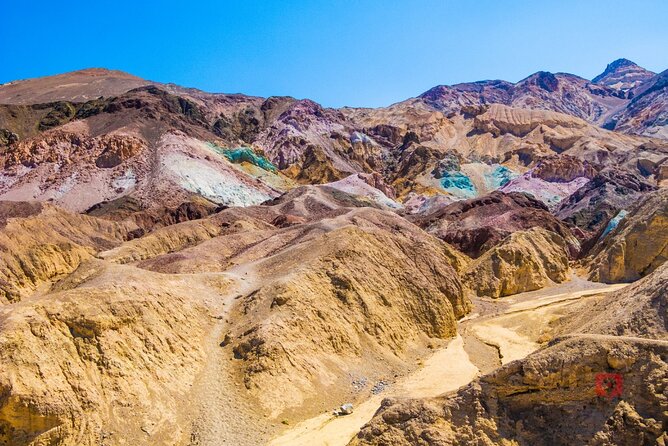
Artist’s Palette turns a short road into a color show
Artist’s Drive is a narrow, one-way detour off Badwater Road. It twists between low hills in a series of sharp bends, giving the road a roller coaster feel without the speed. The drive is about the changing rock colors, not just the final pullout.
At Artist’s Palette, mineral deposits create shades of coppery green, terra-cotta yellow, brick red, and pink. The colors are most concentrated in this section, so it is a natural place to stop for photos.
Plan about 30 minutes here, though your timing can change if you want to walk or wait for a different angle of light. The road is one-way, and its narrow shape means you should follow posted conditions and drive carefully.
This is a good example of where audio commentary adds value. Without context, you see striking colored hills. With explanation, you understand that the colors come from different mineral deposits and that the road is part of the geological story of the park.
More Driving Audio Tours in the USA:
- Ultimate Lake Tahoe Self-Guided Driving Audio Tour
★ 4.5 · 435 reviews - Scenic Newport, RI Self-Guided Driving Audio Tour
★ 4.5 · 325 reviews - Arches National Park Self-Guided Driving Audio Tour
★ 4.5 · 288 reviews - Kauai Adventure Bundle: 4 Epic Audio Driving Tours
★ 4.5 · 211 reviews
Badwater puts the lowest point within reach
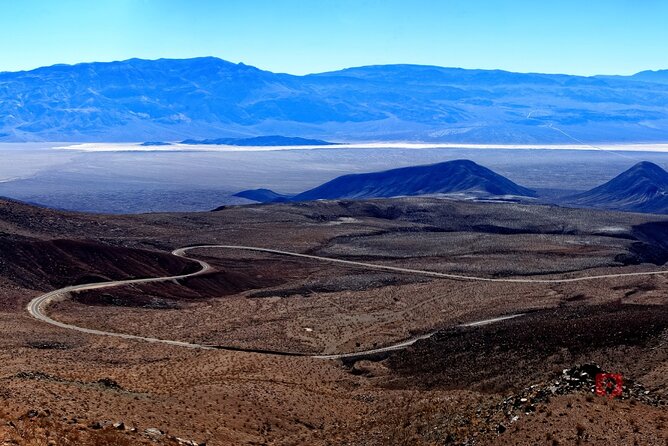
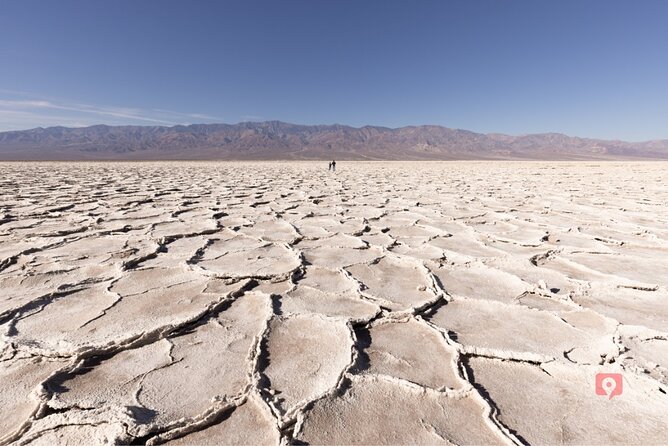
Badwater is the classic Death Valley stop. At 282 feet below sea level, it is the lowest point in North America. The roadside basin includes a small pool of undrinkable water, while the broader salt flat spreads out in pale, patterned shapes.
The scene can change after rare rain. More water may collect across the basin for a short time, but the heat soon returns it to dry salt flats. That contrast helps explain why Death Valley feels so extreme. Water can appear, vanish, and leave a hard mineral surface behind.
Give yourself around 30 minutes. You can look across the basin, take photos, and listen to the commentary before continuing. This is not a stop to rush through, but it is also one of many major sights on the same day.
The key practical point is heat. Carry water and protect yourself from the sun. The park’s distances can make a small delay matter later, so keep an eye on the clock if you also plan Dante’s View or the dunes.
Dante’s View shows the park from 5,000 feet
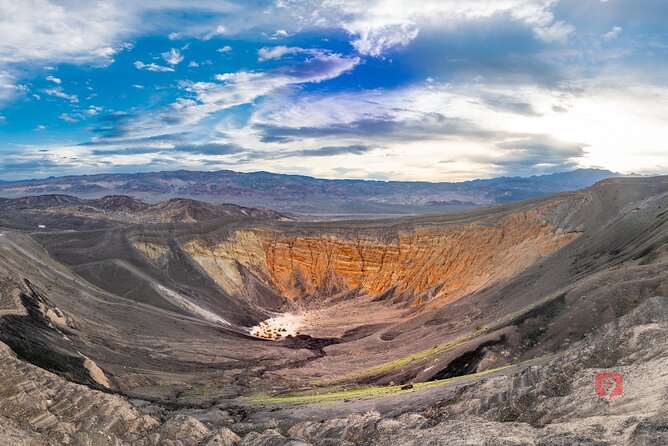
Dante’s View is a 13-mile side trip from the Death Valley Junction approach. The viewpoint sits just above 5,000 feet, creating a dramatic change from the basin below.
From here, you can look down toward Badwater, then across toward the Panamint Mountains, whose highest point rises above 11,000 feet. On a clear day, Mount Whitney may be visible in the distance. At 14,505 feet, it is the highest point in the Lower 48.
Allow about 20 minutes at the viewpoint, plus the driving time to reach it. That extra time is well spent if you want a sense of the park’s scale. Badwater makes more sense when you see it from above, and the elevation shift is part of the story.
Weather and visibility will affect the view. The tour can guide you to the turnoff and explain what you are seeing, but it cannot guarantee clear skies. If the mountains disappear in haze, the viewpoint still gives you a powerful sense of the basin’s depth.
Devil’s Golf Course makes salt look alive
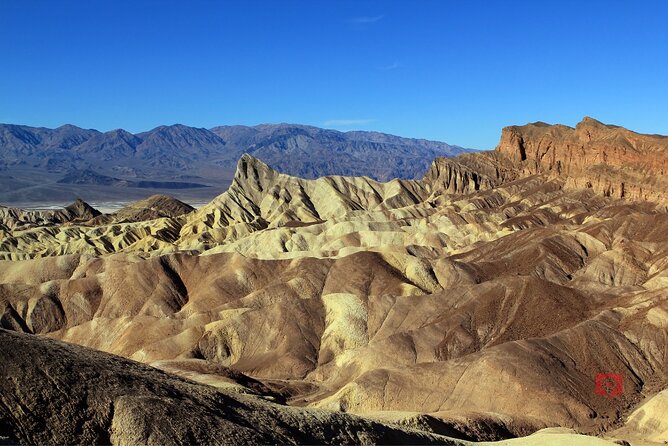
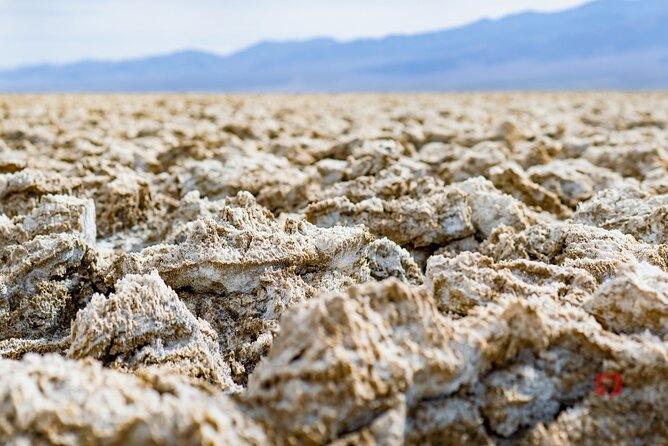
Devil’s Golf Course is a broad field of large salt crystals. Temperature changes cause the crystals to expand and shrink, giving the surface a rough, irregular shape.
The name fits the setting. It is not a manicured place for a game, but a harsh expanse that looks as if it has been carved into jagged lumps. If you listen carefully, you might hear the crystals popping as they respond to heat.
Plan about 30 minutes. The stop is close enough to combine with Badwater and Artist’s Palette during a central park day. It also provides a different view of salt than the flatter surface at Badwater.
Stay aware of where you walk. The surface is uneven, and the heat can be intense. The audio commentary helps turn what might look like a strange patch of ground into a memorable geological stop.
Zabriskie Point is the easy classic
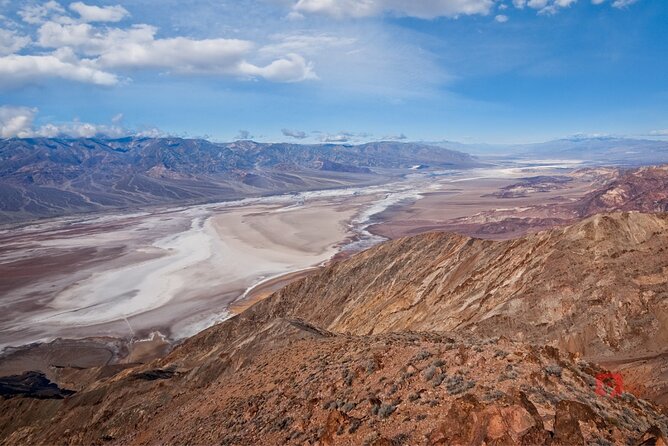
Zabriskie Point is one of Death Valley’s best-known viewpoints, and it earns the attention. From the easy overlook, you can see badlands shaped into folds, ridges, and changing bands of color.
Light matters here. The contours and colors shift as the sun moves, so a morning view will not look exactly like an afternoon view. The tour suggests about 30 minutes, but you can stay longer if you want photos or a short walk.
Hikers can also use the area as a starting point for longer walks, including a 3.5-mile route to Golden Canyon. The audio tour does not turn this into a guided hike, so you will need to manage your own walking plans and timing.
Zabriskie Point is especially useful for a first visit because it gives you a quick, accessible view of the park’s eroded hills. You do not need a long hike to see a memorable section of Death Valley.
Father Crowley Vista Point gives you a western farewell
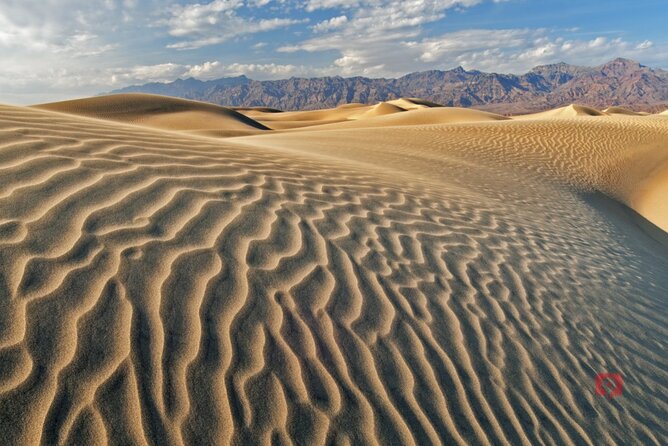
Father Crowley Vista Point is on the western side of the park and offers a broad view across Death Valley. It works well as an opening stop if you enter from the west, or as a final look before leaving.
You can also see Rainbow Canyon to the north, with striking red volcanic rockfields. The viewpoint is named for Father Crowley, an Irish Catholic priest known as the Padre of the Desert, who served communities in Inyo County during the first half of the twentieth century.
Plan about 30 minutes. The view is wide and open, so it benefits from a little time rather than a quick photo stop. The audio adds human context to the place name and helps you connect the overlook with the surrounding desert communities.
This is one of the tour’s best stops for getting your bearings. Death Valley can feel like a series of separate attractions when you drive through it. From Father Crowley, the scale and changing rock colors tie those pieces together.
Mesquite Flat Sand Dunes require good judgment
Mesquite Flat Sand Dunes provide the desert image many people expect: rolling sand with no plant cover, reshaped by the wind. The dunes are easy to recognize and photograph, but they are not effortless to explore.
The tour allows about an hour here. You can walk out across the sand, but distance is deceptive. A dune that looks close may take longer to reach than expected, and the sand can become scorching hot. Carry ample water, especially on a hot day, and avoid wandering farther than you can comfortably return.
This is a stop where the self-guided format works well. You can decide how much energy to spend instead of following a group’s fixed schedule. Just remember that flexibility also means you must make the safety call yourself.
Ubehebe Crater is a major northern detour
Ubehebe Crater is the most demanding stop in the suggested route. It lies in the remote northern corner of the park, and reaching it requires roughly an hour or more on an unpaved road. The audio will point you in the right direction, but commentary does not continue the entire way.
The crater is the largest of about a dozen nearby craters. They formed through explosive events when underground water met hot magma. The result is a broad volcanic feature that feels far removed from the salt flats and badlands farther south.
Allow about two hours for this stop, including the approach, and do not treat it as a quick add-on. Road status matters. Going farther toward Racetrack Playa requires a strong commitment and a suitable 4×4 vehicle. Racetrack Playa is known for large boulders that can move across the salt surface, but the road conditions make it a separate undertaking.
Scotty’s Castle is also in this general northern section. It is a remote ranch, and you should check current road status and any pre-booking requirement before trying to visit. This is the point where a flexible audio tour cannot replace local planning.
How to use the app without losing the day
After booking, you receive instructions by email and text. Search for the message that says Download Audio Tour, sign in with your preferred Apple or Google account, and redeem the voucher code before you arrive.
Then download the free GuideAlong app and sign in with the same account. Download the Death Valley tour under My Tours while you have Wi-Fi or reliable data. Open it before leaving to preview the route, start points, and trip-planning tools.
The commentary starts automatically through your phone’s GPS. You do not need to keep tapping the screen as you drive, which helps you keep your attention on the road. You can also pause, stop, and resume the tour as your day changes.
The support team is available by toll-free phone, online chat, and email. That is useful if the voucher, app, or download causes trouble before you enter an area with weak service.
Who should book this Death Valley audio tour?
I would choose this for a small group arriving by car, especially if you want useful information without paying for a private guide. Families and friends benefit from the single vehicle price, and independent drivers will appreciate the ability to skip, repeat, or extend stops.
It also suits first-time visitors who want a suggested structure but do not want a strict timetable. The audio gives you direction without taking control of the day.
I would think twice if you prefer a guide who can answer questions on the spot or handle every practical decision. I would also avoid trying to squeeze every stop into a short visit. Ubehebe Crater alone can change the shape of your day, and the park’s heat can make ambitious plans tiring.
Should you book it?
Book it if you want a low-cost, private audio guide that works offline and covers the major Death Valley sights. The best reasons are the GPS-triggered commentary, the 220-plus points, the no-expiry access, and the strong group value at $19.99.
Skip it if you want a fully hosted tour or do not want to plan around water, charging, road conditions, and long distances. For an independent park day, though, this is a practical way to add background and direction while keeping the freedom that makes Death Valley special.
Cancellation is free with a full refund when you cancel at least 24 hours before the experience start time. Changes or cancellations within 24 hours are not refunded.
FAQ
How much does the self-guided Death Valley audio tour cost?
The tour costs $19.99 per group, covering up to eight people in one vehicle. Any national park entrance pass or fee is separate.
How long does the Death Valley driving tour take?
The suggested experience takes about eight to 16 hours, depending on which stops and side trips you choose.
Does the tour require cell service?
No. Download the tour to the GuideAlong app before setting out, and the audio works offline using your phone’s GPS.
Where can I start and end the tour?
You can start and end anywhere along the tour route. Commentary plays automatically based on your location, so you are not limited to one fixed meeting point.
Is the tour available in languages other than English?
No. The experience is offered in English.
What should I know before visiting Ubehebe Crater?
Ubehebe Crater requires a long side trip, including about an hour or more on an unpaved road. The audio does not provide commentary for the entire approach. Check road conditions before going, and a suitable 4×4 vehicle is needed to continue toward Racetrack Playa.
More National Park Audio Tours in the USA
- Self-Guided GPS Audio E-Bike Tour Hawaii Volcanoes National Park
★ 4.5 · 131 reviews - Shenandoah National Park Self-Guided Driving Audio Tour
★ 4.5 · 109 reviews - Self-Guided Audio Driving Tour in Mesa Verde National Park
★ 4.5 · 86 reviews - Bryce Canyon National Park Self-Guided Driving Audio Tour
★ 4.5 · 71 reviews
New audio tours around the USA
- Beaches, Bites and Bavaria in Leavenworth: A Self-Guided Audio Tour★ 3.5 · 3 reviews
- Welcome to Fabulous Las Vegas Sign Self-Guided Audio Tour★ 5.0 · 2 reviews
- Las Vegas Day Trips: 3-Day Self-Guided Audio Tour★ 5.0 · 2 reviews
- Hoover Dam and Lake Mead Self-Guided Audio Tour★ 5.0 · 3 reviews
- Driving Lake Tahoe: A Self-Guided Audio Tour From Tahoe City to Incline Village★ 5.0 · 10 reviews
- Las Vegas Neon and Secrets: Self-Guided Audio Tour★ 5.0 · 3 reviews
- Baton Rouge Historic Downtown Self-Guided Audio Walking Tour★ 4.0 · 19 reviews
- Ultimate La Jolla Self-Guided Driving & Walking Audio Tour Bundle★ 3.5 · 9 reviews
USA Audio Tours, compared.

Los Angeles: Hop-On Hop-Off Bus Tour with Audio Guide
Read our review →
City Sightseeing Hop-On Hop-Off Bus Tour with Audio Guide
Read our review →
Medieval Torture Museum Ticket with Audio Guide and Ghost Hunting
Read our review →

San Francisco: Alcatraz, Ferry & Audio Tour w/ Night Option
Read our review →
Ultimate Acadia National Park Self-Guided Driving Audio Tour
Read our review →
Browse the lists this tour appears in