

Review · GERMANY
Trier: City Walk with Audio Guide in 7 Languages on your Phone
Trier’s best feature is its freedom. This 5.5-kilometer self-guided walk links Roman monuments, medieval streets, grand churches, and Karl Marx’s birthplace without tying you to a guide or fixed departure time. The app adds 27 stories, legends, and fun facts as you move through town.
I like the chance to set your own pace and the generous time window. You can finish in two or three hours, or pause for coffee, a museum, or bad weather and continue until the end of the next day. The low price is another plus, especially for couples, families, or small groups.
The main caution is the technology. You need a charged smartphone, internet access, GPS, and headphones, and the audio quality may depend on the language version. One German-language user also reported awkward translations and a few waypoints with little or no useful content.
Key points to know before you book

- Twenty-seven stories over 5.5 kilometers: The route gives you more than a bare list of monuments, with local tales, legends, and facts built into the walk.
- A flexible finish time: Start, stop, take breaks, and continue until the end of the next day instead of squeezing everything into one session.
- Trier’s main historic sights: The route includes the Porta Nigra, Hauptmarkt, Trier Cathedral, Karl Marx House, and Basilica of Constantine.
- Private by design: Only your own group takes part, so you are not matching another group’s walking speed.
- Bring your own equipment: You need a smartphone, headphones, internet connection, GPS, and a full battery or power bank.
- Good value at $9.03: The price covers the app, audio narration, and GPS guidance, but not entry to museums or other attractions.
A Roman city walk with room to wander
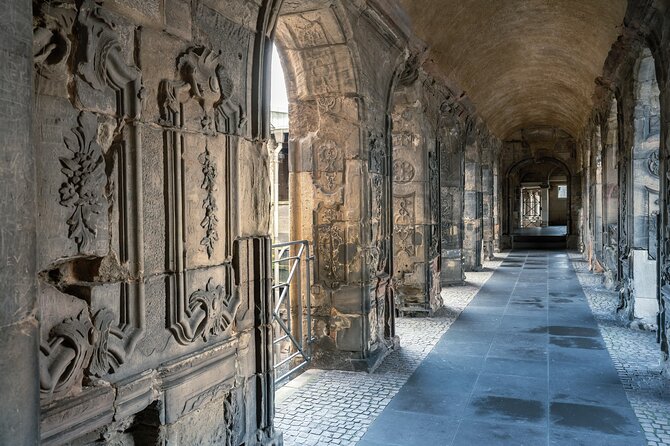
Trier is a rewarding place to explore on foot because major sights sit within a compact central area. This route covers about 5.5 kilometers and connects ancient Roman remains with churches, market squares, and modern political history.
The app is not meant to replace every museum visit. Instead, it gives you context as you walk between sights. That makes it useful for getting oriented on your first day, or for seeing the city without paying for a private guide.
The GPS feature tells you where to go and triggers the audio material along the way. You are not expected to follow a guide holding a flag, and there is no need to arrive at a particular hour. Start at the meeting point listed as 54 Trier, Germany, then return there when the route is finished.
The advertised walking time is about three hours, but you have until the end of the next day to complete it. That extra time changes the feel of the tour. You can listen to several stories, stop for a drink, go inside a museum, and pick up the route later instead of racing through the center.
More Audio Walking Tours in Germany
- Berlin Cathedral Ticket & Audio Tour with a City Walk
★ 4.1 · 28 reviews - Cologne Walking Tour with Audioguide: City and Cathedral
★ 4.5 · 14 reviews - Dusseldorf: City Walk Audio Guide in 7 Languages on your Phone
★ 4.5 · 11 reviews
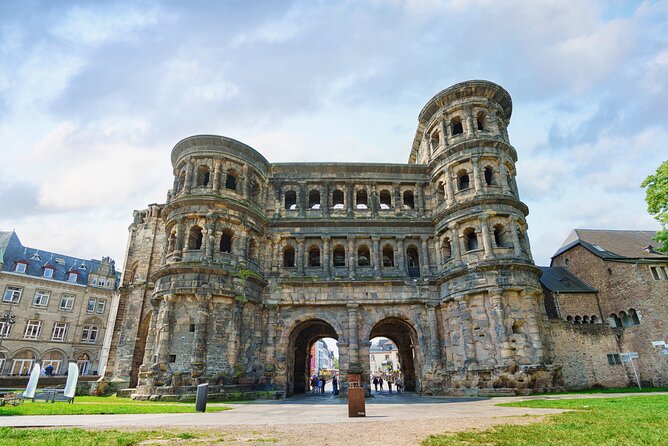
Porta Nigra, Trier’s massive Roman gateway
The Porta Nigra is the natural opening act. This well-preserved Roman city gate dates from the second century AD and was built from enormous stone blocks. Its scale gives you an immediate sense of Trier as an important Roman city, not merely a town with a few scattered ruins.
The audio stories are particularly useful here because the structure is easy to admire but harder to understand at a glance. The narration can explain its original defensive role and place it within the city’s Roman past.
You do not need to pay an admission fee simply to follow the route past the monument. If you choose to enter attractions along the way, admission costs are not included, so check the opening hours and ticket prices separately.
Take a moment here before moving on. The Porta Nigra is one of the route’s clearest visual landmarks, and its heavy stone construction contrasts nicely with the more intimate streets and squares that follow.
Hauptmarkt, where Trier feels most social
The Hauptmarkt is Trier’s central square and one of Germany’s oldest market places. It is surrounded by historic buildings and colorful half-timbered houses, with St. Gangolf Church and the Roman Fountain adding strong visual detail.
This is a good place to pause the app. The square has outdoor cafés, regular markets, and events, so you can use the flexible schedule to sit down without feeling that you are missing a timed departure.
The audio guide’s value here is its ability to point out details you might otherwise pass without noticing. A market square can look like a pleasant open space, but the surrounding buildings tell you how Trier’s commercial and civic life developed.
Allow a little extra time if the square catches your attention. The route itself is free to follow, but a drink or snack is naturally an additional expense. Since the activity gives you until the next day, this is one of the easiest stops at which to take a proper break.
Trier Cathedral and centuries of change

Trier Cathedral, formally the Cathedral of Saint Peter, is identified as the oldest cathedral in Germany. Construction began in the fourth century under Emperor Constantine, and later additions produced a building with several architectural styles.
That long construction story is exactly the kind of subject an audio guide handles well. You can stand outside or walk through the area while hearing how the cathedral changed across the centuries, rather than trying to make sense of its design from a single date.
The cathedral is also known for the Holy Robe, believed to be the tunic worn by Jesus Christ. It remains an important pilgrimage site, and the building is part of Trier’s UNESCO World Heritage listing.
Admission to attractions is not included in the $9.03 price. If you want to go inside, treat the audio walk as an introduction rather than an entrance ticket. You may prefer to listen to the cathedral story first, then decide how much time you want to spend indoors.
More Smartphone Audio Tours in Germany
- 800 Years of History: A Munich GPS Audio Tour
★ 4.5 · 12 reviews - Berlin Walking Tour with Audioguide on Your Smartphone
★ 4.0 · 11 reviews - Koblenz: City Walk with Audio Guide in 7 Languages on your Phone
★ 4.5 · 5 reviews - Cologne: City Walk with Audio Guide in 7 Languages on your Phone
★ 3.5 · 3 reviews
Karl Marx House adds a modern political chapter
Karl Marx House is the birthplace and childhood home of Karl Marx. It now functions as a museum with documents, photographs, and exhibits about his life, ideas, political influence, and the Europe of the nineteenth century.
This stop broadens the route beyond Roman Trier. After ancient gates and imperial buildings, you get a place tied to political theory and social movements. That change of subject keeps the walk from becoming a single-note tour of ruins and churches.
The audio narration can help you approach the site with basic context before deciding to enter. If you want the fuller museum experience, remember that its admission fee is separate.
I especially like having this stop in a city walk because it gives you a more complicated picture of Trier. The city is not only an open-air Roman monument. It also connects to major modern debates about society, labor, economics, and political change.
The Basilica of Constantine and imperial scale

The Basilica of Constantine, also called the Aula Palatina, was built in the early fourth century during Constantine’s reign. It served as an imperial audience hall and formed part of a larger palace complex.
Its enormous rectangular hall and high, flat wooden ceiling express Roman power through size and simplicity. There is little need for decorative clutter when the room itself does the work.
The building is now used as a Protestant church, another reminder that Trier’s sites have not all become frozen archaeological displays. They continue to have present-day uses.
The audio guide’s story should help you connect the building’s original purpose with what you see today. As with the cathedral and other attractions, entering is not included. The route still lets you appreciate the outside and surrounding setting without adding an admission charge.
What the audio format gets right

The strongest part of this experience is control. You decide when to begin, how long to linger, and when to stop listening. That makes the walk a good fit for anyone who dislikes being hurried through a city.
The route also gives you until the end of the following day. That is more useful than it sounds. Rain, a tired child, a museum visit, or a long lunch can easily disrupt a fixed walking tour. Here, you can pause and return later.
The narration is designed to include stories, legends, and fun facts rather than only dates and architectural labels. That should make the walk more engaging than reading a series of plaques.
The private format helps too. Only your group takes part, so you do not need to keep pace with strangers or listen to questions from a large group. For two people or a small family, the experience can feel more relaxed.
The app is available in seven languages, although the booking information specifically lists English as the offered language. Confirm your preferred language before setting out, especially if you do not want to rely on an automatic translation.
Where the technology can let you down

This is not a tour to start with a phone at 12 percent battery. GPS and audio use power, and the provider advises charging fully or carrying a power bank.
You also need an internet connection and GPS function on your phone. Headphones are not supplied, so bring your own. A phone speaker may work in a quiet spot, but headphones are more practical in a public square.
Activation instructions arrive in a separate email. Keep that message available, and look for the six-digit code needed to start the tour. One customer had trouble finding the code but received quick help from a friendly service representative. That suggests support is available, but it is still wise to prepare before you reach the starting point.
The language quality deserves attention. A German-language user found the translation from English awkward, including incorrect place names and odd wording. Another issue involved waypoints marked only by numbers, with no audio or text at one point. These problems may not affect every language, but they are a reason to check the app early and report trouble promptly.
For a couple choosing a duo option, check how the app works on two phones. A reported issue was that both phones needed to remain together, and one stopped working after the pair separated briefly. If you plan to split up, even for a few minutes, a single shared phone may be simpler.
Price, timing, and practical value
At $9.03 per person, this is inexpensive for a private city introduction. The price includes the smartphone app, audio guide, and GPS directions. It does not include your phone, headphones, or admission fees at sights along the way.
That distinction matters. If you only want an orientation walk and plan to admire the exteriors, the price is strong. If you intend to enter several museums and monuments, your total day will cost more.
The 2 to 3 hour estimate is realistic as a basic walking time, but the next-day deadline gives you a better way to use it. You can divide the route into sections, though the information provided does not specify an official number of sections or a separate second-day route.
The 5.5-kilometer distance is manageable for most people who are comfortable with a city walk. The activity states that most people can participate, but it does not provide detailed accessibility information. If you have specific mobility needs, ask the provider before booking.
Free cancellation is available if you cancel at least 24 hours before the local start time. Changes or cancellations inside that 24-hour window are not refunded.
Who will get the most from this walk
I would choose this for an independent first look at Trier, especially if you want the main landmarks without paying for a live private guide.
It suits:
- People who prefer stopping for coffee, food, or photos whenever they wish
- Couples and small groups who want a private route
- Budget-conscious visitors who plan to see attractions from outside
- Families who need a flexible pace
- Visitors who like historical stories but do not want a long lecture
- Anyone with only part of one day, plus some time the following day
It is less suitable if you want a personal guide who can answer questions on the spot. It may also frustrate you if your phone battery is unreliable, your data connection is limited, or you expect polished narration in every language.
The overall rating of 4.2 from 19 ratings suggests a generally positive experience, but the written feedback points to a clear split: the route and freedom receive strong praise, while translation and app functions can cause trouble. I would treat the app as a useful guide, not as a perfect substitute for a local human.
My advice for using it well
Charge your phone fully before leaving. Download or open the activation instructions, bring headphones, and carry a power bank.
Start early enough to use the route’s extra time. If you begin close to closing time for the museums, you may not have enough opportunity to visit the indoor sights, even though the walk itself remains available.
Use the first few minutes to test GPS and audio. If a story does not play or a waypoint shows only a number, contact support while you are still near the start rather than waiting until the end.
Plan to pause at the Hauptmarkt. It is one of the natural places to take a break, and the surrounding cafés make the flexible schedule practical rather than theoretical.
If two people use the duo option, keep both phones together unless you know the app supports separation. The safest approach is to let the phone with the strongest battery lead the walk.
Should you book the Trier audio walk?
Book it if you want a low-cost, private introduction to Trier and value freedom more than personal conversation. The route covers the city’s major Roman, religious, commercial, and political sights, and the next-day finish window is unusually forgiving.
Skip it if you need guaranteed translation quality, live answers, or a fully guided museum experience. For the best result, bring reliable equipment, use headphones, check your activation code, and think of the audio walk as a flexible framework for exploring the city.
At $9.03, it offers good value for a self-guided overview. Its biggest strengths are pace and coverage. Its weak spots are the dependence on your phone and some reported language and waypoint problems. If those limits suit you, this is a practical way to get acquainted with Trier.
FAQ
How long does the Trier audio walk take?
The average walking time is about 2 to 3 hours. You have until the end of the next day to finish the experience, so you can pause and continue later.
How far is the route?
The walking distance is approximately 5.5 kilometers.
How many audio stories are included?
The route includes 27 stories about the sights and places along the walk.
Which Trier sights are included?
The route includes the Porta Nigra, Hauptmarkt, Trier Cathedral, Karl Marx House, and the Basilica of Constantine, among other points along the walk.
Is this a private activity?
Yes. Only your own group participates in the activity.
What is included in the price?
The price includes a smartphone app with an audio guide in seven languages and GPS guidance.
Do I need to bring anything?
You need your own smartphone, headphones, an internet connection, and GPS. Bring a fully charged phone or a power bank.
Are attraction admission fees included?
No. Admission fees for attractions you pass are not included.
Can I cancel for a refund?
You can cancel for a full refund up to 24 hours before the experience start time. Cancellations or changes made less than 24 hours in advance are not refunded.
More Multilingual Audio Guides in Germany
- Heidelberg: City Walk Audio Guide in 7 Languages on your Phone
★ 3.0 · 2 reviews - Athens: Acropolis Ticket with Multilingual Audio Guide
★ 3.9 · 926 reviews - Geiranger: Bus Tour with Multilingual Audio Guide
★ 4.0 · 317 reviews - Sightseeing Cruise on the Danube with Audio Guide in Budapest
★ 3.5 · 229 reviews
New audio tours around Germany
- Leipzig’s Communist Past: A Self-Guided Audio Tour★ 5.0 · 16 reviews
- Discover Leipzig: Self-Guided Audio Tour★ 4.0 · 2 reviews
- Koblenz: City Walk with Audio Guide in 7 Languages on your Phone★ 4.5 · 5 reviews
- Laboe Naval Memorial: A Self-Guided Audio Tour★ 5.0 · 2 reviews
- Baden-Baden Self Guided Audio Tour in English★ 4.0 · 5 reviews
- Heidelberg: City Walk Audio Guide in 7 Languages on your Phone★ 3.0 · 2 reviews
- Heidelberg’s Altstadt: A Self-Guided Audio Tour★ 4.0 · 26 reviews
- Hamburg’s Historical Highlights: A Self-Guided Audio Tour★ 4.5 · 5 reviews
Germany Audio Tours, compared.

Neuschwanstein Castle Skip-the-Line Ticket with Audio Guide
Read our review →
Berlin: Solar Powered Sunset Catamaran Cruise & Audio Guide
Read our review →
Berlin: Boat Sightseeing Cruise with Audioguide
Read our review →
Füssen: Neuschwanstein Castle Express Ticket and Audio Guide
Read our review →
Neuschwanstein Castle Ticket With Audio Guided Tour
Read our review →
Spicy’s Gewürzmuseum Entry Ticket and Audio Guide
Read our review →
Berlin: Panoramic Boat Tour with Bilingual Audio Guide
Read our review →
Berlin: Französischer Dom Viewing Platform with Audio Guide
Read our review →Browse the lists this tour appears in