
Review · PHILADELPHIA
Historic Sites of Philadelphia Self-Guided Walking Audio Tour
Philadelphia’s Revolutionary story comes alive along a short route linking Elfreth’s Alley, Independence Hall, and the Liberty Bell. You’ll hear about Benjamin Franklin, George Washington, Haym Salomon, Alexander Hamilton, and the political risks behind the nation’s founding while walking through Old City.
I like the freedom to pause the narration, explore a side street, or stop for Reading Market and Chinatown before returning to the route. I also like the low $9.49 price and the fact that this is a private experience for your own group. The main drawback is that the walk stays outside, and some commentary may feel brief if you already know Philadelphia’s best-known stories.
Key points at a glance
- Start in one of America’s oldest residential streets: Elfreth’s Alley gives you a close look at preserved 18th-century homes before the tour turns toward the major national landmarks.
- Follow the route through the WalknTours app: Start the narration, put your phone away, and use the on-screen arrow if you need help finding the next stop.
- Hear lesser-known political stories: The tour includes George Washington’s nickname Town Killer, Haym Salomon’s financial role, and Hamilton’s scandal involving Maria Reynolds.
- See major sites without paying admission: The Liberty Bell Center, Independence Hall, Carpenters’ Hall, and other stops are viewed from outside.
- Finish where the founders ate and drank: The route ends at City Tavern on South 2nd Street, an appropriate final stop for a walk about the early republic.
- Plan for earbuds: One review specifically noted that airbuds or headphones make the audio much easier to hear in the street.
A short route through Philadelphia’s revolutionary center
This walk covers roughly one hour to an hour and a half, depending on how quickly you move and how often you stop. The route begins in the northern part of Old City and works south toward the major Independence National Historical Park sights, then continues to Hamilton-related locations and City Tavern.
That order works well. You begin with a quiet, intimate street, then move into the bigger political story of the Revolution. By the end, the route has shifted from colonial resistance to the financial and personal drama of the new United States.
The WalknTours app supplies the narration and directions. You do not follow a human guide, and only your group takes part. This makes the experience easy to fit into a packed Philadelphia day, but it also means you must manage your own timing, phone battery, headphones, and attention.
More Audio Walking Tours in the USA
- Self Guided Classic Freedom Trail Location Aware (GPS) Walking Audio Tour
★ 4.5 · 258 reviews - Cape Cod & Provincetown Self-Guided Driving & Walking Audio Tour
★ 4.0 · 207 reviews - Santa Fe Historic Downtown Smart Phone Audio App Self Guided GPS Walking Tour
★ 4.5 · 112 reviews
Elfreth’s Alley: the best opening scene
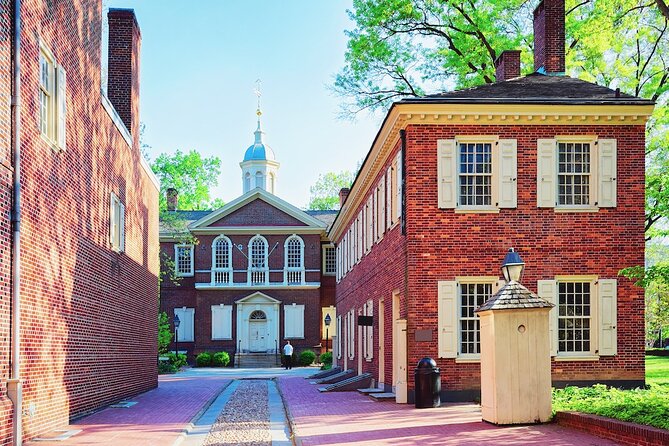
Elfreth’s Alley is named for Jeremiah Elfreth, an 18th-century blacksmith. Its narrow line of historic homes offers a strong visual beginning because it helps you picture Philadelphia before the modern city grew around it.
The alley has remained much as it was during the Revolutionary period and is designated a National Historic Landmark. You begin near the Elfreth’s Alley Museum, at 126 Elfreth’s Alley, and press start in the app.
This is not simply a meeting point. It gives the walk a sense of place before you reach the familiar symbols of American independence. Look closely at the scale of the street and the tightly packed houses. The setting makes the Revolution feel less like a distant textbook event and more like something that happened in a working neighborhood.
You may want to spend a few extra minutes here before starting the audio. The official route allows about five minutes at the stop, but the alley rewards a slower look.
Betsy Ross and the limits of the flag story
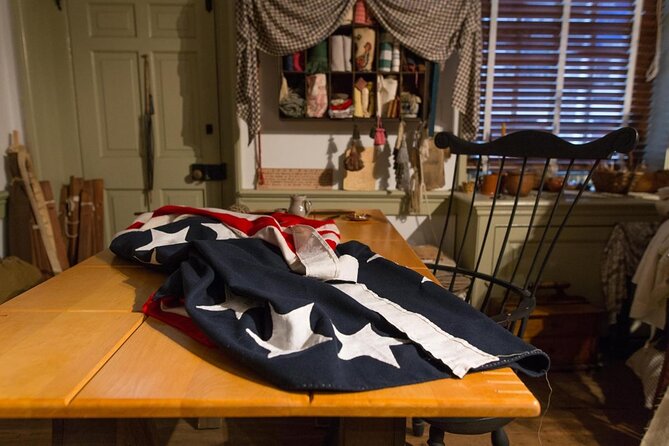
The route continues to a stop outside the Betsy Ross House. The narration covers the familiar story of Ross meeting George Washington and designing the American flag.
The attraction here is not only the flag story. It is the way the stop connects a domestic setting with the political upheaval taking place around it. You are hearing about a craftsperson and a home-based working life while walking through the same old Philadelphia district where the Revolution unfolded.
The house is viewed from outside on this tour. If you want to enter, you will need to arrange admission separately. The audio stop is short, so do not expect a long museum visit or an extended examination of the evidence behind the Ross story.
The music is part of the presentation. That gives the route a more produced feel than a basic phone recording, though your experience will depend on your headphones and the amount of street noise.
Benjamin Franklin’s grave and Haym Salomon’s synagogue
At Benjamin Franklin’s grave, the story turns to Franklin’s role in the Revolution and his work with the French. The narration presents him as a practical political operator whose influence reached beyond Philadelphia.
The stop is brief, about five minutes. That is enough for a quick introduction, but not enough for a full portrait of Franklin’s science, printing career, diplomacy, and public life. If Franklin is your main reason for visiting Philadelphia, consider using this walk as an orientation rather than your only source of information.
The next stop concerns the synagogue known as the Synagogue of the Revolution. Here you hear about Haym Salomon, the financier who helped support the Revolutionary cause. This adds a useful financial angle to the story. Wars require money, credit, and people willing to take serious risks, and Salomon’s role brings that part of the struggle into view.
These two stops work well together. Franklin represents diplomacy, science, and public influence. Salomon represents the financial machinery behind rebellion. Both stories are delivered from the street, so you should expect a concise account rather than a long historical talk.
More History Audio Tours in the USA
- Savannah’s Historical District: A Self-Guided Audio Tour
★ 4.5 · 69 reviews - Salida History Audio Tour l A Self-Guided Wild West Experience
★ 5.0 · 41 reviews - Historic Bar Harbor Self-Guided Walking Audio Tour Guide
★ 4.5 · 38 reviews - Key West’s Old Town Treasures: A Self-Guided Audio Tour
★ 4.5 · 29 reviews
The President’s House and George Washington’s public image
At the President’s House site, the route reaches the place where George Washington lived as the first president. The stop also introduces one of his less familiar nicknames, Town Killer.
That detail is one reason to choose this audio walk instead of simply following a map between landmarks. The major sites are easy to identify, but a short story can give you a fresh reason to pause. Washington is often treated as a solemn marble figure. A nickname such as this adds a more human, less polished edge to his public image.
The stop is outside, and the narration focuses on the political world of the early republic and the secrets of the rebels. If your children are impatient with formal history, the unusual details may help hold their attention, though the overall commentary remains fairly compact.
Liberty Bell Center and Independence Hall
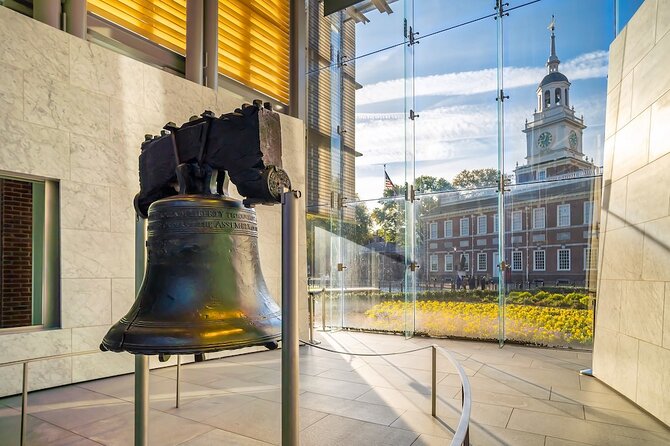
The Liberty Bell Center is one of the simplest stops. The bell can be seen for free, and the audio explains that it was hidden in Allentown during the Revolution. It also points out that the bell became a symbol of liberty after the war, rather than serving as a fully formed national symbol from the beginning.
That distinction matters. It shows how national symbols often gain their meaning over time. You get the famous object, but you also get a little context for how its public image developed.
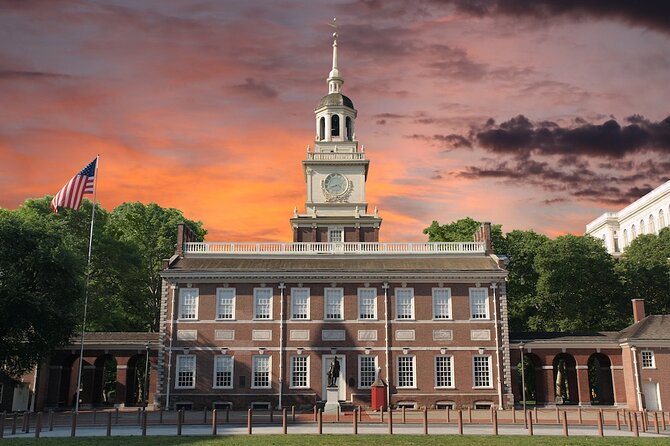
Next comes Independence Hall, where the Declaration of Independence and the United States Constitution were debated and adopted. The route goes outside only. You do not receive an entry ticket, and you will need to book separately if you want to see the interior.
This is the point where the tour’s low price becomes especially clear. At $9.49, you are paying for the route, narration, and app guidance, not for access to the buildings. If you already plan to visit the Liberty Bell area on your own, the audio adds stories without adding a large expense. If you want a full interior visit, treat this as a companion to your timed admission, not a replacement.
The tour also explains that the name Independence Hall came from the French general Marquis de Lafayette, who referred to the state house as the Hall of Independence. It is a small detail, but it gives the building’s familiar name a useful connection to the international side of the Revolution.
Signer’s Garden and the risks behind independence

At Signer’s Garden, a statue honors the spirit and danger involved in signing the Declaration of Independence. The statue depicts George Clymer, a local merchant and politician.
This stop shifts attention away from the most famous founders and toward the people who accepted personal risk by backing independence. The route continues its focus on rebels, not simply presidents and generals.
The stop is short, so you will not get a detailed biography of every signer. Still, the garden helps break up the sequence of major buildings. It gives you an outdoor pause and a reminder that independence was a political gamble for the people who signed their names.
Carpenters’ Hall and the road not taken
Carpenters’ Hall is owned by the Carpenters’ Company of Philadelphia, described as the country’s oldest craft guild. The building is also known as the Birthplace of Liberty.
The story here concerns the meeting of the rebels and their boycott of the British. The narration also covers the surprising possibility that Quebec might have become one of the original colonies. That detail gives this stop more range than a simple description of the building.
Carpenters’ Hall is free to visit, although the walking route itself does not include an interior admission. Check the building on the way, but keep your expectations clear: the included experience is an outside audio stop. You may need to plan separately if you want to go in.
I consider this one of the more useful parts of the route because it shows that the Revolution was not an inevitable march toward independence. Political choices could have led in other directions.
Alexander Hamilton’s money, home, and scandal
The route then turns to Alexander Hamilton. At the First Bank of the United States, the narration explains Hamilton’s financial plan for the new nation.
Hamilton believed a national bank would help stabilize government credit and handle federal finances under the new Constitution. This gives the walking tour a needed change of subject. Philadelphia’s founding story was not only about battles, declarations, and famous speeches. It was also about debt, banking, credit, and the practical work of building a government.
The next Hamilton stop concerns the house where he lived and the affair with Maria Reynolds. The scandal damaged his career and remains one of the more personal stories on the route.
Together, these stops present Hamilton as both institution builder and flawed political figure. The contrast keeps the final part of the walk from becoming a repeat of the earlier founder stories.
Ending at City Tavern
The route ends at City Tavern on South 2nd Street. This is presented as a place where the founding fathers often met to eat and drink, and as the spot where the walk concludes.
It is a fitting ending because the tour moves from street-level colonial life to national political institutions, then finishes in a social setting. The founders were not only names on documents. They met over meals, argued, made plans, and built alliances in places such as taverns.
City Tavern is open daily from midnight to 11:30 p.m. according to the supplied schedule. The experience does not include food or drinks, so any meal or refreshment is your own expense.
How the app works in real use
You start the WalknTours app at Elfreth’s Alley and follow the route through your phone. The provider describes its navigation system as patented technology. In practical terms, the useful feature is the directional arrow: if you are unsure where to go, check the arrow and it points toward the next stop.
Once the narration begins, you can put the phone in your pocket and walk. You can also pause when you need more time at a landmark, take a break, or make a short detour. One person used the freedom to visit Reading Market and Chinatown before returning to the route, which is exactly the kind of flexibility a self-guided walk can provide.
Bring earbuds or headphones. Without them, street noise can make the commentary difficult to hear, and the audio is the main service you are paying for. The route is offered in English only.
Price, timing, and who gets the best value
At $9.49 per person, this is an inexpensive way to add structure and narration to a walk through Old City. You are not paying for a guide, transportation, food, or entry tickets. You are paying for a prepared route and short audio stories.
The value is strongest if you have only an hour or two and want help connecting the sites. It is also useful for couples, families, or small private groups who dislike moving at a guide’s pace. Group discounts may make it more appealing for larger parties.
The value is weaker if you already know the main Philadelphia stories or want detailed museum-level interpretation. The short descriptions may feel too basic, and children who need constant activity could lose interest. One useful way to handle that is to treat the walk as a framework: pause for extra sightseeing, add a museum, or stop for food along the way.
Most people can participate, and the route is near public transportation. It is booked about five days ahead on average, but you can still check availability for your dates. Confirmation arrives at booking, and cancellation is free up to 24 hours before the start time. Changes or cancellations inside that window are not refunded.
Should you book the Historic Sites of Philadelphia Audio Tour?
Book it if you want a cheap, flexible introduction to Old City and prefer exploring without a group schedule. The route connects the essential Revolutionary landmarks with a few less familiar stories, including Haym Salomon, Hamilton’s finances, and Washington’s nickname.
Skip it if you want interior tours, a live historian, or lengthy explanations at each stop. For the best experience, use headphones, allow 90 minutes instead of rushing through in an hour, and plan extra time for Independence Hall or Carpenters’ Hall if you want to go inside.
FAQ
How long does the walking tour take?
The tour takes approximately one hour to one hour and 30 minutes, depending on your walking speed and how often you pause.
Where does the tour begin?
It begins at the Elfreth’s Alley Museum at 126 Elfreth’s Alley, Philadelphia, Pennsylvania 19106.
Where does the tour end?
The route ends at City Tavern on South 2nd Street in Philadelphia.
Is there a human guide?
No. This is a self-guided private activity operated through the WalknTours app.
What language is available?
The tour is offered in English.
Are admission tickets included?
No. The walking tour views the sites from outside. The Liberty Bell can be seen for free, while entry to Independence Hall and other interiors requires separate arrangements where applicable.
Can I pause the audio or leave the route briefly?
Yes. The app allows you to pause, and you can make a detour before returning to the route.
What is the cancellation policy?
You can receive a full refund by canceling at least 24 hours before the experience start time. Cancellations or changes made less than 24 hours before the start time are not refunded.
More Self-Guided Audio Tours in the USA
- Gettysburg Battlefield Self-Guided Driving Audio Tour
★ 4.5 · 910 reviews - Joshua Tree National Park Self-Guided Driving Audio Tour
★ 4.5 · 762 reviews - Ultimate Acadia National Park Self-Guided Driving Audio Tour
★ 4.0 · 521 reviews - Ultimate Lake Tahoe Self-Guided Driving Audio Tour
★ 4.5 · 435 reviews
New audio tours around the USA
- Beaches, Bites and Bavaria in Leavenworth: A Self-Guided Audio Tour★ 3.5 · 3 reviews
- Welcome to Fabulous Las Vegas Sign Self-Guided Audio Tour★ 5.0 · 2 reviews
- Hoover Dam and Lake Mead Self-Guided Audio Tour★ 5.0 · 3 reviews
- Las Vegas Day Trips: 3-Day Self-Guided Audio Tour★ 5.0 · 2 reviews
- Driving Lake Tahoe: A Self-Guided Audio Tour From Tahoe City to Incline Village★ 5.0 · 10 reviews
- Las Vegas Neon and Secrets: Self-Guided Audio Tour★ 5.0 · 3 reviews
- Baton Rouge Historic Downtown Self-Guided Audio Walking Tour★ 4.0 · 19 reviews
- Ultimate La Jolla Self-Guided Driving & Walking Audio Tour Bundle★ 3.5 · 9 reviews
Philadelphia Audio Tours, compared.

Museum of the American Revolution Admission Ticket with Audio Guided Option
Read our review →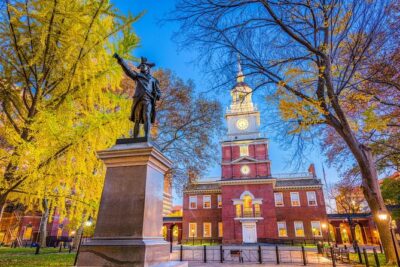
Philadelphia Historic Sites Self-Guided Walking Tour
Read our review →
Art and Controversy: An audio tour of Philadelphia’s most infamous art scandals
Read our review →Browse the lists this tour appears in