
Review · POMPEII
Pompeii Skip-the-Line Ticket and Audioguide
Pompeii is not a museum behind glass. You walk through streets where homes, shops, public buildings, and places of worship were buried by Mount Vesuvius in 79 AD. This one-day self-guided visit gives you the freedom to set your own pace, with an audioguide and map to help make sense of the ruins.
I like the five-language audioguide and the simple numbered system, which lets you hear commentary as you reach different locations. I also like the meeting point at Pompei Scavi Circumvesuviana Station, close to the archaeological park. The main concern is the skip-the-line promise: one recent booking experience involved a queue to exchange the voucher, followed by another line at the ticket office, so the time-saving benefit may not always be clear.
Key points to know before you go

- Pompeii at your own pace: Spend one day exploring without being tied to a group schedule or guide.
- Audio commentary in five languages: Choose English, French, German, Italian, or Spanish.
- A map helps you plan: Use the printed Pompeii ruins map to get your bearings and choose where to go next.
- Meet at the train station: The Tempio Travel office is at Pompei Scavi Circumvesuviana Station.
- Build in extra entry time: The voucher exchange may require a queue, even with a skip-the-line ticket.
Why Pompeii is worth your time

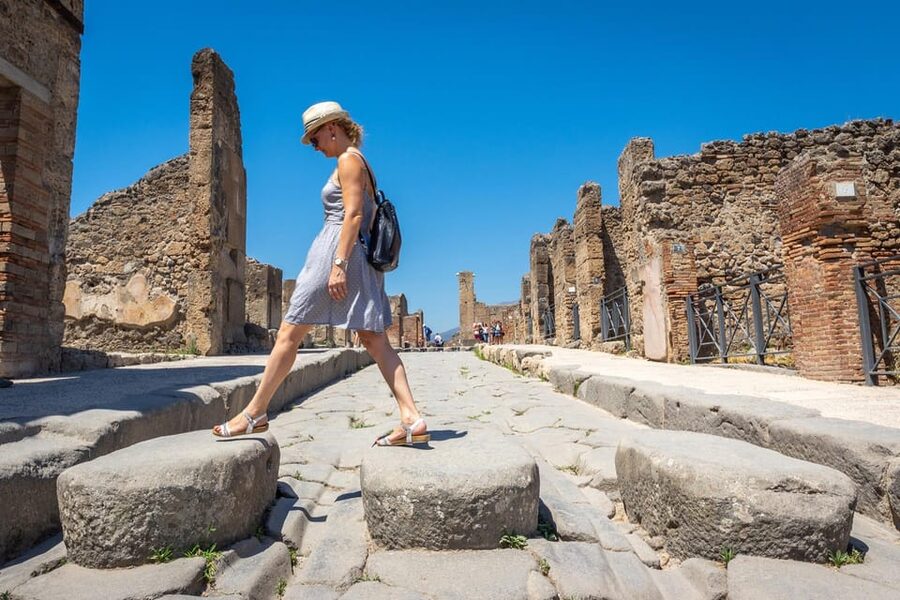
Pompeii gives you something few ancient sites can offer: a full Roman town rather than a single monument. You are not simply looking at broken columns. You can follow paved streets, look into houses, pass public buildings, and see how an ordinary city was arranged nearly 2,000 years ago.
The eruption of Mount Vesuvius buried Pompeii under volcanic ash in AD 79. That sudden burial preserved parts of the city in a way that makes the site unusually direct. The remains show a place where people lived, worked, worshipped, traded, and spent leisure time.
You should arrive ready to walk and to make your own choices. This is not a fixed route with a guide leading you from one stop to the next. The ticket gives you access for one day, while the map and audio commentary help you create a visit that fits your interests and energy.
That freedom is useful because Pompeii can feel overwhelming. There is a great deal to see, and a self-guided format lets you pause when a house or public space catches your attention. If you want to move quickly, you can do that too. If you prefer to listen carefully at each numbered location, you can take your time.
More Skip-the-Line Audio Tours in Pompei Campania:
- Pompeii: Skip-the-line Entry Ticket with Audio Guide & Map
★ 3.9 · 3,153 reviews - Pompeii: Skip-the-Line Entry Ticket with Digital Guide App
★ 4.1 · 770 reviews - Pompeii: Skip-the-Line Entry & Audioguide
★ 3.8 · 225 reviews
Meeting at Pompei Scavi Circumvesuviana Station
Your starting point is the Tempio Travel office at Pompei Scavi Circumvesuviana Train Station. This is a practical location because it puts the ticket collection near the archaeological park and near a major arrival point in Pompeii.
You should have your voucher ready and bring your passport or ID card. The activity information specifically lists identification as something to bring, so do not treat it as optional. The supplied materials include the Pompeii entry ticket, the map, and the audioguide.
The main logistical point is that skip the line does not necessarily mean walking straight through the entrance. A recent booking experience described waiting to exchange the voucher and then waiting again at the ticket office. That creates a real question about the value of paying extra for priority access.
I would allow time for this process rather than planning an exact minute-by-minute schedule. If you have a train, lunch booking, or another timed activity afterward, keep a buffer. The ticket is valid for one day, so the visit does not need to be rushed simply because the entry process takes longer than expected.
Using the map to plan your Pompeii visit

The map is more important than it may first appear. Pompeii is large enough that you can lose your sense of direction, especially when several streets and ruins begin to look alike. A paper map gives you a basic picture of where you are and helps you decide what to see next.
You can use it in two ways. First, treat it as a simple navigation tool. Find your current position, identify nearby numbered locations, and choose a sensible order. Second, use it to manage your energy. If you have already walked a long distance, the map lets you select nearby points rather than wandering without a plan.
The material provided does not promise a guided route or a list of specific stops. That is both a strength and a limitation. You get control, but you must make your own decisions. If you want a detailed plan from an expert guide, this ticket-and-audioguide format may feel too independent.
For many people, though, the map is enough structure. You can listen to a few locations, look around, and then continue when you are ready. There is no group waiting for you and no fixed pace to maintain.
How the numbered audioguide works
The audioguide is designed around the numbered locations in the archaeological park. When you reach a site, you enter the corresponding number and listen to commentary about what you are seeing.
This approach works well at Pompeii because the ruins often need explanation. A wall, courtyard, or road may not tell you much at first glance. Audio commentary can add the historical setting and point out details that might otherwise pass unnoticed.
The guide is available in English, French, German, Italian, and Spanish. That range makes the experience easier to use for many international visitors. You are not dependent on a live guide speaking at a set time, and you can listen in your preferred language.
The tradeoff is that an audioguide depends on your own attention. You must enter the right number and match the commentary to the correct location. You also need to balance listening with looking. If you keep your attention on the device the entire time, you may miss the physical scale and texture of the site.
I would use the audio in short sections. Listen before entering a major area, then put the device aside while you look around. Pompeii rewards direct observation. The guide should support what you see, not replace it.
More audio tours around Pompei Campania:
- Pompeii: Skip-the-Line Ticket with Audio Guide and Map
★ 4.0 · 117 reviews - From Pompeii: Vesuvius Entry with Transfer and Audioguide
★ 4.2 · 74 reviews - Pompeii & Herculaneum: Skip-the-line & Digital Guide App
★ 4.0 · 35 reviews - Herculaneum and Pompeii in one day: Audioguides + Tkts (art)
★ 3.7 · 22 reviews
Seeing Pompeii as a Roman city
The strongest part of this experience is the sense of Pompeii as a functioning city. You can move through spaces that once served very different purposes, from private homes to public buildings and places connected with religion and daily work.
The supplied information does not promise specific houses or monuments, so you should not book this activity expecting a fixed list of famous stops. Instead, think of it as a flexible entry package for exploring the archaeological park broadly.
That broad access is valuable. You can spend more time in areas that interest you and less time in places that do not. A visitor curious about domestic life can focus on homes and courtyards. Someone more interested in city planning can pay attention to roads and public spaces. The audioguide gives you background as you move between them.
The setting also rewards patience. Pompeii is not a quick photo stop. You may find that a plain-looking street becomes more interesting after the audio explains how it fitted into the city. You may also find that some areas are easier to understand when viewed from the map rather than approached at random.
Is the $41 price good value?

At $41 per person, this is more expensive than simply buying an ordinary entrance ticket if one is available at the park. The value depends on how much you want the added convenience of a prearranged ticket, map, and audio commentary.
The audioguide is the clearest part of the value calculation. If you want context but do not want to join a live group, the commentary gives you a middle option. You receive more explanation than you would from walking through the ruins alone, while keeping control of your pace.
The map also matters, especially for a first visit. Pompeii is not a small single-building attraction, and having a basic plan can save time and reduce confusion.
The weaker part of the value is the priority-entry claim. The published experience promises skip-the-line access, yet one recent booking report described two queues, including a wait to exchange the voucher. Another recent booking report said the description was not accurate. Those are serious points to consider when comparing this product with buying a ticket directly or choosing a fully guided visit.
I would pay the $41 if you want the bundled ticket, map, and audio support and prefer to arrange everything before arrival. I would hesitate if your main reason for booking is fast entry. The process may save time, but the available information does not guarantee that it will do so in practice.
Who will enjoy this format most
This experience suits independent visitors who want Pompeii without a live group. You can move at your own speed, choose your language, and spend a full day in the archaeological park.
It is also useful for people who want some interpretation but do not need constant personal attention. The audio gives you a steady source of explanation while leaving you free to stop, turn back, or skip ahead.
Families and mixed-interest groups may appreciate the flexibility. One person can spend longer at a particular ruin while another moves on, provided everyone is comfortable managing the map and audio separately.
The format is less suitable if you want a guide to lead you through the best-known areas or explain every detail in person. It may also be frustrating if you need a fully accessible visit. The activity is listed as not suitable for wheelchair users.
Because the ticket is valid for one day, it is best for someone who wants a substantial Pompeii visit rather than a brief stop between other attractions. You can take advantage of the full validity instead of trying to squeeze the ruins into a short window.
Practical advice for a smoother visit
Bring your passport or ID card, along with the voucher needed for the ticket collection. Keep the map accessible, not buried in a bag, because you may need it often.
Choose your audio language before you begin, if possible, and pay attention to the location numbers. The experience depends on matching each number with the correct ruin.
Plan for walking and allow extra time at the entrance. The skip-the-line wording should not lead you to schedule the visit too tightly. A little spare time is especially useful if you are arriving by train or have another booking later in the day.
The activity offers free cancellation up to 24 hours before the scheduled visit, and you can reserve now and pay later. Those terms are helpful if your plans around Campania are still changing.
Should you book the Pompeii audioguide ticket?

Book this if you want a flexible, self-guided day at Pompeii with entry, a map, and audio commentary in one package. It is a sensible choice for independent visitors who value freedom and want more context than a bare ticket provides.
Think twice if skip-the-line access is your top priority. The reported voucher and ticket-office queues weaken that part of the offer, and the $41 price is harder to justify if the entry process does not save time.
For the best match, book with realistic expectations: you are buying access and self-guided tools, not a live guide or a guaranteed fast walk through the gate. If that suits your style, the format can give you a rewarding way to see Pompeii on your own terms.
FAQ
Where is the meeting point?
The meeting point is the Tempio Travel office at Pompei Scavi Circumvesuviana Train Station.
How long is the ticket valid?
The activity is valid for one day. You should check the available starting times when booking.
Which audioguide languages are available?
The audioguide is available in English, French, German, Italian, and Spanish.
What is included?
The package includes the Pompeii skip-the-line entry ticket, a multilingual audioguide, and a map of the Pompeii ruins.
What should I bring?
Bring your passport or ID card. You should also have the voucher needed for the ticket collection.
Can wheelchair users take part?
No. The activity is listed as not suitable for wheelchair users.
New audio tours around Pompei Campania
- Pompeii Tour_Skip the line ticket + audioguide★ 4.7 · 17 reviews
- Pompeii: Pre-reserved ticket with audio guide★ 3.2 · 15 reviews
- Pompeii: Skip-the-Line Ticket with Audio Guide and Map★ 3.9 · 5 reviews
- Pompeii, skip-the-line ticket with smartphone audio guide on App★ 3.0 · 4 reviews
- Pompeii: Skip-the-Line Ticket with Audio Guide and Map★ 4.0 · 117 reviews
- Pompeii: Skip-the-Line Ticket with Audio Guide and Map★ 4.0 · 14 reviews
- Pompeii: Skip the Line Ticket + Audioguide★ 3.3 · 13 reviews
- Pompeii: Skip The Line Entrance Tickets + Audioguides★ 3.2 · 4 reviews
Pompeii Audio Tours, compared.

Pompeii: Skip-the-line Entry Ticket with Audio Guide & Map
Read our review →
Pompeii: Skip-the-Line Entry Ticket with Digital Guide App
Read our review →

Pompeii: Skip the line ticket (art) + audioguide + map
Read our review →
From Pompeii: Vesuvius Entry with Transfer and Audioguide
Read our review →
Pompeii & Herculaneum: Skip-the-line & Digital Guide App
Read our review →
Herculaneum and Pompeii in one day: Audioguides + Tkts (art)
Read our review →
Browse the lists this tour appears in