

Review · POMPEII
Pompeii Tour_Skip the line ticket + audioguide
Pompeii is the sort of archaeological site that can swallow a whole day. This skip-the-ticket-line entry gets you past the ticket queue, then lets you follow ancient streets to frescoed houses, temples, baths, shops, theaters, and the famous amphitheater at your own speed. The included map helps you make sense of a site that covers about 66 hectares.
I like two things here: the freedom to choose your own pace, and the practical combination of an entry ticket, map, and multilingual audioguide. You can pause at a house that interests you instead of keeping up with a group. The main caution is the audio commentary. One French-language booking found it far too brief, so visitors wanting a detailed historical explanation may prefer a live guide.
Key points to know before booking
- One full day at Pompeii: The ticket is valid for one day, giving you time to explore without rushing every room and street.
- Skip the ticket line: You avoid the ticket-purchase queue, which matters at a major archaeological site visited by about 3 million people each year.
- Independent sightseeing: There is no included guide or transfer. You meet next to Bar De Vivo, receive the materials, and continue on your own.
- Ancient Roman daily life: Look for homes, baths, temples, shops, thermopolia, theaters, brothels, and the casts of eruption victims.
- Audioguide in nine languages: Audio is available in English, French, German, Italian, Hebrew, Chinese, Russian, Spanish, and Portuguese.
- A practical $44 package: The price is reasonable if you value queue protection and a self-guided plan, but less attractive if you want a detailed live explanation.
Getting started beside Bar De Vivo
Your meeting point is next to Bar De Vivo. That detail is worth taking seriously because a large archaeological site is easier to enter when you know exactly where to collect your ticket and audio materials.
A host or greeter may assist in English, Italian, Spanish, or French. This person is not your Pompeii guide for the day. The service provides access and orientation, while your actual visit is independent.
You should bring your passport or ID card, comfortable shoes, and comfortable clothes. The site is enormous, and the most useful item on that list is the footwear. Pompeii is experienced on foot, so thin sandals or stiff shoes can turn a good archaeological visit into a long complaint before lunch.
The package does not include transport. You need to arrange your own way to the meeting point and the ruins. Food and drinks are also not included, so plan around your own needs rather than expecting a meal stop as part of the experience.
More audio tours around Pompei Campania:
- Pompeii: Skip-the-line Entry Ticket with Audio Guide & Map
★ 3.9 · 3,153 reviews - Pompeii: Skip-the-Line Entry Ticket with Digital Guide App
★ 4.1 · 770 reviews - Pompeii: Skip-the-Line Entry & Audioguide
★ 3.8 · 225 reviews
Why skipping the ticket line matters at Pompeii
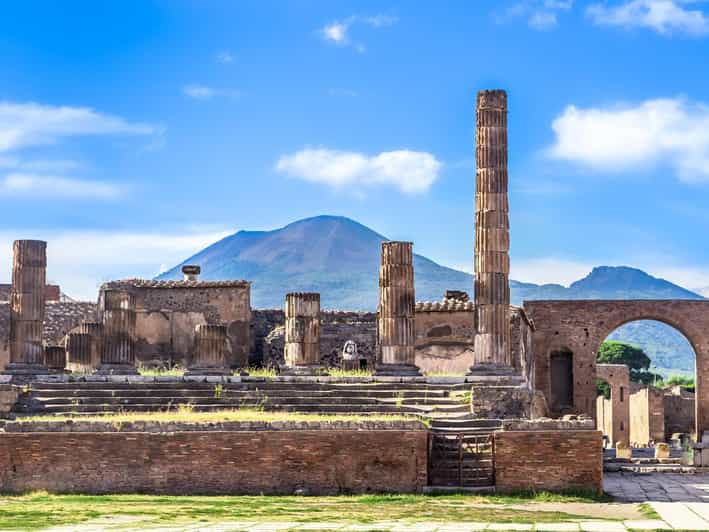
Pompeii is not a small monument you can inspect in 45 minutes. The excavated area covers about 66 hectares, and the site attracts roughly 3 million people a year. A ticket queue can therefore cost you useful time before you have even reached the ancient streets.
The skip-the-ticket-line feature is the clearest practical benefit of this package. It does not mean someone leads you through the ruins or removes every possible wait, but it does remove the need to buy your entrance ticket in the standard line.
That matters most if you have only one day in the area or want to combine Pompeii with other Campania plans. You can begin the visit with the map and audio guide instead of spending your first stretch of time sorting out admission.
At $44 per person, the value depends on what you want. If you want a simple entry solution with a route aid and audio in your language, the price is fair. If you mainly need admission and already know the site well, the package may feel expensive because transport, food, and a live guide are not included.
Reading Pompeii through its streets and houses
The best way to understand Pompeii is to notice how ordinary life appears beside grand public buildings. You are not simply looking at isolated ruins. You are walking through a Roman city with streets, homes, stores, places for bathing, religious buildings, entertainment venues, and food outlets.
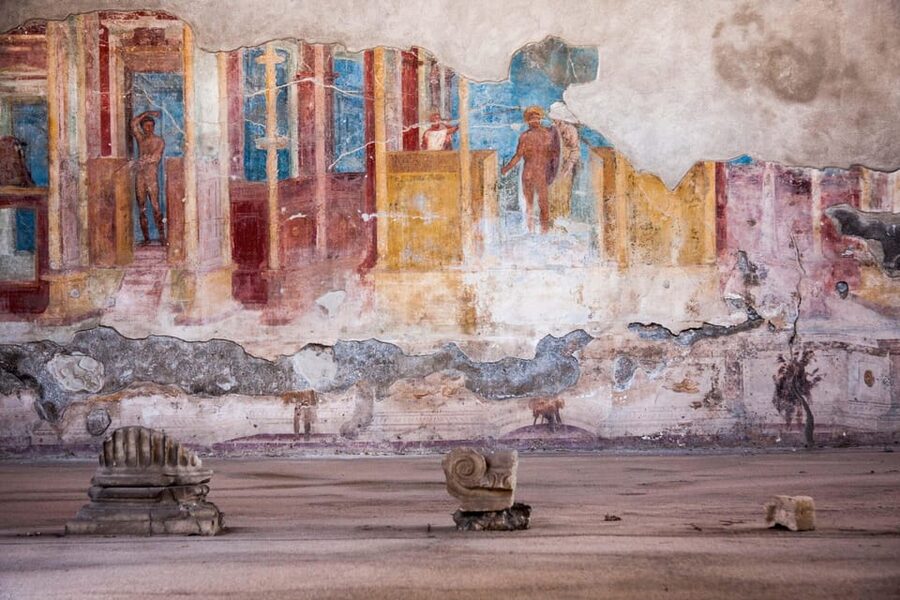
The frescoed houses, or domus, are a major part of the visit. Their painted rooms show how much attention Roman homeowners gave to decoration and presentation. The audio guide and map can help you identify the most interesting houses instead of wandering past them without context.
You may also encounter baths, temples, and shops. These places help connect the site to daily routines. Pompeii becomes easier to picture when you move from private rooms to public spaces, then to the businesses that served people in between.
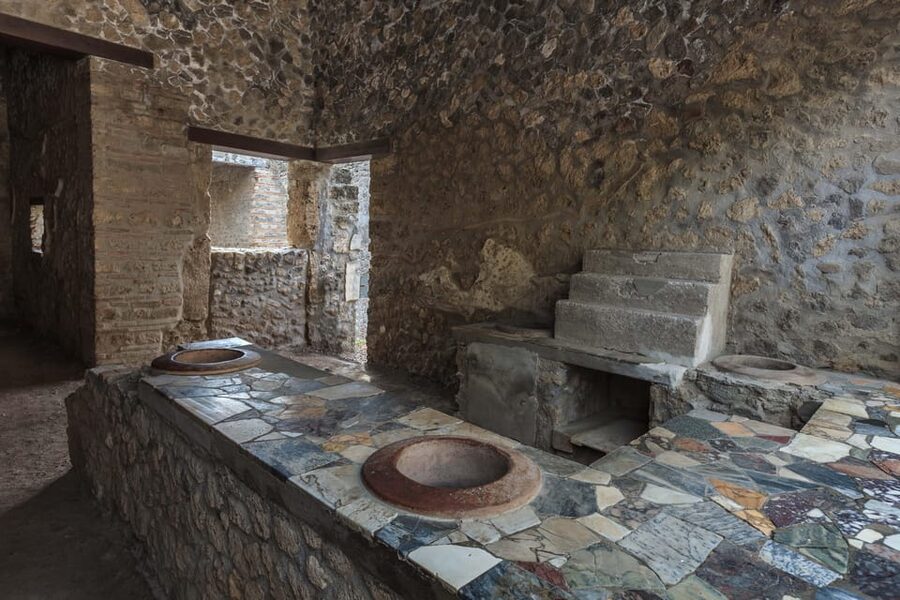
The thermopolia are particularly useful for that reason. These were ancient Roman food and drink counters, described here as the coffee and fast-food outlets of their time. They offer a more grounded view of the city than grand monuments alone. You can imagine the practical side of life, not just formal worship or wealthy domestic decoration.
The map matters because the ruins can feel confusing. Several routes and points of interest compete for your attention, and an unplanned visit can leave you walking past important areas simply because you did not know where to look. The supplied route information is designed to help you make better choices.
The theaters, amphitheater, and public side of the city
Pompeii’s theaters show the city as a place for public entertainment, not just private homes and commercial streets. The theaters are among the places you can include in your self-guided route, and the audioguide can provide a basic explanation as you move between them.
The amphitheater is another major stop. It is described as one of the best-preserved Roman amphitheaters, which makes it an important part of the visit even if you are more interested in houses and frescoes than arena architecture.
I recommend treating these large public buildings as pauses in your route. After examining smaller rooms and narrow streets, a theater or amphitheater gives you a sense of scale. It also helps explain how the city functioned as a community rather than a collection of private properties.
The tradeoff is that the package does not include a guide to point out the best viewing angles or explain the buildings in depth. You will have the audio commentary, but your experience depends on how fully that material covers each place. For a quick overview, it should help. For detailed archaeology, you may want a more substantial guidebook or a live-led visit.
Same sights, a different narrator:
- Pompeii: Skip-the-Line Ticket with Audio Guide and Map
★ 4.0 · 117 reviews - From Pompeii: Vesuvius Entry with Transfer and Audioguide
★ 4.2 · 74 reviews - Pompeii & Herculaneum: Skip-the-line & Digital Guide App
★ 4.0 · 35 reviews - Herculaneum and Pompeii in one day: Audioguides + Tkts (art)
★ 3.7 · 22 reviews
The casts of the eruption victims
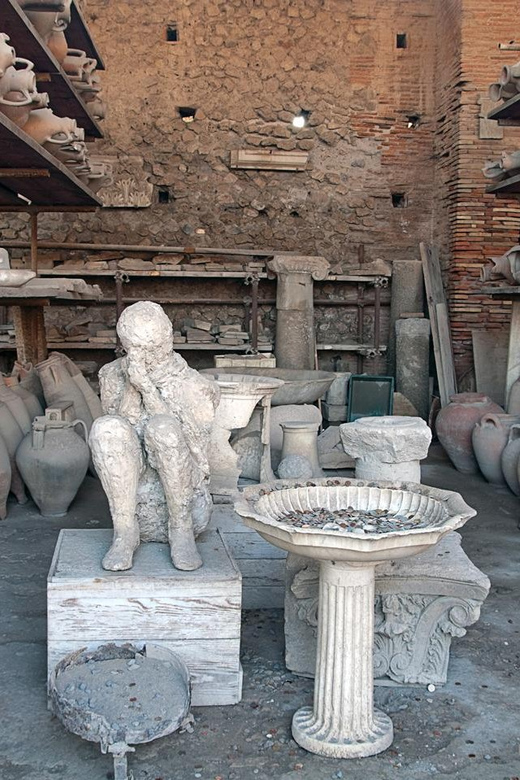
The casts of the victims are among Pompeii’s most powerful and difficult sights. They connect the ancient streets to the human cost of the eruption and make the disaster feel personal rather than abstract.
You should approach this part of the visit with some care. The casts are not simply another item on a sightseeing checklist. They can be disturbing, particularly for children or anyone uncomfortable with displays related to death.
The audioguide may help place what you see within the wider story of Pompeii, but the provided information does not promise extensive commentary on every cast. If this is the part of the site you most want to understand, check the audio content when you begin and allow extra time for reading any available on-site information.
This is also a good example of why independent touring can work well. You can spend a quiet few minutes here, move on, or return later without a group waiting for you. That freedom is one of the strongest reasons to choose a self-guided format.
How much can you cover in one day?
The ticket is valid for one day, which is useful because Pompeii is large and the points of interest are spread out. A one-day visit gives you room to combine major public buildings with selected houses and commercial spaces.
I would not treat the day as a race to see every listed feature. The map and route information are more useful when you use them to set priorities. You might choose frescoed houses, the baths, temples, a thermopolium, the theaters, the amphitheater, and the casts, then add smaller streets and shops as time allows.
The flexible format also suits different energy levels. You can spend more time in areas that interest you and less in those that do not. Families, photographers, independent history enthusiasts, and people who dislike fixed group schedules may appreciate this control.
Still, independence requires a little discipline. Without a set guide leading you from stop to stop, you need to keep an eye on time, use the map, and decide when to move on. The site’s size is part of its appeal, but it can also leave you tired and unsure if you arrive without a plan.
What the audioguide adds, and where it falls short

The audioguide is included in English, French, German, Italian, Hebrew, Chinese, Russian, Spanish, and Portuguese. That range makes the package accessible to many international visitors, and the map gives you a physical reference while you listen.
I like the basic idea. Pompeii makes more sense when you know what you are looking at, and even short explanations can help distinguish a home from a shop, a bath from a temple, or a food counter from an ordinary room.
The important limitation is depth. One French-language booking described the audio as very brief and lacking information. That criticism does not make Pompeii less worthwhile, but it does change how you should judge the package. Think of the audioguide as a route companion and introduction, not a full archaeology course.
If you enjoy building your own understanding, you can use the audio as a starting point and spend time examining the site itself. If you want detailed stories, names, dates, and sustained historical interpretation, this may not provide enough explanation on its own.
Who will get the most from the $44 price?
I see this as a practical middle option between buying a basic ticket and joining a fully guided tour. You pay $44 per person for admission, queue protection, a map, and audio content, but you do not pay for transport, food, or a private guide.
The package suits you best if:
- You want to visit Pompeii independently.
- You value avoiding the ticket line.
- You prefer an audioguide to a live group.
- You need audio in one of the nine listed languages.
- You have one day and want route suggestions.
- You are comfortable walking through a very large site without a guide beside you.
It is less suited to you if you want someone to explain every major building in detail or arrange transport from another town. The experience provider is MOTORENT S.R.L., and the included host or greeter helps with the start of the visit, but the day itself remains self-guided.
The high overall score of 4.7 from 17 ratings suggests that the basic arrangement works well for many people. Still, the lower French-language assessment gives you a useful warning: the ancient site is the star, while the audio content may be fairly limited.
Booking details that affect your decision
You can cancel up to 24 hours in advance for a full refund. That gives you some protection if your Campania plans change.
You can also reserve now and pay later, which keeps your money available while you finalize your schedule. The ticket is valid for one day, and you check availability for the available starting times.
The host or greeter languages are English, Italian, Spanish, and French. The audioguide has a wider language list, including German, Hebrew, Chinese, Russian, and Portuguese.
Remember the key exclusions: there is no transfer, no included live guide, and no food or drink. Those are not minor details if you are staying outside Pompeii or expecting a fully organized excursion.
Should you book this Pompeii experience?
Book it if you want an easy entry arrangement and the freedom to explore at your own pace. The skip-the-ticket-line access, one-day validity, map, and broad audioguide language selection give you a sensible way to handle a huge archaeological site without joining a fixed group.
Think twice if your main goal is detailed historical interpretation. The audio may be concise, and no live guide is included. In that case, the $44 price may be better spent on a more heavily guided option.
For independent visitors who arrive prepared with comfortable shoes, identification, and a simple route plan, this is a useful Pompeii package. Just keep your expectations clear: you are buying convenient access and basic orientation, not an expert-led tour.
FAQ
How much does the Pompeii tour cost?
The price is $44 per person.
What is included in the Pompeii package?
The package includes entrance to the Pompeii ruins, an audioguide, and an updated map to help you plan your visit.
Is transportation included?
No. Transfers are not included, so you must arrange your own transportation to the meeting point and Pompeii.
Where is the meeting point?
The meeting point is next to Bar De Vivo.
Is a live guide included?
No. A host or greeter may assist in English, Italian, Spanish, or French, but the Pompeii visit itself is self-guided.
What languages are available for the audioguide?
The audioguide is available in English, French, German, Italian, Hebrew, Chinese, Russian, Spanish, and Portuguese.
Can I cancel or pay later?
You can cancel up to 24 hours in advance for a full refund. You can also reserve now and pay later.
New audio tours around Pompei Campania
- Pompeii: Pre-reserved ticket with audio guide★ 3.2 · 15 reviews
- Pompeii: Skip-the-Line Ticket with Audio Guide and Map★ 3.9 · 5 reviews
- Pompeii, skip-the-line ticket with smartphone audio guide on App★ 3.0 · 4 reviews
- Pompeii: Skip-the-Line Ticket with Audio Guide and Map★ 4.0 · 117 reviews
- Pompeii: Skip-the-Line Ticket with Audio Guide and Map★ 4.0 · 14 reviews
- Pompeii: Skip the Line Ticket + Audioguide★ 3.3 · 13 reviews
- Pompeii Skip-the-Line Ticket and Audioguide★ 4.2 · 7 reviews
- Pompeii: Skip The Line Entrance Tickets + Audioguides★ 3.2 · 4 reviews
Pompeii Audio Tours, compared.

Pompeii: Skip-the-line Entry Ticket with Audio Guide & Map
Read our review →
Pompeii: Skip-the-Line Entry Ticket with Digital Guide App
Read our review →
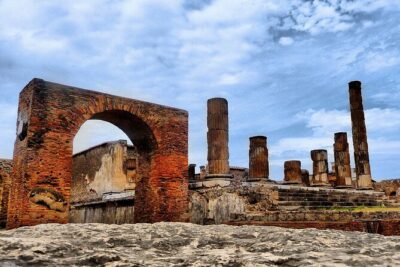
Pompeii: Skip the line ticket (art) + audioguide + map
Read our review →
From Pompeii: Vesuvius Entry with Transfer and Audioguide
Read our review →
Pompeii & Herculaneum: Skip-the-line & Digital Guide App
Read our review →
Herculaneum and Pompeii in one day: Audioguides + Tkts (art)
Read our review →
Browse the lists this tour appears in