

Review · POMPEII
Pompeii: Skip-the-Line Ticket with Audio Guide and Map
Pompeii is not a quick collection of ruins. It is a vast ancient city, covering about 66 hectares, where streets lead to frescoed houses, temples, baths, shops, theaters, and an amphitheater. This self-guided format gives you time to choose what matters to you instead of following a group at someone else’s pace.
I like the simple pairing of an audio guide and updated map, and I like that the ticket is valid for one day. You can build a route that lasts a few hours or stay from 10 a.m. to 5 p.m., as one independent visitor did. The catch is that the map can be tricky, some map points may not match the audio guide, and the skip-the-line benefit may be limited when there is no ticket queue.
Key points to know before booking
- Pompeii is enormous: Plan your route before you start, or you may spend too much time wandering between distant areas.
- You set the pace: The ticket and audio guide let you explore without a group, fixed stops, or a live guide.
- The audio guide covers nine languages: English, Chinese, French, Italian, German, Hebrew, Russian, Spanish, and Portuguese.
- The map helps, but it is not perfect: Some points can be hard to match with the audio content.
- Bring water and sun protection: Pompeii is exposed, warm, and demanding under the sun.
- Pack light: Large bags and luggage are not allowed, and the site is not suitable for people with mobility impairments.
Pompeii is a city, not a single monument
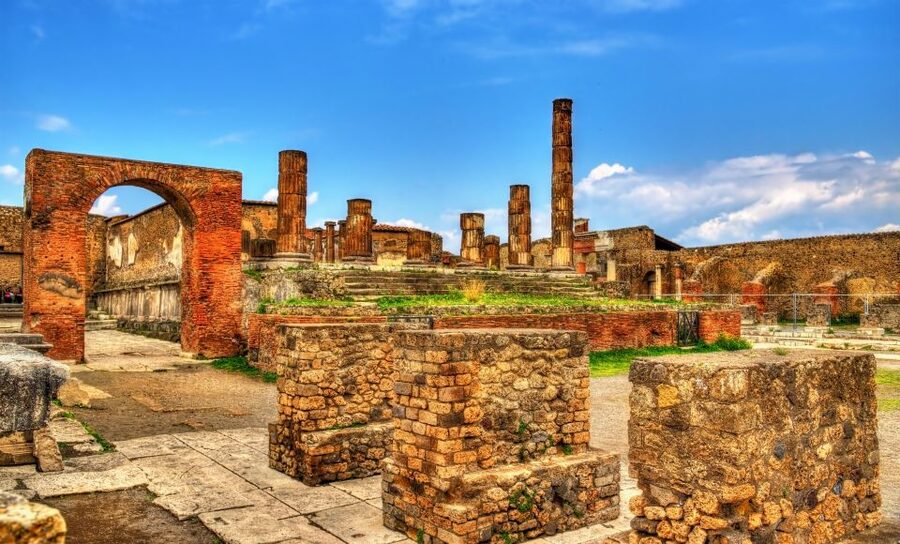
The most important thing to understand before you buy this ticket is the scale of Pompeii. You are not walking into one building, taking a few photos, and leaving. You are entering an ancient Roman city with streets, neighborhoods, public buildings, homes, entertainment spaces, and commercial areas spread across a large archaeological site.
That size is the reason an audio guide and map can be useful. Without some plan, it is easy to miss a major building or waste energy retracing your steps. The supplied route information gives you a framework, while the self-guided setup lets you pause whenever a painted wall, shop counter, or street scene catches your eye.
The city’s appeal comes from its ordinary details. Along with grand temples and theaters, you can see thermopolia, the ancient equivalent of quick food counters, as well as shops, baths, and houses with frescoes. These remains help you picture daily life rather than only Roman monuments built for rulers.
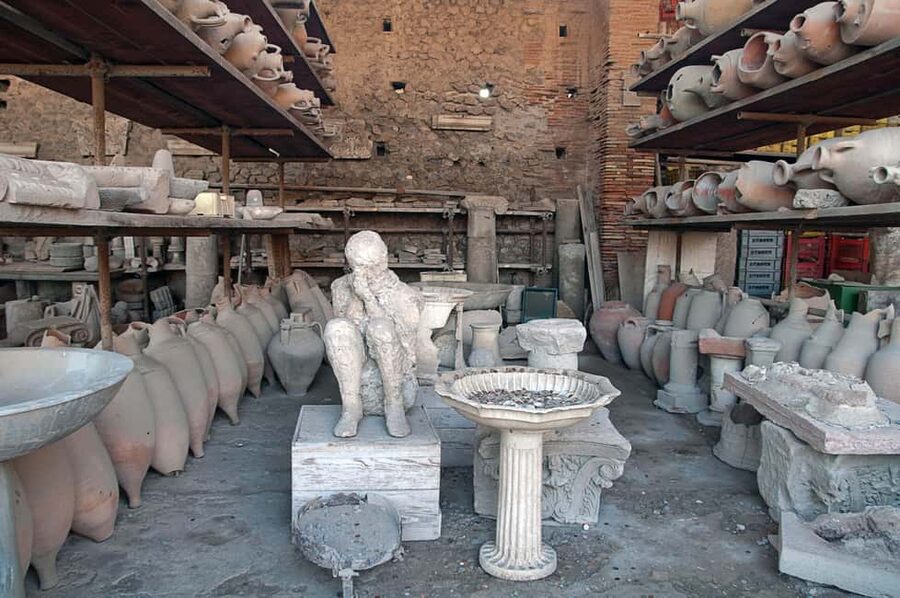
The visit also includes casts of people who died during the eruption. They can be upsetting, especially for children, but they are an important part of the site and a reminder that Pompeii was a lived-in city, not an open-air museum assembled for display.
More Skip-the-Line Audio Tours in Pompei Campania:
- Pompeii: Skip-the-line Entry Ticket with Audio Guide & Map
★ 3.9 · 3,153 reviews - Pompeii: Skip-the-Line Entry Ticket with Digital Guide App
★ 4.1 · 770 reviews - Pompeii: Skip-the-Line Entry & Audioguide
★ 3.8 · 225 reviews
What the one-day ticket actually gives you
For $44 per person, the package includes Pompeii admission, the audio guide, and an updated map. You do not pay separately for food or drinks, so those costs are yours to plan around.
The ticket is valid for one day, and starting times depend on availability. That gives you useful flexibility. You can make Pompeii a short morning visit, spend most of the day there, or return to the site’s main areas during the same day if your schedule allows.
The value depends on how much independence you want. If you prefer a live guide who explains every stop and keeps the group moving, this is not that kind of experience. If you want to choose your own route and avoid paying for a full guided tour, the combination is more appealing.
The skip-the-line feature also needs a realistic reading. It can save time when the ticket queue is long, but it does not mean every part of entry is instant. At 9 a.m., one person found no line for regular entry but still had to queue for children’s tickets. If you are visiting at a quiet time, the ticket’s main value may be the convenience of having admission arranged, not a dramatic wait reduction.
Following Pompeii’s streets with the audio guide
The audio guide is available in English, Chinese, French, Italian, German, Hebrew, Russian, Spanish, and Portuguese. That is a strong choice of languages for an international site.
The guide is meant to help you make sense of what you see. Pompeii has few information panels compared with the number of houses, public buildings, and street remains. An audio explanation can tell you why a room matters, what a building was used for, or how to read the remains in front of you.
The system is described as easy to operate, and the audio guide is handed over quickly after the ticket process. That matters because the site can feel confusing at first. You want to start exploring, not spend your first half hour sorting out basic access.
Still, this is not a perfect substitute for a live person. The audio guide cannot answer a question about a particular detail or change the route when a building is closed or difficult to reach. One practical weakness is that some points shown on the map do not appear to have a matching audio explanation.
Bring your own expectations as well as your device. The information is a support, not a complete lesson on every corner of Pompeii. Use it for the main highlights, then allow yourself to look around without listening constantly. Pompeii rewards both focused explanations and quiet observation.
Using the map without losing half your morning
The updated map is one of the most useful parts of this package, but it requires attention. Pompeii’s streets can look similar, and the sheer number of buildings makes a random walk tiring.
Before setting off, look at the route and choose a few priorities. A sensible plan might include a selection of frescoed domus, a public bath, a temple, a thermopolium, a theater, the victim casts, and the amphitheater. You do not have to see every building to have a satisfying visit.
The map may take time to understand. Some points can be hard to connect with the audio guide, and unclear signing inside the archaeological site adds to the problem. I would not treat the printed map as a perfect turn-by-turn navigation tool. Use it to understand the broad layout, then confirm your position as you go.
A slower route is often better than a heroic one. Pompeii is large enough that trying to cover every lane can leave you hot, tired, and unable to enjoy the last section. Pick the areas that interest you most, and leave room for unplanned discoveries.
More audio tours around Pompei Campania:
- Pompeii: Skip-the-Line Ticket with Audio Guide and Map
★ 4.0 · 117 reviews - From Pompeii: Vesuvius Entry with Transfer and Audioguide
★ 4.2 · 74 reviews - Pompeii & Herculaneum: Skip-the-line & Digital Guide App
★ 4.0 · 35 reviews - Herculaneum and Pompeii in one day: Audioguides + Tkts (art)
★ 3.7 · 22 reviews
The houses, baths, shops, and food counters
The frescoed homes, known as domus, are among the strongest reasons to visit Pompeii. Their walls and rooms show how private Roman spaces were arranged and decorated. Even when only parts of a house survive, the combination of rooms, courtyards, painted surfaces, and worn thresholds can make the city feel remarkably immediate.
The baths show another side of public life. These were not simply places to wash. They were part of the city’s social world, and their surviving rooms help you understand how Romans spent time outside the home.
The shops and thermopolia offer a more everyday view. A thermopolium served prepared food and drink, making it an ancient fast-food counter. Seeing these spaces beside homes and public buildings helps you picture Pompeii as a working town, not just a collection of elegant villas.
Your audio guide should be most useful here, because bare walls and foundations can be hard to read without context. Take time to compare the explanation with the physical remains. The best moments often come when the layout suddenly makes sense.
Temples, theaters, and the amphitheater

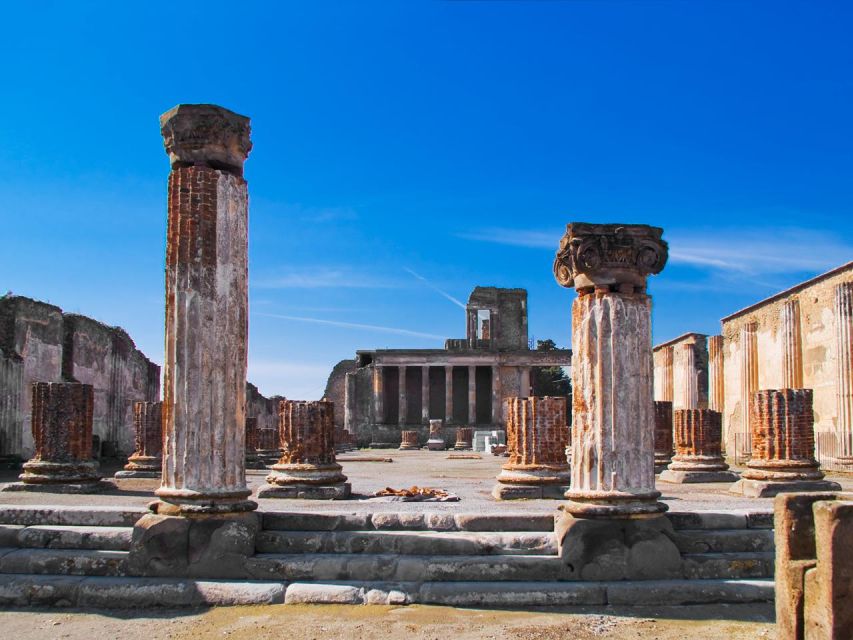
Pompeii’s temples give the visit a religious and civic dimension. Their remains can be less visually complete than the houses, but they show how public space was organized around worship and community life.
The theaters add a different kind of energy. Even without a performance, the shape of the seating and stage area makes it easier to imagine crowds gathering for entertainment. These stops are also useful breaks from the residential streets because they give you a sense of Pompeii’s public scale.
The amphitheater is one of the site’s major draws and one of the best-preserved Roman amphitheaters. It is not just another large ruin to check off. Its size and structure show how many people the city could bring together for public spectacles.
You can visit these areas independently, but the map matters here. A poor route can send you across the site more than once. Check the layout early, then group nearby highlights together.
Heat, water, shoes, and the missing restaurant stop
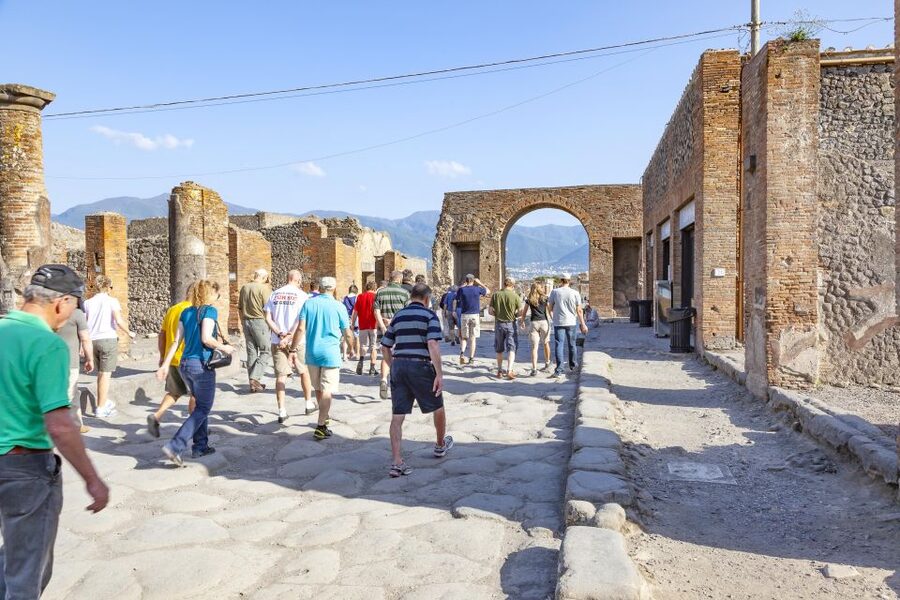
The practical advice is plain: wear comfortable shoes, carry water, and bring a hat and sunscreen. You will be walking over ancient streets and uneven surfaces, and much of the site is exposed.
Heat can change the quality of your visit. A warm day may make the first few hours enjoyable and the later sections exhausting. One person specifically warned that water is essential and that finding a restaurant can be difficult. Do not assume you can stroll out for lunch whenever you feel like it.
Food and drinks are not included. Pack what is allowed and plan your break before you become hungry. Large bags and luggage are not permitted, so travel light from the start.
The experience is listed as unsuitable for people with mobility impairments. That is important information, not a minor footnote. The ancient streets, long distances, and uneven archaeological remains can make the visit physically demanding.
How much time should you allow?
The activity is listed as lasting one day, but you choose how much of that day to use. A shorter visit can work if you focus on selected highlights. A longer visit gives you a better chance to see the city’s mix of homes, public buildings, shops, theaters, and the amphitheater without rushing.
A full-day approach is best for anyone who wants to explore independently and listen to the audio guide at a relaxed pace. One person used the self-guided format from 10 a.m. to 5 p.m. and found that the time was productive. That is a useful indication of what the ticket allows, though you should not feel obliged to stay that long.
If you have limited time, make your choices before entering. The site is too large for last-minute planning. Put your top priorities first, then add nearby buildings as your energy allows.
Who will get the most from this experience?
This ticket suits you if you like to control the day. You can stop for photos, skip a building that does not interest you, replay an explanation, or spend extra time in a frescoed home without holding up a group.
It also works well for visitors who prefer audio information to a live guide. The range of languages is generous, and the guide gives enough structure to make the ruins easier to understand.
Families should think carefully about the ticket arrangement. The regular entry line may be short at quiet times, while children’s tickets can still require a separate queue. If your children tire easily, the site’s size and heat may matter more than the skip-the-line promise.
This is less suitable if you want constant personal explanation, precise navigation, or a low-walking visit. The map has limitations, the signage can be unclear, and the site is not recommended for people with mobility impairments.
Cancellation and practical flexibility
You can cancel up to 24 hours before the scheduled experience for a full refund. You can also reserve now and pay later, which is useful when your Campania plans are still shifting.
A host or greeter is available in English, Spanish, French, or Italian. The audio guide has a wider language selection, including Chinese, German, Hebrew, Russian, and Portuguese.
Because starting times depend on availability, check the date and time before booking. The one-day validity gives you room to explore, but it does not remove the need to arrive prepared with water, sun protection, and a sensible route.
Should you book the Pompeii audio guide ticket?
I would book this experience if you want independent access with useful structure. The ticket removes some admission hassle, the audio guide fills gaps in the limited on-site information, and the map helps you plan a visit to a very large archaeological site.
I would not choose it if your priority is a live expert who manages the route from start to finish. I would also be cautious if you dislike maps, struggle with long walks, or need a fully accessible site.
At $44, the value is strongest for a visitor who intends to spend several hours at Pompeii and wants to explore without a group. Go early if you can, carry water, keep your bag small, and decide on your must-see areas before you enter. That preparation will do as much for your day as the skip-the-line ticket itself.
FAQ
What is included in the Pompeii ticket?
The package includes entrance to Pompeii, an audio guide, and an updated map.
How long is the ticket valid?
The ticket is valid for one day. Available starting times depend on the date you select.
Which languages are available for the audio guide?
The audio guide is available in English, Chinese, French, Italian, German, Hebrew, Russian, Spanish, and Portuguese.
Which languages are available from the host or greeter?
Host or greeter assistance is available in English, Spanish, French, and Italian.
Can I cancel for a full refund?
Yes. You can cancel up to 24 hours in advance for a full refund.
Can I reserve now and pay later?
Yes. The activity offers a reserve now and pay later option.
Can I bring luggage or a large bag?
No. Luggage and large bags are not allowed.
Is this experience suitable for people with mobility impairments?
No. The activity is listed as not suitable for people with mobility impairments.
New audio tours around Pompei Campania
- Pompeii Tour_Skip the line ticket + audioguide★ 4.7 · 17 reviews
- Pompeii: Pre-reserved ticket with audio guide★ 3.2 · 15 reviews
- Pompeii: Skip-the-Line Ticket with Audio Guide and Map★ 3.9 · 5 reviews
- Pompeii, skip-the-line ticket with smartphone audio guide on App★ 3.0 · 4 reviews
- Pompeii: Skip-the-Line Ticket with Audio Guide and Map★ 4.0 · 117 reviews
- Pompeii: Skip the Line Ticket + Audioguide★ 3.3 · 13 reviews
- Pompeii Skip-the-Line Ticket and Audioguide★ 4.2 · 7 reviews
- Pompeii: Skip The Line Entrance Tickets + Audioguides★ 3.2 · 4 reviews
Pompeii Audio Tours, compared.

Pompeii: Skip-the-line Entry Ticket with Audio Guide & Map
Read our review →
Pompeii: Skip-the-Line Entry Ticket with Digital Guide App
Read our review →
Pompeii: Skip the line ticket (art) + audioguide + map
Read our review →
From Pompeii: Vesuvius Entry with Transfer and Audioguide
Read our review →
Pompeii & Herculaneum: Skip-the-line & Digital Guide App
Read our review →
Herculaneum and Pompeii in one day: Audioguides + Tkts (art)
Read our review →
Browse the lists this tour appears in