

Review · USA
Sights of Downtown Houston Smartphone Audio Walking Tour
Houston’s downtown story begins at a small 1847 house and ends at the Cotton Exchange, a fitting route through a city that grew from a frontier settlement into America’s fourth-largest city. Along the way, Davis guides you past old homes, public buildings, churches, theaters, skyscrapers, and reminders of Houston’s cotton trade.
I like the flat, flexible route and the way it brings lesser-known buildings into the picture, not just the tallest towers. I also like the low price, GPS map, and freedom to start when you wish. The main caution is the app: location-triggered narration may not always work, so you should be ready to play stops manually.
Key points to know before you go

- Start at the 1847 Kellum-Noble House: Houston’s oldest-home setting gives the walk a strong historical opening.
- Davis provides the narration: Commentary covers Houston’s history, architecture, arts, religion, commerce, and public life.
- Expect a long but easy walk: The route is flat, yet completing it may mean about four miles of walking and plenty of standing.
- Download on Wi-Fi first: The tour is designed to work without mobile data once downloaded.
- The app needs patience: GPS playback can fail after you stop for photos or leave the screen, so manual controls matter.
- Finish at the Cotton Exchange: The route ends near Allen’s Landing and Houston’s old cotton-trading center.
Starting with Houston’s oldest homes
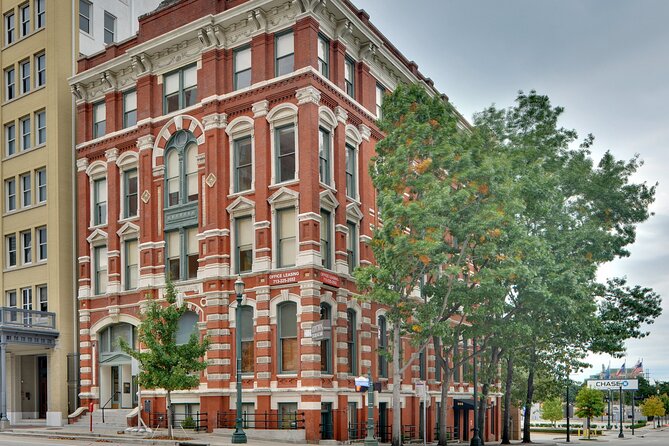
The tour starts at the Kellum-Noble House at 212 Dallas Street. Built in 1847, it is one of the city’s oldest homes and an excellent place to begin because it gives you a sense of Houston before the modern downtown skyline took over.
You do not need a live guide or a set departure time. Davis begins the story through your phone, while the GPS map shows the route and your position. That format works well if you like to pause, take photos, or stop for lunch without holding up a group.
From there, the route moves into a cluster of historic buildings connected with Houston’s early years. The museum complex is devoted to preserving and explaining the history of Houston and the surrounding area. Several historic structures sit within the grounds, so this part of the walk gives you more than a quick look at a single restored building.
You also hear about an old cabin believed to be one of the oldest surviving structures in Houston. The cabin matters because it connects the city’s present-day center with its early settlement period. It is the kind of modest structure that can be missed if you are focused only on office towers and major attractions.
Another stop introduces a house with three names. The audio explains why it acquired those names, which is a useful reminder that Houston’s buildings often changed owners, uses, or identities over time. The tour does not simply point at a facade and move on. It gives you a reason to look at the building more closely.
More Audio Walking Tours in the USA
- Self Guided Classic Freedom Trail Location Aware (GPS) Walking Audio Tour
★ 4.5 · 258 reviews - Cape Cod & Provincetown Self-Guided Driving & Walking Audio Tour
★ 4.0 · 207 reviews - Santa Fe Historic Downtown Smart Phone Audio App Self Guided GPS Walking Tour
★ 4.5 · 112 reviews
Sam Houston Park and the civic heart of downtown
Sam Houston Park was established in 1900 as Houston’s first public park. It forms a natural bridge between the city’s early residential past and its civic center.
I like this portion because the park gives the walk a change of pace. Historic buildings and open public space make it easier to understand how Houston has tried to preserve pieces of its past while continuing to build upward around them.
The audio then turns toward Houston City Hall, a major downtown landmark with its own place in the city’s development. You hear the story behind the building rather than just receiving a date or an architectural label. That extra context is useful when the surrounding blocks contain so many competing visual details.
The Julia Ideson Building follows. It was named for the first librarian of the Houston Public Library, and its presence adds a quieter cultural note to the civic section of the walk. This is a good example of the route’s range: you move from political power to public education and the value of libraries within a few blocks.
The tour also discusses a major music venue created through the work of local arts leaders. A group formed the Houston Music Hall Foundation to raise money and support the project. The story shows how Houston’s cultural life was built not only through city government, but also through local people who wanted a serious home for music and performance.
Another building on the route houses the Public Works and Engineering Department of the City of Houston. It may not be the sort of place you would seek out on your own, but it adds practical context. Cities are shaped by water, roads, buildings, and maintenance as much as by grand monuments.
Art Deco buildings, skyscrapers, and a surprising 1911 structure

Downtown Houston is a useful place to compare architectural styles, and the audio gives you several chances to do that. One Art Deco building, placed on the National Register of Historic Places in 1983, is described as an important example of early 20th-century commercial architecture in Houston.
A neighboring building provides a contrast. The narration points out that it is downtown Houston’s only complete example of a particular architectural style, then explains what makes it different. You need to pay attention at this point because the value is in comparing the details of two nearby facades rather than treating every old building as simply historic.
The route also includes a skyscraper completed in 1929 and designed by Crain & Coe in the Art Deco style. Its age and design help show how Houston’s downtown changed as commercial ambition, new construction methods, and the oil-era city began to reshape the center.
Another stop focuses on an eye-catching structure built in 1911. The tour uses it as another architectural marker, helping you notice how different periods sit side by side. Houston can feel visually modern at first glance, but this walk keeps drawing your attention to older layers.
You should bring your phone fully charged and use headphones if you prefer clear narration in city noise. Headphones are optional, and the audio can play from your device speaker, but busy streets and wind may make the speaker less practical.
Churches, hotels, and Houston’s performing arts
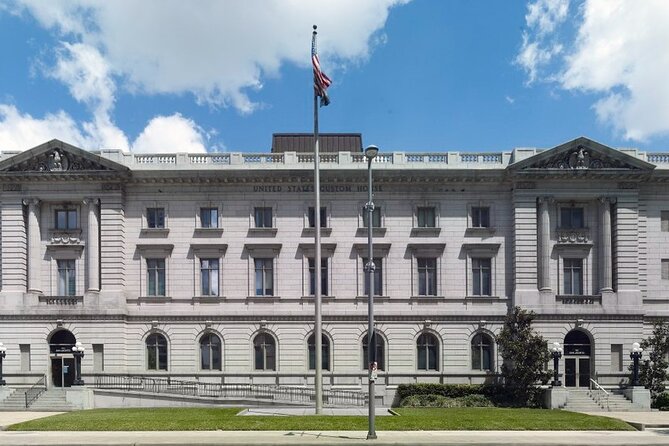
Christ Church Cathedral is one of the route’s most important historic stops. Founded in 1839, it is the oldest continually operating church in Houston. That fact gives the cathedral a special role in the tour, since it connects the present downtown with the city’s earliest civic and religious life.
The route then reaches a historic hotel built in 1913 and named after William Marsh Rice. The audio explains some of its past, giving you a chance to see how hospitality, business, and Houston’s growing wealth shaped downtown.
You also hear about a venue, the people who use it, and the gentleman honored in its name. The tour does not provide every detail in the stop summary, so you should treat this as one of the places where the audio itself supplies the important context.
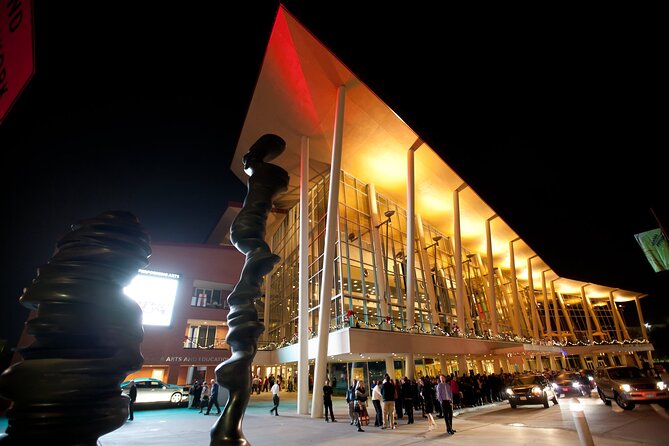
The next stop is home to one of the oldest and most respected theater companies in the United States. That is followed by a popular venue for a wide range of performing arts events, an important part of Houston’s cultural life.
This sequence works well because it shows that downtown is not only a business district. Theaters and performance halls keep the center active after office hours, and the tour explains how these institutions fit into the city’s identity.
The audio also visits an aquarium established in 2003, home to more than 200 species of marine animals. You should not assume the aquarium visit is included in the walking tour price. The route discusses the attraction from outside, making it part of the downtown story rather than a separate admission activity.
More Smartphone Audio Tours in the USA
- Self-Guided GPS Audio E-Bike Tour Hawaii Volcanoes National Park
★ 4.5 · 131 reviews - Ultimate Portland Self-Guided Driving GPS Audio Tour
★ 4.0 · 56 reviews - Birmingham Civil Rights Walk of Freedom Smartphone Audio App Tour
★ 5.0 · 40 reviews - Self Guided GPS Audio Driving Tour Acadia NP From Hulls Cove VC
★ 4.0 · 25 reviews
Buffalo Bayou, Old Town, and the city’s changing center

Buffalo Bayou is one of the key physical features of the Houston area, and the tour gives it a place in the story. The bayou helps explain why this location mattered and how waterways influenced the growth of Houston.
The route also reaches the Old Town area, known for its mix of restaurants, bars, shops, and entertainment venues. The narration explains how the area came to be. This is a useful stop if you want to connect the city’s older commercial roots with its current social life.
The audio then takes you toward a grand theater designed in the Art Deco style. The stop promises an explanation of what makes the theater notable, so look closely at the exterior while the narration plays. Art Deco buildings reward attention to entrances, symmetry, ornament, and the way their lines direct your eyes upward.
The Harris County courthouse adds another civic landmark. It is an important example of early 20th-century public architecture in Texas. Together, the courthouse, City Hall, library, and public works building show different sides of government and public service.
This section also requires some patience with the walking pace. The route is flat, but one detailed account estimated about four miles of walking and warned that the amount of standing can be tiring. You should wear comfortable shoes and allow extra time if you plan to photograph buildings or stop along the way.
Allen’s Landing and Houston’s cotton trade
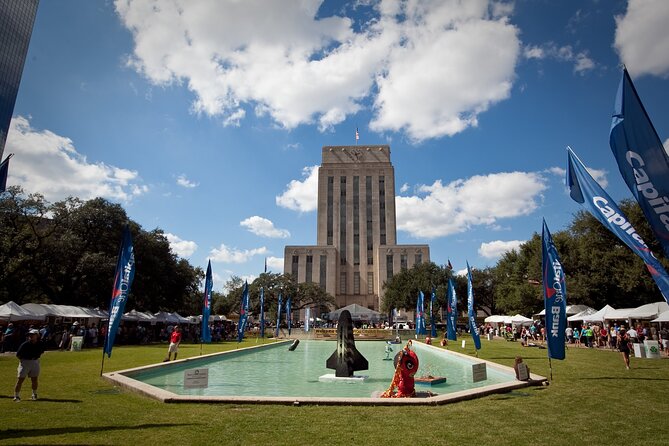
Near the end, the tour reaches Allen’s Landing. Here, Augustus Chapman Allen gives a first-person account in a recorded rendition of the landing’s history. That storytelling device adds a different voice to the usual audio narration and connects the place with the Allen brothers, who played a central role in Houston’s founding story.
The final stop is the Houston Cotton Exchange and Board of Trade at 202 Travis Street. Built in 1884, this impressive structure was once the trading center for Houston’s cotton industry.
Ending at the Cotton Exchange gives the route a clear shape. You begin with an early home, follow Houston through parks, civic buildings, culture, religion, architecture, and waterways, then finish with the trade that helped drive the city’s growth.
The tour provides turn-by-turn instructions for returning to the first stop. That is handy if your car, hotel, or transit connection is near the starting point. The stated ending point is useful for planning, since you do not simply finish somewhere on an unnamed downtown block.
How the self-guided app works in real use
The tour is designed for a smartphone or tablet. You download it over Wi-Fi before setting out, then use the live GPS map during the walk without using mobile data. That is a real benefit if you have a limited data plan or do not want to depend on a strong signal downtown.
At each point of interest, the commentary is supposed to play automatically when you reach the correct location. In practice, GPS triggering can be unreliable on some devices. Location permissions and phone settings may affect it, and the app may return to its main screen after you leave it to take a photo.
My practical advice is simple: check location permissions before leaving, keep the app easy to reopen, and learn where the manual play controls are. If automatic playback works, the tour feels smooth. If it does not, you can still complete the route by starting each recording yourself.
That weakness matters because the app is the guide. There is no live person to correct a missed stop or explain a confusing turn. The route map and directions help, but you need to stay alert at intersections and confirm that the next stop has loaded.
The activity is private in the sense that only your group participates. You are not joining a scheduled crowd, and the tour remains yours to use on flexible dates. The stated operating hours cover every day from midnight to 11:30 p.m., so you have wide freedom in choosing a start time.
Is $10.99 good value?

At $10.99 per person, this is inexpensive for a two-to-three-hour introduction to downtown Houston. You are paying mainly for the route, narration, historical context, and convenience of a map in your hand. There is no separate live guide, transportation, attraction admission, or included smartphone.
The value is strongest if you would otherwise wander downtown without knowing what you are seeing. The tour gives purpose to buildings that can look ordinary from the sidewalk, and it covers a broad range of subjects: early settlement, public spaces, government, architecture, religion, entertainment, marine life, waterways, and cotton commerce.
The price is less appealing if you expect a polished app with perfect automatic playback. A failed GPS trigger does not erase the route’s content, but it does make the experience less carefree. You should view the low price as compensation for doing some of the navigation and playback work yourself.
The tour is suitable for anyone with a moderate level of physical fitness. Service animals are allowed, and the route is near public transportation. The description does not promise a fully step-free or specialized accessible route, so anyone with mobility concerns should confirm details before booking.
Cancellation is allowed up to 24 hours before the experience for a full refund. Confirmation arrives at booking, and the tour is available in English only.
Who should book this Houston walk?
I would choose this tour if you like history, architecture, and city walks but do not need a live guide. It also suits independent visitors who want to begin late, stop often, or spread the route over more time since there is no fixed time limit.
It is a good fit for first-time visitors who want downtown orientation, especially if you are curious about Houston beyond its modern skyline. The route gives you a usable framework for understanding why the city has old homes, public parks, theaters, churches, bayou connections, and commercial towers in the same center.
I would be more cautious if you dislike troubleshooting apps or need narration to trigger perfectly. You should also skip it if four miles of flat walking and extended standing would be uncomfortable.
Final recommendation: buy it if you want control
Book the Sights of Downtown Houston Smartphone Audio Walking Tour if you want a low-cost, flexible way to see the city’s historic center and you are comfortable managing your phone. The strongest features are the wide subject range, flat route, private format, and final stop at the Cotton Exchange.
Before starting, download everything on Wi-Fi, charge your phone, allow location access, and be ready to play recordings manually. With those precautions, the tour offers a useful introduction to downtown Houston at a modest price. If you want a live person, flawless GPS, or a shorter walk, choose another format.
FAQ
How long does the Sights of Downtown Houston tour take?
The tour takes approximately 2 to 3 hours, though you can take as long as you like because there is no time limit.
Where does the tour start?
It starts at the Kellum-Noble House, 212 Dallas Street, Houston, Texas 77002.
Where does the tour end?
The route ends at the Houston Cotton Exchange and Board of Trade, 202 Travis Street, Houston, Texas 77002.
Is the tour guided by a live person?
No. Davis provides the audio commentary through the smartphone tour. Only your group participates, and there is no live guide.
Do I need mobile data during the walk?
No. You should download the tour over Wi-Fi before starting. Once downloaded, it is designed to work without a signal or mobile data.
Do headphones come with the tour?
No. Headphones are not included. They are optional because the audio can also play through your device’s speaker.
Is the walking route difficult?
The route is flat, but you should have a moderate level of physical fitness. The full walk may involve about four miles of walking and a fair amount of standing.
Is the tour available in languages other than English?
No. The tour is offered in English.
Can I cancel for a refund?
Yes. You can cancel up to 24 hours before the experience for a full refund.
New audio tours around the USA
- Beaches, Bites and Bavaria in Leavenworth: A Self-Guided Audio Tour★ 3.5 · 3 reviews
- Welcome to Fabulous Las Vegas Sign Self-Guided Audio Tour★ 5.0 · 2 reviews
- Hoover Dam and Lake Mead Self-Guided Audio Tour★ 5.0 · 3 reviews
- Las Vegas Day Trips: 3-Day Self-Guided Audio Tour★ 5.0 · 2 reviews
- Driving Lake Tahoe: A Self-Guided Audio Tour From Tahoe City to Incline Village★ 5.0 · 10 reviews
- Las Vegas Neon and Secrets: Self-Guided Audio Tour★ 5.0 · 3 reviews
- Baton Rouge Historic Downtown Self-Guided Audio Walking Tour★ 4.0 · 19 reviews
- Ultimate La Jolla Self-Guided Driving & Walking Audio Tour Bundle★ 3.5 · 9 reviews
USA Audio Tours, compared.

Los Angeles: Hop-On Hop-Off Bus Tour with Audio Guide
Read our review →
City Sightseeing Hop-On Hop-Off Bus Tour with Audio Guide
Read our review →
Medieval Torture Museum Ticket with Audio Guide and Ghost Hunting
Read our review →


San Francisco: Alcatraz, Ferry & Audio Tour w/ Night Option
Read our review →
Ultimate Acadia National Park Self-Guided Driving Audio Tour
Read our review →
Browse the lists this tour appears in