
Review · PHILADELPHIA
Philadelphia Historic Sites Self-Guided Walking Tour
The best thing about this Philadelphia walk is its freedom. You begin near City Hall, follow a GPS-guided route through the historic district, and finish near the Museum of the American Revolution. The app starts each story as you reach the right spot, so you can focus on the streets, buildings, and big ideas instead of staring at a map.
I like the pause-and-restart flexibility, especially if you want coffee, photos, or extra time at Independence Hall. I also like the offline access and low price. The main caution is that the audio can move ahead if you keep walking, and app setup problems can spoil the outing if you do not download everything before leaving Wi-Fi.
Key points at a glance
- More than 30 audio stories cover about 1.5 miles, with a stated walking time of one to two hours.
- The route links the Liberty Bell, Independence Square, Franklin’s sites, Elfreth’s Alley, and Christ Church in one historical walk.
- GPS triggers the audio automatically, giving you hands-free directions and narration.
- The app works offline after downloading, so you do not need mobile data during the walk.
- The $14.99 price is good for independent sightseeing, especially since access is advertised as lifetime and can be used again.
- Tickets to museums and attractions are not included, so extra stops can raise the total cost.
What this Philadelphia walk actually feels like

This is not a guided group tour with a person waiting at City Hall. You receive access to Action’s Tour Guide app, download the route, and meet it at the starting point yourself. The audio then leads you from one location to the next.
The walk moves through central Philadelphia’s most important colonial and Revolutionary-era places. You get the broad story of the city, from the Tea Tax and the Continental Congress to the Constitution, early presidents, Benjamin Franklin, slavery, and the long fight to make American freedom real for more people.
The route is designed for a quick introduction, not a full museum day. You can finish in roughly one to two hours if you keep moving. In practice, stopping for photos, reading signs, or entering an attraction can make it closer to two and a half hours.
The route is listed as more than 1.5 miles, though one user judged it closer to three or four miles when considering the full walking pattern. Plan for a proper city walk, not a quick hop between two blocks. Comfortable shoes matter.
More Audio Walking Tours in the USA
- Self Guided Classic Freedom Trail Location Aware (GPS) Walking Audio Tour
★ 4.5 · 258 reviews - Cape Cod & Provincetown Self-Guided Driving & Walking Audio Tour
★ 4.0 · 207 reviews - Santa Fe Historic Downtown Smart Phone Audio App Self Guided GPS Walking Tour
★ 4.5 · 112 reviews
Starting at City Hall and reaching the Liberty Bell
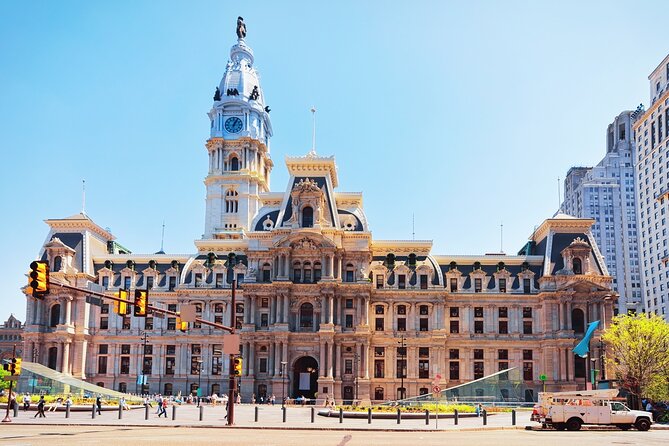
The listed starting point is Philadelphia City Hall at 1400 John F. Kennedy Boulevard. This is a practical starting place because it puts you near central transportation and lets the route move toward the historic district.
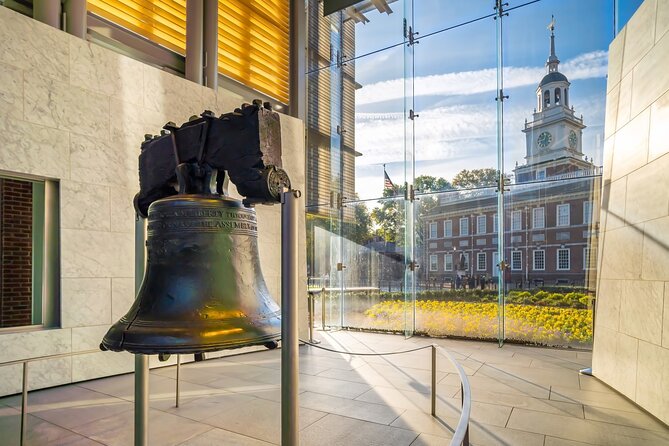
From there, the tour works toward the Liberty Bell Center. The bell receives about ten minutes of narration, covering why it cracked, why it became such a powerful symbol, and how later Americans connected it with the fights against slavery and for voting rights.
The Liberty Bell Center itself is free to enter, though you still need to allow time for the building and its displays. The audio tour is not a substitute for visiting inside. It gives you the historical frame, then you can decide how long to spend at the bell.
One practical tip: download the app and route while you still have a strong Wi-Fi or cellular connection. You should also test the password before setting off. A small number of users have had trouble entering the app or found that a password appeared to have been used already. Support is available, but it is much easier to solve this before you are standing on a busy sidewalk.
Betsy Ross, City Hall, and the road to independence
The next section brings you to the Betsy Ross House. The story focuses on the familiar account of Ross, George Washington, and the creation of the American flag. The house has an admission charge, so you can listen from outside or buy entry separately.
The story is useful because it shows how a modest Philadelphia home became linked with a national symbol. At the same time, the stop is brief. If the Betsy Ross story matters to you, plan extra time for the house instead of treating the audio stop as a full visit.
The route then points you toward Philadelphia City Hall and the political crisis that led to the Revolutionary War. You hear about George Washington, Benjamin Franklin, other colonial leaders, and the Tea Tax that helped push the colonies toward revolt.
This part works best as a bridge between the city you see today and the political arguments that shaped the 1700s. It is also a reminder that Philadelphia’s story is not confined to Independence Hall. Streets, churches, homes, and meeting places all played a role.
Independence Square and the birth of the United States
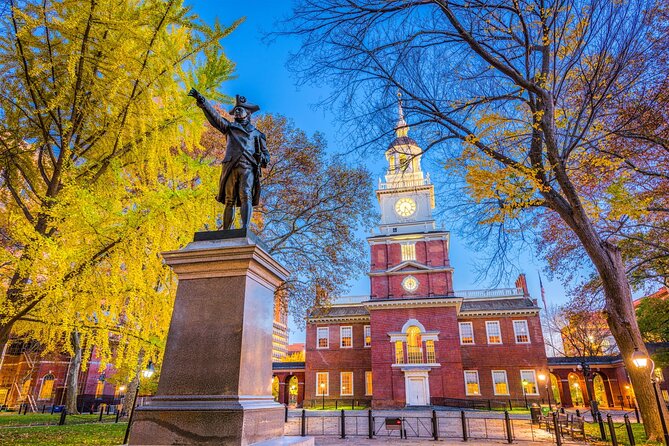
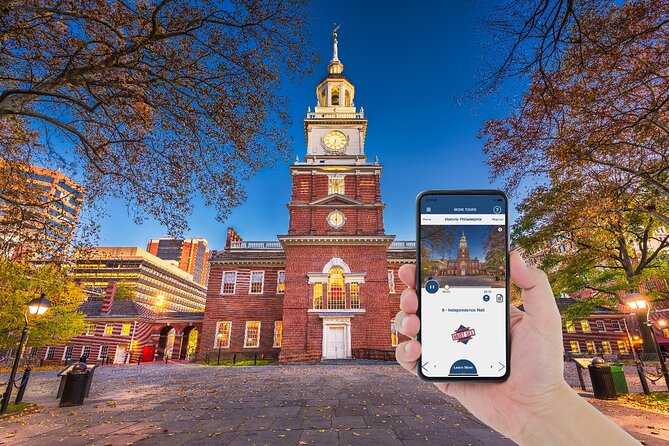
Independence Square is the emotional center of the walk. Here, the audio explains the First Continental Congress, the Second Continental Congress, the planning of military resistance, and the writing of the Declaration of Independence.
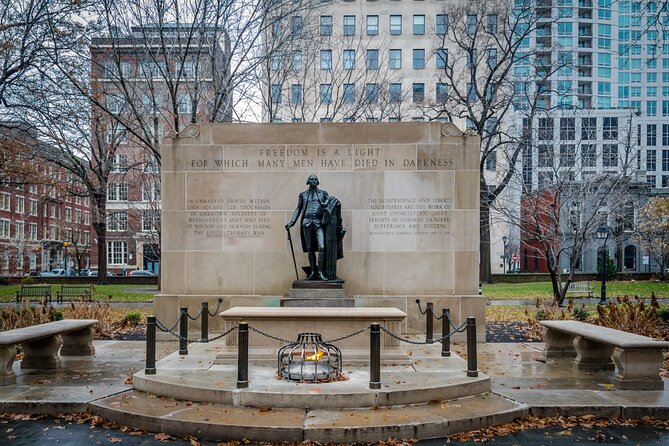
You also hear about John Hancock, Patrick Henry, John Adams, George Washington, and their roles in forming the new country. The stop includes the Washington statue in front of Independence Hall and uses it to tell more of Washington’s story.
The square itself is free to walk through. Independence Hall tours require a ticket or reservation, and that cost is not part of the $14.99 audio tour. If you want to enter, check the current ticket rules separately before your visit.
I like this arrangement because you can use the audio as a low-cost orientation before deciding which buildings deserve paid admission. The drawback is that the narration cannot give you the same sense of the interiors or the trained explanation you receive on a formal hall tour.
West Washington Square adds another short stop connected with the First Continental Congress. It helps place the political events in the city around you before the route turns back toward the main historic sights.
More History Audio Tours in the USA
- Savannah’s Historical District: A Self-Guided Audio Tour
★ 4.5 · 69 reviews - Salida History Audio Tour l A Self-Guided Wild West Experience
★ 5.0 · 41 reviews - Historic Bar Harbor Self-Guided Walking Audio Tour Guide
★ 4.5 · 38 reviews - Key West’s Old Town Treasures: A Self-Guided Audio Tour
★ 4.5 · 29 reviews
Franklin’s Philadelphia, from ideas to electricity
The Benjamin Franklin Museum stop shifts the focus from the Revolution to the complicated personality of Franklin. The narration covers his many interests, his experiments, and his role in public life. It also moves into the story of Benedict Arnold, Franklin’s opposite in the tour’s political drama.
The museum itself requires separate admission. If you do not go inside, the audio still gives you a reason to notice the site and understand why Franklin matters so much in Philadelphia.
Nearby, the President’s House site recalls the first presidential home used by George Washington and John Adams. It offers a more personal look at early national government and the realities of colonial-era life. The stop is short, so think of it as a focused explanation rather than an extended house visit.
The Declaration House, also known as the Graff House site, connects with Thomas Jefferson’s writing of the Declaration of Independence and Franklin’s editing help. The route lets you pass the place linked with the document and then adds context about Jefferson.
These Franklin and Jefferson stops are valuable because they keep the tour from treating the Revolution as a simple story of perfect heroes. You hear about ideas, ambition, personality, and conflict. Still, the short format means you should enter the museums if you want objects, rooms, and more detailed interpretation.
African American history and the limits of liberty
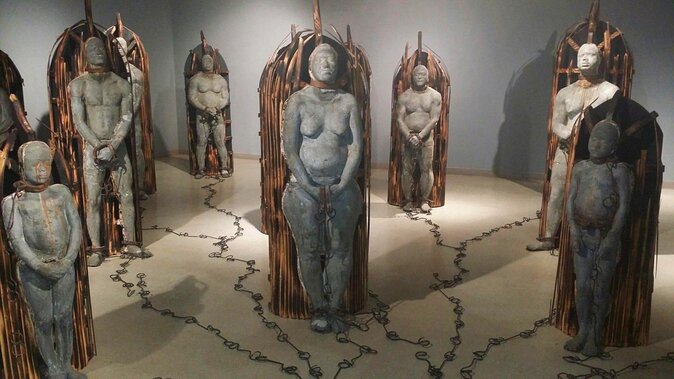
The stop near the African American Museum in Philadelphia adds an essential correction to the usual independence story. The audio addresses slavery and its impact on the early United States, along with figures such as Crispus Attucks.
This is one of the most important parts of the route. Philadelphia’s historic district can make freedom sound universal unless you ask who was excluded from it. The museum itself is not included, but it is a worthwhile extra choice if you want to give this subject more than a few minutes.
The route also passes Franklin Square, where you get more about Franklin’s books, ideas, and experiments. It is a natural place to pause, sit down, and catch up if you have been walking steadily.
The Bolt of Lightning Memorial then gives the tour a visual point for Franklin’s work with electricity. The audio explains what he was trying to learn and why he conducted the famous experiment. It is a short stop, but the memorial helps turn an abstract scientific story into something you can see in the city.
Constitution, money, and Franklin’s grave
The National Constitution Center receives a short explanation about the creation of the United States government and the rights set out for citizens. Like the African American Museum and the Franklin Museum, it requires separate admission.
This stop is useful if you want the tour to move beyond the Declaration of Independence. The Declaration announced a break with Britain, while the Constitution dealt with how the new nation would function. You get both parts in one walk.
The route continues to the United States Mint, where the story shifts to money. You hear about early gold and silver coins, then the materials used in American currency today. The Mint does not provide free entry through this tour, so treat it as an outside stop unless you buy admission separately.
Benjamin Franklin’s grave adds a quiet moment. The narration connects his legacy with the University of Pennsylvania and his belief in educating the next generation. The burial site is not just a final stop for Franklin. It links his public work with the institutions that continued his ideas.
Elfreth’s Alley and Christ Church
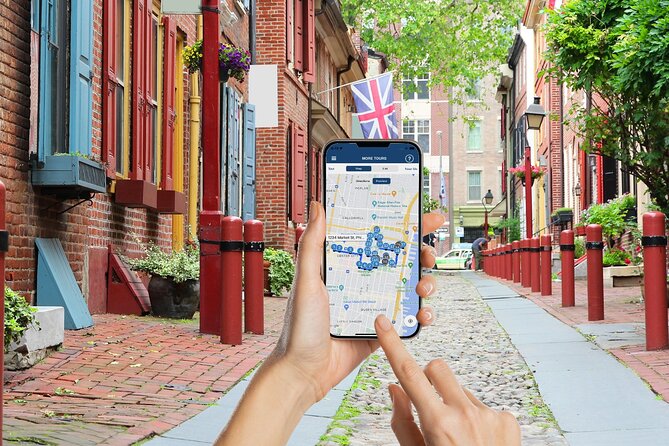
Elfreth’s Alley is one of the most visually appealing parts of the route. The narrow historic street offers a sense of Philadelphia’s early residential life, and its preserved appearance makes it a natural place for photos.
The audio presents it as an early center of the city and explains how it survived changing generations. You should remember that it is still a real historic street, not simply a photo backdrop. Keep your pace respectful and allow space for people who live or work nearby.
Christ Church follows. George Washington, Betsy Ross, and other Revolutionary figures worshipped here, and the building’s architecture gives the story a strong physical setting. The church is free to pass by, but opening arrangements and any interior access can vary, so treat the audio stop as an outside visit unless you confirm otherwise.
This final section is a good example of the tour’s main strength. It takes familiar names and attaches them to actual places. That makes the history easier to remember than a list of dates heard in a classroom.
Finishing near the Museum of the American Revolution
The official end point is the Museum of the American Revolution at 101 South Third Street. The tour ends near the museum rather than including admission, which gives you a sensible option for extending the day.
You can finish the audio route and then decide if you want a longer museum visit. That is useful for families and first-time visitors who want a quick city orientation before committing to another indoor attraction.
The tour has more than 30 stories and extra material for subjects that catch your interest. You can skip stops, pause the narration, or replay sections. The main thing to watch is the automatic playback. If you walk too quickly, the next story may begin before the previous one is finished.
The simple fix is to pause when you reach a stop and finish the current clip before moving on. You can also listen again later, since access is advertised as lifetime with no expiry.
App use, timing, and practical limits
The app is the guide, map, and route marker. Audio begins when you reach the right GPS point, and the next story can start as you approach the next stop. This hands-free system works well if your phone has location access enabled and you follow the route at a normal walking pace.
Bring earbuds or headphones. They make the narration easier to hear and keep the experience less distracting on city streets. A couple can potentially share one tour by splitting headphones, which improves the value.
Use an iPhone with iOS 15 or later, an Android device running version 9 or later, or an iPad or tablet with GPS and cellular capability. You can use the same password on the number of devices matching the number of people booked.
The tour is private in the sense that only your group participates. No guide or other customers set the pace. That is ideal if your group wants to stop often, but it also means you must handle navigation and troubleshooting yourself.
The stated opening period is daily from 9 a.m. to 5 p.m. The app itself can be used on another day and over multiple days, so you do not need to rush through every stop in one outing. If you split the route, save your place and return when convenient.
Is $14.99 a fair price?
At $14.99 per person, this is a good buy if you want a low-cost introduction to central Philadelphia. You receive a route, automatic audio, offline maps, more than 30 stories, and the option to reuse the tour. A live private guide would cost much more, though it would also offer real-time answers and stronger storytelling control.
The price becomes less attractive if you plan to enter several museums and historic buildings. Admission is not included at the Betsy Ross House, Benjamin Franklin Museum, Declaration House, African American Museum, National Constitution Center, United States Mint, or Museum of the American Revolution.
You should think of the audio tour as a walking framework, not an all-inclusive sightseeing ticket. Its best value comes when you use it to see the main sites from outside, then choose one or two paid attractions that match your interests.
The current score is 3.9 out of 5 from 25 ratings. The strongest praise centers on easy directions, automatic GPS playback, useful history, and the ability to stop and start. The main problems are app access, limited detail for some listeners, and audio clips overlapping when the walker moves too fast.
Who should book this tour?
I would choose it for a first Philadelphia visit, a family that dislikes fixed schedules, or a solo visitor who wants clear direction without joining a group. It is also a smart option if you have only a few hours and want to cover the city’s main historic areas quickly.
It suits people who enjoy listening while walking and are comfortable using a phone app. It is less suitable if you want a historian beside you, extensive discussion at every site, or guaranteed access to museum interiors.
Do not try to drive the route. Philadelphia’s one-way streets can make the audio hard to follow from a car, and the route is designed for walking. Rain can also make the experience less pleasant, although the app itself still works if you decide to continue.
Should you book it?
Book this tour if you want an affordable, flexible way to connect Philadelphia’s major historic sites. Download it before you leave, carry headphones, keep your phone charged, and slow down enough to finish each story.
Skip it if app setup makes you uneasy or if your main goal is detailed indoor interpretation. In that case, spend the money on timed admissions and a live tour. For most independent visitors, though, this is a practical first pass through the city, with enough flexibility to make the route your own.
FAQ
How long does the Philadelphia Historic Sites Self-Guided Walking Tour take?
The stated duration is about one to two hours. If you stop for photos, food, or attractions, it can take around two and a half hours or longer.
How far is the walking route?
The route is more than 1.5 miles long and includes over 30 audio stories. Allow extra distance if you make side trips or walk back to sites.
Where does the tour start?
It starts at Philadelphia City Hall, at 1400 John F. Kennedy Boulevard, Philadelphia, Pennsylvania 19107.
Where does the tour end?
It ends near the Museum of the American Revolution at 101 South Third Street, Philadelphia, Pennsylvania 19106.
Is a live guide included?
No. This is a private self-guided activity. You follow the route and listen through Action’s Tour Guide app.
Does the app work without internet?
Yes. You must download the tour while you have strong Wi-Fi or cellular service. After that, the route works offline.
Are attraction tickets included?
No. Entry tickets, reservations, and attraction passes are not included in the $14.99 price.
Can I pause and resume the tour?
Yes. You can pause, restart, skip stories, take breaks, and return to the tour on another day.
Can I use the tour more than once?
Yes. Access is advertised as lifetime with no expiry, so you can use it on future trips and replay the stories.
What should I bring?
Bring a charged compatible phone and headphones or earbuds. You should also download the app, route, and access information before reaching the starting point.
More Self-Guided Audio Tours in the USA
- Gettysburg Battlefield Self-Guided Driving Audio Tour
★ 4.5 · 910 reviews - Joshua Tree National Park Self-Guided Driving Audio Tour
★ 4.5 · 762 reviews - Ultimate Acadia National Park Self-Guided Driving Audio Tour
★ 4.0 · 521 reviews - Ultimate Lake Tahoe Self-Guided Driving Audio Tour
★ 4.5 · 435 reviews
New audio tours around the USA
- Beaches, Bites and Bavaria in Leavenworth: A Self-Guided Audio Tour★ 3.5 · 3 reviews
- Welcome to Fabulous Las Vegas Sign Self-Guided Audio Tour★ 5.0 · 2 reviews
- Hoover Dam and Lake Mead Self-Guided Audio Tour★ 5.0 · 3 reviews
- Las Vegas Day Trips: 3-Day Self-Guided Audio Tour★ 5.0 · 2 reviews
- Driving Lake Tahoe: A Self-Guided Audio Tour From Tahoe City to Incline Village★ 5.0 · 10 reviews
- Las Vegas Neon and Secrets: Self-Guided Audio Tour★ 5.0 · 3 reviews
- Baton Rouge Historic Downtown Self-Guided Audio Walking Tour★ 4.0 · 19 reviews
- Ultimate La Jolla Self-Guided Driving & Walking Audio Tour Bundle★ 3.5 · 9 reviews
Philadelphia Audio Tours, compared.

Museum of the American Revolution Admission Ticket with Audio Guided Option
Read our review →
Historic Sites of Philadelphia Self-Guided Walking Audio Tour
Read our review →
Art and Controversy: An audio tour of Philadelphia’s most infamous art scandals
Read our review →Browse the lists this tour appears in