
Review · MOAB
Canyonlands National Park Self-Guided Driving Audio Tour
Canyonlands is easy to admire and surprisingly easy to miss. This self-guided drive helps you notice the smaller stories behind the giant views, from living biological soil crust to the cowboys who named local cliffs and springs. The audio route covers the Island in the Sky area, with GPS-triggered narration and offline maps.
I especially like the private, go-at-your-own-pace format and the fact that one $16.99 purchase covers a carload of up to four people. I also like the practical route advice, including where to pull over, which walks are short, and why you should bring food and water. The main concern is technical: you must download and activate the tour before reaching areas with weak or no service.
Key things to know before you go
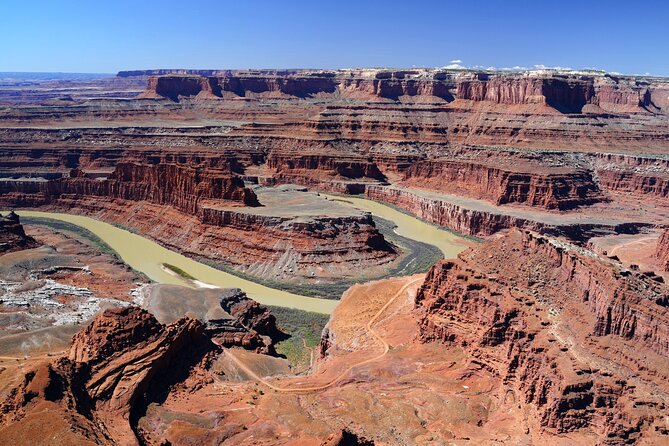
- More than 62 miles and 37 audio stories: The route points out major overlooks, geological features, Native American granaries, rivers, arches, and cowboy lore.
- GPS-triggered narration: Stories begin as you reach the right location, so you can keep your hands on the wheel and your eyes on the road.
- The audio itself takes about one to two hours: Your full outing can take much longer once you add stops, walks, photos, meals, and slower driving.
- One purchase covers up to four people: At $16.99 per group, the price is especially good for a family or small group sharing one vehicle.
- Download before entering the park: The app works offline after setup, but access codes and the tour download require a strong connection.
- The park entrance pass is separate: You must arrange the required Canyonlands entry permit on your own.
What this Canyonlands drive actually covers

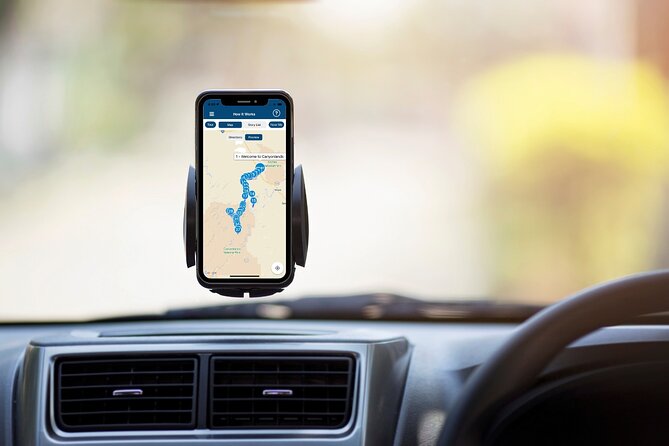
This is not a guided van trip and no guide meets you at the starting point. You drive your own vehicle, open the Action Tour Guide app, and follow the route from the Moab Giants Cafe on UT-313 toward Grand View Point.
The tour focuses on Canyonlands National Park’s Island in the Sky district. That is important because Canyonlands is a huge park with several distinct areas. The Needles, the Maze, Horseshoe Canyon, and Cataract Canyon are not all connected by one simple sightseeing road. This route gives you a focused way to explore the Island in the Sky area while adding context about the broader park.
The audio content mixes geology, local stories, practical directions, and descriptions of what you are seeing. The narration also includes music and side notes, which helps the drive feel less like a string of map instructions.
The listed tour time is about one to two hours, but do not treat that as the length of your entire visit. One audio story may take only a few minutes, while Mesa Arch, Murphy Point, Grand View Point, and other stops deserve time outside the car. A full run of the recommended road, with stops and breaks, can take several hours.
More Self-Guided Audio Tours in the USA
- Gettysburg Battlefield Self-Guided Driving Audio Tour
★ 4.5 · 910 reviews - Joshua Tree National Park Self-Guided Driving Audio Tour
★ 4.5 · 762 reviews - Ultimate Acadia National Park Self-Guided Driving Audio Tour
★ 4.0 · 521 reviews
Start at the Neck and learn the park’s shape
The route begins around the Neck, the narrow strip of high ground connecting Island in the Sky to other mesas. This is a useful first lesson because it explains why the district feels so exposed and separate from the lowlands below.
Canyonlands is not one single canyon viewed from one rim. The Colorado River and Green River have cut a broad network of canyons, mesas, and cliffs. From Island in the Sky, you look out across a huge area rather than simply down into one gorge.
The app starts automatically when you reach the first story point. You can pause, stop for a snack, or take a side trip and return later. The lifetime access also means you can use the tour again on another visit without worrying about an expiration date.
White Rim views and living desert soil
One of the early themes is the pull of the White Rim and the temptation to wander off the marked path. The audio explains biological soil crust, a living surface found throughout Canyonlands, Arches, and the Moab area.
This is more than a technical footnote. In a dry desert, a fragile crust can take years to recover after being damaged. The reminder gives you a better reason to stay on established paths instead of treating the open ground as harmless sand.
The White Rim itself is also a good example of Canyonlands scale. From above, the pale rock forms a broad band around the lower canyons. You will get the best sense of the region by stopping often, rather than rushing from one GPS point to the next.
Rivers, canyons, and the Green River Overlook
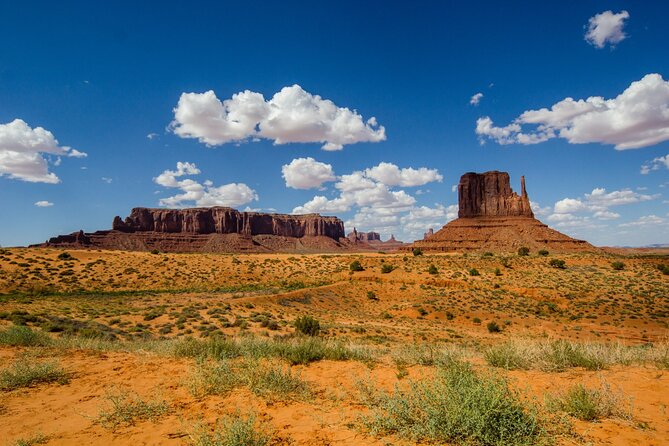
The route introduces Cataract Canyon, a 46-mile canyon carved by the Colorado River within Canyonlands National Park and Glen Canyon National Recreation Area. You will not explore all of Cataract Canyon from the roadside, but the story helps you understand the force of the water below.
At Green River Overlook, the view shifts toward the Green River and the canyon walls it continues to shape. The river runs for 730 miles and is the largest stream in Utah. The narration also explains the likely connection between the river’s name and green soapstone along its banks.
This is where the audio format earns its keep. A dramatic view is easy to recognize, but a short explanation of the river’s role gives the scene a clearer meaning. You can stop the story, walk to the overlook, and take in the view without trying to read a long sign in the sun.
More Driving Audio Tours in the USA:
- Ultimate Lake Tahoe Self-Guided Driving Audio Tour
★ 4.5 · 435 reviews - Scenic Newport, RI Self-Guided Driving Audio Tour
★ 4.5 · 325 reviews - Arches National Park Self-Guided Driving Audio Tour
★ 4.5 · 288 reviews - Kauai Adventure Bundle: 4 Epic Audio Driving Tours
★ 4.5 · 211 reviews
The Visitor Center and practical planning
The route points out the Visitor Center as a useful place for supplies, bathrooms, and water bottles. Take this advice seriously. The park has limited infrastructure, and the drive can last much longer than the stated audio time.
Bring water, snacks, and a full tank of gas. One useful detail from the experience is that there are very few places inside the park to buy food. A later stop has a cafe and another has picnic tables, but you should not plan your entire day around finding a meal.
The Visitor Center is also a good place to check your timing. If you started late, want to add a longer walk, or are traveling with children, you may need to skip some stops rather than trying to force the entire route into a short afternoon.
Overlooks around Sevenmile Canyon
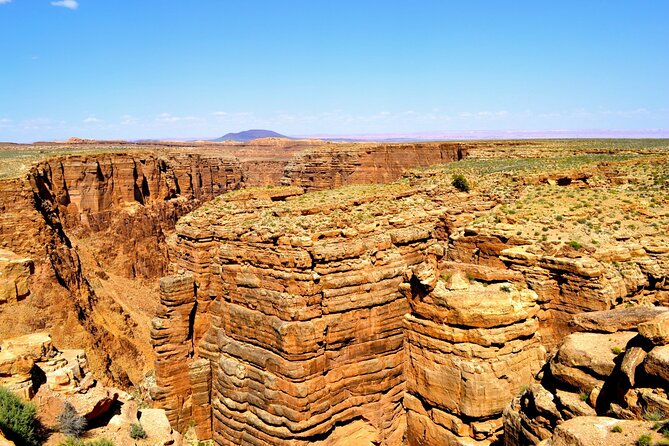
Several sections of the route focus on changing views rather than major hikes. Near the floor of Sevenmile Canyon, tall rock walls close in around the road. As you continue, the view opens toward the Merrimac and Monitor rock formations.
This kind of commentary helps with orientation. Without it, the road can feel like a long sequence of similar red and tan cliffs. With the narration, you know to watch for a change in the view and can slow down safely when a formation appears.
Plateau Viewpoint provides another useful pullout. It includes a spectacular view, an accessible toilet, and an information panel about anthropological work in the area. The practical details matter because they help you plan comfort breaks instead of discovering facilities by chance.
At one overlook, the view comes from three sides with little between you and the canyon. If heights make you uneasy, take care near the edge and listen to the description before stepping forward. Another stop has a paved short trail, a rail, and views of Buck Canyon and the La Sal Mountains, making it a better choice for anyone who wants scenery without a rough approach.
Murphy Point, cowboy names, and the stories behind places
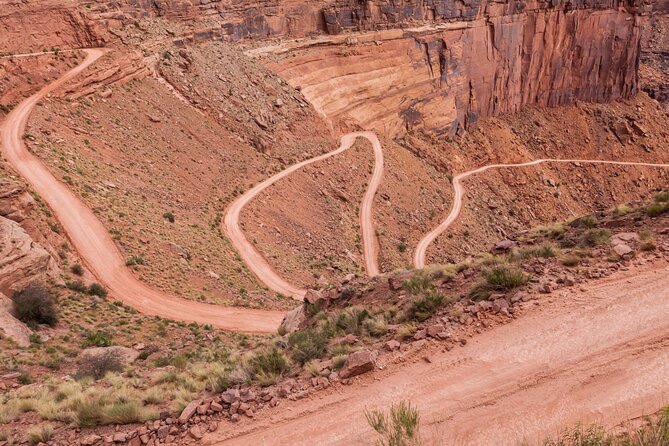
The walk to Murphy Point Overlook is described as an easy 3.5-mile round trip. The trail itself may not offer constant scenery, but the reward is a strong view of Stillwater Canyon and the Green River.
You should pay attention to the distance before committing. Three and a half miles is manageable for many people, but it is not a quick roadside stroll. If your priority is seeing several overlooks in one day, you may want to save this walk for a return visit.
The narration also explains why so many local names sound like they came from a ranching story. Cowboys and ranchers influenced the names of landmarks and trails, including a spring connected with Ned Chaffin’s family. These details give the place a human layer without pretending that every stop needs a dramatic tale.
Dead Horse Point is another example. The audio shares the local explanation for the name, involving wild mustangs, cowboys, and horses left behind after the desirable animals had been claimed. The story is brief, memorable, and well suited to a drive where you want context without a lecture.
Mesa Arch and the natural whale
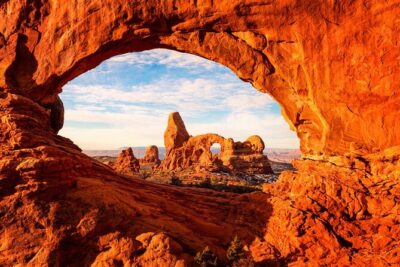
Mesa Arch is one of the route’s clear must-stop locations. From the parking area, a short trail leads to the arch, with juniper and pinyon trees along the way.
The arch frames the canyon country below, but it can become a quick photo stop if you let it. Give yourself enough time to walk out, look around, and notice how the trees and low vegetation contrast with the open rock beyond.
The route also points out a formation shaped like a giant whale. Its head is on the left side of the rock, and an easy one-mile walk follows the whale’s back. From the top, you can see Upheaval Dome.
The playful description works well here. It gives you something specific to look for, which makes a broad rock formation easier to read. You are not just driving past a wall of stone and hoping to guess what matters.
Granaries, Orange Cliffs, and geology in layers
Another stop highlights Native American granaries, some of them hundreds of years old. They can be seen from the base of the final hill on the route described. Treat them with care and do not approach in a way that could damage the structures.
The audio also explains the layers of rock visible throughout the park. In many places, those layers have remained largely undisturbed since they formed hundreds of millions of years ago. That gives the cliffs their stacked appearance and helps explain why one viewpoint can show several colors and textures at once.
Orange Cliffs brings the focus back to ranching history. Cowboys used the cliffs and referred to one section as Under the Ledge. It is a small detail, but these local names make the drive feel connected to the people who worked through this difficult country.
Big Mesa, Candlestick Tower, and helpful pullouts
Big Mesa Viewpoint is a good place for a short pause. The enormous mesa appears almost misplaced, as if someone set it down and walked away. The narration gives you a reason to stop instead of passing another broad view.
Candlestick Tower is easier to spot once you know what to seek: three tall rock forms rising in the distance, with layers that resemble a birthday cake and candles. The white, reddish-brown, and red bands show how varied the rock can look in one formation.
Some stops are built for a longer break. One overlook has a view of the Colorado River and a cafe where you can reenergize. Another has only eight picnic tables, so finding an open table may depend on timing. These details are useful because the route can stretch into a full day, especially if you are photographing, walking, and listening at each stop.
How the app works in real use
Download the separate Action Tour Guide app before you arrive. After booking, you receive setup instructions and a password by email and text. Search for audio tour in your messages if the instructions are not easy to find.
Use strong Wi-Fi or cellular service for the download. Once the tour is stored on your phone, it is designed to work without cellular service or Wi-Fi. Your phone uses GPS to trigger each story, and the app can connect to your vehicle by Bluetooth, USB, or AUX.
Apple CarPlay is supported for audio playback. Navigation features are still being developed, and Android Auto support is not yet available according to the supplied information. An iPhone running iOS 15 or later, an Android device running version 9 or later, or an iPad or tablet with GPS and cellular capability is recommended.
The app works best when you follow the listed starting point and direction. If you begin elsewhere or drive the route backward, stories may not match the scenery. One technical complaint involved audio cutting out and requiring an internet connection to restart, so test the download and playback before leaving town.
You also need to match your speed to the tour. One user found that the posted speed limit was sometimes faster than the narration, causing sections to be missed. Do not speed or drive unsafely to make the audio line up. Pull over, pause, or replay a story when needed.
Is $16.99 a good value?
For a private carload of up to four people, $16.99 is a strong price. A family pays one fee rather than buying four individual tickets, and you receive lifetime access with no expiration date.
The value depends on how much help you want. If you already research every overlook, understand the park’s geology, and prefer complete silence, you may not need it. If you want a steady stream of stories and directions without hiring a private guide, the price is easy to justify.
Remember that the national park entrance permit is not included. The tour also does not provide transportation, food, or a person in the vehicle. You are paying for the digital narration, route guidance, and offline map.
Who should book this self-guided drive?
I would choose this for a first visit, a family sharing one car, or anyone with limited planning time. It points out the major stops and adds enough science and local history to make the drive more meaningful.
It also suits you if you dislike fixed departure times. You can start whenever you want, pause for lunch, skip a stop, or spread the route over more than one day. The lifetime access makes it useful for a return trip.
I would be more cautious if your phone setup is unreliable or if you plan to drive in a direction different from the route. Downloading early and testing the app is not optional here. Canyonlands has weak service in places, and last-minute access problems can leave you with a paid tour you cannot use.
Cancellation is free when completed at least 24 hours before the scheduled start time. Changes or cancellations inside that window are not accepted for a refund.
FAQ
How much does the Canyonlands audio tour cost?
The tour costs $16.99 per group of up to four people. It is priced by vehicle group rather than per person.
How long does the tour take?
The audio route is described as taking about one to two hours, but the full outing can take several more hours when you add overlooks, walks, meals, photos, and slower driving.
Does the tour expire?
No. The tour provides lifetime access with no expiration date, and you can use it again on future trips.
Does the price include the Canyonlands entrance permit?
No. A required entrance permit or park pass is separate from the audio tour.
Where does the tour start and end?
The listed starting point is Moab Giants Cafe at 112 UT-313 in Moab. The route ends at Grand View Point.
Do I need cell service during the drive?
You need strong Wi-Fi or cellular service to download and set up the tour. After downloading, the tour is designed to work offline.
How does the narration begin?
Open the Action Tour Guide app at the starting point and enter the first story location. The audio should begin automatically and continue with GPS-triggered stories along the route.
Can I connect the audio to my car?
Yes. You can connect your phone by Bluetooth, USB, or AUX. Audio playback is compatible with Apple CarPlay. Android Auto support is not currently available according to the supplied information.
Is this a private tour with a live guide?
It is a private self-guided activity for your own group, but no person meets you at the start and no live guide rides with you.
Should you book it?
Book this Canyonlands drive if you want structure without surrendering control. The strongest parts are the automatic narration, clear stop-by-stop route, useful warnings about water and desert soil, and the freedom to pause whenever a view deserves more time.
Just prepare properly. Download the app and confirm the code before entering the park, follow the route in its intended direction, bring water and food, and allow far more than two hours if you plan to walk. With those basics handled, $16.99 buys a practical private guide for one of Utah’s most bewildering and rewarding drives.
More National Park Audio Tours in the USA
- Self-Guided GPS Audio E-Bike Tour Hawaii Volcanoes National Park
★ 4.5 · 131 reviews - Shenandoah National Park Self-Guided Driving Audio Tour
★ 4.5 · 109 reviews - Self-Guided Audio Driving Tour in Mesa Verde National Park
★ 4.5 · 86 reviews - Bryce Canyon National Park Self-Guided Driving Audio Tour
★ 4.5 · 71 reviews
New audio tours around the USA
- Beaches, Bites and Bavaria in Leavenworth: A Self-Guided Audio Tour★ 3.5 · 3 reviews
- Welcome to Fabulous Las Vegas Sign Self-Guided Audio Tour★ 5.0 · 2 reviews
- Las Vegas Day Trips: 3-Day Self-Guided Audio Tour★ 5.0 · 2 reviews
- Hoover Dam and Lake Mead Self-Guided Audio Tour★ 5.0 · 3 reviews
- Driving Lake Tahoe: A Self-Guided Audio Tour From Tahoe City to Incline Village★ 5.0 · 10 reviews
- Las Vegas Neon and Secrets: Self-Guided Audio Tour★ 5.0 · 3 reviews
- Baton Rouge Historic Downtown Self-Guided Audio Walking Tour★ 4.0 · 19 reviews
- Ultimate La Jolla Self-Guided Driving & Walking Audio Tour Bundle★ 3.5 · 9 reviews
Moab Audio Tours, compared.

Arches and Canyonlands NP Self-Guided Driving Audio Bundle Tour
Read our review →
Browse the lists this tour appears in