

Review · POMPEII
Pompeii, skip-the-line ticket with smartphone audio guide on App
Pompeii is one of Italy’s great time machines. Behind its ancient walls, you can walk along Roman streets, enter private homes, and stand in the Forum with Mount Vesuvius rising behind it. This is a self-guided visit, not a group tour, so you set the pace and choose how long to spend at each ruin.
I like the express admission, especially on a busy day, and I like having an audio guide to explain buildings that can otherwise look like piles of old stone. The main caution is the audio-guide handoff: you may be asked to leave an identification document, including a passport, which some visitors will understandably refuse. Clarify that arrangement before handing anything over.
Key points to know
- A full day of access: Your ticket is valid for one day, giving you time to explore without following a fixed route.
- Roman life in plain view: See the Forum, baths, fountains, shops, homes, theaters, and amphitheater.
- Self-guided freedom: The audio guide and picture map let you move at your own speed.
- A serious ID concern: Identification is required, and the audio-guide process may involve leaving a document.
- Pack lightly: Large bags, luggage, drones, pets, alcohol, and drugs are not allowed.
- Good access details: The activity is wheelchair accessible, and hosts speak Italian and English.
What the $40 Pompeii ticket actually gives you
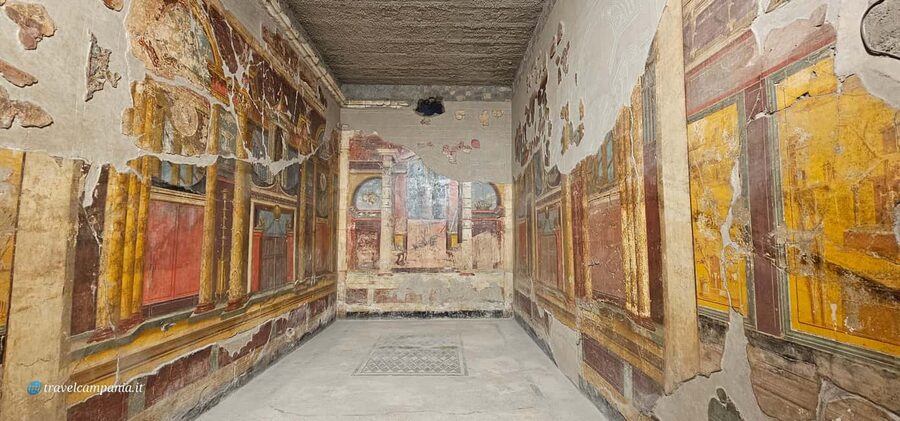
This experience costs $40 per person. You are paying for express admission to Pompeii Archaeological Park, a smartphone audio guide, and a picture map of the ancient city. Hotel pickup, return transport, food, and drinks are not included.
That price can make sense if you value speed and want explanations while you walk. Pompeii is large, and the ruins do not come with a sign beside every interesting doorway. An audio guide can help you understand the purpose of a building, the layout of Roman public life, and the difference between a house, a shop, a bath, and a theater.
The value is less clear if you only want entry. A single ticket bought directly at the park may cost less, so I would compare prices before booking. One booking complaint reported paying more than twice the on-site ticket cost and receiving little practical value after refusing to leave a passport for the audio guide. That does not erase the value of express entry, but it does mean you should know exactly what you are buying.
This is best viewed as a convenience package, not a private tour. You do not get a personal archaeologist or a guide walking beside you. You get access, a map, and recorded information that you can use when you want it.
More Smartphone Audio Tours in Italy
- Pompeii: Skip-the-Line Entry Ticket with Digital Guide App
★ 4.1 · 770 reviews - Pompeii & Herculaneum: Skip-the-line & Digital Guide App
★ 4.0 · 35 reviews - Pompeii Audioguide – TravelMate app for your smartphone
★ 3.9 · 10 reviews
Starting at the Wellcome box
Your visit begins at the Wellcome box, which is also the end point. The supplied information does not give a hotel pickup, transfer, or detailed street directions, so plan your arrival carefully and allow time to find the meeting point.
You must provide the full name and age of every participant, and you need identification documents. Bring the same ID details used during booking. If the staff asks to retain a passport for the audio guide, ask what alternative is available before handing over anything valuable.
That point matters. A passport is not just another piece of luggage. It is your key travel document. If you are uncomfortable leaving it, declining the audio guide may be the sensible choice, but you should then confirm what portion of the service price can still be used. The supplied information does not promise a deposit system, photocopy option, or alternate device.
The hosts or greeters speak Italian and English. Their role is mainly to help you get started with your ticket and audio guide. After that, you explore independently.
Entering Pompeii with express admission
The main practical benefit is avoiding the ticket line with an express ticket. That does not mean every entrance procedure disappears. You still need to meet the host, show the required identification, and pass through the park’s entry controls.
Once inside, use the picture map before setting off. Pompeii is not a small collection of ruins gathered around one courtyard. You will be walking through streets and moving between public buildings, homes, commercial spaces, and performance venues. A quick look at the map helps you avoid spending your first hour circling the same blocks.
I suggest treating the day as a loose route rather than a race. Start with the major public spaces, then give yourself time for smaller houses and shops. The audio guide works best when you pause at a site, listen, and look closely instead of playing it continuously while marching from one building to the next.
Wear hiking shoes or another pair with solid support. The site includes ancient streets and uneven surfaces, and you should expect plenty of walking. A reusable water bottle is also important. Food and drinks are not included, and the activity does not provide them.
Walking the Roman Forum

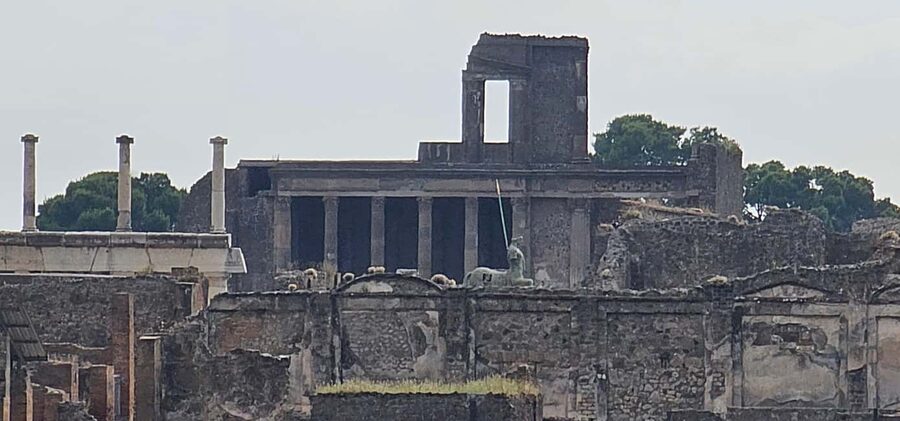
The Forum is the natural heart of the visit. This broad public area once served as a center for civic, religious, and commercial life. Here, you get the clearest sense that Pompeii was not simply a town buried by disaster. It was a functioning Roman city with places for public business, worship, trade, and ceremony.
The view toward Vesuvius gives the Forum extra force. The volcano is not an abstract part of the story. It rises behind the remains and connects the quiet ruins with the event that ended the city in 79 AD.
Use the audio guide here to add meaning to the open spaces and surrounding structures. Without context, the Forum can look sparse. With an explanation of how the space was used, the columns, paving, and building remains begin to form a picture of daily civic life.
This is also a good place to slow down. Take in the relationship between the public buildings and the mountain. You are seeing architecture, geology, and history in one frame.
More Smartphone Audio Tours in Pompei Campania:
- Rome: Colosseum & Forum with Audio Guide App -Optional Arena
★ 4.2 · 24,770 reviews - Florence: Timed Entry to Michelangelo’s David + Audio App
★ 4.6 · 19,496 reviews - Florence: Cathedral & Brunelleschi’s Dome Ticket & Audio App
★ 4.4 · 6,973 reviews - Florence: Michelangelo’s David Priority Ticket & Audio App
★ 4.4 · 6,812 reviews
Ancient streets, fountains, and waterworks
Pompeii becomes more personal once you leave the Forum and walk its streets. The roads, fountains, and remains of the aqueduct show how the city handled movement and water. You can follow the routes people once used to reach homes, businesses, baths, and public buildings.
The streets help you understand scale. A single monument can feel isolated, but connected streets show how homes and public buildings fit together. You can also look for changes in the character of each block, from commercial spaces to larger private residences.
The remains of the aqueduct and fountains are especially useful for understanding the city as a lived-in place. Water systems are not as dramatic as painted walls or theaters, but they explain how ordinary life functioned. The audio guide should be most useful here, since the remains may need interpretation to make sense.
The site is open to independent wandering, so you can stop at a fountain, listen to the relevant section, and then continue when you are ready. There is no need to keep pace with a group.
Houses, shops, baths, and painted walls
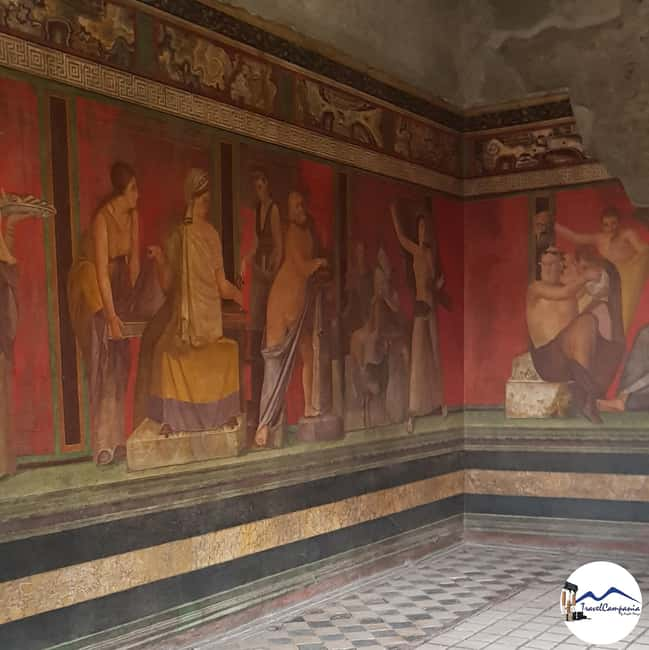
Pompeii’s private houses are among its most memorable spaces. You can walk through rooms where people lived, worked, entertained, and displayed their wealth. Even partial walls and floor plans reveal the difference between public-facing areas and more private parts of a home.
The colorful frescoes deserve close attention. Time, weather, and excavation have taken a toll, so do not expect every wall to look complete. What survives can still show how strongly Romans used painted decoration to shape a room.
Businesses offer another useful contrast. Shops and work spaces bring the city down to street level. They remind you that Pompeii was not only about temples, officials, and wealthy homeowners. It was also a place of buying, selling, eating, working, and passing through.
The public baths add another layer. Baths were not simply places to wash. They were important social and civic spaces. Let the audio guide explain the buildings rather than judging them by appearance alone. A room with bare walls may have had a clear purpose in Roman life that is not obvious today.
I like this part of the visit because it connects major archaeology with small human details. A house doorway or shopfront can make the ancient city feel more immediate than a grand monument.
The amphitheater and dramatic theaters
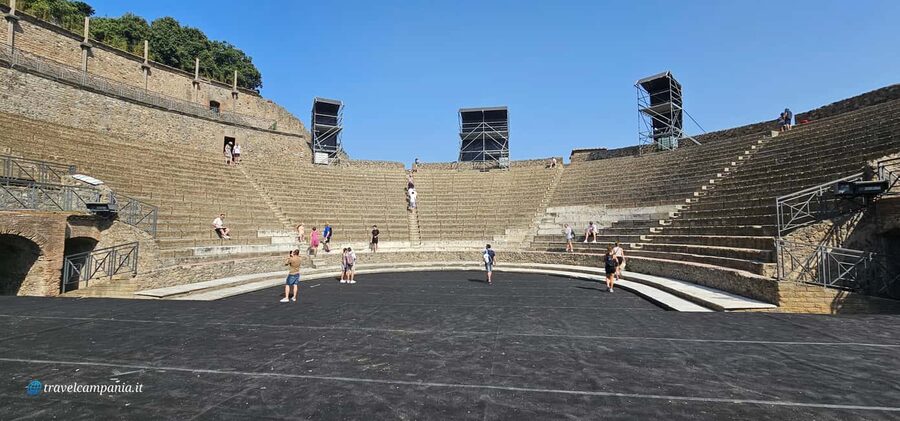
Pompeii’s performance buildings show the city’s appetite for public entertainment. The amphitheater could hold large crowds, while the theaters offered a different setting for staged performances.
These spaces are easy to appreciate even if you are not a specialist. Their size and shape explain how spectators would have seen and heard events. Walk slowly through the seating areas and imagine the difference between the present silence and a full audience.
The amphitheater is one of the strongest stops for understanding crowd life. It was built for shared spectacle, just as the Forum was built for public business. The theaters, by contrast, bring you closer to performance and culture.
Use the audio guide to distinguish the venues and their purposes. A picture map is also helpful here, since the performance buildings may not be directly beside the Forum. If you are short on time, these are the kind of major landmarks you should mark before entering.
Using the smartphone audio guide well

The audio guide is the feature that can change this from a simple ruin walk into a more informed visit. You use a smartphone rather than joining a live guide, which gives you control over the order and length of each stop.
That freedom has a tradeoff. A live guide can notice what interests you and answer questions. An app cannot do that. You need to choose the right stop, manage your phone, and keep the commentary matched to the building in front of you.
Download or prepare your phone as instructed before setting out, and bring enough battery for a day of use. The supplied information does not state whether headphones, a power bank, or mobile data are provided, so do not assume any of those are included.
Most important, settle the ID issue at the start. A complaint about being asked to leave a passport for the audio guide is a major practical warning. You can ask whether an alternative identification document, a deposit, or another process is accepted. Do not surrender your passport simply because the handoff feels routine.
If you decide not to use the audio guide, you can still explore with the picture map and the park itself. But since the guide is part of the price, resolve the policy before you enter.
How much time should you allow?

The ticket is valid for one day, and the activity does not impose a short timed route. That is useful because Pompeii rewards patience. You can spend longer in the Forum, skip a building that does not interest you, or return to a house after hearing more context.
The exact visit length is not specified, so I would plan around your own walking speed and interest. Do not schedule a tight connection immediately afterward. You need time for entry, the meeting point, walking between areas, audio stops, and breaks.
A reusable water bottle is essential preparation. Food and drinks are not included, and there is no hotel pickup or return service. You are responsible for reaching the Wellcome box and making your own way back afterward.
Large luggage and large bags are not allowed. Pack lightly from the start. Drones are prohibited, as are pets except assistance dogs. Alcohol and drugs are also not permitted.
Access, cancellation, and who should book

The activity is wheelchair accessible, which makes it a possible choice for visitors who need accessible arrangements. Still, the ruins are an archaeological site, and the information supplied does not describe the condition of every path or building. If you use a wheelchair, confirm the practical route with the provider before arrival.
Free cancellation is available up to 24 hours in advance for a full refund. You can also reserve now and pay later, which is useful if your Campania plans may shift.
I would recommend this for you if you want independent exploration but prefer some explanation along the way. It suits people who dislike being tied to a group schedule and who value express entry, a map, and audio commentary.
I would be more cautious if you only want the cheapest possible admission, if you need a live guide for questions, or if you are not willing to leave identification for the audio-guide arrangement. In those cases, direct entry or a different guided option may offer better value.
Should you book this Pompeii experience?
Book it if saving time at entry and having a self-guided audio tour are worth paying extra for. The Forum, volcano views, streets, homes, baths, shops, frescoes, amphitheater, and theaters give you a full picture of Pompeii, and the one-day validity lets you explore without rushing.
Before paying, compare the $40 price with direct admission and ask the Wellcome box staff exactly how identification is handled. If they require you to leave a passport and offer no acceptable alternative, I would skip the audio guide rather than surrender the document.
For a first Pompeii visit, the experience offers useful structure and freedom. Its weak point is not the archaeological park itself. The ruins are the reason to come. The question is simply whether the express ticket and audio guide justify the added cost and the ID policy for you.
FAQ
Where does the activity start?
The activity starts at the Wellcome box. It also ends back at the meeting point.
How long is the ticket valid?
The ticket is valid for one day. You should check availability for the available starting times.
Is this a guided group tour?
No. You explore Pompeii independently using the smartphone audio guide and picture map. A host or greeter is available in Italian and English.
What is included in the price?
The price includes express entry to Pompeii Archaeological Park, a smartphone audio guide, and a picture map of the city.
Is hotel transportation included?
No. Hotel pickup and return service are not included.
What should I bring?
Bring identification documents, hiking shoes, and a reusable water bottle. You must provide the full name and age of every participant.
Can I cancel the booking?
Yes. You can cancel up to 24 hours in advance for a full refund. Reserve now and pay later is also available.
More Skip-the-Line Audio Tours in Pompei Campania
- Pompeii: Skip-the-line Entry Ticket with Audio Guide & Map
★ 3.9 · 3,153 reviews - Pompeii: Skip-the-Line Entry & Audioguide
★ 3.8 · 225 reviews - Pompeii: Skip-the-Line Ticket with Audio Guide and Map
★ 4.0 · 117 reviews - Pompeii: Skip-the-Line Ticket with Audio Guide and Map
★ 4.0 · 14 reviews
New audio tours around Pompei Campania
- Pompeii Tour_Skip the line ticket + audioguide★ 4.7 · 17 reviews
- Pompeii: Pre-reserved ticket with audio guide★ 3.2 · 15 reviews
- Pompeii: Skip-the-Line Ticket with Audio Guide and Map★ 3.9 · 5 reviews
- Pompeii: Skip-the-Line Ticket with Audio Guide and Map★ 4.0 · 117 reviews
- Pompeii: Skip-the-Line Ticket with Audio Guide and Map★ 4.0 · 14 reviews
- Pompeii: Skip the Line Ticket + Audioguide★ 3.3 · 13 reviews
- Pompeii Skip-the-Line Ticket and Audioguide★ 4.2 · 7 reviews
- Pompeii: Skip The Line Entrance Tickets + Audioguides★ 3.2 · 4 reviews
Pompeii Audio Tours, compared.

Pompeii: Skip-the-line Entry Ticket with Audio Guide & Map
Read our review →
Pompeii: Skip-the-Line Entry Ticket with Digital Guide App
Read our review →

Pompeii: Skip the line ticket (art) + audioguide + map
Read our review →
From Pompeii: Vesuvius Entry with Transfer and Audioguide
Read our review →
Pompeii & Herculaneum: Skip-the-line & Digital Guide App
Read our review →
Herculaneum and Pompeii in one day: Audioguides + Tkts (art)
Read our review →
Browse the lists this tour appears in